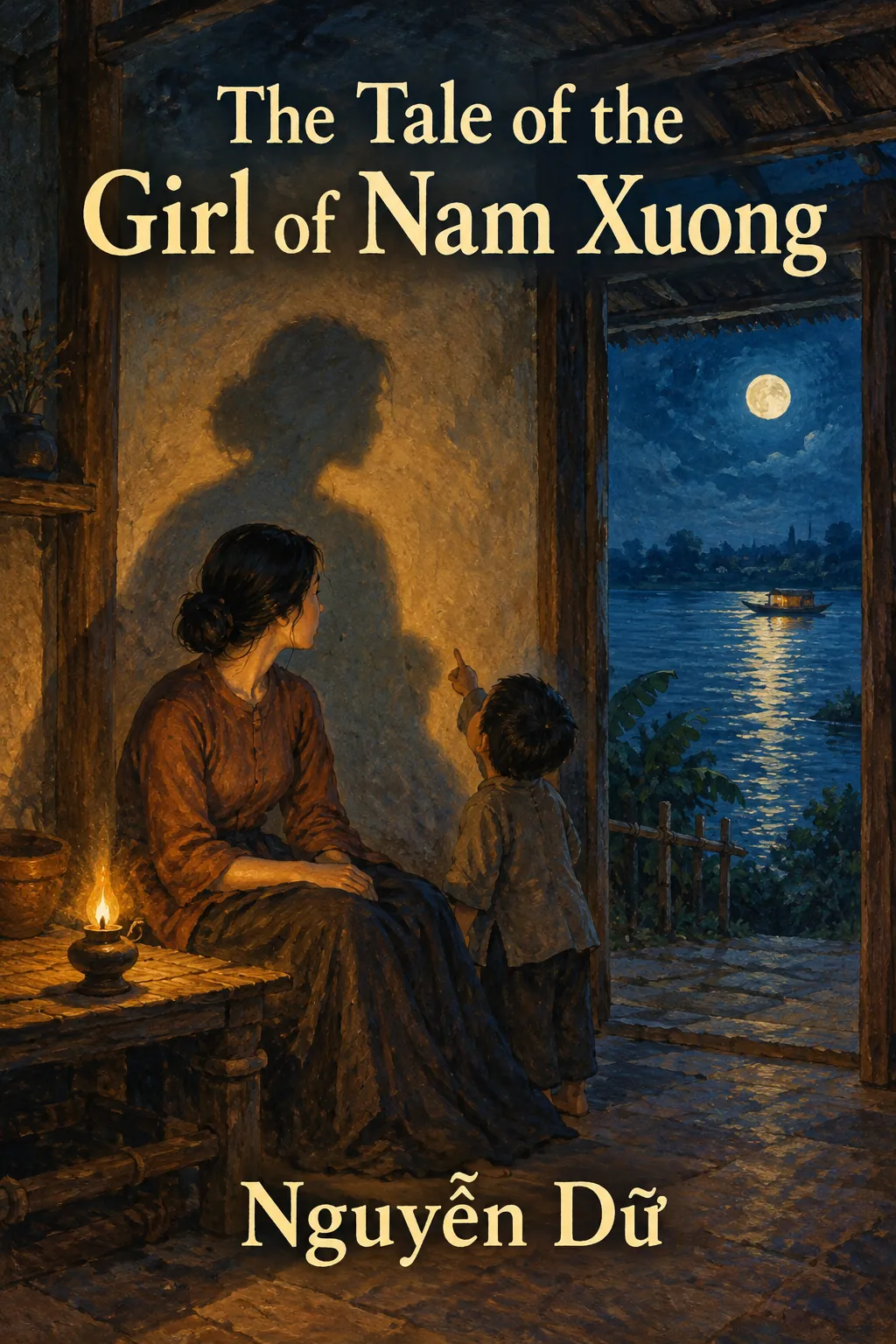
The Tale of the Girl of Nam Xuong
by Nguyễn Dữ
Nguyễn Dữ's sixteenth-century tale follows Vũ Nương, a virtuous young wife from Nam Xương. Her husband Trương Sinh leaves to fight in the south, and she raises their son and cares for his mother alone. When he returns, a careless remark from the child makes him doubt her loyalty. He asks her no questions and trusts only his own suspicion, and she has no power to make herself heard. Who is to blame when war, pride and silence turn a child's words into a verdict?
The Big Idea
"A faithful wife is doubted by her husband because of a child's innocent words about a shadow on the wall. The tale asks who pays when war, power and suspicion go unchecked."
Key Insights
A woman with no power to defend herself
Vũ Nương has every virtue her society praises, yet she cannot protect herself. Her husband may suspect, accuse and punish; she may only explain, and her explanation is ignored. Nguyễn Dữ shows that harm does not need a villain, only an order that gives one person the right to decide.
Her three pleas fail to stop Trương Sinh.
The shadow as knot and release
The shadow first appears as an act of love, becomes false evidence, and finally clears her name. It also stands for loneliness: a wife waiting for her husband has only a shadow to lean on.
Đản points at his father's shadow and says it is the night visitor.
War breaks homes
Everything begins when Trương Sinh is conscripted. War steals years of shared life, leaves a young wife carrying the household and sends home a husband whose mind is full of doubt.
When he returns, his mother is dead and his son does not know him.
The supernatural as a wish for justice
The underwater palace and the ceremony show a hope that the innocent will be cleared. But Vũ Nương cannot come home, so the fantasy comforts without erasing the loss.
She appears on the river, thanks Trương Sinh and disappears.
Chapter Breakdown
Study notes: author, genre, structure
The tale comes from Nguyễn Dữ's Truyền kỳ mạn lục, a sixteenth-century collection of twenty stories in classical Chinese that Vietnamese students usually meet in Grade 9.
It belongs to the truyền kỳ genre, which records strange events in order to talk about ordinary life.
The story divides naturally into three movements: Vũ Nương's married life until her husband returns, her false accusation and death, and the meeting under the water followed by the ceremony that clears her name.
It reworks an older folk tale, but Nguyễn Dữ gives the characters inner life and deepens the injustice.
Chapter-by-chapter summary
Spoiler warning: this section covers the whole plot, including the ending.
Part 1: Vũ Nương, the model wife
Vũ Nương is a gentle, beautiful young woman from Nam Xương who marries Trương Sinh, a rich but poorly educated man with a jealous, suspicious temper.
Knowing this, she is careful in every word and gesture so that no quarrel can start.
The opening matters because her virtue is real, yet her husband's character already carries the seed of the disaster.
Part 2: Farewell and the long wait
Trương Sinh is conscripted to fight the Champa invaders while Vũ Nương is pregnant.
At the farewell she asks only for his safe return, not for rank or glory, and then raises their son Đản alone.
She nurses her husband's mother through illness and, when the old woman dies, arranges the funeral as if for her own parent.
This part establishes her as a faithful wife, a dutiful daughter-in-law and a loving mother.
Part 3: The shadow and the child's words
To comfort a boy who has no father at home, Vũ Nương points to her own shadow on the wall each evening and calls it his father.
When Trương Sinh returns, the child will not call him father and says that a man visits every night, standing when his mother stands and sitting when she sits.
Trương Sinh does not ask a single question; he insults and beats his wife and ignores the neighbours who plead for her.
A child's honest remark becomes the knot that drags the story into tragedy.
Part 4: Death at the Hoàng Giang river
Vũ Nương defends herself three times: about her humble origins and loyalty, about the pain of being doubted, and finally by calling on Heaven.
Nobody believes her, so she bathes, prays and throws herself into the river to prove her purity.
That night Trương Sinh lights a lamp and the boy points to his father's shadow, saying it is the man who comes at night.
The shadow both caused the injustice and reveals the truth, but the truth arrives too late.
Part 5: Phan Lang in the underwater palace
Phan Lang, a man from the same village, once saved Linh Phi, wife of the Southern Sea Dragon King.
When he is lost at sea she rescues him in return, and in her palace he meets Vũ Nương, whom she has also sheltered.
Vũ Nương gives him a golden flower as a token and asks him to tell Trương Sinh to hold a ceremony by the river.
The supernatural world offers what the human one refused: protection and justice for an innocent woman.
Part 6: The ceremony and the farewell
Trương Sinh builds an altar by the Hoàng Giang and prays for three days and nights.
Vũ Nương appears on the water, thanks him and says she cannot return to the human world, then vanishes.
The ending restores her honour but not her happiness, which is why the tale feels both consoling and sad.
Themes and craft
Realism
The tale shows a sixteenth-century society where war keeps tearing couples apart and the husband holds almost unlimited authority at home.
Vũ Nương commits no fault, yet she is condemned because she has no voice in her own household.
Her fate stands for many women of the period, which is why her tragedy is read as typical rather than exceptional.
Humanism
Nguyễn Dữ praises the moral beauty of a woman and treats her with deep sympathy.
By letting her name be cleared, he also voices a popular belief that goodness will finally be recognised, even though happiness cannot be restored.
Craft
- Situation: a harmless detail placed at exactly the wrong moment creates drama without any villain.
- Dialogue: the three pleas rise from explanation to despair and give the heroine psychological depth.
- Two worlds: realistic family scenes lead into the underwater palace, so reality and wish sit side by side.
- Structure: the shadow ties the knot in the middle of the tale and unties it near the end.
Why it still matters
Five centuries later, the tale still speaks about families in which one person is not heard.
Readers meet the same pattern today in rumours, rushed messages and quarrels where a conclusion arrives before a question.
That is why teachers also use the story for social-issue essays on trust, listening and equal dialogue at home.
Key terms to use in an answer
- Truyền kỳ: a genre that uses the supernatural to talk about real life.
- Knot and release: the two functions of the shadow in the plot.
- Patriarchy: an order that lets the husband decide the wife's fate.
- Humanism: sympathy for people, especially the oppressed.
Common mistakes in exam answers
Many students retell the plot for most of the answer, which earns little credit because the task asks for analysis.
Others blame only Trương Sinh and forget the deeper causes: war and a social order that gives husbands total power.
A third mistake is to treat the supernatural ending as a simple happy ending, when Vũ Nương still cannot return.
Finally, spell the names correctly: Vũ Nương, Trương Sinh, Phan Lang, Linh Phi and the river Hoàng Giang.
Characters
- Vũ Nương: the beautiful, loyal, dutiful wife whose virtue cannot save her.
- Trương Sinh: her uneducated, jealous husband, whose suspicion causes her death.
- Bé Đản: their young son, whose honest words are misread.
- Trương Sinh's mother: the mother-in-law Vũ Nương nurses and buries.
- Phan Lang: the villager who links the human and underwater worlds.
- Linh Phi: the sea king's wife who protects Vũ Nương.
- The shadow: the key symbol that ties and unties the plot.
Writing about this book
For a literary analysis of about 600 words, build your essay on three details: the farewell wish, the shadow and the three pleas.
Give each point one short piece of evidence from the text in your own textbook, then a sentence of commentary saying why it matters.
- Argument 1: the faithful wife who protects her marriage.
- Argument 2: the dutiful daughter-in-law and loving mother.
- Argument 3: the woman of dignity wrongly accused.
- Argument 4: the meaning of the supernatural ending.
Do not retell the plot; examiners reward analysis of craft and ideas.
The model answers below are for learning and comparing with your own work, not for copying.
Take Action
Practical steps you can implement today:
-
In a character essay, state Vũ Nương's virtues, then show what makes her vulnerable.
-
Remember the knot-and-release structure around the shadow for many question types.
-
Name both the immediate cause and the deeper causes: war, patriarchy and jealousy.
-
For social-issue links, use trust and listening in families.
Notable Quotes
"Vũ Nương's farewell wish: not glory, only that he return safely. (Part 2)"
— Nguyễn Dữ
"Đản's report: a man comes every night, sits when mother sits, and never speaks. (Part 3)"
— Nguyễn Dữ
"Her vow: pure, she would become a pearl; false, food for the fish. (Part 4)"
— Nguyễn Dữ
"Her last words: she thanks him but cannot return to the human world. (Part 6)"
— Nguyễn Dữ
Who Should Read This
Suitable for Grade 9 students in Vietnam preparing lessons, tests and the entrance exam to Grade 10, and for readers who want to know why a tale by Nguyễn Dữ is still read after five centuries. Teachers can use the three-level model answers for marking practice.
Characters
Vũ Nương
protagonist, the virtuous wife
Gentle, beautiful, faithful to her husband, devoted to her mother-in-law and son. Wrongly accused, she drowns herself, is cleared in the supernatural episode, but cannot return.
Trương Sinh
husband, source of the tragedy
A rich, poorly educated man with a jealous, domineering temper. He refuses to listen to his wife and understands the truth only when it is too late.
Bé Đản
child, innocent witness
Reports honestly what he sees, a man who copies his mother's movements. His words unintentionally cause the accusation, and later he reveals the truth by pointing to his father's shadow.
Trương Sinh's mother
mother-in-law
Cared for by Vũ Nương during the war years. Her death shows her daughter-in-law's devotion and leaves Vũ Nương alone.
Phan Lang
go-between of two worlds
A villager who once saved Linh Phi. Rescued in return, he meets Vũ Nương and carries her token and message to Trương Sinh.
Linh Phi
supernatural protector
The Southern Sea Dragon King's wife, who repays Phan Lang and shelters Vũ Nương. She embodies the hope for a fair judgment beyond human society.
The shadow
symbol and plot device
A mother's comfort for her son, then false evidence, then the key to the truth. It also hints at a woman's dependent, silent position.
Exam practice: sample answers
Model answers are examples to learn from; write your own in your words.
literary analysis: character
1. Analyse the character of Vũ Nương in Nguyễn Dữ's Tale of the Girl of Nam Xuong (about 600 words in the original exam).
Outline
- Introduction: author, collection, character.
- Faithful wife.
- Dutiful daughter-in-law and mother.
- Dignified woman wrongly accused.
- Meaning of the supernatural ending.
- Conclusion: humane message.
Basic Model answer
Vũ Nương is the main character of Nguyễn Dữ's tale. She is beautiful and gentle, but her life ends in tragedy.
She is a loyal wife. When her husband goes to war, she only asks for his safe return, and she waits for him for years.
She is also a devoted daughter-in-law and mother. She nurses her husband's mother until her death and raises her son alone.
When Trương Sinh wrongly accuses her, she explains herself, but he does not listen. She throws herself into the river to prove her innocence.
Later she lives in the underwater palace, but she cannot return to her family.
Through Vũ Nương, the author shows sympathy for women in feudal society and criticises war and jealousy.
Good Model answer
In the Tale of the Girl of Nam Xuong, Nguyễn Dữ presents Vũ Nương as the ideal woman of her society and also as its victim.
First, she is a faithful wife who protects her marriage. Knowing her husband is suspicious, she is careful never to cause a quarrel, and at the farewell she asks only that he come home safe.
Second, she is a dutiful daughter-in-law and loving mother. She nurses her husband's mother and buries her with full ceremony, and every evening she points to her shadow so her son feels he has a father.
Third, she is a woman of dignity. Accused unjustly, she pleads three times, but nobody listens, so she chooses death in the Hoàng Giang to keep her honour.
Her injury is heavier because the people closest to her refuse to hear her.
The supernatural ending, where Linh Phi shelters her and a ceremony clears her name, expresses the people's wish for justice. Yet she says she cannot return, so happiness in the human world is lost for good.
Through Vũ Nương, the author pities women crushed by a male-dominated order and condemns war. Prejudice and domination, not her own fault, destroy her.
Excellent Model answer
In the truyền kỳ genre, Nguyễn Dữ uses the fantastic to talk about real society. In the Tale of the Girl of Nam Xuong, Vũ Nương's fate exposes the tragedy of a virtuous woman in a male-dominated world, where truth has no standing against prejudice.
Her virtue is carefully drawn. She comes from a poor family and marries wealth, yet stays humble, and because she knows her husband is suspicious, she is always careful.
Her happiness therefore rests on one-sided patience from the start. At the farewell she wishes only for his safe return, a plain wish that recalls the waiting wives of the Chinh phụ ngâm.
That virtue extends to her roles as daughter-in-law and mother. Alone in the war years, she raises her son and cares for her husband's mother, burying her as her own parent.
This makes the accusation absurd: the person who served the family is rejected by it.
The central knot follows. A loving remark about the shadow on the wall is read as proof of adultery.
The shadow is harmless; it destroys her only because it meets Trương Sinh's jealousy and authority. The tragedy thus comes from a structure of power in which a husband may suspect, judge and punish, while a wife may only explain and is not heard.
Her three pleas move from her humble status and loyalty to her pain and finally to Heaven, meaning human persuasion has failed. Drowning herself is therefore not weakness but a last accusation: she defends her honour with her life and leaves her husband with remorse.
The ending deepens rather than softens the tragedy. In the underwater palace she is protected, meets Phan Lang and asks for a ceremony, then appears on the river and says she cannot return.
Honour is restored, happiness is not; the golden flower and her message show she holds no grudge.
Set against a turbulent feudal society, the tale is both realist and humane. It asks who is responsible: war that separates families, a code that gives husbands absolute power, and silence that turns suspicion into a verdict.
Vũ Nương endures because her story still warns that trust and listening are the foundation of every home.
Marking rubric
- Identify the issue: Vũ Nương's qualities and tragedy.
- Clear arguments with textual evidence.
- Analysis of craft: the shadow, the pleas, the supernatural ending.
- Humane message and links.
- Structure and expression.
Now write your own
Rewrite the third argument (the accusation and death) in your own words with one short quotation from your textbook, then compare it with the model.
literary analysis: narrative detail
2. Explore the significance of the shadow in Nguyễn Dữ's Tale of the Girl of Nam Xuong.
Outline
- Introduction: the shadow as knot and release.
- A sign of love and loneliness.
- The misunderstanding that causes death.
- The truth, revealed too late.
- Conclusion: artistic and human meaning.
Basic Model answer
The shadow is the most important detail in the tale. It both creates and solves the story's central problem.
First, it shows Vũ Nương's love. With her husband away, she points to her own shadow and tells her son it is his father, so that he feels less alone.
Second, it causes the tragedy. When Trương Sinh returns, the boy says a man comes every night and copies his mother.
The jealous husband believes his wife is unfaithful and treats her cruelly until she drowns herself.
Third, it reveals the truth. One night the boy points at his father's shadow, and Trương Sinh finally understands, but it is too late.
So the shadow makes the story surprising and shows the sadness of women's lives.
Good Model answer
With one small detail, the shadow, Nguyễn Dữ shapes the whole story. It is the knot, the release and a carrier of meaning.
First, it grows from love and loneliness. With her husband at war, Vũ Nương points to her shadow each evening and calls it the boy's father, showing how a family lives on the image of the absent.
Second, it becomes the knot that pushes the story into tragedy. The boy innocently describes a man who stands and sits as his mother does but never speaks.
That honest remark meets Trương Sinh's jealousy, so he accuses his wife without asking a question and ignores the neighbours who defend her. Vũ Nương, unheard, drowns herself.
Third, it releases the knot. One night the boy points at his father's shadow and says this is the man who comes, and Trương Sinh finally understands.
Because the truth comes too late, the reader feels deep pity. The detail makes the plot surprising and natural, and it criticises domination and jealousy.
A small misunderstanding is enough to break a family when no one listens.
Excellent Model answer
A small detail can carry the structure of a whole work, and Nguyễn Dữ achieves this with the shadow. It begins as a loving remark, becomes the knot, then the release, and holds the author's humane criticism.
First, it expresses love and loneliness. With her husband far away and her son asking for a father, Vũ Nương can only point to her shadow on the wall.
A lie told out of love, repeated each night, shows how she carries the whole family's absence on her shoulders.
At the knot, the construction is clever. The boy does not lie; he reports what he sees, a figure that stands and sits as his mother does and never speaks.
Because this honest report matches the suspicion already in Trương Sinh's mind, it becomes evidence. The tragedy therefore comes not from a crime but from the gap between what is seen and what is understood.
Notably, the husband asks nothing more. One question would have changed everything, so the true knot is his domineering silence, and the shadow is only a catalyst.
At the release, the author turns the detail around. The shadow that killed her also restores her name, when the boy points at his father's shadow.
The truth is revealed by the same detail that hid it, yet too late, which magnifies the sorrow. The device is neat and natural and needs no outside judge.
At a deeper level the shadow symbolises a woman's position. A shadow has no voice and depends on another body, just as Vũ Nương depends on her role as wife and is silenced when her pleas are useless.
Ironically, the shadow is treated as a real man, while the real woman is treated as if she does not count.
The shadow is therefore both clever craft and moral argument: it shows how easily a family breaks when trust and dialogue are missing.
Marking rubric
- Correct role of the shadow in the plot.
- All three functions: feeling, knot, release.
- Comment on craft and ideas.
- Structure and expression.
Now write your own
Write one paragraph of 8 to 10 sentences on the irony of the shadow, then ask a friend or teacher for feedback.
social-issue essay linked to the text
3. Using the tragedy of Vũ Nương, write a short argumentative essay on the importance of trust and listening in the family.
Outline
- Introduction: from Vũ Nương to the issue.
- Define trust and listening.
- Discuss their role and what happens without them.
- Counter-argument: trust is not blind.
- Action and conclusion.
Basic Model answer
In the Tale of the Girl of Nam Xuong, Vũ Nương dies because her husband does not trust or listen to her. The story shows how important trust and listening are in a family.
Trust means believing in the character and words of loved ones. Listening means patiently hearing someone's explanation before judging.
When a family has trust, its members feel safe and happy. Without it, misunderstandings grow and hurt feelings.
Trương Sinh doubts his wife because of a child's words. He does not ask questions but insults and beats her.
So we should trust our relatives, calmly listen to explanations and talk honestly. Students can start by listening to parents, siblings and friends every day.
In short, trust and listening are the foundation of a happy family.
Good Model answer
Vũ Nương's tragedy begins not with a crime but with an unchecked suspicion. Five centuries on, it still shows why trust and listening matter in a family.
Trust is belief in a person's character built over time. Listening is giving someone the time to explain before we conclude.
Together they make a family a safe place. When people trust each other, they dare to tell the truth, admit faults and solve problems together.
Without them, any remark can be misread. Trương Sinh heard the boy and condemned his wife at once, so he destroyed his own home.
Today, similar misunderstandings arise from a rushed text message or online rumour. A parent who scolds without asking, or a child who shuts the door and says nothing, widens the gap in the same way.
Still, trust is not blindness. We should check facts by asking and listening, not ignore every warning sign.
As students, we can start small: tell our parents about school, hear friends out before judging. Trust and listening are small habits that keep a family together for a long time.
Excellent Model answer
Some tragedies are caused not by a villain but by a loved one who will not hear another out. Vũ Nương's injustice in the Tale of the Girl of Nam Xuong is one, and it reminds us that trust and listening are the foundation of a family.
Trust is confidence built on what we have seen of a person over the years. Listening is not just silence but the effort to understand what someone really means, especially when they are accused or hurting.
Together they let a family be a place where people can be themselves. Where there is trust, people dare to confess mistakes and show weakness before problems grow.
Trương Sinh shows the opposite. Vũ Nương pleaded three times, but he heard only what fitted his suspicion, so every explanation sounded like a denial.
This suggests that listening is blocked not by the ears but by prejudice. When we believe we already know the truth, we can no longer hear anything else.
Today the same prejudice takes many forms: a parent who convicts a child over an odd message, friends who turn away at a rumour, a post shared before anyone asks the person involved. On social media, conclusions run faster than checks, so the wronged find it harder to speak.
Yet trust is not the same as ignoring doubts. A mature trust asks directly, checks facts and gives the other person a chance to explain.
Trust must also run both ways: Vũ Nương needed a husband who believed her and a place to speak, which her society denied women. Families today need a culture of equal dialogue.
As students, we can begin with small acts: tell our parents the truth, let friends finish before we answer, and ask before we judge. These habits prevent many small tragedies from becoming deep wounds.
Vũ Nương's injustice cannot be undone, but it leaves a warning: listen in time, because some truths are understood only when it is too late.
Marking rubric
- Understand the task: social-issue essay with a link to the text.
- Clear definitions.
- Argument with life evidence and a counter-argument.
- Lesson and personal link.
- Structure and expression.
Now write your own
Choose a situation where a misunderstanding arose from not listening, write a paragraph about it and state your own lesson.
Frequently Asked Questions
What is the summary of the tale in a few sentences?
Vũ Nương is a virtuous wife. While her husband is away at war she raises their son and nurses his mother. When he returns, the boy's talk of a shadow makes him suspect her; she drowns herself in the Hoàng Giang. She is later sheltered by Linh Phi, meets Phan Lang, and is cleared at a ceremony, but cannot return.
What genre is it and where does it come from?
It is a truyền kỳ tale from Nguyễn Dữ's Truyền kỳ mạn lục, written in classical Chinese in the sixteenth century. The genre uses strange events to speak about real life.
What causes Vũ Nương's death?
The immediate cause is Trương Sinh's jealousy and the misunderstanding about the shadow. The deeper causes are war, which separates the family, and a patriarchal order that denies women a voice.
Why does the tale end with a supernatural episode?
It expresses the hope for justice and completes Vũ Nương's portrait. The fact that she cannot return to the human world also deepens the tragedy.
What is a good outline for analysing Vũ Nương?
Introduce the author and character. Then make four points: the faithful wife, the dutiful daughter-in-law and mother, the dignified woman wrongly accused, and the meaning of the supernatural ending. End with the tale's humane message.
Check Your Understanding
Pick an answer for each question to see if you were right.
-
Which collection contains the tale?
Truyền kỳ mạn lục — It is one of the twenty tales of Nguyễn Dữ's Truyền kỳ mạn lục.
-
Why does Trương Sinh suspect his wife?
Đản says a man comes every night — The boy's remark about the shadow is misread as a sign of an affair.
-
How does Vũ Nương prove her innocence?
She throws herself into the Hoàng Giang — After her pleas fail, she prays and throws herself into the river.
-
Who meets Vũ Nương under the water and brings her message?
Phan Lang — Phan Lang is rescued by Linh Phi, meets Vũ Nương and carries her message home.
-
Which detail both ties and unties the plot?
The shadow — The shadow causes the misunderstanding and later reveals the truth.
About Nguyễn Dữ
Nguyễn Dữ was a sixteenth-century Vietnamese writer from Hải Dương and a pupil of the scholar Nguyễn Bỉnh Khiêm. After a short time in office he withdrew to care for his mother. His Truyền kỳ mạn lục is a set of twenty tales in classical Chinese that use the supernatural to talk about real life.
Summary Written By

Software Engineer & Writer
Software engineer with a passion for distilling complex ideas into actionable insights. Writes about finance, investment, entrepreneurship, and technology.
View all summaries →Reviews
No reviews yet. Be the first to share your thoughts!
Write a Review
Keep reading
Explore the topic: Study GuidesSummaries

Animal Farm by George Orwell
George Orwell
The animals of Manor Farm revolt against their human owner to create a utopian society based on equality. However, the…

The Outsiders by S.E. Hinton
S.E. Hinton
Ponyboy Curtis and his gang of Greasers clash with the wealthy Socs in a cycle of violence. After a tragic…

The Great Gatsby by F. Scott Fitzgerald
F. Scott Fitzgerald
Nick Carraway enters the orbit of Jay Gatsby, a mysterious millionaire obsessed with reclaiming his past love, Daisy Buchanan. Amidst…

Of Mice and Men by John Steinbeck
John Steinbeck
George and Lennie, two migrant workers during the Great Depression, dream of owning their own land to escape a life…
Articles

How to Write a Literary Analysis Essay
A literary analysis essay argues one clear claim about how a text works and proves it with short quotations and…

The Tale of the Bamboo Cutter
The Tale of the Bamboo Cutter (Taketori Monogatari) tells of Princess Kaguya, a girl found inside a glowing bamboo stalk,…

Ragnarok: the end of the Norse gods
Ragnarök is the end of the world in Norse mythology: a final battle in which gods, giants and monsters destroy…