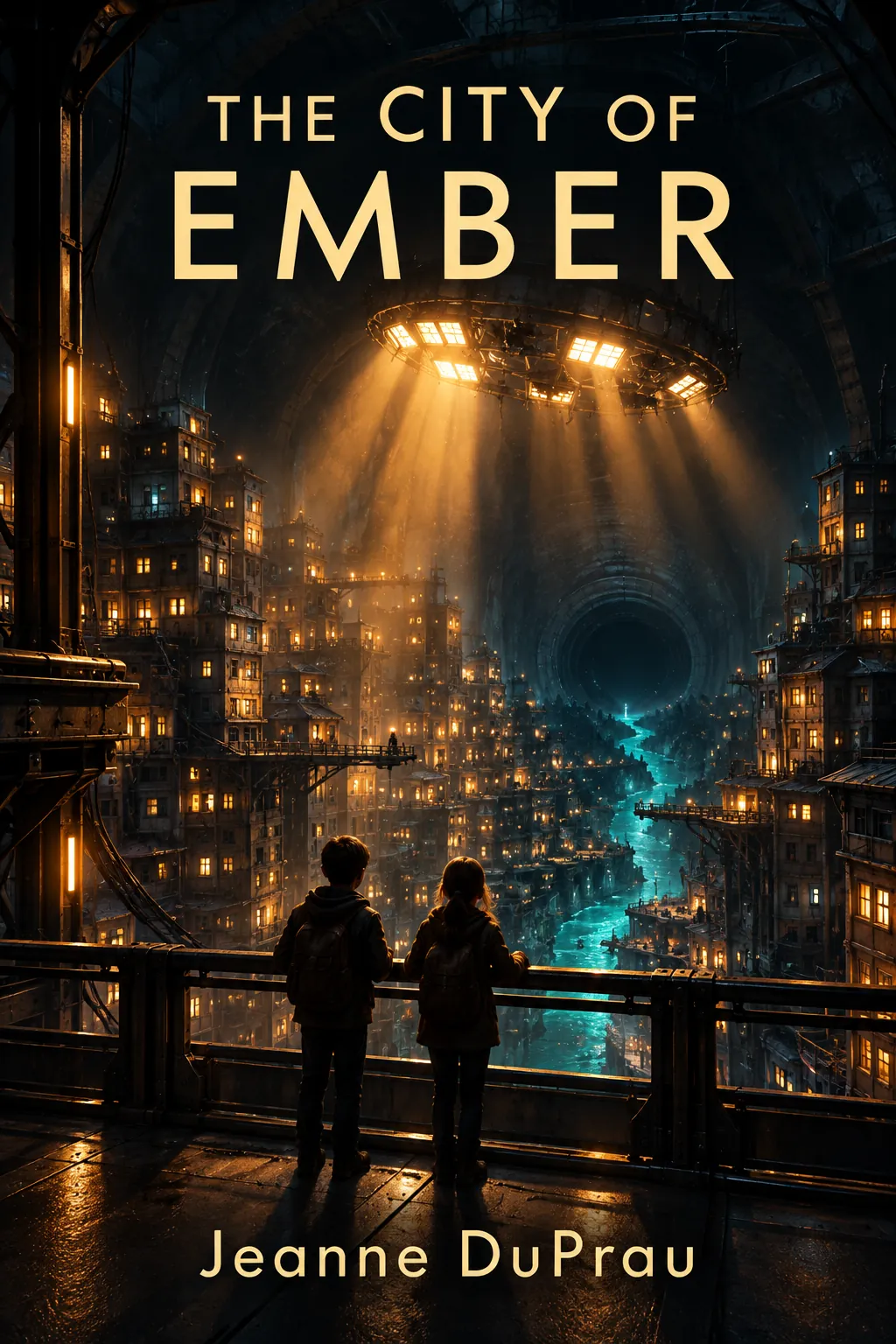
The City of Ember
by Jeanne DuPrau
The City of Ember is a middle-grade science-fiction novel by Jeanne DuPrau, published in 2003. Ember is a city built underground long ago, and its great lamps are failing more often every year. Twelve-year-olds Lina Mayfleet and Doon Harrow swap their first jobs, notice that supplies are vanishing, and begin to suspect that the city's leaders are hiding something. When Lina finds a damaged old document, the pair race to understand it before the lights go out for good.
Try Audible · As an Amazon Associate we earn from qualifying purchases. Details
The Big Idea
"In a sealed city whose lights are failing, two twelve-year-olds learn that the adults in charge have run out of answers, and that finding the truth is a job for anyone curious enough to look."
Key Insights
Light stands for knowledge
Ember's lamps are the city's life support, and their failure mirrors the loss of knowledge. People can no longer say how the generator works, where supplies come from or what lies beyond the dark. The book suggests a society stays alive only while it keeps asking how things work, and that forgetting is as dangerous as any enemy.
Poppy chews the Builders' instructions, so a message built to last for generations is almost lost in minutes.
Leaders can protect themselves instead of people
Mayor Cole is supposed to look after Ember, yet he and the storeroom worker Looper steal the city's supplies. DuPrau shows how secrecy and comfort can replace responsibility, and how the guards who should protect people end up protecting the mayor. Readers are invited to notice who benefits when problems stay hidden, and to ask who is speaking up.
When Doon and Lina report the theft, the guards side with the mayor and Lina is arrested.
Young people can act when adults stall
Lina and Doon are twelve, yet they are the only ones who follow the evidence to the end. They succeed not because they are special, but because they pay attention and do not give up when the trail is messy. The novel respects young readers by giving them real agency, as well as real fear.
The pair piece the torn pages together over many attempts, then risk the tunnels to test what the words mean.
Different minds solve different problems
Lina notices words, gaps and patterns, while Doon thinks in machines, flows and repairs. Neither could reach the exit alone. The story treats this teamwork as the real solution, showing that a hard problem opens up when different ways of thinking are joined.
Doon's knowledge of the Pipeworks and the river explains where Lina's reading of the fragments leads.
Waiting is a choice with a cost
For generations the people of Ember trusted that someone else would solve the problem, and so nothing was solved. The Builders' message could only help people willing to act on it. The book gently warns that doing nothing is also a decision, and that its price grows each time the lights flicker.
Blackouts keep getting longer, yet most adults simply wait for the lamps to come back on.
Chapter Breakdown
Chapter-by-chapter summary
Spoiler warning: this section covers the whole plot, including the ending.
Part 1: Assignment Day
Ember is an underground city lit by huge electric lamps, with unbroken darkness beyond its edges. On Assignment Day each twelve-year-old pulls a job slip from a bag, and Lina Mayfleet draws Pipeworks laborer while Doon Harrow draws Messenger.
Each had hoped for the other's job, so they trade. The swap matters because it puts a curious runner on the city's errand routes and a restless mechanic among its failing pipes, the two places where the secrets can be seen.
Part 2: A City Running Down
Lina's parents are dead, and her grandmother dies early in the story, so Lina and her little sister Poppy are taken in by a neighbour, Mrs. Murdo. Her messenger rounds show her empty shelves and a shortage of light bulbs, and blackouts last a little longer each time.
Speeches in the city urge everyone to stay calm while the shortages grow. Ember's problem is not only broken machines but also a habit of not looking.
Part 3: The Chewed Papers
In an old closet at home, Lina finds a box that has been passed down in her family, and Poppy has already chewed the papers inside. Lina rescues the scraps and sees a heading that seems to say "Instructions for Egress."
The scene turns the mystery into something you can hold. It also shows how knowledge can be lost by accident, not by a villain.
Part 4: Doon Goes Deeper
Doon is determined to repair the generator and explores the lowest tunnels of the Pipeworks. There he finds the river.
His discoveries give the story its practical side: Doon trusts evidence and tools, while Lina trusts patterns in words.
Part 5: Putting the Scraps Together
Lina shows Doon the fragments, and together they work out that the document describes a way out of Ember. Following its hints, they find a hidden room in the Pipeworks that holds boats, matches and candles.
The instructions were written for people generations later, but nobody was left to pass them on. This is the novel's turning point, because Ember may not be the whole world after all.
Part 6: Thieves, Guards and a Chase
Meanwhile Doon discovers that Mayor Cole and a storeroom worker named Looper are stealing the city's supplies. The two children report them to the guards, but the guards are working with the mayor and declare Doon and Lina criminals.
Lina is arrested and brought before Mayor Cole, who plans to lock her up. A blackout lets her escape, and she meets Doon and Poppy in the Pipeworks while the guards chase them.
The story argues that authority and honesty are not the same thing. The adults with power are part of the problem, so the children must act alone.
Part 7: Down the River
Lina, Doon and Poppy climb into a boat from the hidden room and flee into the tunnels, heading down the underground river. They travel through the dark where no one from Ember has gone, and an old diary they find tells them how Ember began.
The journey replaces fear of the dark with a plan. Courage here means working through a puzzle step by step.
Part 8: Out in the Open
The three climb a steep tunnel to a cave and come out onto open land. Looking back, they see Ember's lights far below and realise how long they have lived underground.
They wrap a letter describing the way out into a packet and throw it down toward the city. The ending is hopeful but unfinished, and the story continues in the next book, The People of Sparks.
Characters
- Lina Mayfleet: a quick, observant twelve-year-old who becomes a messenger and finds the damaged document. She is the book's heart, driven by care for her family.
- Doon Harrow: a stubborn, practical boy obsessed with fixing the generator. He grows from a lone angry thinker into a real partner.
- Poppy: Lina's toddler sister, whose chewing of the papers is both funny and costly. She travels with Lina and Doon down the river, which shows what Lina is protecting.
- Lina's grandmother and Mrs. Murdo: the grandmother raises the girls but dies early in the novel, and the neighbour Mrs. Murdo then takes Lina and Poppy in. The family box that starts the mystery is part of the household they leave behind.
- Mayor Cole: the city's leader, who steals supplies with Looper and uses the guards to protect himself. He stands for self-serving authority.
- Looper: a storeroom worker who helps Mayor Cole steal the city's supplies. Doon's discovery of the theft sets the chase in motion.
- Loris Harrow: Doon's father, an inventor who tinkers with ideas at home. He helps Doon see that questions are worth asking.
- Lizzie Bisco: Lina's lively friend, who stands for everyday Ember life and what the children want to save.
Setting and background
Ember is built around one simple idea: a city survives only as long as someone remembers how it works. The Builders designed it as a shelter, stocked it with supplies and left instructions for leaving it.
Those instructions were meant to be passed on to people generations later. Somewhere along the way the chain of memory broke, and the city forgot that it was ever meant to be temporary.
Everything in Ember is a little worn: the lamps, the pipes, the food in the storerooms and the rules people follow. DuPrau lets the reader feel this slow decay through small details rather than long explanations.
The darkness outside the city is never fully described, which keeps the world small and tense. Readers learn about Ember at the same pace as Lina and Doon, so each discovery feels earned.
How the story is told
The novel is told in the third person and moves between Lina and Doon, so the reader sees the city through a messenger's eyes and then through a mechanic's. The chapters are short and often end on a question, which makes the book easy to read in small pieces.
The language is plain and the mood is quiet rather than violent. The suspense comes from not knowing, from what is missing in the stores and what the torn paper might say.
Because the two main characters think so differently, the book repeats one lesson in many forms. One person alone sees only part of the problem, and a pair can see more.
Questions to discuss in class
- Why do the people of Ember keep going about their daily lives while the lights fail?
- What does Mayor Cole's theft show about leaders who put themselves first, and why do the guards side with him?
- What would have happened if Poppy had not found the box, or if Lina had thrown the scraps away?
- How do Lina's and Doon's different talents help them, and could either have succeeded alone?
- Why do the children send a message back to the city instead of simply escaping?
Ember and other dystopias
Many dystopian novels show a society controlled by force. Ember is gentler: nobody is jailed for asking questions, but nobody is asking them either.
That makes it a useful first step toward harder books. Readers who go on to The Giver will recognise a society that hides its past, and those who later read 1984 will see a far darker version of leaders controlling what people know.
What sets Ember apart is its hope. The book suggests that a stuck society can be freed by curiosity, patience and honest teamwork.
Writing about this book
Start with a clear question, such as how light stands for knowledge in Ember. Then choose two or three scenes to support your answer, for example the blackouts, the chewed papers and the final climb out of the tunnel.
Use short quotations only, and explain each one in your own words. A strong paragraph names the scene, says what it shows, and links that to the theme.
Good essay angles include why Ember's adults fail, how Lina and Doon complement each other, and what the novel says about waiting for someone else to fix a problem. Compare Ember with another dystopia such as The Giver to sharpen your argument.
Finally, state your own opinion about whether the ending is hopeful. Back it up with evidence rather than just saying you liked it.
For wider reading, see our overview of dystopia in fiction.
Take Action
Practical steps you can implement today:
-
Notice who benefits when a problem is kept quiet, and ask questions anyway.
-
Keep important knowledge written down and shared so it cannot be lost by accident.
-
Combine different strengths, such as reading carefully and fixing things, to solve a hard problem.
-
Do not wait for someone in charge to rescue you when evidence is in front of you.
Notable Quotes
""Instructions for Egress" (the heading on the Builders' document, Part 3)"
— Jeanne DuPrau
Who Should Read This
Readers aged about 10 to 14 who like adventure, mysteries and survival stories, and anyone who has been assigned this book in middle school. It also suits teachers looking for an accessible way to introduce dystopian ideas before The Giver or 1984.
Frequently Asked Questions
What is The City of Ember about?
It follows two twelve-year-olds in an underground city whose lights are failing. They find that the mayor is stealing the city's supplies and that Ember was built as a temporary refuge. They then flee through the tunnels with Lina's little sister Poppy and send word of the way out back to the city.
Who are the main characters?
Lina Mayfleet, a messenger, and Doon Harrow, a Pipeworks worker, are the main characters. Important supporting figures are Lina's little sister Poppy, the neighbour Mrs. Murdo, Doon's father Loris, Mayor Cole and the storeroom worker Looper.
What age is The City of Ember for?
It is written for middle-grade readers, roughly ages 10 to 14. The language is plain, and the suspense is mild, although there are scary dark places and the theme of a failing society.
Is The City of Ember part of a series?
Yes. It is the first of four Books of Ember. The People of Sparks continues the story after the escape, followed by The Prophet of Yonwood and The Diamond of Darkhold.
What are the main themes?
The main themes are light and darkness as knowledge and ignorance, selfish leadership, the loss of information over time, and young people taking responsibility. Teamwork and curiosity also matter.
Is there a movie of The City of Ember?
A film version was released in 2008. This guide covers the novel only, and the film changes some details of the story.
Check Your Understanding
Pick an answer for each question to see if you were right.
-
What happens on Assignment Day?
Children draw job slips — Each twelve-year-old pulls a job slip from a bag to learn their first job.
-
Which jobs do Lina and Doon end up with after trading?
Lina is a messenger and Doon works in the Pipeworks — They swap the slips they drew, so Lina becomes the messenger and Doon joins the Pipeworks.
-
What damages the Builders' document before Lina can read it?
Poppy chewing it — Lina's toddler sister Poppy chews the papers, leaving only fragments.
-
What do Doon and Lina discover about Mayor Cole?
He is stealing the city's supplies — Doon finds that the mayor and the storeroom worker Looper are stealing supplies, and the guards side with the mayor.
-
Who goes down the river in the boat?
Lina, Doon and Poppy — Poppy travels with Lina and Doon, and at the end they send a letter back to the city about the way out.
Want the full book?
Read or listen to The City of Ember in full.
Try Audible · As an Amazon Associate we earn from qualifying purchases. Details
About Jeanne DuPrau
Jeanne DuPrau is an American author who worked as an editor and teacher before writing fiction. The City of Ember (2003) was her first novel for young readers and began the four-book Books of Ember series, which has been widely assigned in middle schools.
Summary Written By

Software Engineer & Writer
Software engineer with a passion for distilling complex ideas into actionable insights. Writes about finance, investment, entrepreneurship, and technology.
View all summaries →Reviews
No reviews yet. Be the first to share your thoughts!
Write a Review
Keep reading
Explore the topic: Science FictionSummaries

Out of My Mind
Sharon M. Draper
“Out of My Mind” by Sharon M. Draper is a poignant narrative that explores the life of Melody Brooks, a…

Ender’s Game
Orson Scott Card
“Ender’s Game” by Orson Scott Card is a riveting science fiction novel that transports readers into a future where humanity…

Pachinko
Min Jin Lee
“Pachinko”, a spellbinding multigenerational historical saga by Min Jin Lee, explores the lives of a Korean family trying to make…

The Perks of Being a Wallflower
Stephen Chbosky
The Perks of Being a Wallflower by Stephen Chbosky is a profound coming-of-age novel, told through the intimate letters of…
Articles

A Christmas Carol themes: generosity, isolation and responsibility
Dickens's novella is usually read as a story about a man who changes his mind. Its themes are sharper than…
Chinese Room Argument
The Chinese room argument is a thought experiment by philosopher John Searle, published in 1980. It says a computer that…
Books Like The Hunger Games: 10 Dystopian Novels
The best books like The Hunger Games are young-adult dystopias where a teenager fights a rigged system. This list picks…