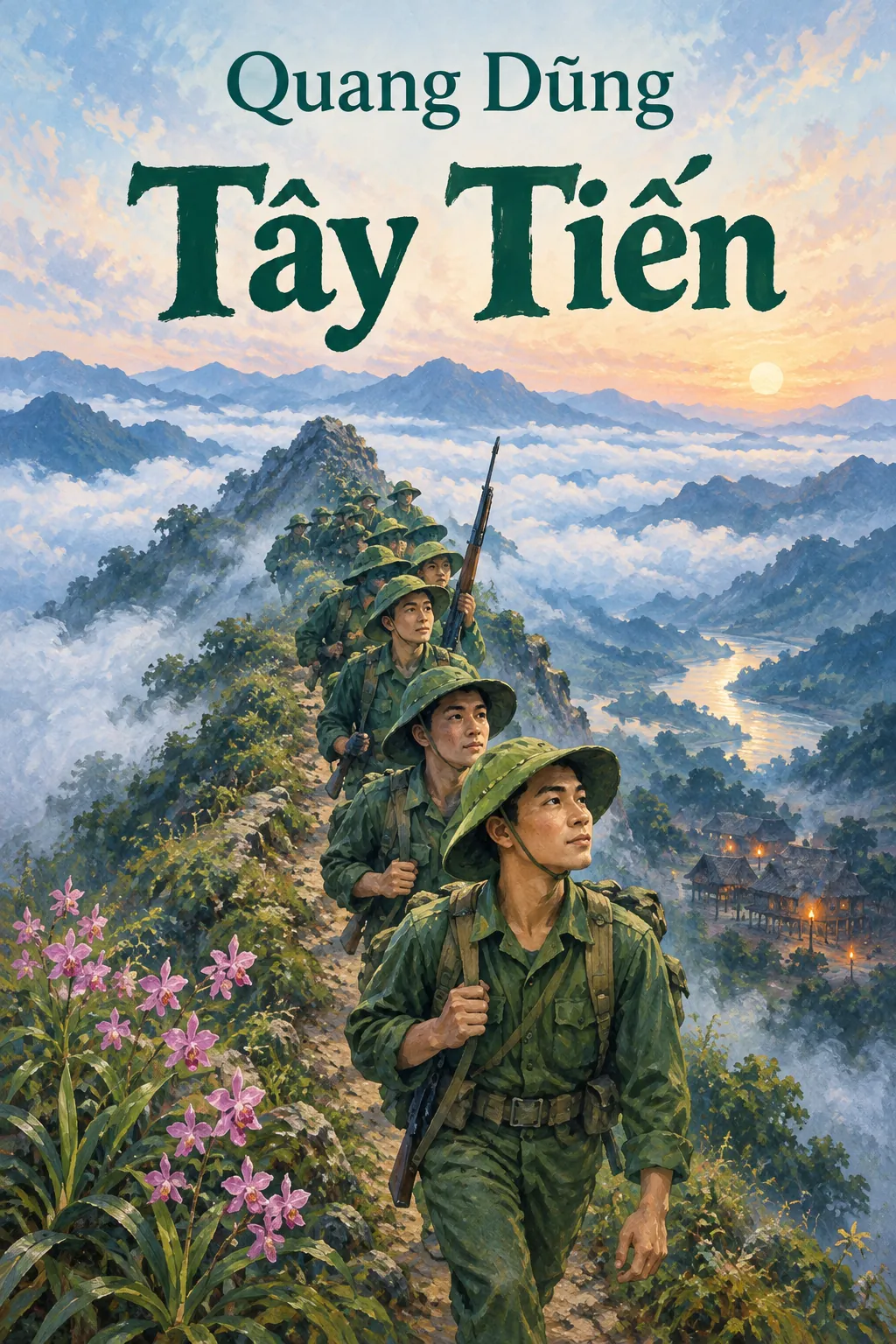
Tây Tiến
by Quang Dũng
Tây Tiến is a poem by Quang Dũng, written in 1948 in memory of the Tây Tiến regiment, which fought along the Vietnam–Laos border. The poet looks back from far away and recalls steep passes, mist and waterfalls, a night of music in a mountain village, and the thin, proud faces of young soldiers. In four stanzas it moves from longing to landscape, from festival to farewell, and shows how a poem can honour comrades without hiding their suffering.
The Big Idea
"Tây Tiến is a poem of remembering: Quang Dũng recalls the fierce mountains of the north-west and the young soldiers who crossed them, and shows a tragic-heroic beauty in which hardship, romance and sacrifice sit side by side."
Key Insights
Bi tráng: sorrow and pride together
Bi tráng joins bi, loss and hardship, with tráng, the grandeur of an ideal. Quang Dũng never hides death, yet he does not let it become self-pity. He looks at sacrifice with respect, and that respect is why the poem sounds like a hymn and not like a complaint.
“Rải rác biên cương mồ viễn xứ” names lonely graves, but the formal words “biên cương” (frontier) and “viễn xứ” (far land) give them dignity.
Nature as both danger and home
The north-west appears with bottomless slopes, roaring waterfalls and tigers, yet also with rice smoke, sticky rice and festival nights. For the poet nature is not only an enemy: it is a place he belonged to. That is why remembering it hurts and comforts at once.
The last two lines of stanza 1, “cơm lên khói” and “thơm nếp xôi”, soften a stanza full of fierce images.
The romantic soldier
The soldiers are guards at the border and also young men who dream. Quang Dũng lets them be both, and the mix avoids two clichés: the stone hero and the pitiable victim. Readers meet real young people who chose a hard road.
“Mắt trừng gửi mộng qua biên giới / Đêm mơ Hà Nội dáng kiều thơm”: the eyes glare on guard while the dreams travel to Hanoi.
Language that lifts ordinary things
Formal Sino-Vietnamese words and euphemism raise plain facts to a solemn level. A mat becomes a robe, a field grave becomes a frontier grave, and the soldier becomes a warrior from classical literature. This is a main reason the poem sounds both ancient and fresh.
“Áo bào thay chiếu anh về đất”: a general's robe stands where only a mat could be, honouring the dead and softening the pain.
Chapter Breakdown
Tây Tiến summary: background and structure
Quang Dũng (1921–1988) was a company commander in the Tây Tiến regiment, a unit formed in 1947 to work with Lao forces and wear down French troops along the Vietnam–Laos border.
Many of its soldiers were young men from Hanoi who marched through remote forest and suffered badly from malaria.
In 1948, after he had moved to another unit, the poet wrote the poem at Phù Lưu Chanh. Its first title was Nhớ Tây Tiến (Remembering Tây Tiến), later shortened to Tây Tiến.
The poem has four stanzas of mostly seven-syllable lines, with a free, musical rhythm and many formal Sino-Vietnamese words.
Its dominant mood is romantic and tragic-heroic (bi tráng). The four stanzas move from longing and the marching road, to a night festival and a river scene, to a portrait of the soldiers, and finally to a farewell.
Stanza-by-stanza summary of Tây Tiến
Spoiler warning: this section covers the whole poem, including the closing lines.
Stanza 1: Longing and the marching road (lines 1–14)
The poem opens with a call to the Mã River and to the regiment, and a longing that has nowhere to rest. From that feeling the poet walks us back through the mountains.
He names places such as Sài Khao, Mường Lát and Pha Luông, and shows a tired column hidden by mist on a road that climbs and falls by a thousand measures. A rifle seems to sniff the sky, a comrade collapses and does not rise, waterfalls roar and tigers prowl at night.
The stanza ends warmly, with steam from a rice pot and the scent of sticky rice in Mai Châu.
Why it matters: it sets the base of the whole poem, a harsh nature that is still loved, so the soldiers' suffering is always wrapped in memory and tenderness.
Stanza 2: The night festival and the river (lines 15–22)
The mood turns to a night of celebration in camp. Torches light up the barracks, girls appear in festive dress, and the khèn, a reed pipe, plays a shy mountain dance tune.
Then the view widens to a misty river at Châu Mộc at dusk, with reeds that seem to hold a spirit and a small dugout canoe swaying in flood water among drifting flowers.
The poet closes with a question: did those who passed that evening see the spirit of the reeds and remember the figure in the canoe?
Why it matters: the soldiers' world held gentleness and beauty as well as danger, which is what makes the poem romantic and not only heroic.
Stanza 3: Portrait of the Tây Tiến soldier (lines 23–30)
This stanza paints the soldiers: heads without hair, skin green and pale, yet fierce as tigers. They glare across the border by day and dream of Hanoi's girls at night.
Then the poet looks at death directly. Graves lie scattered along the frontier, the men left without regret for their youth, and a robe stands in for a mat as a comrade is laid in the earth.
The Mã River roars like a lonely song as if it were seeing them off.
Why it matters: this is the heart of the poem and the passage most often set for essays on the soldier image, where hardship, romance and sacrifice meet.
Stanza 4: Departure without a promise (lines 31–34)
The last four lines return to the regiment as a whole: the men set out with no promise of return, and the road ahead is endless and ends in parting.
The poet imagines that the souls of those who went up in that spring went on to Sầm Nứa in Laos and did not come back down to the plains.
Why it matters: the poem ends in a respectful farewell and shows soldiers who go for an ideal, not for a promise.
Writing about Tây Tiến: phân tích and dàn ý
Vietnamese exams usually ask you to analyse one stanza or to give your feelings about the soldier image in about 600 words (chữ), in the shape of mở bài, thân bài, kết bài.
Part 1: Planning the essay (dàn ý)
- Mở bài: introduce Quang Dũng, the 1948 setting and the stanza, and state your main claim.
- Thân bài: give three arguments, such as a gaunt but proud appearance, a romantic inner life, and a tragic-heroic view of death. Each one needs a short quotation and a comment on the wording.
- Kết bài: sum up the bi tráng beauty and, if the question asks, link it to young people's ideals today.
Part 2: Using quotations and devices
In each argument, state the point, quote one short line, then explain a device such as Sino-Vietnamese vocabulary, euphemism, personification or contrast.
The model answers on this page are labelled learning examples at three levels. Compare them with your own draft and write your own version rather than copying one.
Take Action
Practical steps you can implement today:
-
Start an analysis with a clear claim about the soldiers, then support it with short quotations and comments on the wording.
-
Learn the key vocabulary: bi tráng, lãng mạn, từ Hán Việt, nói giảm nói tránh, nhân hóa.
-
Read the poem as a memory: the soldiers are shown through the poet's longing, which explains the praise and the tenderness.
-
Link the line “đi chẳng tiếc đời xanh” to a social-essay idea about the ideals of young people.
Notable Quotes
"“Sông Mã xa rồi Tây Tiến ơi!” (The Mã River is far now, Tây Tiến!) (Stanza 1)"
— Quang Dũng
"“Heo hút cồn mây súng ngửi trời” (Rifles seem to sniff the sky among far clouds) (Stanza 1)"
— Quang Dũng
"“Mắt trừng gửi mộng qua biên giới” (Eyes glare, dreams cross the border) (Stanza 3)"
— Quang Dũng
"“Áo bào thay chiếu anh về đất” (A robe replaces a mat as he returns to earth) (Stanza 3)"
— Quang Dũng
"“Tây Tiến người đi không hẹn ước” (Tây Tiến men leave with no promise to return) (Stanza 4)"
— Quang Dũng
Who Should Read This
Upper-secondary students in Vietnam (grade 12 and exam revision for the national high-school exam) who must write a phân tích or cảm nhận essay on Tây Tiến, teachers who want a clear stanza plan, and anyone new to Vietnamese war poetry who wants the context and key images in five minutes.
Characters
The Tây Tiến soldier
protagonist
The central figure of the poem is a collective portrait of young soldiers: thin from malaria, fierce in look, dreamy at night, and ready to die for the country. They are both guards and young romantics.
The poet (lyrical voice)
narrator
The voice that remembers is Quang Dũng himself, a former company commander. He speaks from distance and longing, and his affection is what turns hardship into beauty.
The Mã River
symbol
The river opens the poem as a call, roars in stanza 3 like a lonely song, and so links memory and farewell. It stands for the land and for the soldiers' fate.
The mountains and forest of the north-west
antagonist and home
Sài Khao, Mường Lát, Pha Luông and Mường Hịch are steep, misty and wild, with waterfalls and tigers. They test the soldiers, yet they are also loved and remembered.
The highland girl (“em”)
symbol
She appears in festival dress at the torch-lit night and in the scent of Mai Châu sticky rice. She represents gentleness, local kindness and the beauty the soldiers met on the road.
Hanoi (“dáng kiều thơm”)
symbol
The city and its fragrant beauty live in the soldiers' dreams. It shows the home they left and the romantic side of young men who came from the capital.
The fallen comrade
symbol
Lines in stanzas 1 and 3 show soldiers who collapse or lie in distant graves. They are never named, so they stand for every comrade who did not return.
The river scene at Châu Mộc
setting and symbol
Reeds, mist and a dugout canoe in flood water create a dreamlike picture in stanza 2. It adds quiet beauty and a feeling of passing time to the poem.
Exam practice: sample answers
Model answers are examples to learn from; write your own in your words.
nghị luận văn học: phân tích đoạn thơ
1. Analyse the portrait of the Tây Tiến soldiers in stanza 3 of Tây Tiến by Quang Dũng (from “Tây Tiến đoàn binh không mọc tóc” to “Sông Mã gầm lên khúc độc hành”).
Outline
- Introduction: Quang Dũng, 1948, claim about the soldiers' tragic-heroic portrait
- Argument 1: a gaunt body and a fierce spirit
- Argument 2: a romantic inner life
- Argument 3: sacrifice told with dignity
- Conclusion: sum up and widen
Basic Model answer
Quang Dũng wrote Tây Tiến in 1948 to remember his comrades in the Tây Tiến regiment. In the third stanza he describes soldiers who are thin and sick.
They are “không mọc tóc” (hairless) and have skin “xanh màu lá” (green like leaves), a result of jungle malaria. Even so, they look “dữ oai hùm”, fierce as tigers.
At night they dream of Hanoi and its “dáng kiều thơm”, the fragrant beauty of the girls they left behind. This shows that they are also young romantics.
For death the poet writes “Áo bào thay chiếu anh về đất”: a robe replaces a mat as the soldier returns to the earth. The soft wording shows respect and softens the pain.
The last line, “Sông Mã gầm lên khúc độc hành”, says the Mã River roars a solitary song, as if nature were saying farewell.
In short, the stanza shows soldiers who suffer but stay proud, and it shows the poet's love for the friends who fell.
Good Model answer
Tây Tiến is often read as a song of tragic grandeur (bi tráng) about soldiers of the anti-French resistance. In the third stanza Quang Dũng draws soldiers who are worn down, dreamy and ready to die, and he turns hardship into beauty.
First, the soldiers look gaunt but proud. “Tây Tiến đoàn binh không mọc tóc / Quân xanh màu lá dữ oai hùm” names the effects of jungle malaria, hairless heads and pale skin.
Yet the poet does not complain. The phrase “dữ oai hùm”, with the strength of a tiger, makes spirit outweigh illness, so the contrast between body and will becomes the point.
Second, the soldiers have a romantic inner life. Their eyes stare across the border, but at night they dream of Hanoi's “dáng kiều thơm”, which reminds us that many were young city men who left their studies for the front.
Third, death is shown with solemn dignity. Words such as “biên cương” (frontier) and “viễn xứ” (far land) give distant graves the weight of a nation's borders.
“Áo bào thay chiếu anh về đất” uses euphemism: the robe of a general replaces the plain mat. It honours the fallen and softens grief.
The final line, “Sông Mã gầm lên khúc độc hành”, lets the river roar a lonely farewell song, so sadness turns into grandeur.
In conclusion, through a romantic style and tragic-heroic tone, Quang Dũng makes the Tây Tiến soldier unforgettable. The stanza also asks readers to remember those who gave their youth to the country.
Excellent Model answer
Few poems of the First Indochina War give soldiers a portrait as truthful and as radiant as Tây Tiến. In the third stanza Quang Dũng does not hide hardship; he uses it to show a bi tráng beauty in which courage, romance and sacrifice fuse.
The poem was written in 1948, after the poet had left the unit, so the portrait is also a memory: selected and lifted, but not false.
The first argument is the contrast between a ruined body and a fierce spirit. “Đoàn binh” is a solemn word for a company, set beside the everyday detail of a head without hair after malaria.
The word “xanh” has two layers: the pale skin of the sick and the green of the forest the men defend. Then “dữ oai hùm” brings in the tiger of the sacred forest, so the weakness of the body is overwhelmed by strength of spirit.
The second argument concerns inner depth. “Mắt trừng gửi mộng qua biên giới” is a double image: eyes glare on guard while dreams travel far, and the dream turns to Hanoi's “dáng kiều thơm”, a softness that stops the soldier from becoming a stone hero.
The third argument is a tragic-heroic view of death. “Rải rác biên cương mồ viễn xứ” scatters lonely graves, yet the formal words “biên cương” and “viễn xứ” give them the dignity of the frontier.
“Chiến trường đi chẳng tiếc đời xanh” answers the grief with a choice. Here “xanh” no longer means pallor but youth, so the poet names the loss and the willingness together.
The climax is “Áo bào thay chiếu anh về đất”. “Áo bào” belongs to classical literature and evokes a fallen general, while the reality was a plain mat; the euphemism comforts and honours at once, and “về đất” returns the soldier peacefully to the earth.
The last line, “Sông Mã gầm lên khúc độc hành”, joins roar and solitude. It also closes a circle, because the poem opens with “Sông Mã xa rồi”, and now the river returns to see the soldier off.
Finally, the spirit of this stanza meets the line “Tây Tiến người đi không hẹn ước” in the last stanza: the men leave without asking for a promise of return. That depth of ideal is why young readers still find the poem relevant when they think about a meaningful life.
In sum, the third stanza is a bi tráng portrait in which hardship, dreams and sacrifice meet in carefully chosen words. Quang Dũng does not wallow in grief; he turns death into a proud farewell song.
Marking rubric
- Clear thesis about the soldiers' tragic-heroic portrait
- Accurate, short quotations from the stanza
- Analysis of language: Sino-Vietnamese words, euphemism, contrast, personification
- Links to the rest of the poem and its context
- Organised introduction, body and conclusion
Now write your own
Choose one of the three arguments and write your own 150-word paragraph with one short quotation and a comment on a single key word. Then compare it with the model paragraphs.
nghị luận văn học: cảm nhận về một đoạn thơ
2. Give your feelings about the picture of nature and the longing in stanza 1 of Tây Tiến (from “Sông Mã xa rồi Tây Tiến ơi” to “Mai Châu mùa em thơm nếp xôi”).
Outline
- Introduction: the poem and its opening stanza
- Longing: the call and “chơi vơi”
- The harsh landscape and the soldiers' fatigue
- The warm ending in Mai Châu
- Conclusion
Basic Model answer
The first stanza opens with Quang Dũng's deep longing for the Tây Tiến regiment. “Nhớ về rừng núi nhớ chơi vơi” shows a longing that floats with nowhere to land.
Then the mountains of the north-west appear as steep and dangerous. “Dốc lên khúc khuỷu dốc thăm thẳm” (winding, bottomless slopes) shows how hard the marching road is.
“Heo hút cồn mây súng ngửi trời” is a playful image: the guns seem to sniff the sky, so high are the peaks.
Nature is also wild, with roaring waterfalls and tigers at night. The soldiers suffer, and one is so tired that he does not go on.
The last two lines are warm: rice steaming and sticky rice fragrant in Mai Châu. They recall kindness and food shared with local people.
In short, the stanza combines grand scenery with deep longing. It shows the poet's love for his comrades and the north-west.
Good Model answer
The first stanza of Tây Tiến begins not with a landscape but with a call: “Sông Mã xa rồi Tây Tiến ơi!” The whole stanza is then a memory, taking us through the north-west with the longing of someone who lived there.
First comes the longing. The word “chơi vơi” describes a feeling with no support, wide as the mountains and painful because the poet has left the unit while his heart stays.
Second is the harsh landscape. Place names such as Sài Khao, Mường Lát and Pha Luông give a highland colour, and “sương lấp đoàn quân mỏi” (mist hides the tired column) shows people made small by mist.
Reduplicated words like “khúc khuỷu”, “thăm thẳm” and “heo hút” suggest steepness and emptiness through sound alone. “Ngàn thước lên cao ngàn thước xuống” has two balanced halves, like steps going up and down without end.
In this scene “súng ngửi trời” adds humour, so hardship does not erase the soldiers' youth. Yet the poet does not sugar-coat: “Gục lên súng mũ bỏ quên đời” refers softly to a comrade who falls and does not rise.
Third, the mood turns warm. “Cơm lên khói / Mai Châu mùa em thơm nếp xôi” brings smoke, rice and human kindness after the fear.
This contrast gives the stanza the rhythm of memory: hardships become beautiful because they are tied to comradeship. That is a romantic outlook typical of Quang Dũng.
In conclusion, through reduplication, place names, contrast and personification, the stanza opens the poem with strong feeling.
Excellent Model answer
The first stanza of Tây Tiến can be read as music in three movements: an opening of longing, a harsh middle of marching, and a warm close of memory. The north-west of Quang Dũng is majestic, dangerous and full of human warmth, and everything is seen through remembering.
The first two lines set the base. “Sông Mã xa rồi Tây Tiến ơi!” speaks as to a dear person, and “Nhớ về rừng núi nhớ chơi vơi” shows longing without an anchor, because its object is a whole land and a stretch of youth.
The repeated “nhớ” and the cry “ơi” create the rhythm of a sigh. The poem is built on feeling more than on description.
Place names then open the space. Sài Khao, Mường Lát, Pha Luông and Mường Hịch are markers of memory that give longing an address.
“Sương lấp đoàn quân mỏi” turns mist into a force that swallows a column, which highlights human tiredness and smallness. In the next lines, “khúc khuỷu”, “thăm thẳm” and “heo hút” give slope and emptiness, and “cồn mây” turns clouds into hills to be climbed.
The peak is “súng ngửi trời”. The verb personifies the rifle and shows soldiers who face danger with a playful eye, a youthfulness proper to Tây Tiến.
Yet the poet does not embellish. “Gục lên súng mũ bỏ quên đời” says the saddest thing in the lightest tone, and “Chiều chiều oai linh thác gầm thét” lifts the danger into legend.
From here the tragic-heroic tone is clear: the tragic is the loss, the heroic is the grand language in which it is told.
Against this violence the last two lines are tender. “Cơm lên khói” and “thơm nếp xôi” are small images, but they stand for shelter and kindness on the march.
The word “em” blends the girl of Mai Châu into the fragrance of the season, so people and nature are no longer separate, and the longing becomes longing for a whole way of life.
Structurally the stanza goes from remembering to scenery and back to remembering, forming an arc. Hardships are wrapped in the affection of the one who remembers, so they seem precious rather than only frightening.
Beside the later stanzas, this one is the foundation: the second brings the dreamy night festival and river, the third the soldier's portrait. Without this fierce nature, the soldiers' sacrifice would lack weight.
In sum, the first stanza leads the reader into a wild north-west and leaves the warmth of human kindness. It shows that the bi tráng beauty of Tây Tiến begins with sincere longing.
Marking rubric
- A clear feeling or claim about the stanza as a whole
- Accurate short quotations
- Analysis of nature imagery and of the longing
- Attention to structure and contrast
- Organised introduction, body and conclusion
Now write your own
Write a 120-word paragraph that explains one contrast in this stanza, for example between the fierce mountains and the warm last two lines, using one short quotation.
Frequently Asked Questions
Who wrote Tây Tiến and when?
Quang Dũng wrote it in 1948, after he had moved away from the Tây Tiến regiment where he served as a company commander. It was first titled Nhớ Tây Tiến and later shortened. The poem is a memory of his comrades and of the north-west.
What was the Tây Tiến regiment?
It was a unit formed in 1947 that fought along the Vietnam–Laos border, working with Lao forces and wearing down French troops. Many soldiers were young people from Hanoi, and the harsh forest and malaria cost many lives.
What is the main theme of Tây Tiến?
The main theme is a tragic-heroic and romantic memory of the Tây Tiến soldiers and the land they crossed. The poem honours their courage, their dreams and their sacrifice without hiding hardship.
Why do the soldiers have no hair and green skin?
The wording points to jungle malaria, which left many soldiers thin, pale and hairless. Quang Dũng names the suffering plainly, then turns it into pride with the phrase “dữ oai hùm” (fierce as a tiger).
What does bi tráng mean?
Bi tráng joins bi (sorrow, loss) and tráng (grandeur, nobility). In Tây Tiến, death and hardship are described in dignified language, so the reader feels both grief and admiration.
How long should a phân tích Tây Tiến essay be in an exam?
A literary analysis task of this kind is usually about 600 words (chữ), with an introduction, a body of three or so arguments with short quotations, and a conclusion. A dàn ý, or plan, helps you choose what to keep.
Check Your Understanding
Pick an answer for each question to see if you were right.
-
In which year did Quang Dũng write Tây Tiến?
1948 — The poem was written in 1948, after the poet had left the Tây Tiến regiment.
-
What does “xanh màu lá” in stanza 3 point to?
Pale skin from jungle malaria — The phrase shows pale, sick soldiers, yet the next words turn it into fierce pride.
-
Which line uses euphemism for the death of a soldier?
Áo bào thay chiếu anh về đất — The robe replacing a mat gently honours the dead and softens the reality of poverty and loss.
-
Which river opens and closes the central images of the poem?
The Mã River — Sông Mã is called in the first line and roars its farewell in stanza 3.
-
What does the word bi tráng combine?
Sorrow and grandeur — Bi is sorrow and loss, tráng is grandeur. Together they describe the tone of the poem.
About Quang Dũng
Quang Dũng (1921–1988), born Bùi Đình Diệm, was a Vietnamese poet who also painted and wrote music. He served as a company commander in the Tây Tiến regiment in 1947–1948 and wrote the poem in 1948, after moving to another unit. Tây Tiến is his best-known work and a standard text in Vietnamese literature classes.
Summary Written By

Software Engineer & Writer
Software engineer with a passion for distilling complex ideas into actionable insights. Writes about finance, investment, entrepreneurship, and technology.
View all summaries →Reviews
No reviews yet. Be the first to share your thoughts!
Write a Review
Keep reading
Explore the topic: Study GuidesSummaries

Animal Farm by George Orwell
George Orwell
The animals of Manor Farm revolt against their human owner to create a utopian society based on equality. However, the…
The Outsiders by S.E. Hinton
S.E. Hinton
Ponyboy Curtis and his gang of Greasers clash with the wealthy Socs in a cycle of violence. After a tragic…

The Great Gatsby by F. Scott Fitzgerald
F. Scott Fitzgerald
Nick Carraway enters the orbit of Jay Gatsby, a mysterious millionaire obsessed with reclaiming his past love, Daisy Buchanan. Amidst…
Of Mice and Men by John Steinbeck
John Steinbeck
George and Lennie, two migrant workers during the Great Depression, dream of owning their own land to escape a life…
Articles

Dàn ý nghị luận văn học: Outline for Literary-Analysis Essays
A dàn ý nghị luận văn học is a short plan you write before a Vietnamese literary-analysis essay: an opening,…

How to Write a Literary Analysis Essay
A literary analysis essay argues one clear claim about how a text works and proves it with short quotations and…
The Tale of the Bamboo Cutter
The Tale of the Bamboo Cutter (Taketori Monogatari) tells of Princess Kaguya, a girl found inside a glowing bamboo stalk,…