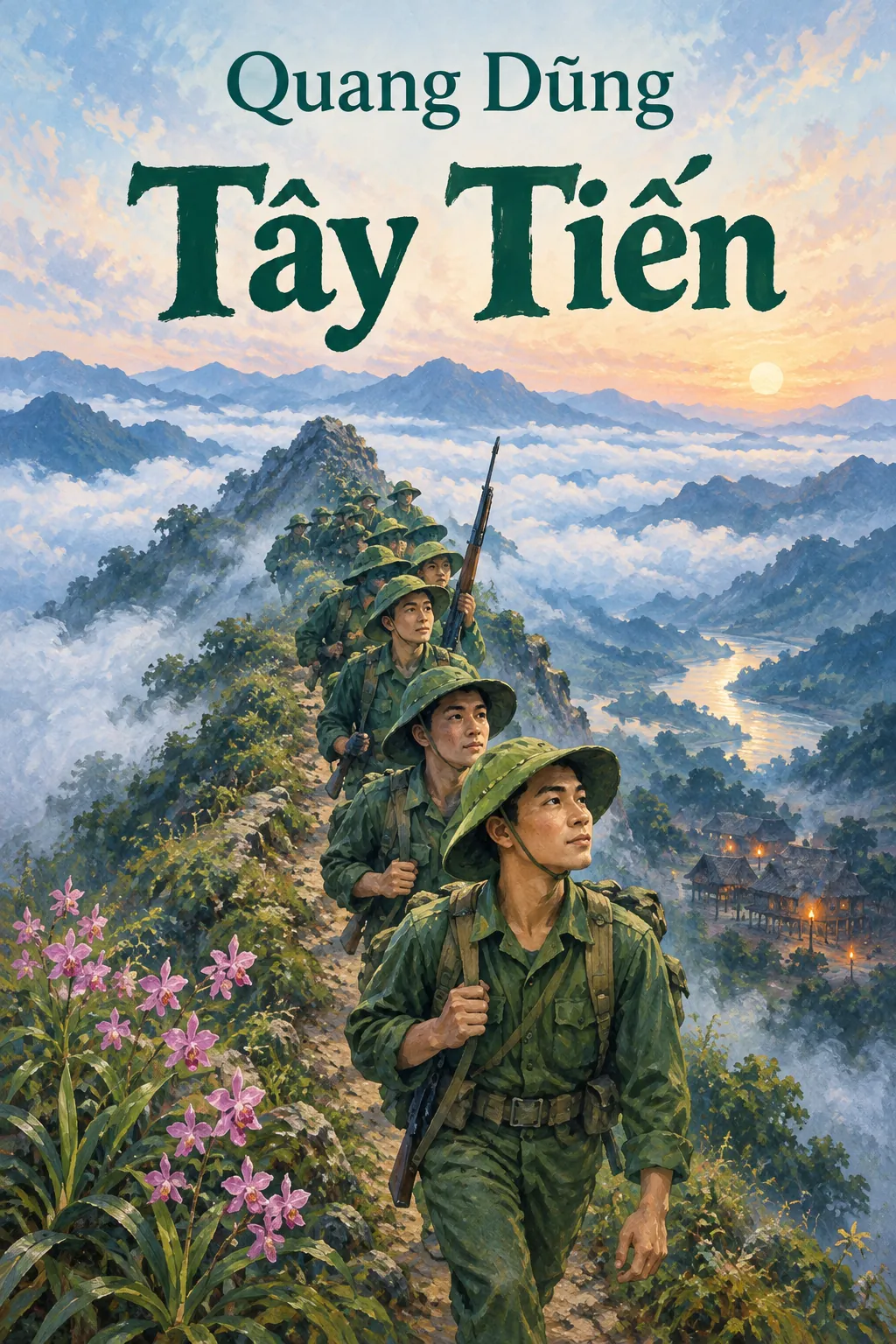
Tây Tiến
Quang Dũng 著
Tây Tiến is a poem by Quang Dũng, written in 1948 in memory of the Tây Tiến regiment, which fought along the Vietnam–Laos border. The poet looks back from far away and recalls steep passes, mist and waterfalls, a night of music in a mountain village, and the thin, proud faces of young soldiers. In four stanzas it moves from longing to landscape, from festival to farewell, and shows how a poem can honour comrades without hiding their suffering.
核心的なアイデア
"Tây Tiến is a poem of remembering: Quang Dũng recalls the fierce mountains of the north-west and the young soldiers who crossed them, and shows a tragic-heroic beauty in which hardship, romance and sacrifice sit side by side."
重要な洞察
Bi tráng: sorrow and pride together
Bi tráng joins bi, loss and hardship, with tráng, the grandeur of an ideal. Quang Dũng never hides death, yet he does not let it become self-pity. He looks at sacrifice with respect, and that respect is why the poem sounds like a hymn and not like a complaint.
“Rải rác biên cương mồ viễn xứ” names lonely graves, but the formal words “biên cương” (frontier) and “viễn xứ” (far land) give them dignity.
Nature as both danger and home
The north-west appears with bottomless slopes, roaring waterfalls and tigers, yet also with rice smoke, sticky rice and festival nights. For the poet nature is not only an enemy: it is a place he belonged to. That is why remembering it hurts and comforts at once.
The last two lines of stanza 1, “cơm lên khói” and “thơm nếp xôi”, soften a stanza full of fierce images.
The romantic soldier
The soldiers are guards at the border and also young men who dream. Quang Dũng lets them be both, and the mix avoids two clichés: the stone hero and the pitiable victim. Readers meet real young people who chose a hard road.
“Mắt trừng gửi mộng qua biên giới / Đêm mơ Hà Nội dáng kiều thơm”: the eyes glare on guard while the dreams travel to Hanoi.
Language that lifts ordinary things
Formal Sino-Vietnamese words and euphemism raise plain facts to a solemn level. A mat becomes a robe, a field grave becomes a frontier grave, and the soldier becomes a warrior from classical literature. This is a main reason the poem sounds both ancient and fresh.
“Áo bào thay chiếu anh về đất”: a general's robe stands where only a mat could be, honouring the dead and softening the pain.
章ごとの解説
Tây Tiến summary: background and structure
Quang Dũng (1921–1988) was a company commander in the Tây Tiến regiment, a unit formed in 1947 to work with Lao forces and wear down French troops along the Vietnam–Laos border.
Many of its soldiers were young men from Hanoi who marched through remote forest and suffered badly from malaria.
In 1948, after he had moved to another unit, the poet wrote the poem at Phù Lưu Chanh. Its first title was Nhớ Tây Tiến (Remembering Tây Tiến), later shortened to Tây Tiến.
The poem has four stanzas of mostly seven-syllable lines, with a free, musical rhythm and many formal Sino-Vietnamese words.
Its dominant mood is romantic and tragic-heroic (bi tráng). The four stanzas move from longing and the marching road, to a night festival and a river scene, to a portrait of the soldiers, and finally to a farewell.
Stanza-by-stanza summary of Tây Tiến
Spoiler warning: this section covers the whole poem, including the closing lines.
Stanza 1: Longing and the marching road (lines 1–14)
The poem opens with a call to the Mã River and to the regiment, and a longing that has nowhere to rest. From that feeling the poet walks us back through the mountains.
He names places such as Sài Khao, Mường Lát and Pha Luông, and shows a tired column hidden by mist on a road that climbs and falls by a thousand measures. A rifle seems to sniff the sky, a comrade collapses and does not rise, waterfalls roar and tigers prowl at night.
The stanza ends warmly, with steam from a rice pot and the scent of sticky rice in Mai Châu.
Why it matters: it sets the base of the whole poem, a harsh nature that is still loved, so the soldiers' suffering is always wrapped in memory and tenderness.
Stanza 2: The night festival and the river (lines 15–22)
The mood turns to a night of celebration in camp. Torches light up the barracks, girls appear in festive dress, and the khèn, a reed pipe, plays a shy mountain dance tune.
Then the view widens to a misty river at Châu Mộc at dusk, with reeds that seem to hold a spirit and a small dugout canoe swaying in flood water among drifting flowers.
The poet closes with a question: did those who passed that evening see the spirit of the reeds and remember the figure in the canoe?
Why it matters: the soldiers' world held gentleness and beauty as well as danger, which is what makes the poem romantic and not only heroic.
Stanza 3: Portrait of the Tây Tiến soldier (lines 23–30)
This stanza paints the soldiers: heads without hair, skin green and pale, yet fierce as tigers. They glare across the border by day and dream of Hanoi's girls at night.
Then the poet looks at death directly. Graves lie scattered along the frontier, the men left without regret for their youth, and a robe stands in for a mat as a comrade is laid in the earth.
The Mã River roars like a lonely song as if it were seeing them off.
Why it matters: this is the heart of the poem and the passage most often set for essays on the soldier image, where hardship, romance and sacrifice meet.
Stanza 4: Departure without a promise (lines 31–34)
The last four lines return to the regiment as a whole: the men set out with no promise of return, and the road ahead is endless and ends in parting.
The poet imagines that the souls of those who went up in that spring went on to Sầm Nứa in Laos and did not come back down to the plains.
Why it matters: the poem ends in a respectful farewell and shows soldiers who go for an ideal, not for a promise.
Writing about Tây Tiến: phân tích and dàn ý
Vietnamese exams usually ask you to analyse one stanza or to give your feelings about the soldier image in about 600 words (chữ), in the shape of mở bài, thân bài, kết bài.
Part 1: Planning the essay (dàn ý)
- Mở bài: introduce Quang Dũng, the 1948 setting and the stanza, and state your main claim.
- Thân bài: give three arguments, such as a gaunt but proud appearance, a romantic inner life, and a tragic-heroic view of death. Each one needs a short quotation and a comment on the wording.
- Kết bài: sum up the bi tráng beauty and, if the question asks, link it to young people's ideals today.
Part 2: Using quotations and devices
In each argument, state the point, quote one short line, then explain a device such as Sino-Vietnamese vocabulary, euphemism, personification or contrast.
The model answers on this page are labelled learning examples at three levels. Compare them with your own draft and write your own version rather than copying one.
アクション
今日から実践できるステップ:
-
Start an analysis with a clear claim about the soldiers, then support it with short quotations and comments on the wording.
-
Learn the key vocabulary: bi tráng, lãng mạn, từ Hán Việt, nói giảm nói tránh, nhân hóa.
-
Read the poem as a memory: the soldiers are shown through the poet's longing, which explains the praise and the tenderness.
-
Link the line “đi chẳng tiếc đời xanh” to a social-essay idea about the ideals of young people.
注目すべき引用
"“Sông Mã xa rồi Tây Tiến ơi!” (The Mã River is far now, Tây Tiến!) (Stanza 1)"
— Quang Dũng
"“Heo hút cồn mây súng ngửi trời” (Rifles seem to sniff the sky among far clouds) (Stanza 1)"
— Quang Dũng
"“Mắt trừng gửi mộng qua biên giới” (Eyes glare, dreams cross the border) (Stanza 3)"
— Quang Dũng
"“Áo bào thay chiếu anh về đất” (A robe replaces a mat as he returns to earth) (Stanza 3)"
— Quang Dũng
"“Tây Tiến người đi không hẹn ước” (Tây Tiến men leave with no promise to return) (Stanza 4)"
— Quang Dũng
おすすめの読者
Upper-secondary students in Vietnam (grade 12 and exam revision for the national high-school exam) who must write a phân tích or cảm nhận essay on Tây Tiến, teachers who want a clear stanza plan, and anyone new to Vietnamese war poetry who wants the context and key images in five minutes.
Quang Dũng について
Quang Dũng (1921–1988), born Bùi Đình Diệm, was a Vietnamese poet who also painted and wrote music. He served as a company commander in the Tây Tiến regiment in 1947–1948 and wrote the poem in 1948, after moving to another unit. Tây Tiến is his best-known work and a standard text in Vietnamese literature classes.
要約作成者

Software Engineer & Writer
Software engineer with a passion for distilling complex ideas into actionable insights. Writes about finance, investment, entrepreneurship, and technology.
すべての要約を見る →レビュー
レビューはまだありません。最初のレビューを書きましょう!
レビューを書く
続けて読む
このテーマを探る: 学習ガイド要約
ジョージ・オーウェル『動物農場』— 要約と分析
George Orwell
マナー農場の動物たちが人間を追い出し、「平等」を掲げたユートピアを建設しようとするが、次第に豚たちが権力を掌握し独裁体制を築く。最終的に、…
アウトサイダーズ(S.E.ヒントン著)
S.E. Hinton
1960年代のオクラホマを舞台に、貧困層の「グリース」と富裕層の「ソッシュ」という対立する二つのグループの少年たちの葛藤を描いた物語。主人…
F・スコット・フィッツジェラルド『グレート・ギャツビー』— 要約と分析
F. Scott Fitzgerald
ニック・キャラウェイの視点から、謎の富豪ジェイ・ギャツビーの人生が描かれます。ギャツビーは失った恋人デイジーを取り戻すため、狂信的なまでに…
ハツカネズミと人間たち(ジョン・スタインベック)
John Steinbeck
大恐慌時代のアメリカを舞台に、知的に優れたジョージと、心優しいが知能に制限のある巨漢レニーが、自分たちの農場を持つという夢を追い求める物語…
記事

Dàn ý nghị luận văn học: Outline for Literary-Analysis Essays
A dàn ý nghị luận văn học is a short plan you write before a Vietnamese literary-analysis essay: an opening,…
共通テスト国語の時間配分・解き方と対策
共通テスト国語は、2025年度から90分・200点満点・大問5題のマーク式になりました。現代文3題、古文、漢文を、題ごとの配点に合わせて時…
竹取物語(The Tale of the Bamboo Cutter)
『竹取物語』は、光る竹の中から見つかったかぐや姫が、五人の貴公子の求婚と帝の誘いを断り、八月十五日の夜に月へ帰っていく物語です。十世紀ごろ…