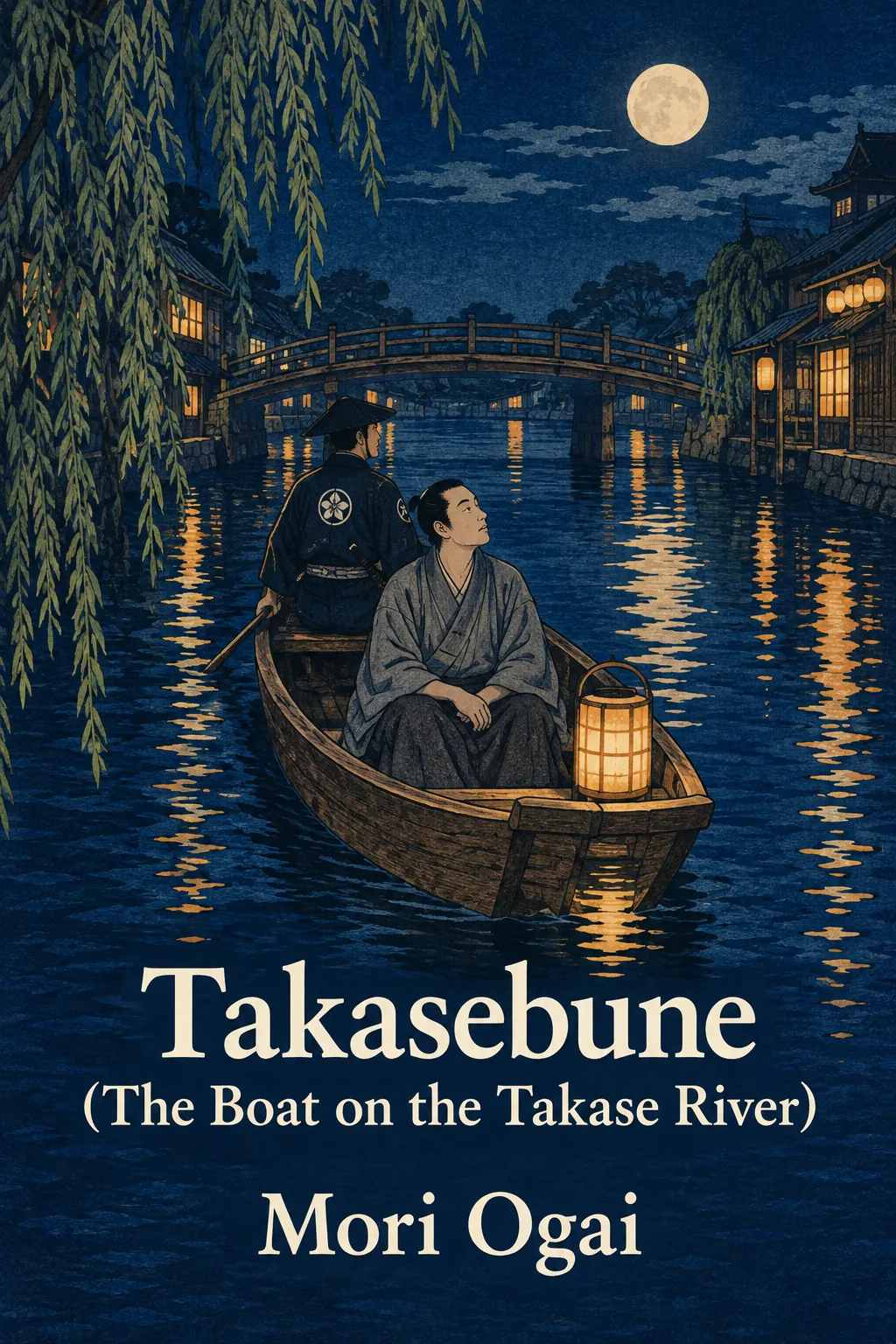
Takasebune (The Boat on the Takase River)
by Mori Ogai
Takasebune is a short story by Mori Ogai set in Edo-period Kyoto. A junior officer, Haneda Shobei, escorts a convict named Kisuke down the Takase River at night toward exile. Kisuke is oddly cheerful, and as Shobei listens to his life story he starts to question his own never-ending wants and the justice of Kisuke's sentence. The story leaves two questions open: what is enough, and who may end a suffering life.
The Big Idea
"On a night boat carrying an exile to Osaka, a junior officer meets a convict who seems strangely content. The story asks what it means to be satisfied, and who may decide when a suffering person's life should end."
Key Insights
Enough is a way of looking
Kisuke owns almost nothing, yet he is grateful for food in prison and a small sum of money. Shobei has a salary and a family, yet he always feels short. The story suggests that contentment comes less from how much a person has than from where the person starts counting. Kisuke counts what he has; Shobei counts what he lacks. At the same time, Kisuke's calm was shaped by a hard life, so the story should not be read as praise of poverty.
Kisuke plans to use his two hundred mon as a start on the island.
An open question about ending a life
Kisuke ended his brother's suffering at his brother's request, and the court treated it as a crime. Shobei cannot say it was simply murder, and he cannot say that taking a life is acceptable either. Ogai names no side. Debates about euthanasia and assisted dying are still alive today, which is one reason the story has not aged. A careful reader traces why each character acts as they do rather than rushing to a verdict.
The word euthanasia rises in Shobei's mind, but he cannot rest on it.
Shobei is the reader's stand-in
Shobei is not a judge or a relative, only an officer who happens to be on the boat. Because the narration stays close to his thoughts, the reader hears Kisuke's story from the same seat and asks the same questions. His doubt grows as he listens, so the reader is pushed to ask what they would think. He also has no power to decide, which makes his doubt sharper and more helpless.
Shobei's view of Kisuke changes as he listens to the story of the two hundred mon.
Authority and conscience do not always agree
The law has already ruled on Kisuke: exile. Shobei, however, is not convinced that the ruling matches what he sees. At the end he tries to calm himself by deferring to the magistrate's authority, but the doubt remains. The story shows that an official answer can settle a case without settling a person's conscience. This gap between rule and feeling is one reason an Edo-period tale still feels close to modern readers.
Shobei decides to follow the magistrate, yet the boat slides on in unresolved silence.
Chapter Breakdown
Chapter-by-chapter summary
Spoiler warning: this section covers the whole plot, including the ending.
Part 1: The boat on the Takase River
In Kyoto, convicts sentenced to exile were taken down the Takase River to Osaka in a small boat. A low-ranking officer, called a doshin, rode along to guard them.
It was a custom that one relative could ride along for the last night together, if the officer looked the other way. The story is set in the late Edo period, in the Kansei years.
Ogai took the idea from an older Edo-period collection of essays, Okinagusa, and rebuilt it as fiction. This opening puts two people from very different positions alone together on a quiet night boat.
Part 2: A convict who looks content
One night the convict is Kisuke, a man of about thirty, and the officer in charge is Haneda Shobei. Shobei has taken many convicts down the river, and most of them were crushed by grief.
Kisuke is different: he seems calm, even cheerful, although the papers say he killed his younger brother. The gap between his face and his crime is the puzzle that drives the story.
Shobei cannot stop watching him, and that curiosity is what starts their conversation.
Part 3: Knowing what is enough
Shobei finally asks how Kisuke can be so calm. Kisuke says he has always worked but never saved a coin, because every wage went on food.
In prison he is fed without working, and the court has given him two hundred mon, which he plans to use as a start on the island.
Listening, Shobei sees that he has a salary and a family and still always wants more. This is the theme of knowing when you have enough, called chisoku in Japanese.
Part 4: The brother
Shobei then asks about the crime, and Kisuke answers quietly. He and his brother lost their parents young and lived together in Kyoto, leaning on each other.
When the brother fell ill and could not work, Kisuke supported them both. One day he came home and found his brother in terrible suffering, having tried to end his own life.
The brother begged Kisuke to end the pain, and after hesitating, Kisuke did as he asked. A neighbour saw what had happened, and Kisuke was arrested.
Part 5: Shobei's doubt
Shobei wonders whether this was really murder. The brother could not be saved, and Kisuke acted out of love, not for gain.
The word euthanasia, which Ogai writes in katakana as yutanajii, comes into his mind. Yet he cannot say that anyone may end another person's life, and he cannot decide whether the magistrate judged rightly.
His uncertainty becomes the reader's uncertainty. The story asks both questions at once and refuses to settle them.
Part 6: No answer
Shobei tells himself he must follow the magistrate's decision, an idea Ogai names with the word otoritee, meaning authority. His doubt does not go away.
Kisuke sits quietly, and the boat slides on down the dark river. Ogai gives no verdict, so the reader has to carry the question.
The ending works because the silence on the boat feels heavier than any answer would. It is also why the story is still taught today.
About the story
Takasebune appeared in the magazine Chuo Koron in January 1916. Mori Ogai was an army surgeon as well as a writer, so he knew medicine and death at first hand.
In a short essay about the story he named two themes: the endless wish for more property, and euthanasia. These two ideas give students a simple way to organise their notes.
Reading with both themes in mind also explains why Kisuke and Shobei are set side by side: one counts what he has, and the other counts what he lacks.
Characters
Kisuke
A convict of about thirty, sentenced to exile after his brother's death. He has no savings, yet he is calm and grateful for what he is given.
Ogai uses him to show contentment that comes from attitude, not from possessions.
Haneda Shobei
The doshin, a low-ranking officer, who escorts Kisuke. He is an ordinary man with a family and a salary that never feels like enough.
He is the reader's stand-in and the one who doubts.
Kisuke's brother
A younger brother who fell ill and could no longer work. In great suffering he asked Kisuke for help, and he appears only in Kisuke's account.
The neighbour
A person from the neighbourhood who saw what happened, which is how the case reached the authorities. The role is small but it explains why Kisuke is a convict at all.
The magistrate
The unseen official who sentenced Kisuke. Shobei turns to this authority at the end to quiet his doubts, so the magistrate stands for the law and the system.
What exams ask
Exam questions on Takasebune usually ask how Shobei's feelings change, why Kisuke is content, and what the two themes mean.
- Feelings: link the trigger (Kisuke's cheerful face) to the result (puzzlement, then self-reflection, then doubt).
- Reasons: choose from no savings, free food in prison, the two hundred mon and the chance to work on the island.
- Themes: contentment and euthanasia, with the point that the story gives no verdict.
Whatever the format, give a point, support it with a short pointer from the story, and explain what it shows. Do not claim that Ogai gives a verdict on euthanasia, because he does not.
Writing about this book
A strong essay on Takasebune picks one question and stays with it. Either follow the idea of contentment, comparing Kisuke's money habits with Shobei's, or follow the doubt about Kisuke's act and trace how Shobei's feelings change.
Use short pointers from the story, such as the two hundred mon, the word euthanasia or the final appeal to authority, and explain what each one shows.
Because the story deals with death and suffering, avoid giving a verdict as if the question were simple. It is stronger to say exactly why Shobei cannot decide.
If the topic touches your own experience, you do not have to write about it. If it feels heavy, talk to a teacher or someone you trust.
For a reaction paper, finish by saying what changed in your own thinking. The model answers below are learning examples to compare with your own work, not texts to copy.
Take Action
Practical steps you can implement today:
-
Write down when you feel you have enough, and compare it with Kisuke's way of counting what he already has.
-
With an open-ended story, collect the reasons a character hesitates instead of looking for one correct answer.
-
In a feelings question, link the trigger to the feeling in one sentence, then show how the feeling changes.
-
On heavy topics, explain why you are unsure instead of forcing a verdict.
Notable Quotes
"“ユウタナジイ” (euthanasia): the word that comes to Shobei's mind as he thinks about the brother. (Part 5)"
— Mori Ogai
"“オオトリテエ” (authority): the power Shobei leans on to calm his doubt. (Part 6)"
— Mori Ogai
"“Two hundred mon”: the small sum Kisuke treats as a precious gift. (Part 3)"
— Mori Ogai
Who Should Read This
Students who study Takasebune in Japanese high school Kokugo or in a world literature class, and anyone preparing a reaction paper. It is short enough for middle schoolers to read in one sitting. The story deals with death and suffering, so read it in a calm setting.
Characters
Kisuke
protagonist / convict
A man of about thirty sentenced to exile after his brother's death. He has no savings but is calm and grateful for what he has. His attitude makes Shobei question his own life.
Haneda Shobei
viewpoint character / escort
A low-ranking officer with a salary and a family who is never satisfied. He escorts Kisuke and gradually doubts both himself and the sentence. The reader sees the story through his mind.
Kisuke's brother
key figure in the past
A sick younger brother who could no longer work and asked Kisuke for help in great suffering. He appears only in Kisuke's account, yet his request drives the whole question of the story.
The neighbour
witness
A person from the neighbourhood who saw what had happened. This is how the case became known to the authorities and how Kisuke became a convict.
The magistrate
authority (unseen)
The official who sentenced Kisuke to exile. He never appears, but Shobei leans on his authority at the end to quiet his doubt.
Exam practice: sample answers
Model answers are examples to learn from; write your own in your words.
character analysis
1. How does Shobei's attitude toward Kisuke and toward his own life change during the voyage? Refer to specific moments in the story.
Outline
- State the three stages: puzzlement, self-examination, doubt
- Stage 1: the contrast with earlier convicts and Kisuke's cheerful face
- Stage 2: Kisuke's account of money and Shobei's own restlessness
- Stage 3: the brother's story, the word euthanasia and the appeal to authority
- Conclusion: doubt left unresolved
Basic Model answer
At the start, Shobei is puzzled because Kisuke looks cheerful even though he is going into exile. Other convicts he has escorted were sad, and this difference seems strange to him.
Then Kisuke explains that he is grateful for the two hundred mon and for the food in prison. Shobei realises he has a salary but is never satisfied, so he starts to think Kisuke may be happier than he is.
After hearing about the brother, Shobei is unsure whether Kisuke really committed murder. The brother was suffering and asked for help.
So Shobei moves from surprise, to self-reflection, to doubt. At the end he has no answer, but it is clear he is thinking deeply.
Overall, the change shows that Shobei is a thoughtful man who looks at his own life as well as at the convict.
Good Model answer
Shobei's attitude changes in three stages: puzzlement, self-examination and doubt about the law.
First, he is puzzled. Convicts he has escorted before were weighed down by grief, but Kisuke, who is going into exile for his brother's death, seems calm and even cheerful.
This clashes with what Shobei expects.
Second, he examines himself. Kisuke explains that he never managed to save money, that he is fed in prison and that he is grateful for the two hundred mon he received to start a new life on the island.
Shobei has a salary and a family, yet he is never satisfied. He realises that wanting more has no limit, so he begins to see Kisuke as someone who understands what is enough better than he does.
Third, he doubts. When Kisuke describes his sick brother's suffering and his request for help, Shobei wonders whether the act deserves the name murder.
The word euthanasia comes to his mind, but he cannot say that ending a life is right either.
Finally, he tries to calm himself by deferring to the magistrate's authority, but the doubt stays. The change shows Shobei moving from judging another person to questioning himself and the system he serves.
Excellent Model answer
Shobei's attitude shifts from surprise at another man, through recognition of his own restlessness, to a doubt about authority that is never settled.
The starting point is a clash with experience. Shobei has escorted many convicts, and they were crushed by grief, so Kisuke's calm, which sits oddly beside the charge of killing his brother, cannot be explained by anything he knows.
At this stage he treats Kisuke as a puzzle to be solved.
The turning point is Kisuke's account of money. Kisuke counts from what he has: food in prison and two hundred mon as a stake for the island.
Shobei, with a salary and a family, still feels short.
Ogai's own essay on the story names the endless desire for property as one theme, and here it becomes concrete. Shobei changes from an official looking at a convict into a man looking at himself.
The third stage begins when the crime is explained. The brother's suffering, his request and Kisuke's quiet, undramatic way of telling it make “murder” seem too small a word.
That the word euthanasia, in Ogai's katakana, surfaces in Shobei's mind shows that he is reaching for a concept his world has no ordinary word for.
His doubt has two layers: sympathy for Kisuke's love, and unease about anyone ending a life.
The ending is deliberately unresolved. Shobei decides to bow to the magistrate's authority, but this reads as a way to quiet his mind, not as conviction, and the boat keeps sliding down the dark river.
Because the narration stays close to Shobei, the reader shares his uncertainty. As an escort rather than a judge, he also has no power to decide, which makes the doubt sharper.
Overall, Shobei's journey moves from judging another person to questioning himself and then the system he serves. Ogai refuses a verdict, so the unsettled feeling is the point: the story asks readers to take both questions, what is enough and who decides, as their own.
Marking rubric
- Identifies a clear movement of feeling with a trigger for each stage
- Uses specific moments (earlier convicts, two hundred mon, the brother's request, appeal to authority)
- Explains cause and effect, not only description
- Notes that the ending gives no verdict
- Shows awareness of Ogai's two themes and of the narrative viewpoint
Now write your own
Write your own answer in 150 to 250 words. Pick the moment where you think Shobei's attitude changes most and explain why, then compare your answer with the three levels above.
reflection / reaction paper
2. Write a short reflection on Takasebune: what does the story say about contentment, and how does it handle the question of ending a suffering person's life?
Outline
- Open with the scene or detail that stayed with you
- Contentment: compare Kisuke and Shobei and link to your own experience
- The brother's story: describe your uncertainty carefully, without a quick verdict
- Why the open ending matters
- Close with what changed in your thinking
Basic Model answer
After reading Takasebune, I was surprised that Kisuke was so happy with only two hundred mon. I often want new things, so his attitude made me think.
Shobei also realises he is never satisfied, and I felt the same as him. I learned that feeling content depends more on the mind than on how much we own.
The story of the brother is very sad and heavy. I do not know if Kisuke was right, but I think it is important to keep thinking carefully instead of deciding quickly.
I also noticed that the story does not tell the reader what to think, which I liked. In future I want to notice the things I already have.
Good Model answer
Takasebune made me rethink what it means to have enough. Kisuke, a convict going into exile, is grateful for two hundred mon and the food he receives in prison.
The officer Shobei, who has a salary and a family, never feels satisfied. Seeing them side by side, I realised that contentment is shaped by how we look at what we have, not only by how much we have.
However, Kisuke's calm does not mean that poverty is good. His peace comes from a hard life, and the story does not ask us to be poor.
It asks us to notice what we already hold. In my own life, I often want the next phone or the next grade before I have enjoyed the last one, so Shobei's restlessness felt familiar.
The second question, about Kisuke's brother, is harder. Kisuke acted because his brother was in great pain and asked him to.
Shobei wonders whether that can be called murder, yet he cannot say that taking a life is right either. I felt the same pull in two directions and could not settle it.
Ogai gives no verdict, and I think this is honest. The story shows that authority can give an answer without giving peace of mind.
I want to keep both lessons: to count what I have and to think slowly about questions that have no easy answer.
Excellent Model answer
Takasebune joins two questions that seem unrelated: how much is enough, and who may end a suffering life. After reading it I think they are linked by one skill, which is honest attention to a person's real situation instead of to a habit or a rule.
Kisuke counts what he has: food in prison and two hundred mon as a starting stake. Shobei, with a salary and a family, counts what is missing.
Ogai's own comment that the story concerns the limitless wish for property helped me see this as more than a moral lesson. It is a description of a mind that can never arrive, and I recognise it in myself when a good result is followed at once by worry about the next one.
I do not read Kisuke's contentment as praise of poverty. His calm was formed by a hard life, and the story never suggests that suffering is good.
It suggests that gratitude is a skill that can be learned.
The question of the brother is heavier, and I want to treat it carefully. Kisuke acts at the request of a brother in terrible pain, out of love and not for gain, yet the law calls it killing.
Shobei summons the word euthanasia but cannot accept it fully, and he falls back on the magistrate's authority, which does not settle his mind. I felt the same two pulls: sympathy for Kisuke, and fear of a world in which one person may end another's life.
Ogai does not ask the reader to choose a side quickly. That refusal is why the ending stays with me, because a verdict would have let me stop thinking, whereas the silent boat makes me carry the question.
If a story like this touches something in our own lives, it is wise to talk to someone we trust.
Before reading, I thought satisfaction was something to be earned by getting more. Now I want to practise counting what I have, and to practise staying with hard questions without forcing them into easy answers.
Marking rubric
- A central idea that connects the two themes
- Specific details from the story rather than general statements
- A personal link that is honest and not forced
- Careful, respectful handling of death and suffering, with no verdict
- A conclusion showing how your thinking changed
Now write your own
Write your own reflection in 200 to 300 words. Choose either contentment or the open ending, give one example from the story and one from your own life, and say what you now think differently.
Frequently Asked Questions
What is Takasebune about?
Takasebune is a short story by Mori Ogai about a night boat taking a convict, Kisuke, from Kyoto to Osaka for exile. The officer guarding him, Haneda Shobei, is puzzled by his calm and, after hearing his story, begins to doubt both his own desires and the sentence. The story ends without an answer.
What are the main themes of Takasebune?
The two main themes are knowing when you have enough (chisoku) and euthanasia. Ogai himself pointed to the endless wish for property and to the question of ending a suffering person's life. The story leaves both open, which makes it good material for discussion and essays.
Why is Kisuke cheerful?
Kisuke has never saved money, so a prison that feeds him and a gift of two hundred mon feel like good fortune. He expects to work again on the island. He counts what he has, not what he lacks, and this is the attitude that surprises Shobei.
Who are the main characters?
The two central figures are Kisuke, the convict, and Haneda Shobei, the officer who escorts him. Kisuke's brother and a neighbour appear only in Kisuke's account, and the magistrate who sentenced him never appears. With so few characters, the conversation on the boat carries the story.
When was Takasebune published, and is it in the public domain?
It appeared in the magazine Chuo Koron in January 1916. Ogai died in 1922, so the Japanese text is in the public domain and can be read freely online, for example at Aozora Bunko. Our guide uses our own wording and short pointers only.
Check Your Understanding
Pick an answer for each question to see if you were right.
-
Who wrote Takasebune?
Mori Ogai — Takasebune is a short story by Mori Ogai, published in 1916.
-
Where does the boat take convicts?
From Kyoto to Osaka — Convicts sentenced to exile were taken down the Takase River from Kyoto to Osaka.
-
What is Haneda Shobei's job?
Doshin (low-ranking officer) — Shobei is a doshin who escorts the convict on the boat.
-
What does Kisuke plan to use as a start on the island?
Two hundred mon — The court gave Kisuke two hundred mon, which he treats as a precious start for a new life.
-
Which two themes did Ogai name for the story?
Endless desire for property, and euthanasia — Ogai pointed to the limitless wish for property (contentment) and to euthanasia.
About Mori Ogai
Mori Ogai (1862-1922) was a Japanese novelist, translator and army surgeon who rose to the top medical post in the army. He wrote historical fiction and modern stories, including Maihime and Sansho the Bailiff, and helped introduce European literature to Japanese readers. Takasebune is one of his best-known short stories.
Summary Written By

Software Engineer & Writer
Software engineer with a passion for distilling complex ideas into actionable insights. Writes about finance, investment, entrepreneurship, and technology.
View all summaries →Reviews
No reviews yet. Be the first to share your thoughts!
Write a Review
Keep reading
Explore the topic: Study GuidesSummaries

Animal Farm by George Orwell
George Orwell
The animals of Manor Farm revolt against their human owner to create a utopian society based on equality. However, the…

The Outsiders by S.E. Hinton
S.E. Hinton
Ponyboy Curtis and his gang of Greasers clash with the wealthy Socs in a cycle of violence. After a tragic…

The Great Gatsby by F. Scott Fitzgerald
F. Scott Fitzgerald
Nick Carraway enters the orbit of Jay Gatsby, a mysterious millionaire obsessed with reclaiming his past love, Daisy Buchanan. Amidst…

Of Mice and Men by John Steinbeck
John Steinbeck
George and Lennie, two migrant workers during the Great Depression, dream of owning their own land to escape a life…
Articles

Dokusho Kansobun for High School: How to Write a Japanese Book Reflection
A dokusho kansobun is a Japanese book reflection: not a plot summary, but your own thinking about a book, backed…

How to Write a Literary Analysis Essay
A literary analysis essay argues one clear claim about how a text works and proves it with short quotations and…
The Tale of the Bamboo Cutter
The Tale of the Bamboo Cutter (Taketori Monogatari) tells of Princess Kaguya, a girl found inside a glowing bamboo stalk,…