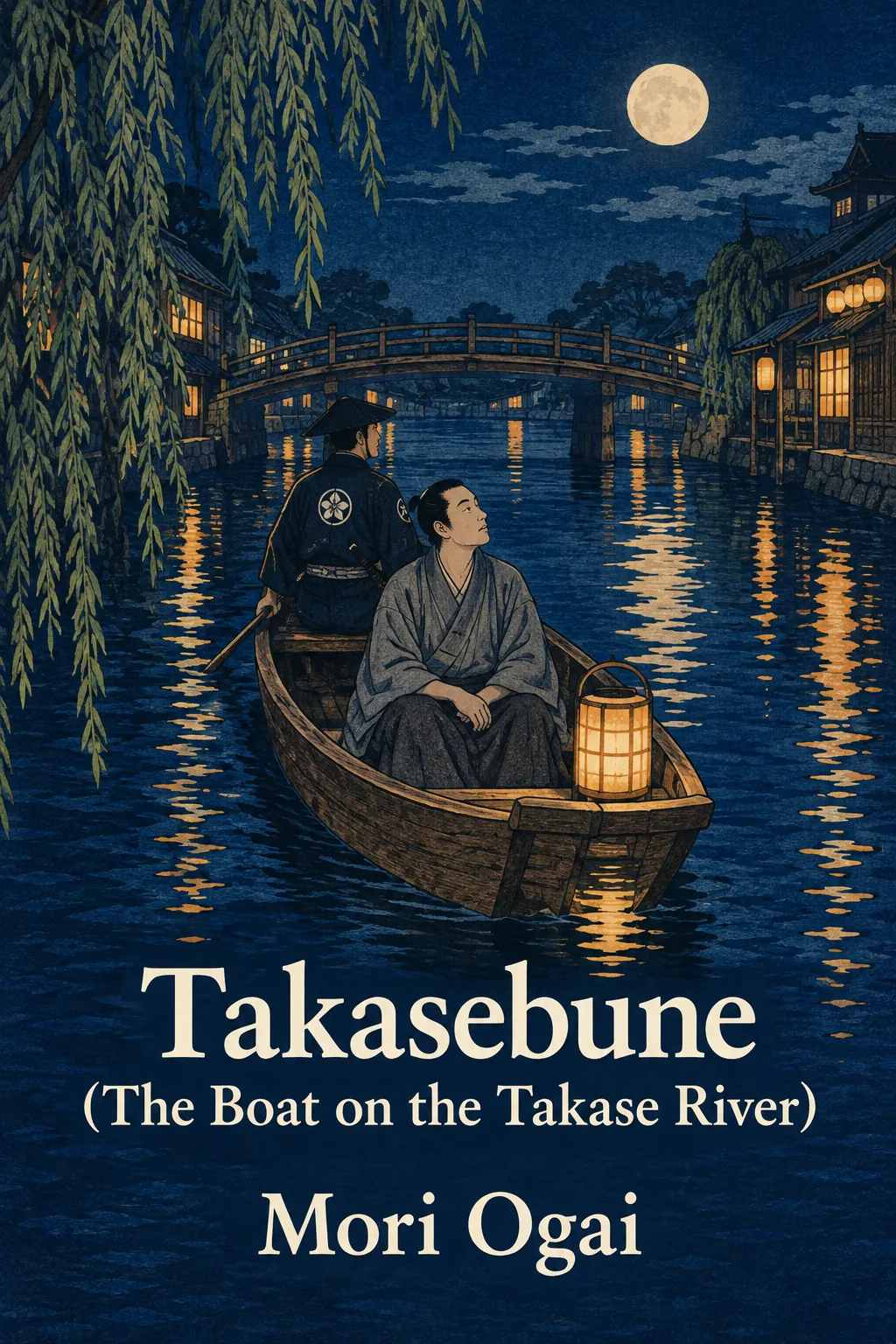
Takasebune (The Boat on the Takase River)
oleh Mori Ogai
Takasebune is a short story by Mori Ogai set in Edo-period Kyoto. A junior officer, Haneda Shobei, escorts a convict named Kisuke down the Takase River at night toward exile. Kisuke is oddly cheerful, and as Shobei listens to his life story he starts to question his own never-ending wants and the justice of Kisuke's sentence. The story leaves two questions open: what is enough, and who may end a suffering life.
Ide Utama
"On a night boat carrying an exile to Osaka, a junior officer meets a convict who seems strangely content. The story asks what it means to be satisfied, and who may decide when a suffering person's life should end."
Wawasan Utama
Enough is a way of looking
Kisuke owns almost nothing, yet he is grateful for food in prison and a small sum of money. Shobei has a salary and a family, yet he always feels short. The story suggests that contentment comes less from how much a person has than from where the person starts counting. Kisuke counts what he has; Shobei counts what he lacks. At the same time, Kisuke's calm was shaped by a hard life, so the story should not be read as praise of poverty.
Kisuke plans to use his two hundred mon as a start on the island.
An open question about ending a life
Kisuke ended his brother's suffering at his brother's request, and the court treated it as a crime. Shobei cannot say it was simply murder, and he cannot say that taking a life is acceptable either. Ogai names no side. Debates about euthanasia and assisted dying are still alive today, which is one reason the story has not aged. A careful reader traces why each character acts as they do rather than rushing to a verdict.
The word euthanasia rises in Shobei's mind, but he cannot rest on it.
Shobei is the reader's stand-in
Shobei is not a judge or a relative, only an officer who happens to be on the boat. Because the narration stays close to his thoughts, the reader hears Kisuke's story from the same seat and asks the same questions. His doubt grows as he listens, so the reader is pushed to ask what they would think. He also has no power to decide, which makes his doubt sharper and more helpless.
Shobei's view of Kisuke changes as he listens to the story of the two hundred mon.
Authority and conscience do not always agree
The law has already ruled on Kisuke: exile. Shobei, however, is not convinced that the ruling matches what he sees. At the end he tries to calm himself by deferring to the magistrate's authority, but the doubt remains. The story shows that an official answer can settle a case without settling a person's conscience. This gap between rule and feeling is one reason an Edo-period tale still feels close to modern readers.
Shobei decides to follow the magistrate, yet the boat slides on in unresolved silence.
Rincian Bab
Chapter-by-chapter summary
Spoiler warning: this section covers the whole plot, including the ending.
Part 1: The boat on the Takase River
In Kyoto, convicts sentenced to exile were taken down the Takase River to Osaka in a small boat. A low-ranking officer, called a doshin, rode along to guard them.
It was a custom that one relative could ride along for the last night together, if the officer looked the other way. The story is set in the late Edo period, in the Kansei years.
Ogai took the idea from an older Edo-period collection of essays, Okinagusa, and rebuilt it as fiction. This opening puts two people from very different positions alone together on a quiet night boat.
Part 2: A convict who looks content
One night the convict is Kisuke, a man of about thirty, and the officer in charge is Haneda Shobei. Shobei has taken many convicts down the river, and most of them were crushed by grief.
Kisuke is different: he seems calm, even cheerful, although the papers say he killed his younger brother. The gap between his face and his crime is the puzzle that drives the story.
Shobei cannot stop watching him, and that curiosity is what starts their conversation.
Part 3: Knowing what is enough
Shobei finally asks how Kisuke can be so calm. Kisuke says he has always worked but never saved a coin, because every wage went on food.
In prison he is fed without working, and the court has given him two hundred mon, which he plans to use as a start on the island.
Listening, Shobei sees that he has a salary and a family and still always wants more. This is the theme of knowing when you have enough, called chisoku in Japanese.
Part 4: The brother
Shobei then asks about the crime, and Kisuke answers quietly. He and his brother lost their parents young and lived together in Kyoto, leaning on each other.
When the brother fell ill and could not work, Kisuke supported them both. One day he came home and found his brother in terrible suffering, having tried to end his own life.
The brother begged Kisuke to end the pain, and after hesitating, Kisuke did as he asked. A neighbour saw what had happened, and Kisuke was arrested.
Part 5: Shobei's doubt
Shobei wonders whether this was really murder. The brother could not be saved, and Kisuke acted out of love, not for gain.
The word euthanasia, which Ogai writes in katakana as yutanajii, comes into his mind. Yet he cannot say that anyone may end another person's life, and he cannot decide whether the magistrate judged rightly.
His uncertainty becomes the reader's uncertainty. The story asks both questions at once and refuses to settle them.
Part 6: No answer
Shobei tells himself he must follow the magistrate's decision, an idea Ogai names with the word otoritee, meaning authority. His doubt does not go away.
Kisuke sits quietly, and the boat slides on down the dark river. Ogai gives no verdict, so the reader has to carry the question.
The ending works because the silence on the boat feels heavier than any answer would. It is also why the story is still taught today.
About the story
Takasebune appeared in the magazine Chuo Koron in January 1916. Mori Ogai was an army surgeon as well as a writer, so he knew medicine and death at first hand.
In a short essay about the story he named two themes: the endless wish for more property, and euthanasia. These two ideas give students a simple way to organise their notes.
Reading with both themes in mind also explains why Kisuke and Shobei are set side by side: one counts what he has, and the other counts what he lacks.
Characters
Kisuke
A convict of about thirty, sentenced to exile after his brother's death. He has no savings, yet he is calm and grateful for what he is given.
Ogai uses him to show contentment that comes from attitude, not from possessions.
Haneda Shobei
The doshin, a low-ranking officer, who escorts Kisuke. He is an ordinary man with a family and a salary that never feels like enough.
He is the reader's stand-in and the one who doubts.
Kisuke's brother
A younger brother who fell ill and could no longer work. In great suffering he asked Kisuke for help, and he appears only in Kisuke's account.
The neighbour
A person from the neighbourhood who saw what happened, which is how the case reached the authorities. The role is small but it explains why Kisuke is a convict at all.
The magistrate
The unseen official who sentenced Kisuke. Shobei turns to this authority at the end to quiet his doubts, so the magistrate stands for the law and the system.
What exams ask
Exam questions on Takasebune usually ask how Shobei's feelings change, why Kisuke is content, and what the two themes mean.
- Feelings: link the trigger (Kisuke's cheerful face) to the result (puzzlement, then self-reflection, then doubt).
- Reasons: choose from no savings, free food in prison, the two hundred mon and the chance to work on the island.
- Themes: contentment and euthanasia, with the point that the story gives no verdict.
Whatever the format, give a point, support it with a short pointer from the story, and explain what it shows. Do not claim that Ogai gives a verdict on euthanasia, because he does not.
Writing about this book
A strong essay on Takasebune picks one question and stays with it. Either follow the idea of contentment, comparing Kisuke's money habits with Shobei's, or follow the doubt about Kisuke's act and trace how Shobei's feelings change.
Use short pointers from the story, such as the two hundred mon, the word euthanasia or the final appeal to authority, and explain what each one shows.
Because the story deals with death and suffering, avoid giving a verdict as if the question were simple. It is stronger to say exactly why Shobei cannot decide.
If the topic touches your own experience, you do not have to write about it. If it feels heavy, talk to a teacher or someone you trust.
For a reaction paper, finish by saying what changed in your own thinking. The model answers below are learning examples to compare with your own work, not texts to copy.
Ambil Tindakan
Langkah praktis yang bisa Anda terapkan hari ini:
-
Write down when you feel you have enough, and compare it with Kisuke's way of counting what he already has.
-
With an open-ended story, collect the reasons a character hesitates instead of looking for one correct answer.
-
In a feelings question, link the trigger to the feeling in one sentence, then show how the feeling changes.
-
On heavy topics, explain why you are unsure instead of forcing a verdict.
Kutipan Menarik
"“ユウタナジイ” (euthanasia): the word that comes to Shobei's mind as he thinks about the brother. (Part 5)"
— Mori Ogai
"“オオトリテエ” (authority): the power Shobei leans on to calm his doubt. (Part 6)"
— Mori Ogai
"“Two hundred mon”: the small sum Kisuke treats as a precious gift. (Part 3)"
— Mori Ogai
Siapa yang Harus Membaca Ini
Students who study Takasebune in Japanese high school Kokugo or in a world literature class, and anyone preparing a reaction paper. It is short enough for middle schoolers to read in one sitting. The story deals with death and suffering, so read it in a calm setting.
Tentang Mori Ogai
Mori Ogai (1862-1922) was a Japanese novelist, translator and army surgeon who rose to the top medical post in the army. He wrote historical fiction and modern stories, including Maihime and Sansho the Bailiff, and helped introduce European literature to Japanese readers. Takasebune is one of his best-known short stories.
Ringkasan Ditulis Oleh

Software Engineer & Writer
Software engineer with a passion for distilling complex ideas into actionable insights. Writes about finance, investment, entrepreneurship, and technology.
Lihat semua ringkasan →Ulasan
Belum ada ulasan. Jadilah yang pertama berbagi pemikiran Anda!
Tulis Ulasan
Lanjut membaca
Jelajahi topik: Panduan BelajarRingkasan

Animal Farm karya George Orwell — Ringkasan & Analisis
George Orwell
Hewan-hewan di Peternakan Manor memberontak melawan petani kejam Mr. Jones untuk mendirikan masyarakat utopia berdasarkan kesetaraan. Namun, kepemimpinan babi yang…
The Outsiders oleh S.E. Hinton
S.E. Hinton
Novel ini mengikuti kehidupan Ponyboy Curtis dan kelompok 'Greasers' yang terjebak dalam perang saudara dengan kelompok 'Socs' yang kaya. Melalui…

The Great Gatsby karya F. Scott Fitzgerald — Ringkasan & Analisis
F. Scott Fitzgerald
Diceritakan oleh Nick Carraway, novel ini mengikuti Jay Gatsby, seorang jutawan misterius yang berusaha memenangkan kembali cinta Daisy Buchanan. Di…

tikus dan Manusia oleh John Steinbeck
John Steinbeck
Kisah tentang dua buruh tani migran, George dan Lennie, yang bermimpi memiliki tanah sendiri untuk hidup mandiri. Namun, keterbatasan mental…
Artikel

Dokusho Kansobun for High School: How to Write a Japanese Book Reflection
A dokusho kansobun is a Japanese book reflection: not a plot summary, but your own thinking about a book, backed…
Kisah Penebang Bambu (Taketori Monogatari)
Kisah Penebang Bambu (Taketori Monogatari) bercerita tentang Putri Kaguya, gadis yang ditemukan di dalam batang bambu yang bersinar. Ia tumbuh…
Ragnarok: Akhir Dunia dan Kiamat Para Dewa Nordik
Ragnarök adalah akhir dunia dalam mitologi Nordik: pertempuran terakhir tempat para dewa, raksasa, dan monster saling membinasakan, bumi tenggelam ke…