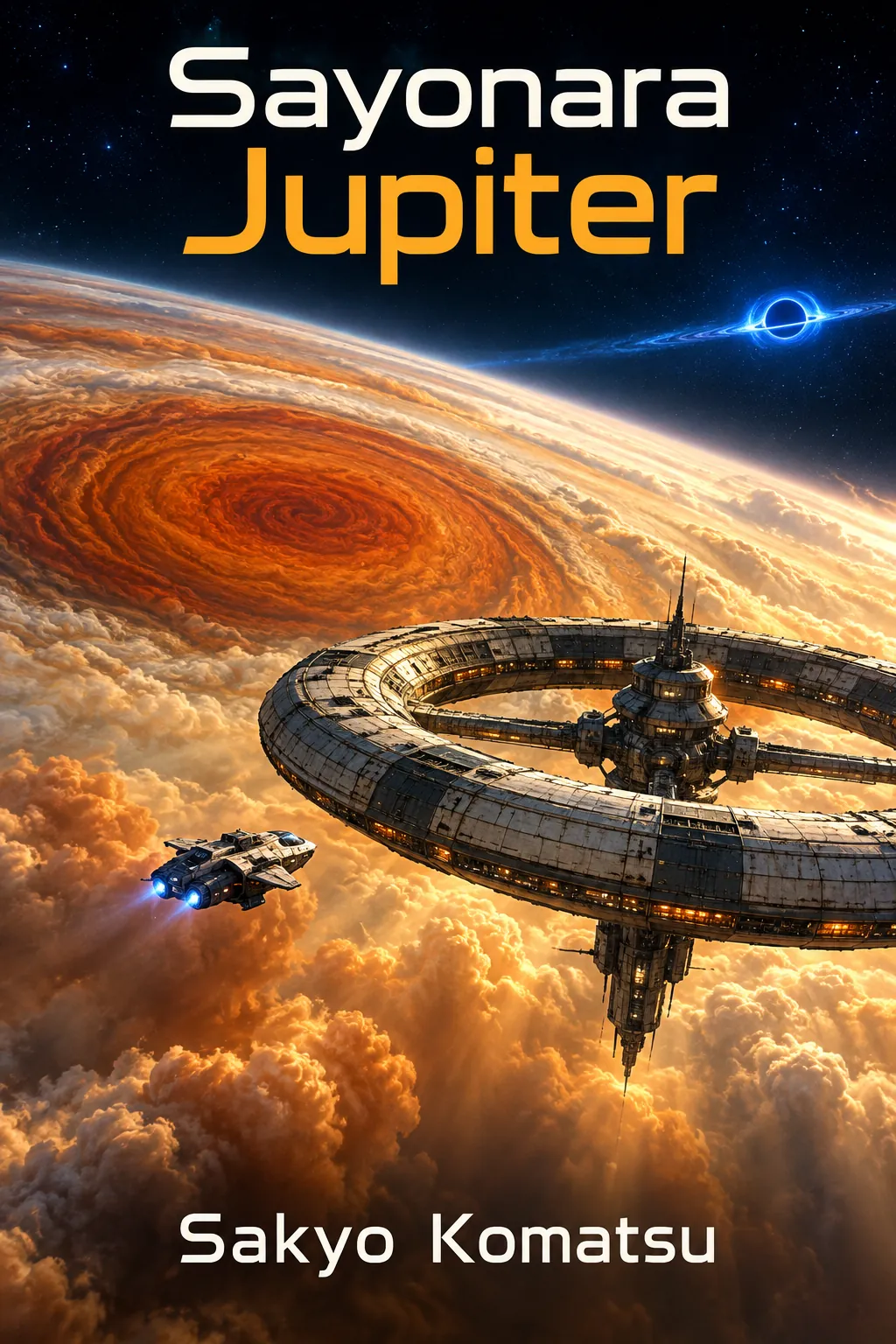
Sayonara Jupiter
by Sakyo Komatsu
Sayonara Jupiter is a hard science fiction novel by Sakyo Komatsu, set in the 22nd century. Humanity is working to turn Jupiter into a second sun, and project chief Eiji Honda finds the plan tied to a danger for the whole solar system. The novel is about scale, careful science and what people do when time is short.
Try Audible · As an Amazon Associate we earn from qualifying purchases. Details
The Big Idea
"In the 22nd century humanity is turning Jupiter into a second sun, until a threat to the whole solar system forces people to ask what they would give up to protect it."
Key Insights
Human ambition at planetary scale
The second-sun plan treats a gas giant as a project with a schedule: an agency, a target year of 2140 and a front-line base. Set beside a planet and a black hole, human plans look both bold and small, and the novel keeps that comparison in the reader's mind.
People measure the work in meetings and decades, while the danger is measured in orbits and the mass of a black hole. The contrast makes the human project feel both impressive and fragile.
A future made of small details
Komatsu builds his world from named ranks, offices and everyday habits. Kin serves in the Space Air Force, watches a film before he leaves, and a fleet in the second volume has an informal nickname, so the future feels as though people really live in it.
Because the world feels ordinary, the arrival of a huge threat feels like a real event rather than a stage effect.
Science as the engine of suspense
The book was shaped in brainstorming sessions between Komatsu and a group of younger science fiction writers. That habit of working out the science together shows in a story where tension comes from orbits, distances and explained steps, not from cheap surprises.
Readers worry because the problem is laid out in believable stages, from the project's schedule to the discovery of the threat.
Decisions made by groups under pressure
The crisis cannot be solved by one hero. Scientists, officers and officials each hold part of the answer, and opponents such as the Jupiter Church push against the plan, so the book shows how hard it is to agree on a drastic action.
The question is not only what is possible but who is willing to approve a plan that gives up their own greatest work, while some people try to stop it from inside the base.
Chapter Breakdown
Chapter-by-chapter summary
Spoiler warning: this section covers the whole plot, including the ending.
The novel has no English translation, and its paperback edition runs to two volumes, so this guide describes it from the Japanese text. The book is not divided into titled chapters, so the parts below are descriptive labels for the story's natural stages.
This guide covers the novel only. The novel is a novelisation of an early draft of the film script, so it and the 1984 film share an outline but differ in details.
Part 1: A crowded Earth and a second sun
The story is set in the year 2125, when Earth is crowded and people already live and work across the solar system. The largest undertaking of the age is the Jupiter Solarization Project, which aims to ignite the giant planet so that it shines as a second sun.
The work is carried out by the Solar System Development Organization, known as the SSDO. Its target year is 2140, and its front-line station is Minerva Base, near Jupiter.
Eiji Honda is the chief of the project, and he is the figure through whom the reader meets the whole plan.
Why it matters: the novel opens with a believable plan of enormous size, so a second sun is treated as a practical job with schedules, offices and teams. Only a plan on this scale can make the later crisis feel as large as the book wants it to be.
Part 2: The people around the project
Around Eiji stand the people who carry the story. Hoja Kin is his old friend, and in the novel he serves in the Space Air Force, a detail that differs from the film, where he is an astronaut.
Millicent Willem, whom some pages of the novel call Milly, and Carlos Alvarez belong to the same circle of colleagues and friends. The novel gives them full names and a lived-in future society to move through.
Before he leaves on the long-range ship Space Arrow, Kin watches a Star Wars film. It is a small everyday touch, and it shows how ordinary this future feels to the people living in it.
Why it matters: the novel spends time on its people and its world before the emergency begins. That patient start is why the danger that follows lands on characters the reader already knows.
Part 3: A danger to the Sun
The voyage of Space Arrow leads into the story's central danger. In the outline the novel shares with the film, the ship is lost, and the loss shows that a black hole is moving on a course toward the Sun.
From this point the project and the danger are tied together. Jupiter is no longer only an engineering target for a better future, because it becomes part of the question of how to protect the solar system.
Why it matters: the story turns from planning and wonder to a race against time. The huge scale of the threat means that no single person can solve it alone.
Part 4: Opposition inside the base
Not everyone supports the project. The Jupiter Church, a cult-like group that opposes the plans for Jupiter, infiltrates Minerva Base, and its sabotage group is linked to Maria, a woman who is personally close to Eiji.
The group makes the crisis harder, because the people trying to act must also watch for trouble from inside their own station.
Why it matters: the opposition is not only a plot obstacle. It lets the book ask whether people have the right to remake a world at all, at the very moment when they most need to use that world.
Part 5: The proposal
Faced with the black hole, Eiji proposes to use Jupiter itself. The idea is to blow up the planet that humanity has worked so hard to transform, so that the blast turns the black hole away from the Sun, and he is given two years to do it.
Eiji works with Carlos and others to prepare, while the sabotage group tries to stop the work from inside the base.
The last stretch of the book is best read for itself, so this guide stops at the plan and what it asks of everyone.
Why it matters: the proposal turns the title into a real decision. Saying goodbye to Jupiter means giving up humanity's greatest achievement for the sake of the real Sun, and it tests courage, judgement and cooperation.
The world of the novel
The novel builds its future from small, concrete details. Ranks, offices and institutions are named, and a vice president and the chairman of a world astronomers' union appear as officials with their own names.
In the second volume, a fleet of ships called the Flash Bird fleet has an informal nickname, Space Hot Rod. Details like this make the future feel lived in rather than invented for one scene.
The Jupiter project is not shown as a dream. It is shown as a job: an agency, a target year of 2140, a base and a chief, with all the reports and decisions that such a job brings.
This matters because the book wants its readers to believe in the project before it asks them to imagine losing it. A planet-sized plan feels real when the people around it do ordinary work.
Characters
Eiji Honda
Chief of the Jupiter second-sun project and the book's main viewpoint. He is a practical scientist who is pulled from routine work into a crisis for the whole solar system.
Hoja Kin
Eiji's old friend. In the novel he serves in the Space Air Force and watches a Star Wars film before leaving on the ship Space Arrow, which differs from the film, where he is an astronaut.
Millicent Willem (Milly)
A member of Eiji's circle whom some pages of the novel call Milly. She shows that the story belongs to a group of colleagues and friends, not to one hero.
Carlos Alvarez
A scientist who works with Eiji and helps prepare the plan for Jupiter. His full name is given in the novel, and he shows that the work depends on a team.
Maria
A woman close to Eiji who is tied to the sabotage group of the Jupiter Church. Her place in the story puts personal loyalty on the same stage as the fate of the solar system.
The Jupiter Church
A cult-like group that opposes the plans for Jupiter and infiltrates Minerva Base. It stands for the argument that people should not remake a whole planet.
Themes and context
Planetary engineering against belief
The Jupiter Church is not a simple villain. It asks whether people have the right to rebuild a world, and the book lets that question stand next to the practical case for the project.
Readers can note that both sides care about Jupiter. One wants to use it, the other wants to leave it alone, and the crisis forces everyone to choose again.
What humanity owes other worlds
The plan treats Jupiter as an energy source and a future home for people. That raises the question of what humans owe to a planet they decide to reshape.
The proposal to use Jupiter against the threat makes the question sharper. The book does not hand out one neat answer, and it lets the reader feel the weight of the choice instead.
Komatsu's scale
Komatsu likes to set human affairs against huge spans of space and time. A planet made into a sun, a distant black hole and a danger to the Sun itself all push the story far beyond one world.
Yet the focus returns to people: a project chief, a friend in the Space Air Force, a colleague named Milly. The mix of the vast and the personal is what gives his work its feel.
Beside Japan Sinks
Japan Sinks (1973) asks what a people do when their land is about to vanish. Sayonara Jupiter widens the same question from one country to the whole solar system.
Both books treat a disaster as a problem of knowledge, organisation and nerve, and both show ordinary experts doing their best. Reading them together shows how Komatsu moved from a national crisis to a cosmic one.
How it was written
The novel grew out of an early draft of the film script. From 1980 it ran as a serial in the weekly magazine Shukan Sankei, under a joint byline with the writers Arimasa Toyota, Koji Tanaka and Masaki Yamada.
The joint byline was meant as a safeguard in case Komatsu was too busy to write an instalment. In the end the text was his alone, and the book edition carries only his name.
The novel won the Seiun Award for Japanese long-form fiction in 1983. Paperback editions followed from Tokuma Bunko, with cover art by Naoyuki Kato, and in 1999 from Haruki Bunko, which runs to two volumes.
Writing about this book
A good essay starts with a question rather than a plot list. One option is: what does the novel say about the cost of a great human project?
The second-sun plan is a good case study. It begins as a symbol of human success and ends up at the centre of a crisis, so an essay can follow how the meaning of the same object changes.
For a short school essay, one scene explained closely works well. Kin's departure on Space Arrow or the Jupiter Church's entry into Minerva Base each show how the author builds tension from ordinary detail.
The book can also be compared with other science fiction. A useful question is whether the story is mostly about aliens, about science, or about how people decide under pressure.
Strong essays use their own words and at most a short phrase of any quotation. A first paragraph usually gives the title and the author, and says that the Japanese edition was the one read, if that is the case.
Take Action
Practical steps you can implement today:
-
Look for the small unexplained fact in any problem, because large discoveries often start there.
-
Treat even your proudest achievement as something you may need to let go of if the facts change.
-
When reading hard science fiction, follow how the author explains each step; the logic is where the suspense comes from.
-
Notice who has to cooperate to solve a problem, not only who has the idea.
Who Should Read This
Readers aged about 15 and up who enjoy hard science fiction, space science and large-scale disaster stories will get the most from it. It also suits students of Japanese literature who want to see postwar Japanese SF beyond Japan Sinks, as long as they can read the Japanese edition.
Frequently Asked Questions
What is Sayonara Jupiter about?
It is a Japanese science fiction novel set in the 22nd century. Humanity is working to turn Jupiter into a second sun, and the project becomes tied to a danger for the whole solar system, so people must decide how far they will go to protect it.
Is there an English translation of Sayonara Jupiter?
No. The novel has not been translated into English. The 1984 film adaptation is called Bye-Bye Jupiter in English, but this guide covers the novel, which you can read in Japanese.
Who wrote Sayonara Jupiter and when?
Sakyo Komatsu wrote it. It ran as a serial in the weekly magazine Shukan Sankei from 1980 under a joint byline, and was later published as a book with Komatsu's name alone. It won the Seiun Award, the fan-voted prize for Japanese long-form science fiction, in 1983.
Is the novel the same as the 1984 film?
No. The novel is a novelisation of an early draft of the film script, so the two share an outline, but details differ. For example, Hoja Kin serves in the Space Air Force in the novel, while he is an astronaut in the film. This page summarises the novel only.
Who are the main characters?
The main figures are Eiji Honda, chief of the Jupiter second-sun project, his old friend Hoja Kin, Millicent Willem (called Milly in some pages) and Carlos Alvarez. The Jupiter Church, a cult-like group, opposes the project.
What are the main themes?
The main themes are human ambition at planetary scale, the cost of giving up a great achievement, the use of careful science to build suspense, and how groups make hard decisions under pressure.
Check Your Understanding
Pick an answer for each question to see if you were right.
-
In what century is the story set?
The 22nd century — The novel takes place in the 22nd century, when humanity is already working on a second sun.
-
What is the large human project in the book?
Turning Jupiter into a second sun — The Jupiter second-sun plan is the project Eiji Honda heads.
-
In which magazine did the novel first run as a serial?
Shukan Sankei — It ran in the weekly magazine Shukan Sankei from 1980.
-
Which service does Hoja Kin belong to in the novel?
The Space Air Force — In the novel Kin serves in the Space Air Force, which differs from the film.
-
Which award did the novel win in 1983?
The Seiun Award — It won the Seiun Award for Japanese long-form fiction in 1983.
Want the full book?
Read or listen to Sayonara Jupiter in full.
Try Audible · As an Amazon Associate we earn from qualifying purchases. Details
About Sakyo Komatsu
Sakyo Komatsu (1931-2011) was one of the most important Japanese science fiction writers of the postwar era. He is best known for the disaster novel Japan Sinks (1973) and for the novels Virus: The Day of Resurrection and Sayonara Jupiter, and he also worked as a thinker and organiser who helped the genre grow in Japan.
Summary Written By

Software Engineer & Writer
Software engineer with a passion for distilling complex ideas into actionable insights. Writes about finance, investment, entrepreneurship, and technology.
View all summaries →Reviews
No reviews yet. Be the first to share your thoughts!
Write a Review
Keep reading
Explore the topic: Science FictionSummaries

Out of My Mind
Sharon M. Draper
“Out of My Mind” by Sharon M. Draper is a poignant narrative that explores the life of Melody Brooks, a…

Ender’s Game
Orson Scott Card
“Ender’s Game” by Orson Scott Card is a riveting science fiction novel that transports readers into a future where humanity…

Pachinko
Min Jin Lee
“Pachinko”, a spellbinding multigenerational historical saga by Min Jin Lee, explores the lives of a Korean family trying to make…

The Perks of Being a Wallflower
Stephen Chbosky
The Perks of Being a Wallflower by Stephen Chbosky is a profound coming-of-age novel, told through the intimate letters of…
Articles

A Christmas Carol themes: generosity, isolation and responsibility
Dickens's novella is usually read as a story about a man who changes his mind. Its themes are sharper than…
Chinese Room Argument
The Chinese room argument is a thought experiment by philosopher John Searle, published in 1980. It says a computer that…
Books Like The Hunger Games: 10 Dystopian Novels
The best books like The Hunger Games are young-adult dystopias where a teenager fights a rigged system. This list picks…