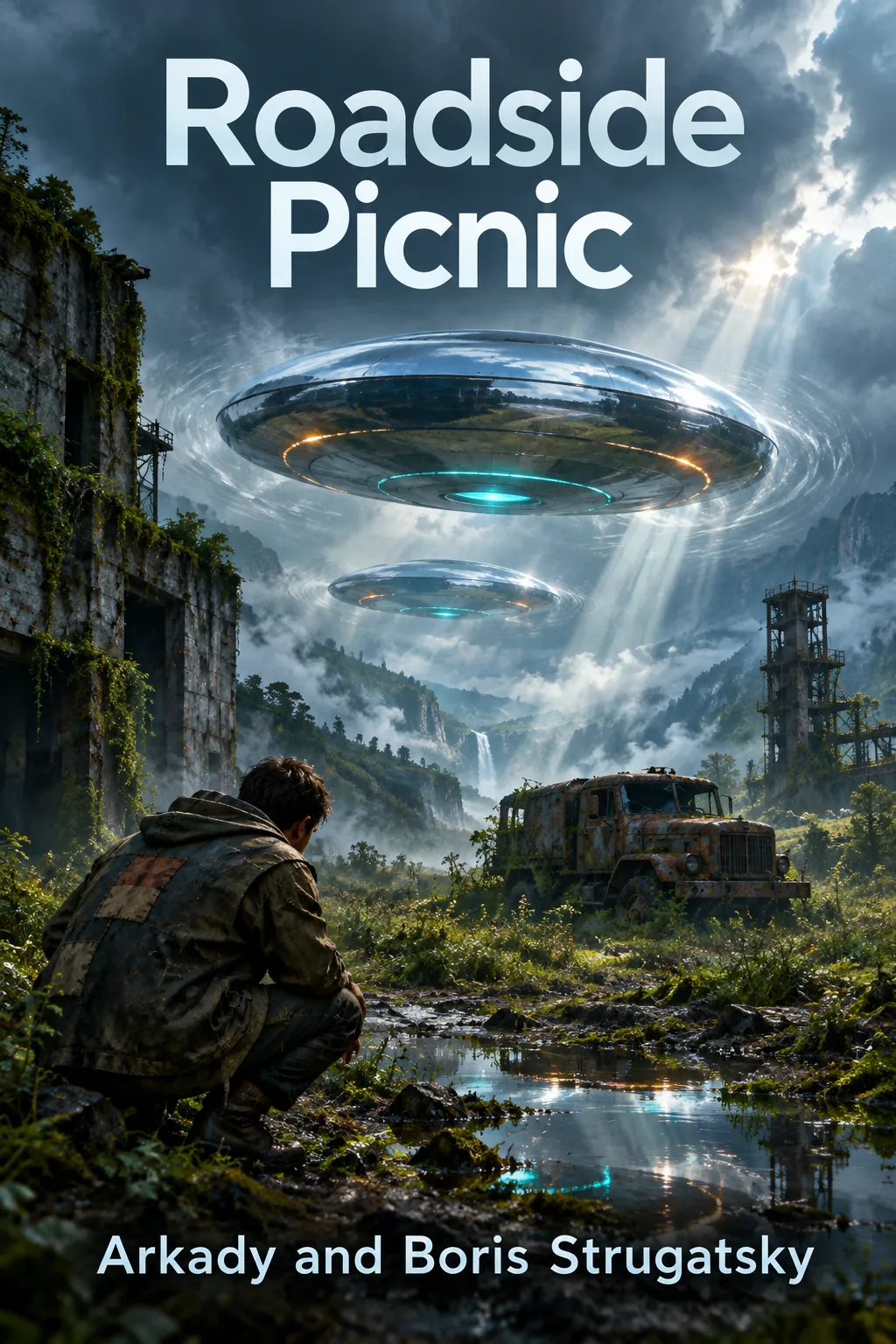
Roadside Picnic
by Arkady and Boris Strugatsky
Roadside Picnic is a 1972 Soviet science fiction novel about the world after aliens briefly visit Earth and leave without a word. Six Zones are left full of strange objects and deadly traps. Illegal scavengers called stalkers sneak in to haul out artifacts for money, while scientists, soldiers and criminals fight over the spoils. Through the stalker Redrick Schuhart, the Strugatsky brothers ask whether humans can understand something that never noticed them.
Try Audible · As an Amazon Associate we earn from qualifying purchases. Details
The Big Idea
"Visitors came, left, and abandoned rubbish we cannot understand. The novel asks what people do with a miracle that was never meant for them."
Key Insights
Indifference is harder to bear than hostility
The visitors neither attack humanity nor help it. In Pilman's picnic image people are animals beside a road, and the Zones may be nothing more than leftovers. Being ignored hurts human pride more than being hated, and it makes the Zone eerie and a little absurd at once.
Pilman's radio interview in the introduction.
People sell what they cannot understand
Nobody knows how the artifacts work, yet each gets a price. The Institute studies them, the military looks for weapons, and stalkers hunt for the best buyer. Faced with the unknown, people first reach for use and profit, not understanding. The book is quietly ironic about how science and technology move through money and power.
Red selling goods to buyers who want hell slime.
The Zone reaches into bodies and families
The danger is not limited to traps. Red's daughter slowly turns monkey-like and loses speech, and his dead father walks home from the cemetery. The Zone is supposed to be a place you stay out of, but its effects arrive in the kitchen. Those who pay are often the family and the next generation.
Red's daughter and his returned father.
Everyone near the Zone has two faces
Noonan is Red's friend and also a covert operative. Burbridge's weekend tours hide smuggling. Around the Zone no one can live with a single role. The Strugatskys show how loyalty, law and friendship pull against each other without preaching, and neither face is simply a lie.
Noonan's double role in Part 3.
Can people know what they want?
The Golden Sphere is said to grant wishes, but the book cares less about its power than about the person asking. Characters can name money, safety or comfort, yet few can state a real wish. A miracle is useless to someone who has never learned to hope for anything larger. The novel gives no easy answer.
The long walk toward the Golden Sphere in Part 4.
Chapter Breakdown
Chapter-by-chapter summary
Spoiler warning: this section covers the whole plot, including the ending.
The novel opens with a radio interview and then runs through four parts. Each part follows Red Schuhart at a different stage of his life beside the Zone, and the third part is told through his friend Noonan.
Introduction: The interview about the picnic
A radio interviewer talks to Dr. Valentine Pilman, the scientist who showed that the six Visitation Zones lie along a line pointing toward the star Deneb.
Pilman offers a famous picture: a family picnic leaves bottles and wrappers beside a road, and the animals who find them cannot guess what they were for.
The idea matters because it frames the whole book. Nobody in the story can prove that the Zones are a gift, a message or just litter.
Part 1: Red joins the Institute
Redrick “Red” Schuhart is a young stalker in Harmont, the town beside the Zone. He takes a legal job as a lab assistant at the International Institute of Extraterrestrial Cultures.
Red goes into the Zone with an official expedition to help his boss, and the man dies soon after they return. Back in town, he runs from a police raid carrying an artifact and then marries his pregnant girlfriend, Guta.
The Institute and the black market both live off the Zone, and Red belongs fully to neither. That tension drives the rest of the book.
The part also shows ordinary life carrying on beside a place that kills people for a living.
Part 2: Burbridge's legs and the hell slime
Red goes back to stalking, now as a family man who needs money. His partner Burbridge, an older stalker nicknamed the Vulture, loses both legs to “hell slime” in the Zone.
Red carries him out and gets him to a surgeon. Afterwards he sells artifacts to clients who want the slime, most likely for military research, and the deal ends with his arrest.
This part shows what the Zone does to bodies and how outside powers try to turn its dangers into weapons.
Part 3: Noonan's point of view
Part 3 is told through Red's old friend Richard Noonan, a supply contractor connected with the Institute. He turns out to be a covert operative whose job is to stop artifacts leaking out of the Zone.
His superior tells him the smuggling is worse than ever and orders him to find who is behind it. The trail leads to Burbridge's weekend “picnic” tours, a harmless-looking business that hides the illegal trade.
Noonan also visits Red after his release from prison. He finds him at home with Guta, their daughter, who is growing more and more like a monkey, and Red's dead father, who has come back from the cemetery to live in the house.
The part shows that even friendship has a second face near the Zone.
Part 4: The road to the Golden Sphere
Some time later Red is living at home with his family. His daughter has changed further, and his father is still there.
Red leads Burbridge's son, Arthur, into the Zone to reach the Golden Sphere, which is said to grant wishes. The way there is guarded by the “meatgrinder,” a trap that can only be passed if someone dies.
Red knows one of the two of them must be sacrificed, and he plans for it to be Arthur. Arthur is killed while wishing for a better world for everyone.
Alone before the Sphere, Red cannot name his own wish. In the end he repeats Arthur's words.
The ending is bitter and open: a man who could finally ask for anything discovers he has no words for what he wants.
Key terms of the Zone
- Visitation: the short, unexplained visit that created the six Zones.
- Stalker: an illegal guide and scavenger who enters a Zone to bring out artifacts.
- Artifact: any object left in the Zone, usually with a strange effect nobody can fully explain.
- Hell slime: a deadly substance that destroys flesh and attracts military buyers.
- Meatgrinder: a lethal trap on the route to the Golden Sphere.
Characters
Redrick “Red” Schuhart: the protagonist, a hard, experienced stalker who also works for a time as a lab assistant. He loves his family but keeps making ruthless choices to protect it.
Guta: Red's girlfriend and later wife. She keeps the baby against the odds, supports a dangerous household, and is worn down by her daughter's condition.
The Monkey: Red and Guta's daughter, nicknamed for her light body hair and black eyes. She gradually loses the ability to speak, a sign that the Zone's effects pass to the next generation.
Dr. Valentine Pilman: the scientist who maps the Zones along a line toward Deneb and offers the picnic comparison. He gives the book its central image of indifference.
Richard Noonan: Red's old friend, a supply contractor and secret operative against smuggling. He is the narrator of Part 3 and is torn between friendship and duty.
Burbridge: an older stalker nicknamed the Vulture, who loses his legs to hell slime. His weekend tours cover for smuggling.
Arthur Burbridge: Burbridge's young son, honest and hopeful. He follows Red toward the Golden Sphere without knowing what Red intends.
Red's father: a dead man who returns from the cemetery and lives at home again. He is one of the Zone's eeriest effects on ordinary life.
The Zone: not a person, but the book's true centre. It attracts, injures and enriches people while giving nothing back that anyone can understand.
Where the book comes from
The Strugatskys wrote the novel in 1971, and it first appeared in 1972 in the Soviet literary magazine Avrora.
Soviet censorship changed the text, and a later version based on Boris Strugatsky's restored text brought it closer to the original.
The first English edition came out in 1977, translated by Antonina W. Bouis, and a new translation by Olena Bormashenko followed in 2012.
The novel is also the starting point of Tarkovsky's 1979 film Stalker, which tells a very different story; this page covers the book only.
Writing about this book
Roadside Picnic suits an essay because it refuses to explain itself. You are free to argue what the Zones mean, and the text supports more than one answer.
Start from Pilman's picnic image and ask what it does to human pride.
If we are animals beside a road, what do science, the state and the family look like from outside?
Three angles work well:
- Red's choices: is he a victim of the Zone or a man who uses it, and where does the book judge him?
- The cost of exploitation: who pays when artifacts become goods, from Burbridge to Arthur to Red's daughter?
- The wish: why can no one in the novel say clearly what they want?
Pick one scene and quote at most a few words from your own edition. Say what the scene shows, then connect it to your argument about indifference, greed or hope.
Avoid retelling the plot. A strong answer treats the plot as evidence for a claim.
Read next
For the wider idea of meeting the unknown, see First contact (in fiction and science).
For another novel about something humans cannot understand, try Solaris.
Take Action
Practical steps you can implement today:
-
Ask who benefits when something is not understood, since the book shows how quickly confusion turns into trade.
-
When you cannot explain an event, resist the urge to say it was made for you.
-
Notice the double roles people play, and judge them by what they do, not by their label.
-
Practise naming what you truly want before someone offers to grant it.
Notable Quotes
"Introduction: Pilman compares the Visitation to a picnic whose leftovers baffle the animals that find them."
— Arkady and Boris Strugatsky
"Part 4: Arthur runs toward the Sphere calling out wishes for a better world for everyone."
— Arkady and Boris Strugatsky
"Part 4: Red cannot find a wish of his own and repeats Arthur's words."
— Arkady and Boris Strugatsky
Who Should Read This
Readers of about 15 and up who like thoughtful, slow science fiction will find it rewarding. It suits upper secondary and university students writing about alien contact, power or the cost of exploitation, and anyone who enjoys a plain, gritty adventure with a big question at its heart.
Frequently Asked Questions
What is Roadside Picnic about?
It follows Redrick Schuhart, a stalker who goes into a Zone left behind by an alien visit to bring out artifacts. The novel moves through four stages of his life and asks what humans do with a mystery they cannot understand.
What is a stalker in the book?
A stalker is an illegal guide and scavenger who crosses into a Zone to take out artifacts, then sells them. The job is deadly, because the Zone is full of unseen traps, and the word has no connection to the modern meaning of harassment.
What does the title Roadside Picnic mean?
It comes from Dr. Pilman's comparison of the visit to a picnic. People leave rubbish beside a road, and animals who find it cannot tell its purpose. The picture suggests the visitors may not have noticed humanity at all.
Is the novel the same as the film Stalker?
No. The 1979 film by Tarkovsky, for which the Strugatskys wrote the screenplay, is based on the book but tells a quite different story. The novel follows Red across several years, and later video games borrowed its setting.
Which English translation should I read?
Antonina W. Bouis translated the first English edition in 1977. Olena Bormashenko's translation of 2012 uses Boris Strugatsky's restored text and is generally the one to choose if you want the version closest to the original.
Check Your Understanding
Pick an answer for each question to see if you were right.
-
What does Dr. Pilman compare the Visitation to?
A picnic beside a road — Pilman likens the visit to a picnic whose leftovers confuse the animals who find them.
-
Who is the main character?
Redrick Schuhart — Redrick “Red” Schuhart is the stalker the novel follows most closely.
-
What do stalkers do?
Enter the Zone to bring out artifacts — Stalkers are illegal scavengers who take artifacts out of the Zone to sell.
-
How many Visitation Zones are there?
Six — The visit left six Zones along a line toward the star Deneb.
-
What is the Golden Sphere said to do?
Grant wishes — The Sphere is rumoured to fulfil wishes, which is why Red sets out to find it.
Want the full book?
Read or listen to Roadside Picnic in full.
Try Audible · As an Amazon Associate we earn from qualifying purchases. Details
About Arkady and Boris Strugatsky
Arkady Strugatsky (1925–1991) and Boris Strugatsky (1933–2012) were Soviet brothers who wrote science fiction together for decades. Arkady worked as a translator from Japanese and English, and Boris worked as an astronomer. Their novels used alien and future settings to ask hard questions about ethics, power and the state.
Summary Written By

Software Engineer & Writer
Software engineer with a passion for distilling complex ideas into actionable insights. Writes about finance, investment, entrepreneurship, and technology.
View all summaries →Reviews
No reviews yet. Be the first to share your thoughts!
Write a Review
Keep reading
Explore the topic: Science FictionSummaries

Out of My Mind
Sharon M. Draper
“Out of My Mind” by Sharon M. Draper is a poignant narrative that explores the life of Melody Brooks, a…

Ender’s Game
Orson Scott Card
“Ender’s Game” by Orson Scott Card is a riveting science fiction novel that transports readers into a future where humanity…

Pachinko
Min Jin Lee
“Pachinko”, a spellbinding multigenerational historical saga by Min Jin Lee, explores the lives of a Korean family trying to make…

The Perks of Being a Wallflower
Stephen Chbosky
The Perks of Being a Wallflower by Stephen Chbosky is a profound coming-of-age novel, told through the intimate letters of…
Articles

A Christmas Carol themes: generosity, isolation and responsibility
Dickens's novella is usually read as a story about a man who changes his mind. Its themes are sharper than…
Chinese Room Argument
The Chinese room argument is a thought experiment by philosopher John Searle, published in 1980. It says a computer that…
Books Like The Hunger Games: 10 Dystopian Novels
The best books like The Hunger Games are young-adult dystopias where a teenager fights a rigged system. This list picks…