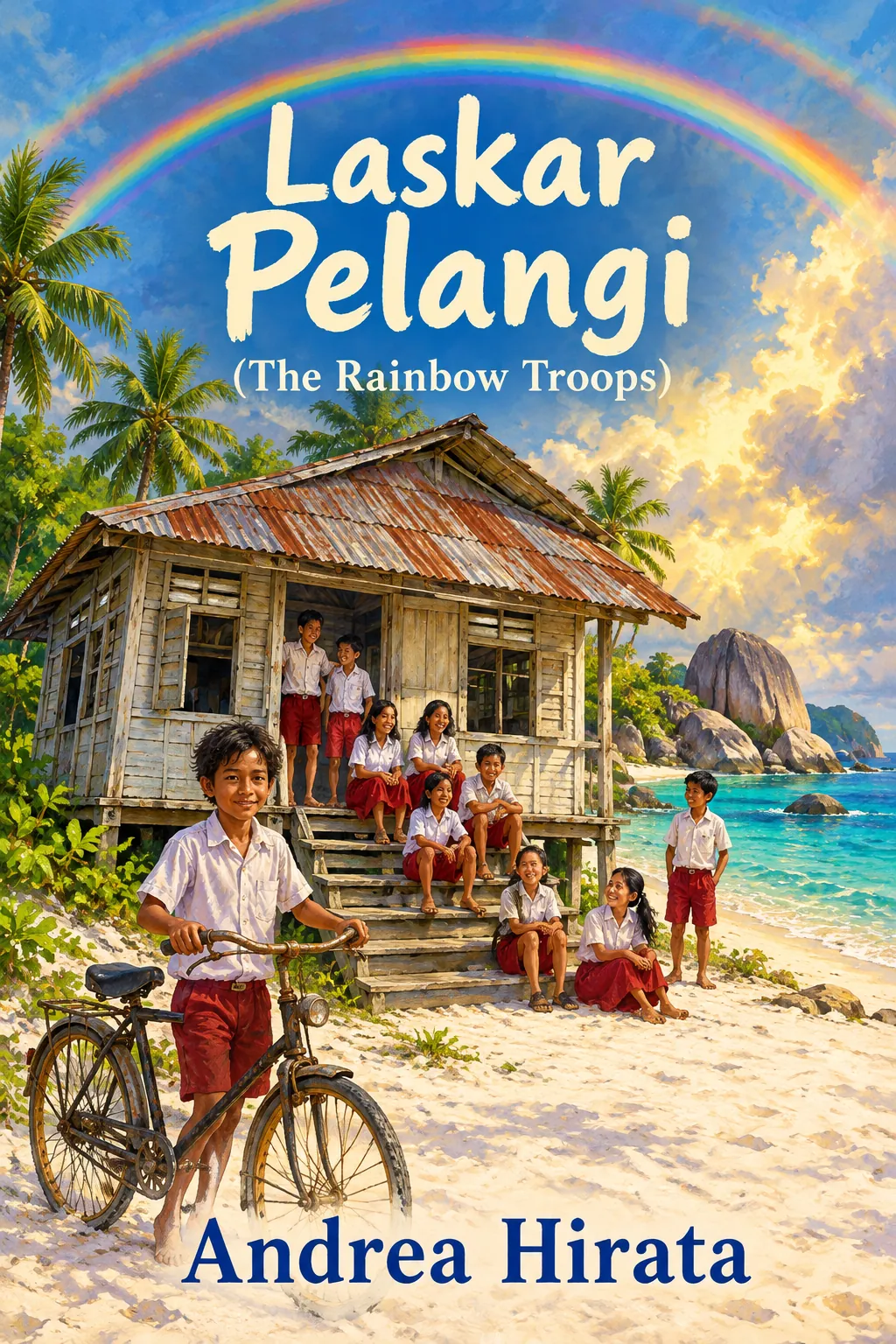
Laskar Pelangi (The Rainbow Troops)
by Andrea Hirata
Laskar Pelangi is a 2005 novel by Andrea Hirata about ten children in a poor village school run by the Muhammadiyah movement on Belitung island, Indonesia. Narrated by Ikal and set in the 1970s, it follows the children and their two devoted teachers, Bu Muslimah and Pak Harfan, as they keep the school open despite poverty and the shadow of the rich tin company school nearby. It is about friendship, the right to education and talent that grows in unlikely places.
The Big Idea
"Talent and dignity do not depend on money: with devoted teachers and loyal friends, even a crumbling school can show what poor children are capable of."
Key Insights
Education is a right, not a privilege
The novel puts two schools side by side to show that the difference between the children is not intelligence but resources. One school has money and facilities, the other has a leaning building and teachers who work almost for free. The book argues that every child deserves the chance to learn.
Lintang is the best pupil in the class, yet he is the one who must leave school.
Poverty wastes talent
Hirata shows that gifts appear in every home, but only some children are allowed to develop them. Lintang's skill at maths and Mahar's creativity would be lost without a school that believes in them. The book blames circumstances, not people, which makes its criticism gentle but strong.
After his father's death, Lintang leaves school even though he has just helped his team win.
Teachers who keep faith
Bu Muslimah and Pak Harfan are not famous or well paid, but their belief in the children makes the school survive. The novel treats teaching as a calling, not just a job. Pak Harfan values character above prizes, and the pupils learn this from him.
Pak Harfan waits anxiously on the first day until the tenth pupil arrives and the school can open.
Friendship across difference
The ten children are different in family, religion and talent, and the rainbow in the title is the image of that variety. They are stronger together than apart. The narrator's warmth shows that childhood friendship can shape a whole life.
The group comes to be known as the Laskar Pelangi because each pupil adds a different colour.
Chapter Breakdown
Chapter-by-chapter summary
Spoiler warning: this section covers the whole plot, including the ending.
The book has many short chapters, so this summary groups them into seven parts. The part labels are ours.
Part 1: Ten pupils and a leaning school
On the first day of school in a Belitung village, anxious parents and children gather at the Muhammadiyah elementary school. The school will be closed if it enrols fewer than ten pupils, and the headmaster, Pak Harfan, counts nervously until Harun arrives at the last moment.
The young teacher Bu Muslimah and Pak Harfan welcome the children into an old building that leans in the wind. Ikal, the narrator, says this is where his group of friends begins.
The scene is small, but it sets the tone: a whole community holds its breath over a single number. The children are nervous, the parents are hopeful, and the teachers hide their fear behind a smile.
Why it matters: the opening makes survival, not success, the first question of the story, and it introduces the two teachers who hold the school together.
Part 2: The ten children
Ikal introduces his classmates one by one, among them Lintang, Mahar, Kucai, Syahdan, A Kiong, Borek, Trapani, Sahara and Harun. They differ in religion, family and talent, yet they share one cramped classroom.
They come to be known as the Laskar Pelangi, the rainbow troops, a name tied to their delight in rainbows and to how different they are.
Each child gets a quick, funny sketch, so the reader learns the names the way a new pupil would, through habits and oddities. The humour makes the class feel like a real family before any trouble arrives.
Why it matters: the name turns difference into a strength, which is the book's gentlest argument.
Part 3: Two schools, two worlds
Belitung life is shaped by the state tin company. Its staff live in comfortable housing and send their children to a well-equipped company school, while the Muhammadiyah school has little more than courage.
Ikal describes the gap with humour, but the pain underneath is clear. The poor school has no proper resources and its teachers earn almost nothing.
The children notice the difference every day, in the buildings, the uniforms and the way the company families are treated in town. They do not yet have words for inequality, but they feel it.
Why it matters: the contrast between the two schools sets up the class divide that drives the rest of the story.
Part 4: Gifts, friendship and first love
Lintang, a fisherman's son who cycles a very long way every day, proves to be astonishing at mathematics and science. Mahar shows a gift for art and an interest in the mystical.
Ikal falls in love for the first time with A Ling, a girl he meets at a shop in town. Flo, a girl from the company school, later joins the class, which shows that the divide can be crossed.
These chapters mix comedy and tenderness, from awkward crushes to long afternoons of friends learning from each other. Teachers and pupils grow closer as the class finds its identity.
Why it matters: the chapters give each friend a talent and a feeling, so the later victories and losses feel personal.
Part 5: The carnival and the death of Pak Harfan
At the school carnival, Mahar's imagination helps the class stage a performance that surprises the crowd.
Soon afterwards, Pak Harfan dies. The headmaster who guided the school from its first day is gone, and the grief falls on teachers and pupils alike.
Hirata keeps the tone quiet here, with no villain to blame. The reader is left alone with the sadness, which makes it stronger.
Why it matters: the school loses its moral centre just as it begins to shine, which raises what is at stake in the contest that follows.
Part 6: The contest and Lintang's departure
In the academic contest, Ikal, Lintang and Mahar face the favoured company school. Lintang's quick mind carries the Muhammadiyah team to a win that nobody expected.
On the day of that victory, Lintang's father, a fisherman, dies. Lintang must leave school to support his family, and the brightest pupil in the class is lost just as the school wins.
The victory belongs to the whole class and to the teachers who believed in them, yet it is followed at once by a quiet, painful loss. Nobody is to blame, and that is what makes it sting.
Why it matters: these chapters turn the comedy into a quiet criticism, since talent alone could not protect Lintang from poverty.
Part 7: The rainbow scatters
The children finish school and go in different directions. Ikal looks back with love and sadness at what the group shared.
Lintang does not become the scientist his friends once imagined, and the book lets this hurt. Ikal's own journey continues in the sequels.
The ending is not a tidy reward for hard work. It is a memory, held together by affection and by a question about what the children might have been.
Why it matters: the ending asks the reader who is responsible for children like Lintang.
Setting and context
The story takes place on Belitung, an island in Indonesia long known for tin mining. The state tin company shaped daily life there, from housing to schooling, and that background explains the gap between the two schools.
Muhammadiyah is an Islamic education and social movement that runs many schools across Indonesia. In the novel its small village school depends on volunteers and community effort rather than on money.
The author grew up on Belitung, and the book blends childhood memory with fiction. That is why it is useful for both intrinsic and extrinsic analysis.
Characters
Ikal is the narrator and an ordinary boy with curly hair. He tells the story with humour and deep affection.
Lintang is the brilliant fisherman's son who cycles to school every day. He shows what talent can do and what poverty can take away.
Mahar is the creative member of the group. He leads with imagination and a love of art and the unseen.
Bu Muslimah is the young, devoted teacher who stays when others would leave. She teaches with patience and belief in her pupils.
Pak Harfan is the headmaster who keeps the school alive. He cares more about character than about winning.
A Ling is Ikal's first love. She stands for the first feelings of growing up and for the town's mixed communities.
Kucai, Syahdan, A Kiong, Borek, Trapani and Sahara round out the class with their own quirks and ambitions. They make the group feel like a real, noisy school year rather than a pair of heroes with extras.
Harun is the gentle tenth pupil whose arrival saves the school. Flo comes from the company school and shows that friendship can cross the divide.
Writing about this book
Most Indonesian school tasks ask for unsur intrinsik (theme, plot, characters, setting, point of view, style, message), tokoh dan penokohan, amanat or a resensi (review). Start from one clear claim, such as the novel's argument that talent is everywhere but opportunity is not.
For theme, link the school gap and Lintang's story. For setting, use Belitung in the 1970s and the tin company.
For point of view, notice that Ikal tells the story in the first person, with warm humour.
For penokohan, separate what the narrator says about a character from what the character does. For a resensi, name the book, author and publisher, summarise without the ending, then judge the strengths and weaknesses and say who should read it.
Keep quotes short and give the part of the story where they come from. Use the model answers below as examples to compare with your own work, not to copy.
Take Action
Practical steps you can implement today:
-
Look for talent in unexpected places, because ability is not decided by family income.
-
Value the teachers and mentors who believe in you, even when they have little to give.
-
Work as a group: different strengths make a team stronger.
-
Treat education as something to protect and share, not just something to win with.
Notable Quotes
"“Tahun lalu SD Muhammadiyah hanya mendapatkan sebelas siswa, dan tahun ini Pak Harfan pesimis dapat memenuhi target sepuluh.” (Chapter 1, “Sepuluh Murid Baru”. Gloss: last year the school got only eleven pupils, and this year Pak Harfan doubts it can reach ten.)"
— Andrea Hirata
"“Genap sepuluh orang …” (Pak Harfan when Harun arrives, Chapter 1, “Sepuluh Murid Baru”. Gloss: exactly ten people.)"
— Andrea Hirata
"“Bagi Lintang, kota kecamatan, tempat sekolah kami ini, adalah metropolitan yang harus ditempuh dengan sepeda sejak subuh.” (Chapter 2, “Antediluvium”. Gloss: for Lintang, the district town where our school stands is a metropolis he must reach by bicycle from dawn.)"
— Andrea Hirata
Who Should Read This
Students in junior and senior high school who study Indonesian literature, especially those preparing analisis unsur intrinsik, tokoh dan penokohan or a resensi. Readers from about age 13 will enjoy the humour, and adults will find the criticism of unequal schooling worth thinking about.
Characters
Ikal
narrator and protagonist
Ikal is a curly-haired boy who tells the story as an adult looking back. His humour and affection frame the whole book, and his first love for A Ling gives it a tender thread.
Lintang
brilliant classmate and tragic figure
Lintang is a fisherman's son who rides a long way to school each day and is outstanding at mathematics. His forced departure from school is the most painful part of the book.
Mahar
artistic friend
Mahar is imaginative, creative and drawn to the mystical. His ideas help the class shine at the school carnival.
Bu Muslimah
devoted teacher
Bu Muslimah is the young teacher who stays with the school despite low pay and poor conditions. Her patience and belief in her pupils are the heart of the book.
Pak Harfan
headmaster and moral guide
Pak Harfan keeps the school open and teaches the children that character matters more than winning. His worry on the first day, when he counts pupils, shows how fragile the school is.
A Ling
first love
A Ling is the girl Ikal falls for after meeting her at a shop in town. She stands for the first feelings of growing up and for the mixed communities of Belitung.
Flo
classmate from the company school
Flo comes from the wealthier company school and joins the class later. Her move shows that the divide between rich and poor children can be crossed.
Harun
the tenth pupil
Harun is an older, gentle boy who arrives just in time to make the tenth pupil. Without him the school would have closed on the first day.
Exam practice: sample answers
Model answers are examples to learn from; write your own in your words.
character analysis
1. Analyse the characterisation of Lintang in Laskar Pelangi. What does his story say about education and poverty?
Outline
- State what Lintang represents.
- Show his talent and determination with scenes.
- Explain how his poverty shapes his fate.
- Link to the novel's message and conclude.
Basic Model answer
Lintang is one of the most important characters in Laskar Pelangi. He is a very clever boy from a poor fishing family who goes to the Muhammadiyah school.
The author shows that he is clever by telling us he understands maths and science faster than everyone else. He cycles a very long way to school every day, which shows that he is hardworking and wants to learn.
However, Lintang is poor. When his father dies, he has to leave school and work to help his family.
This is sad because he could have had a bright future. The message is that talent needs a chance, so every child should have the right to go to school.
Good Model answer
Lintang is presented as a gifted child whose brilliance is set against his poverty, and this contrast drives the novel's argument about education.
First, the narrator Ikal shows Lintang's talent through action. Lintang solves problems that puzzle others, and in the school competition he helps the team beat the privileged team from the tin company school.
His long daily bicycle ride to school, which Ikal describes in detail, shows determination as well as intelligence.
Second, his background explains why his story matters. He is a fisherman's son who lives far from school with no money for books or for a better school.
Unlike the company children, he has no safety net, so when his father dies he must leave the classroom and earn a living.
This end to his schooling is the sharpest moment of characterisation. It turns a hopeful story of a clever boy into a criticism of a society that wastes talent because of money.
Hirata also uses Ikal's admiring point of view, so the reader feels the loss more strongly.
In conclusion, Lintang is both a hero and a warning: the novel shows that talent is everywhere, but only opportunity lets it grow.
Excellent Model answer
In Laskar Pelangi, Andrea Hirata builds Lintang as the book's clearest proof that talent is spread evenly across society while opportunity is not. Through his brilliance, his journey to school and his forced departure, the novel argues that poverty, not ability, decides who gets an education.
Hirata first establishes Lintang through admiration. Ikal, the first-person narrator, describes his friend with awe and comic exaggeration, so that Lintang becomes almost a legend in the class.
This is indirect characterisation: we learn about him from how others react to his speed of thought, not only from what the narrator claims.
Second, the setting shapes the character. The long road, the coast and the fishing village are not background; they measure his commitment.
The distance he covers each day is the physical form of his hunger for knowledge.
Third, his intelligence is tested in public. In the academic contest, his quick reasoning helps defeat the favoured team, which turns a private gift into a public victory for the poor Muhammadiyah school.
His triumph belongs to Bu Muslimah, Pak Harfan and his classmates as well.
The most important move comes when his schooling ends. After his father dies, Lintang leaves to support his family.
The scene is painful because it is quiet: there is no villain, only circumstances. Hirata therefore shifts the target of criticism from individuals to a system in which a child's future depends on family income.
It would be too simple to read Lintang only as a victim. His dignity and his influence on Ikal show that learning leaves a mark even when formal schooling ends.
Still, the narrator's sadness prevents the reader from calling the outcome fair.
In conclusion, Lintang works as both a character and an argument. Through admiration, setting and loss, Hirata shows that education is a matter of justice, and that a society which ignores this wastes its brightest children.
Marking rubric
- Clear thesis about Lintang's role.
- Specific scenes as evidence.
- Analysis of narrator and setting.
- Link to the message about education.
- Controlled conclusion.
Now write your own
Now write your own answer about another character, such as Mahar or Bu Muslimah, and compare your structure with the three levels above.
literary argument
2. Write an argumentative essay: 'Every child deserves a good education, whatever the family's income.' Use Laskar Pelangi as your main example.
Outline
- State your position.
- Argument 1: the gap between the schools.
- Argument 2: what teachers and talent can do.
- Argument 3: the cost of leaving Lintang behind.
- Answer one objection and conclude.
Basic Model answer
I agree that every child deserves a good education, whatever the family's income. Laskar Pelangi shows why.
In the novel, ten poor children study in a school that is almost falling down. They have few books and little money, while the children of the tin company go to a school with better buildings and equipment.
Still, the poor children are not less clever. Lintang is a genius and Mahar is very creative.
When they get a chance in the school competitions, they do very well.
This shows that talent does not depend on money. So society should help all schools, not only rich ones.
Teachers like Bu Muslimah also deserve support because they work hard for little pay. In conclusion, education should be for everyone.
Good Model answer
Education should be a right for every child and not a privilege of the rich. Andrea Hirata's Laskar Pelangi supports this view with the story of a poor village school on Belitung.
First, the novel shows an unfair gap. The Muhammadiyah school has a weak building, few resources and hardly enough pupils to stay open, while the tin company's school next door has what it needs.
The children do not differ in ability, only in how much money stands behind them.
Second, the story proves that poor children can succeed when someone believes in them. Bu Muslimah and Pak Harfan give time and care for little reward, and their pupils repay them by winning against the favoured team in the school contest.
Lintang's talent for maths and Mahar's creativity are signs of potential in every village.
Third, the book shows the cost of ignoring this. When Lintang's father dies, he must leave school even though he is the best pupil, and his loss is a loss for the whole community.
Some people may argue that families, not society, are responsible for schooling. However, a child cannot choose his parents' income, so a fair society must give every child the same chance.
In conclusion, Laskar Pelangi presents good education as a matter of justice. The ten children show what happens when talent and good teaching meet, and Lintang shows what happens when they do not.
Excellent Model answer
The claim that every child deserves a good education, whatever the family's income, is easy to accept in theory and hard to apply in practice. Andrea Hirata's Laskar Pelangi turns the claim into a concrete case, showing that the real injustice is not that poor children are less able but that their ability is left to chance.
The novel's first argument is structural. In Belitung two schools stand close together: the Muhammadiyah school, which risks closing if it cannot find ten pupils, and the tin company's school, which has money and prestige.
Because the children live in the same place, the difference in their schooling cannot be blamed on geography or culture. It is a difference of resources.
The second argument concerns teachers. Bu Muslimah and Pak Harfan have almost nothing except belief in their pupils, yet that faith produces results.
At the school carnival Mahar's imagination helps the class surprise everyone with its performance, and later Lintang, Ikal and Mahar win the academic contest against better-funded rivals.
The novel suggests that money buys facilities, but good teaching and trust can compete with it. It does not romanticise this sacrifice, though: teachers should not have to be heroes for children to learn.
The third argument is the cost of failure. Lintang, the most gifted pupil, leaves school when his father dies.
If the contest showed that poverty can be overcome, his departure shows how rarely it is.
A fair objection is that individual effort matters more than outside help, and the novel does celebrate determination, for instance in Lintang's long daily ride. However, effort has limits.
A child can cycle to school but not cycle out of his father's death.
The book therefore supports a balanced position: effort is necessary, but a just society must make sure effort has somewhere to go.
In conclusion, Laskar Pelangi supports equal access to education by showing both the success and the loss that follow from an unequal system. Its force comes from refusing easy answers: the school survives only because adults sacrifice, and the brightest child still leaves.
Marking rubric
- Clear position on the question.
- Three developed arguments with evidence from the novel.
- A counter-argument that is answered.
- Logical structure and a controlled conclusion.
Now write your own
Write your own argumentative essay on a different statement, for example 'Teachers matter more than buildings', and use two scenes from the book.
Frequently Asked Questions
What is Laskar Pelangi about?
It is about ten poor children and their two teachers at a Muhammadiyah elementary school on Belitung island in the 1970s. The story follows their friendships, talents and struggle to keep the school open against poverty and the more privileged company school.
Who wrote Laskar Pelangi and when?
Andrea Hirata wrote it and it was published in 2005. It is his first novel and the first of a four-book series that continues with Sang Pemimpi, Edensor and Maryamah Karpov.
What are the themes of Laskar Pelangi?
The main themes are the right to education, social inequality, friendship, dedicated teaching and the waste of talent through poverty. Hope and humour run through all of them.
What is the message (amanat) of Laskar Pelangi?
The message is that every child deserves the chance to learn, and that determination, good teachers and friends can help children overcome hardship. It also reminds readers that society must not waste talent because of money.
Who is the narrator?
The narrator is Ikal, one of the ten pupils, who tells the story in the first person as an adult looking back. The viewpoint gives the book its warmth and humour.
Check Your Understanding
Pick an answer for each question to see if you were right.
-
Who wrote Laskar Pelangi?
Andrea Hirata — Andrea Hirata published the novel in 2005.
-
On which island is the story set?
Belitung — The story takes place in a village on Belitung island.
-
How many pupils does the school need to stay open?
Ten — The school is closed if fewer than ten pupils enrol, so the tenth pupil matters.
-
Who is the brilliant fisherman's son who cycles to school?
Lintang — Lintang is the gifted pupil whose long ride to school shows his determination.
-
What does the story criticise most?
Unequal access to education — The novel shows how poverty can stop talented children from continuing school.
About Andrea Hirata
Andrea Hirata (born 1967) is an Indonesian novelist from the village of Gantong on Belitung island. He studied economics at the University of Indonesia and later studied in Europe on a scholarship. Laskar Pelangi was his debut novel and one of the best-selling books in Indonesian publishing. It began a four-book series that continues with Sang Pemimpi, Edensor and Maryamah Karpov.
Summary Written By

Software Engineer & Writer
Software engineer with a passion for distilling complex ideas into actionable insights. Writes about finance, investment, entrepreneurship, and technology.
View all summaries →Reviews
No reviews yet. Be the first to share your thoughts!
Write a Review
Keep reading
Explore the topic: Study GuidesSummaries

Animal Farm by George Orwell
George Orwell
The animals of Manor Farm revolt against their human owner to create a utopian society based on equality. However, the…

The Outsiders by S.E. Hinton
S.E. Hinton
Ponyboy Curtis and his gang of Greasers clash with the wealthy Socs in a cycle of violence. After a tragic…

The Great Gatsby by F. Scott Fitzgerald
F. Scott Fitzgerald
Nick Carraway enters the orbit of Jay Gatsby, a mysterious millionaire obsessed with reclaiming his past love, Daisy Buchanan. Amidst…

Of Mice and Men by John Steinbeck
John Steinbeck
George and Lennie, two migrant workers during the Great Depression, dream of owning their own land to escape a life…
Articles

Kyotsu Test Japanese (共通テスト国語): Time Plan and Strategy
The Kyotsu Test Japanese paper is a 90-minute, 200-point multiple-choice exam with five sections: three modern-text sections, classical Japanese and…

How to Write a Literary Analysis Essay
A literary analysis essay argues one clear claim about how a text works and proves it with short quotations and…

The Tale of the Bamboo Cutter
The Tale of the Bamboo Cutter (Taketori Monogatari) tells of Princess Kaguya, a girl found inside a glowing bamboo stalk,…