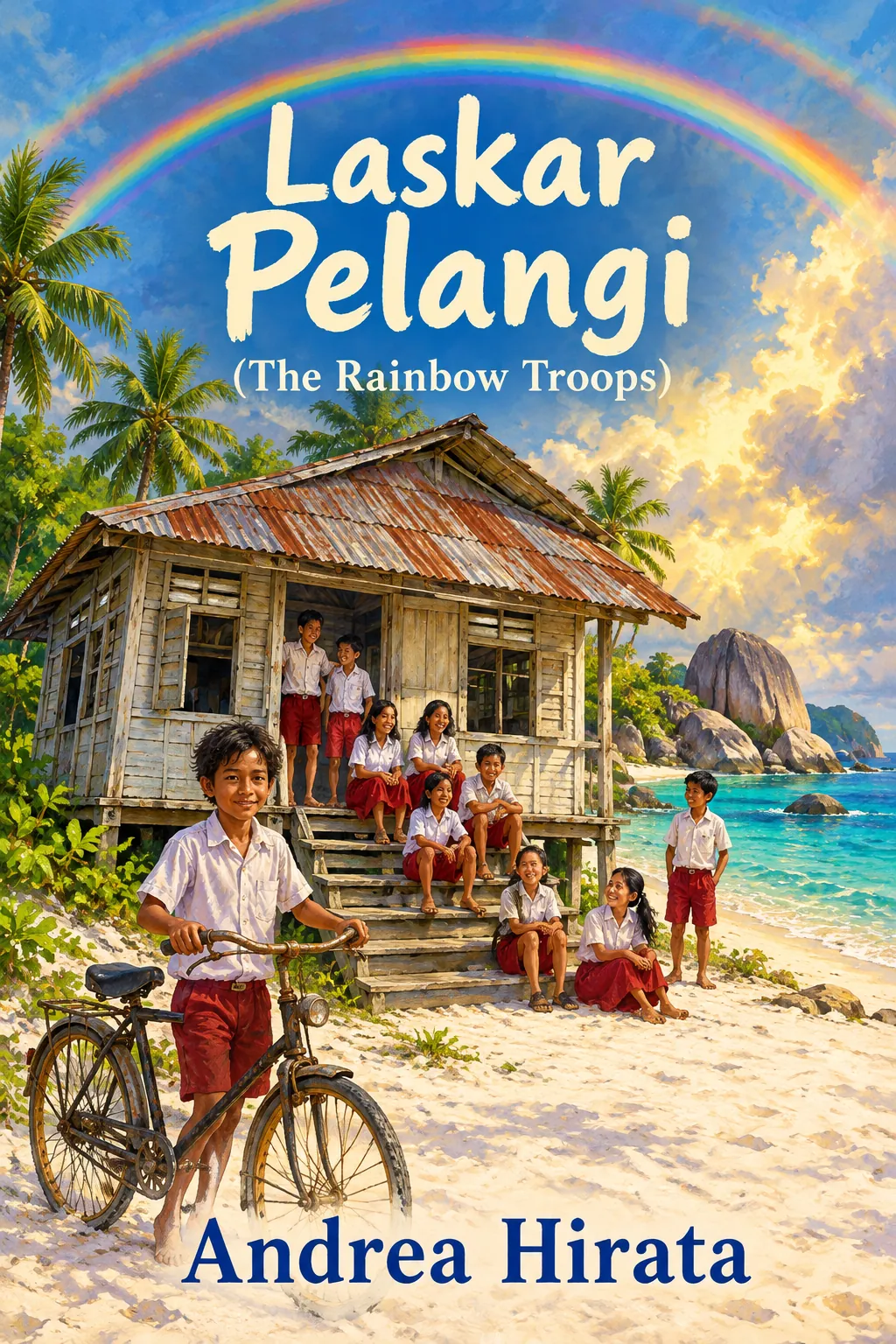
Laskar Pelangi (The Rainbow Troops)
par Andrea Hirata
Laskar Pelangi is a 2005 novel by Andrea Hirata about ten children in a poor village school run by the Muhammadiyah movement on Belitung island, Indonesia. Narrated by Ikal and set in the 1970s, it follows the children and their two devoted teachers, Bu Muslimah and Pak Harfan, as they keep the school open despite poverty and the shadow of the rich tin company school nearby. It is about friendship, the right to education and talent that grows in unlikely places.
L'idée principale
"Talent and dignity do not depend on money: with devoted teachers and loyal friends, even a crumbling school can show what poor children are capable of."
Aperçus clés
Education is a right, not a privilege
The novel puts two schools side by side to show that the difference between the children is not intelligence but resources. One school has money and facilities, the other has a leaning building and teachers who work almost for free. The book argues that every child deserves the chance to learn.
Lintang is the best pupil in the class, yet he is the one who must leave school.
Poverty wastes talent
Hirata shows that gifts appear in every home, but only some children are allowed to develop them. Lintang's skill at maths and Mahar's creativity would be lost without a school that believes in them. The book blames circumstances, not people, which makes its criticism gentle but strong.
After his father's death, Lintang leaves school even though he has just helped his team win.
Teachers who keep faith
Bu Muslimah and Pak Harfan are not famous or well paid, but their belief in the children makes the school survive. The novel treats teaching as a calling, not just a job. Pak Harfan values character above prizes, and the pupils learn this from him.
Pak Harfan waits anxiously on the first day until the tenth pupil arrives and the school can open.
Friendship across difference
The ten children are different in family, religion and talent, and the rainbow in the title is the image of that variety. They are stronger together than apart. The narrator's warmth shows that childhood friendship can shape a whole life.
The group comes to be known as the Laskar Pelangi because each pupil adds a different colour.
Détail des chapitres
Chapter-by-chapter summary
Spoiler warning: this section covers the whole plot, including the ending.
The book has many short chapters, so this summary groups them into seven parts. The part labels are ours.
Part 1: Ten pupils and a leaning school
On the first day of school in a Belitung village, anxious parents and children gather at the Muhammadiyah elementary school. The school will be closed if it enrols fewer than ten pupils, and the headmaster, Pak Harfan, counts nervously until Harun arrives at the last moment.
The young teacher Bu Muslimah and Pak Harfan welcome the children into an old building that leans in the wind. Ikal, the narrator, says this is where his group of friends begins.
The scene is small, but it sets the tone: a whole community holds its breath over a single number. The children are nervous, the parents are hopeful, and the teachers hide their fear behind a smile.
Why it matters: the opening makes survival, not success, the first question of the story, and it introduces the two teachers who hold the school together.
Part 2: The ten children
Ikal introduces his classmates one by one, among them Lintang, Mahar, Kucai, Syahdan, A Kiong, Borek, Trapani, Sahara and Harun. They differ in religion, family and talent, yet they share one cramped classroom.
They come to be known as the Laskar Pelangi, the rainbow troops, a name tied to their delight in rainbows and to how different they are.
Each child gets a quick, funny sketch, so the reader learns the names the way a new pupil would, through habits and oddities. The humour makes the class feel like a real family before any trouble arrives.
Why it matters: the name turns difference into a strength, which is the book's gentlest argument.
Part 3: Two schools, two worlds
Belitung life is shaped by the state tin company. Its staff live in comfortable housing and send their children to a well-equipped company school, while the Muhammadiyah school has little more than courage.
Ikal describes the gap with humour, but the pain underneath is clear. The poor school has no proper resources and its teachers earn almost nothing.
The children notice the difference every day, in the buildings, the uniforms and the way the company families are treated in town. They do not yet have words for inequality, but they feel it.
Why it matters: the contrast between the two schools sets up the class divide that drives the rest of the story.
Part 4: Gifts, friendship and first love
Lintang, a fisherman's son who cycles a very long way every day, proves to be astonishing at mathematics and science. Mahar shows a gift for art and an interest in the mystical.
Ikal falls in love for the first time with A Ling, a girl he meets at a shop in town. Flo, a girl from the company school, later joins the class, which shows that the divide can be crossed.
These chapters mix comedy and tenderness, from awkward crushes to long afternoons of friends learning from each other. Teachers and pupils grow closer as the class finds its identity.
Why it matters: the chapters give each friend a talent and a feeling, so the later victories and losses feel personal.
Part 5: The carnival and the death of Pak Harfan
At the school carnival, Mahar's imagination helps the class stage a performance that surprises the crowd.
Soon afterwards, Pak Harfan dies. The headmaster who guided the school from its first day is gone, and the grief falls on teachers and pupils alike.
Hirata keeps the tone quiet here, with no villain to blame. The reader is left alone with the sadness, which makes it stronger.
Why it matters: the school loses its moral centre just as it begins to shine, which raises what is at stake in the contest that follows.
Part 6: The contest and Lintang's departure
In the academic contest, Ikal, Lintang and Mahar face the favoured company school. Lintang's quick mind carries the Muhammadiyah team to a win that nobody expected.
On the day of that victory, Lintang's father, a fisherman, dies. Lintang must leave school to support his family, and the brightest pupil in the class is lost just as the school wins.
The victory belongs to the whole class and to the teachers who believed in them, yet it is followed at once by a quiet, painful loss. Nobody is to blame, and that is what makes it sting.
Why it matters: these chapters turn the comedy into a quiet criticism, since talent alone could not protect Lintang from poverty.
Part 7: The rainbow scatters
The children finish school and go in different directions. Ikal looks back with love and sadness at what the group shared.
Lintang does not become the scientist his friends once imagined, and the book lets this hurt. Ikal's own journey continues in the sequels.
The ending is not a tidy reward for hard work. It is a memory, held together by affection and by a question about what the children might have been.
Why it matters: the ending asks the reader who is responsible for children like Lintang.
Setting and context
The story takes place on Belitung, an island in Indonesia long known for tin mining. The state tin company shaped daily life there, from housing to schooling, and that background explains the gap between the two schools.
Muhammadiyah is an Islamic education and social movement that runs many schools across Indonesia. In the novel its small village school depends on volunteers and community effort rather than on money.
The author grew up on Belitung, and the book blends childhood memory with fiction. That is why it is useful for both intrinsic and extrinsic analysis.
Characters
Ikal is the narrator and an ordinary boy with curly hair. He tells the story with humour and deep affection.
Lintang is the brilliant fisherman's son who cycles to school every day. He shows what talent can do and what poverty can take away.
Mahar is the creative member of the group. He leads with imagination and a love of art and the unseen.
Bu Muslimah is the young, devoted teacher who stays when others would leave. She teaches with patience and belief in her pupils.
Pak Harfan is the headmaster who keeps the school alive. He cares more about character than about winning.
A Ling is Ikal's first love. She stands for the first feelings of growing up and for the town's mixed communities.
Kucai, Syahdan, A Kiong, Borek, Trapani and Sahara round out the class with their own quirks and ambitions. They make the group feel like a real, noisy school year rather than a pair of heroes with extras.
Harun is the gentle tenth pupil whose arrival saves the school. Flo comes from the company school and shows that friendship can cross the divide.
Writing about this book
Most Indonesian school tasks ask for unsur intrinsik (theme, plot, characters, setting, point of view, style, message), tokoh dan penokohan, amanat or a resensi (review). Start from one clear claim, such as the novel's argument that talent is everywhere but opportunity is not.
For theme, link the school gap and Lintang's story. For setting, use Belitung in the 1970s and the tin company.
For point of view, notice that Ikal tells the story in the first person, with warm humour.
For penokohan, separate what the narrator says about a character from what the character does. For a resensi, name the book, author and publisher, summarise without the ending, then judge the strengths and weaknesses and say who should read it.
Keep quotes short and give the part of the story where they come from. Use the model answers below as examples to compare with your own work, not to copy.
Passer à l'action
Étapes pratiques à mettre en œuvre dès aujourd'hui :
-
Look for talent in unexpected places, because ability is not decided by family income.
-
Value the teachers and mentors who believe in you, even when they have little to give.
-
Work as a group: different strengths make a team stronger.
-
Treat education as something to protect and share, not just something to win with.
Citations notables
"“Tahun lalu SD Muhammadiyah hanya mendapatkan sebelas siswa, dan tahun ini Pak Harfan pesimis dapat memenuhi target sepuluh.” (Chapter 1, “Sepuluh Murid Baru”. Gloss: last year the school got only eleven pupils, and this year Pak Harfan doubts it can reach ten.)"
— Andrea Hirata
"“Genap sepuluh orang …” (Pak Harfan when Harun arrives, Chapter 1, “Sepuluh Murid Baru”. Gloss: exactly ten people.)"
— Andrea Hirata
"“Bagi Lintang, kota kecamatan, tempat sekolah kami ini, adalah metropolitan yang harus ditempuh dengan sepeda sejak subuh.” (Chapter 2, “Antediluvium”. Gloss: for Lintang, the district town where our school stands is a metropolis he must reach by bicycle from dawn.)"
— Andrea Hirata
À qui s'adresse ce texte
Students in junior and senior high school who study Indonesian literature, especially those preparing analisis unsur intrinsik, tokoh dan penokohan or a resensi. Readers from about age 13 will enjoy the humour, and adults will find the criticism of unequal schooling worth thinking about.
À propos de Andrea Hirata
Andrea Hirata (born 1967) is an Indonesian novelist from the village of Gantong on Belitung island. He studied economics at the University of Indonesia and later studied in Europe on a scholarship. Laskar Pelangi was his debut novel and one of the best-selling books in Indonesian publishing. It began a four-book series that continues with Sang Pemimpi, Edensor and Maryamah Karpov.
Résumé écrit par

Software Engineer & Writer
Software engineer with a passion for distilling complex ideas into actionable insights. Writes about finance, investment, entrepreneurship, and technology.
Voir tous les résumés →Avis
Pas encore d'avis. Soyez le premier à partager vos impressions !
Écrire un avis
Continuer la lecture
Explorer le thème: Guides d’étudeRésumés

La Ferme des animaux de George Orwell — Résumé & Analyse
George Orwell
Les animaux de la Ferme du Manoir se révoltent contre M. Jones pour créer une société utopique basée sur l'égalité.…
outsiders (S.E. Hinton)
S.E. Hinton
L'histoire suit Ponyboy Curtis et son gang, les Greasers, dans leur conflit violent avec les Socs, les jeunes riches de…

Gatsby le Magnifique de F. Scott Fitzgerald — Résumé & Analyse
F. Scott Fitzgerald
Narré par Nick Carraway, le roman suit Jay Gatsby, un millionnaire mystérieux qui tente de reconquérir son ancien amour, Daisy…

Des souris et des hommes par John Steinbeck
John Steinbeck
L'histoire suit George et Lennie, deux ouvriers agricoles itinérants pendant la Grande Dépression. Ensemble, ils rêvent de posséder leur propre…
Articles

Le Conte du coupeur de bambou (Taketori Monogatari)
Le Conte du coupeur de bambou (Taketori Monogatari) raconte l'histoire de la princesse Kaguya, une fillette trouvée dans une tige…

Ragnarök : la fin des dieux nordiques
Le Ragnarök est la fin du monde dans la mythologie nordique : une bataille finale où dieux, géants et monstres…

Narcisse et Écho
Narcisse et Écho est un mythe grec : un bel adolescent tombe amoureux de son propre reflet, tandis qu'une nymphe…