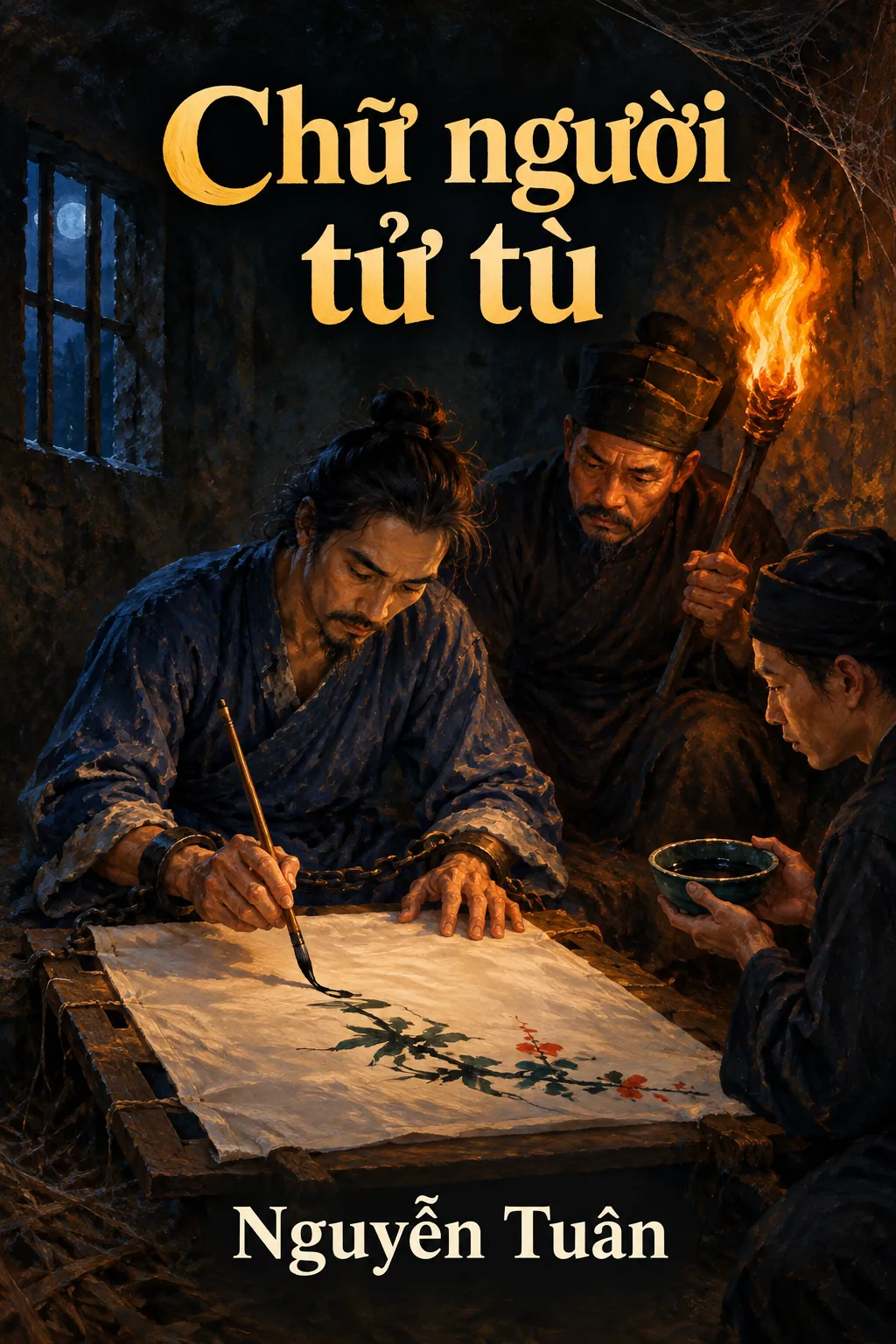
Chữ người tử tù
by Nguyễn Tuân
Chữ người tử tù is a short story by Nguyễn Tuân, first printed in 1939 and collected in 1940, set in a provincial prison in old Vietnam. A warden who loves fine calligraphy learns that the greatest calligrapher of his age, the rebel Huấn Cao, is arriving as a death-row prisoner. The warden, a decent man inside a rotten system, wants just a few written characters from a prisoner who bows to no power. The story asks what beauty is worth, and what it asks of the people who love it.
The Big Idea
"A condemned rebel and a prison warden meet over calligraphy, and the story argues that beauty and a pure conscience (thiên lương) can survive, and even grow, in the foulest place."
Key Insights
Beauty and goodness belong together
Huấn Cao refuses to write for people who only want to own his art. He gives it to someone who understands what it means, and then he insists that beauty must not live next to crime and corruption. For Nguyễn Tuân, a person with a fine eye also needs a clean heart. Art is not a decoration but a test of character.
Huấn Cao tells the warden to leave the prison and keep his conscience whole before he collects any more calligraphy.
Thiên lương survives in unlikely places
Thiên lương means a person's inborn goodness, the clear conscience at the centre of the self. The story places it in a prison warden, a man the reader expects to be hardened. His job is cruel, yet his love of beauty has kept something clean inside him. The author suggests that goodness is not decided by position but by what a person protects.
The warden risks his dignity by sending word to a despised prisoner through the clerk, then weeps and bows when he is told to change his life.
Real power is not rank
In the cell the usual order of power turns upside down. The man with chains on his neck commands, and the men with keys bow and obey. Nguyễn Tuân shows that skill, courage and character give a kind of authority that laws and guards cannot take away.
The warden and the clerk hold the torch and the silk while the shackled Huấn Cao writes, and the narrator calls the scene unlike any before it.
A lament for a vanishing world
The story appears in a collection about the fading culture of Confucian scholars, so Huấn Cao is also a symbol of a vanishing way of life. The slow, ceremonial scene of writing, with ink, silk and torchlight, reads like a farewell to the refined skills of the past. This gives the story its serious, nostalgic tone.
The long description of the writing ritual treats a few brushstrokes as something close to a sacred ceremony.
Chapter Breakdown
Chapter-by-chapter summary
Spoiler warning: this section covers the whole plot, including the ending.
The story has no numbered chapters, so this guide splits it into five natural parts.
Part 1: Two men in a night prison
The story opens at night in a provincial jail, where the warden (quản ngục) and his clerk (thầy thơ lại) discuss a prisoner who is about to arrive. He is Huấn Cao, a leader of a revolt against the court and the most admired calligrapher in the region.
The warden guards criminals for a living, yet he loves beautiful handwriting and has long wished to own a piece by Huấn Cao. He treats the coming prisoner with a respect that no other inmate would get.
Why it matters: the opening sets up the central contrast between a brutal job and a delicate taste, and it makes the reader ask whether such a man deserves what he wants.
Part 2: The prisoner who does not bow
Huấn Cao arrives in chains but calm, with the bearing of a free man. He answers the jailers with cold contempt and wants only one thing from them: that they stay out of his cell.
The warden and the clerk keep sending him wine and food anyway, and Huấn Cao accepts it all as if it were his due. He never thanks them and never asks for anything.
Why it matters: his pride shows that his art cannot be bought or ordered. The warden's patience shows that his respect is not flattery.
Part 3: A message through the clerk
The warden agonises over whether to speak, afraid of being despised and afraid of running out of time. When he learns that Huấn Cao will soon be sent away to face his sentence, he does not dare to ask the prisoner himself and confides in the clerk instead.
The clerk goes to the cell and passes on the warden's feelings and his wish. Huấn Cao realises that this is no ordinary jailer but someone who truly values talent (a quality the text calls biệt nhỡn liên tài), and he agrees to write that very night.
Why it matters: the clerk's errand is the turning point, where contempt gives way to recognition.
Part 4: The night of the writing
In the filthy cell, Huấn Cao writes by torchlight on a sheet of white silk, with a cangue on his neck and shackles on his feet. The warden and the clerk hold the light and steady the silk, standing humbly beside him.
While he works, Huấn Cao says that he has never in his life forced his brush for gold or power, and that he nearly wronged a heart rare in the world.
The narrator calls it a scene never seen before. The prisoner has become the teacher, and the men who hold power over his life have become pupils.
Why it matters: this is the climax. Beauty overturns the order of rank and fills a place of dirt and fear with something sacred.
Part 5: The last advice and the bow
When he has finished, Huấn Cao advises the warden to leave this place, return to a clean life in the countryside and keep his conscience whole, and only then to think about collecting calligraphy. Such beautiful writing, he says, does not belong in a setting of crime and corruption.
The warden is overcome, tears running down his face. He bows to the prisoner and says, in effect, that this foolish man accepts the lesson with gratitude.
Why it matters: the ending turns an exchange of favours into a moral awakening and states the story's creed, that goodness and beauty belong together.
Characters
- Huấn Cao is a rebel leader and the finest calligrapher of his age. He is proud, unbought and generous to those who truly love beauty.
- The warden (quản ngục) is a jailer who loves calligraphy. He is gentle and humble, and he is the one who changes.
- The clerk (thầy thơ lại) is the warden's assistant. He shares the warden's respect for Huấn Cao, carries the warden's request to the cell and stays to help with the writing.
- The calligraphy (chữ) stands for beauty and for the writer's character. It cannot be bought or forced.
- The prison is a place of dirt, fear and power. It is where the story shows how fragile and how strong beauty can be.
Writing about this book
Most exam questions on Chữ người tử tù ask about Huấn Cao, the cho chữ scene (the writing scene), or the ideas of beauty and thiên lương. Choose one clear argument and prove it with scenes.
Good evidence is concrete: the prisoner's calm, his refusal to write for gold or power, the reversal of roles in the cell, and the warden's bow.
- Say what the contrast does. Dark prison against bright torch and white silk makes beauty stand out.
- Quote briefly. A phrase or two is enough, such as the warden calling himself a foolish man.
- Link the scene to the whole story. Ask why the warden, not a scholar, is the one who is saved.
- Finish with meaning, not just summary: what does the author want readers to value?
The model answers below show three levels, from a basic answer to an excellent one. Use them to compare with your own work, never to copy.
Take Action
Practical steps you can implement today:
-
Protect your conscience first. Talent and taste matter less than the kind of person you are.
-
Notice what people value, not just what job they have. The kindest reader in the story is a prison warden.
-
Give your best work to people who respect it, and do not let money or pressure force it out of you.
-
In an essay, tie every scene to an idea: say what a detail shows, not only what happens.
Notable Quotes
"“Thiếu chút nữa, ta đã phụ mất một tấm lòng trong thiên hạ.” (Part 4; roughly, ‘I almost wronged a heart rare in this world.’)"
— Nguyễn Tuân
"“Ta nhất sinh không vì vàng ngọc hay quyền thế mà ép mình viết câu đối bao giờ.” (Part 4; roughly, ‘Never in my life have I forced my brush for gold or power.’)"
— Nguyễn Tuân
"“cảnh tượng xưa nay chưa từng có” (Part 4; ‘a scene never seen before’)"
— Nguyễn Tuân
"“Kẻ mê muội này xin bái lĩnh.” (Part 5; roughly, ‘This foolish man humbly accepts.’)"
— Nguyễn Tuân
Who Should Read This
Students in Vietnamese upper-secondary school, and learners of Vietnamese literature, who need to study Nguyễn Tuân for class or an exam. It also suits any reader aged 15 and over who likes short, richly written stories about art, honour and moral courage.
Characters
Huấn Cao
protagonist
A rebel leader condemned to death and the finest calligrapher of his age. He is proud, calm under chains and unwilling to write for gold or power. He gives his best work to a warden who truly loves beauty and then warns him to protect his conscience.
The warden (quản ngục)
deuteragonist
A jailer who loves calligraphy and keeps a refined heart inside a cruel job. He is patient and humble, and he wants writing from the prisoner badly enough to send his wish to the cell through the clerk. At the end he weeps, bows and accepts a new direction for his life.
The clerk (thầy thơ lại)
supporting character
The warden's assistant, who shares his respect for Huấn Cao. He is the go-between who carries the warden's feelings and request to the cell, and he stays to help at the writing. He stands for a quiet kind of goodness among low-ranking men.
The calligraphy (chữ)
symbol
The written characters stand for beauty, talent and the writer's character. They cannot be bought, forced or hung in just any place. They bring the prisoner and the warden together.
The prison
setting and symbol
A dark, dirty place ruled by fear and authority. Its filth makes the white silk and the torchlight shine brighter. It is where the story proves that beauty can appear anywhere.
Exam practice: sample answers
Model answers are examples to learn from; write your own in your words.
character analysis (nghị luận văn học)
1. Analyse the character of Huấn Cao in Nguyễn Tuân's short story Chữ người tử tù (a literary essay of about 600 Vietnamese words in the original exam; here a condensed model).
Outline
- Introduction: author, story and thesis about Huấn Cao
- Talent: his famous calligraphy
- Courage and pride: calm in chains, refusing to write for gold or power
- Kindness: recognising the warden and giving him advice
- Technique: contrast and ceremonial language
- Conclusion: what Huấn Cao stands for
Basic Model answer
Huấn Cao is the central figure of the story. He is a gifted calligrapher and a rebel leader who is now a death-row prisoner.
Three qualities define him. First, talent: his writing is so famous that the warden longs for even a few characters.
Second, courage: chained, he treats the guards with calm contempt and says he has never written for gold or power. Third, kindness: when he sees that the warden truly loves beauty, he agrees to write for him and advises him to leave the prison and keep a pure conscience.
Nguyễn Tuân sets the chained prisoner against the powerful jailer, but it is the prisoner who commands respect. In short, Huấn Cao shows that talent, pride and goodness can belong to one person.
Good Model answer
In Chữ người tử tù, Nguyễn Tuân creates Huấn Cao as a figure who joins talent, courage and a generous heart. He is a prisoner on the surface, but the story shows him as the moral master of the prison.
First, he is a true artist. His calligraphy is famous across the region, and even the warden, who guards criminals for a living, dreams of owning a piece.
Second, he has a proud independence. Wearing chains, he accepts the food sent to him without thanks and wants only to be left alone by the jailers.
During the writing night he declares that he has never forced his brush for gold or power, which shows that his art is tied to his freedom.
Third, he is generous to those who deserve it. When the clerk brings him the warden's wish, he sees a sincere love of beauty and agrees to write that night, and as he writes he says he nearly wronged a good heart.
His final advice, to leave the prison and keep his conscience whole, shows that he cares more about the warden's soul than about himself.
The author builds this portrait through contrast: a chained man stands higher than the men who hold the keys, and white silk shines in a filthy cell. The solemn, old-fashioned language gives him the dignity of a sage.
Overall, Huấn Cao shows that real power belongs to talent joined with character, and that beauty and goodness can survive in the darkest place.
Excellent Model answer
Nguyễn Tuân is a writer who spent his life chasing beauty, and Huấn Cao is where that search reaches its purest form in Chữ người tử tù. The character is not just a talented prisoner but an argument: that skill, courage and conscience are one thing, and that when they are united, no chain can lower a person.
His talent is built by reputation before he appears, so that the reader accepts him as an artist before seeing him act. Yet the story quickly shows that talent alone is not what makes him great.
What does is his pride. In the cell he is chained, yet he accepts the jailers' wine and food as if it were owed to him and wants only that they stay out of his space.
This is not arrogance but principle, and he states it plainly on the writing night: never in his life has he forced his brush “vì vàng ngọc hay quyền thế” (for gold or power). His art is not for sale because it expresses who he is.
The turning point is his recognition of the warden. When the clerk carries the warden's feelings to the cell, Huấn Cao sees a man of biệt nhỡn liên tài and agrees to write; then, as he works, he admits he nearly wronged a heart rare in the world.
He judges people by their hearts, not by their rank, and in this he is more just than the court that sentenced him.
His final advice is the deepest test. On his last night, with his own death near, he spends his words on the warden's future: leave this place, keep your conscience whole, and only then think about calligraphy.
In doing so he turns the gift of writing into a gift of moral guidance and shows that beauty is useless without goodness.
Nguyễn Tuân gives this portrait its force through contrast. Torchlight against darkness, white silk against filth, a chained man against free ones: each opposition makes Huấn Cao brighter, and the narrator marks the result as a “cảnh tượng xưa nay chưa từng có”.
The ceremonial language, full of Sino-Vietnamese words, lifts him into the company of old sages, in keeping with a collection that mourns a vanished age.
In the end, Huấn Cao is a rebel and an artist who refuses to separate the two. His chains show what the world does to such a person, and the warden's bow, with the words “Kẻ mê muội này xin bái lĩnh”, shows what such a person does to the world.
The story's last lesson is that a conscience kept whole is a victory no sentence can cancel.
Marking rubric
- Clear thesis about Huấn Cao
- Accurate scenes and short quotations as evidence
- Analysis of technique, not only plot
- Link to the author's idea of beauty and thiên lương
- Clear structure with introduction, body paragraphs and conclusion
Now write your own
Write your own essay on Huấn Cao. Choose one quality as your main argument and prove it with two scenes, then compare your draft with the three levels above.
passage analysis (nghị luận văn học)
2. Give your impression of the writing scene (cảnh cho chữ) in Chữ người tử tù (an essay on a passage; here a condensed model).
Outline
- Introduction: where the scene sits and why it is the climax
- Setting: dark cell, torch, white silk
- People: reversal of roles
- Idea: Huấn Cao's advice and the warden's bow
- Technique and conclusion
Basic Model answer
The writing scene is the best part of the story. It takes place on the last night before Huấn Cao is sent away to face his sentence.
First, the place. The cell is dark and dirty, but a bright torch and a sheet of white silk appear in it.
Beauty shows up where it should not be possible.
Next, the people. Huấn Cao is in chains but writes calmly.
The warden and the clerk stand beside him with respect, holding the light and the silk.
The roles are reversed: the prisoner becomes the teacher and the jailers become pupils. At the end Huấn Cao tells the warden to leave this place and keep his pure conscience, and the warden bows in thanks.
The scene shows the victory of beauty and goodness over darkness. It is the high point of the story.
Good Model answer
The writing scene is the heart of Chữ người tử tù, and the narrator calls it a scene never seen before. To see why, we can look at the place, the people and the idea.
The place is a cramped, dark and foul cell. Yet a blazing torch and a clean sheet of white silk shine there like two points of light.
The contrast between dark and bright, dirty and clean makes beauty stand out.
The people are Huấn Cao, with a cangue on his neck and shackles on his feet, and two jailers who hold the light and steady the silk. The prisoner writes calmly, while the men with power over him are humble.
The roles of master and servant are turned upside down.
The idea comes in Huấn Cao's advice. He tells the warden to leave the prison and keep his conscience whole, because beautiful writing cannot live beside crime.
The warden bows and says this foolish man accepts, with tears running down his face. The bow shows a soul awakening.
Because this is the prisoner's last night before he is sent to face his sentence, every stroke carries more weight. He writes not for fame but to hand over what he holds most dear.
In conclusion, the scene shows that beauty and goodness are stronger than darkness and power, and it is the place where Nguyễn Tuân's ideal appears most clearly.
Excellent Model answer
If Chữ người tử tù has one passage that explains the whole story, it is the writing scene. The narrator calls it a “cảnh tượng xưa nay chưa từng có” (a scene never seen before), and the phrase is exact: here beauty appears in the least beautiful place, and power bows to a man in chains.
The setting is carefully built from opposites. The cell is cramped, dark and foul, yet a torch burns and clean white silk is stretched ready.
The author does not hide the dirt; he uses it, because only against filth can the clean line of a brushstroke look sacred.
The people stand in a reversed order. Huấn Cao wears a cangue and shackles, yet he writes steadily, while the warden and the clerk hold the light and steady the silk, almost like acolytes at a ritual.
Rank in the world outside is replaced by rank of skill and character, and the prisoner holds the highest.
The scene is placed on the last night before he is sent away to face his sentence, which turns every stroke into something close to a testament. Huấn Cao is not writing to be remembered; he is giving the most valuable thing he has to the one person who understands it.
Then comes the advice that gives the scene its moral weight. He tells the warden to leave this place, return to a clean life and keep his conscience whole, and only then think of collecting calligraphy.
The point is hard and clear: beauty cannot be owned by a person who lives inside cruelty and corruption.
The warden's answer completes the scene. Tears reach his lips, he bows to the prisoner and says “Kẻ mê muội này xin bái lĩnh” (this foolish man humbly accepts).
A man whose whole career is guarding the condemned bows to one of them, and in that bow his heart turns.
Nguyễn Tuân's language supports all of this. The prose is solemn and visual, full of Sino-Vietnamese words and still images, so that the cell feels like a painting of an old ritual.
This is consistent with the collection's mourning for a vanished age, in which art was a discipline of character.
In the end, the scene argues that beauty is not decoration but a moral force. It lifts a jailer, humbles power and gives a condemned man the last word, which is why it is the high point of the story.
Marking rubric
- Placing the scene in the story
- Analysis of setting, people and ideas
- Short quotations used as evidence
- Comment on language and contrast
- Clear conclusion about what the scene means
Now write your own
Choose one image from the writing scene, such as the torch, the silk or the bow, and write one paragraph explaining what it adds to the scene.
social-issue essay (nghị luận xã hội)
3. Using the warden in Chữ người tử tù as your starting point, write a paragraph or short essay about keeping your goodness in a bad environment (a social-issue essay, nghị luận xã hội).
Outline
- Link from the story: the warden and his conscience
- Explain: what keeping goodness in a bad environment means
- Discuss: why it is hard, why it matters, and what to do
- Counter-view: not only protecting yourself but also improving things
- Lesson for students
Basic Model answer
In Chữ người tử tù, the warden works in a prison but still loves beauty. He shows that a person can keep a clean heart in a bad place.
Keeping goodness in a bad environment means not letting your surroundings make you worse. Even when many people around us do wrong, we can still choose what is right.
This matters because a bad environment pulls people along. Someone who holds firm lives with peace of mind and earns respect.
As students, we can refuse cheating, lying and bullying, and we can choose good friends and good books. Keeping goodness is hard, but it is worth the effort.
Good Model answer
In Nguyễn Tuân's story, the warden does a harsh job in a place of fear, yet he keeps a love of beauty and a gentle heart. His conscience, the thiên lương that Huấn Cao tells him to protect, is a good image for the question of staying good in a bad environment.
To keep goodness in a bad environment means holding on to our values when the people and habits around us push us the other way. It is not the same as being cut off from the world; it is the effort to stay honest and kind where dishonesty seems normal.
It is hard because bad habits spread easily and the right choice is often lonely. A student who sees classmates cheat may feel foolish for not doing the same.
But those who give in slowly lose their self-respect, while those who hold firm gain trust and peace of mind.
There are also limits. Staying pure is not enough if it means ignoring harm.
The warden is told to leave a place that damages him, which shows that sometimes the wise choice is to change the environment or to leave it.
For students, the lesson is practical: choose friends who share good values, read and listen to things that feed the heart, and speak up when something is wrong.
In short, the warden reminds us that a conscience is something to defend every day, and that defending it is the beginning of a better life.
Excellent Model answer
When Huấn Cao tells the warden in Chữ người tử tù to keep his conscience whole, he is stating a problem that every generation meets: how do you stay good where goodness is not rewarded? The warden is the story's answer, and also its warning.
First, what does it mean? Keeping goodness in a bad environment is the active choice to live by honesty, kindness and respect for what is beautiful when the surroundings reward the opposite.
It is not a passive state of being untouched; it is a daily act of resistance.
Why is it so hard? Because people are social.
We copy what we see, we fear being left out, and we tell ourselves that one small compromise changes nothing. The warden lives inside cruelty by profession, so we would expect his heart to harden.
Instead, his love of fine writing is a small light he does not allow to go out. His tears and his words, “Kẻ mê muội này xin bái lĩnh” (this foolish man humbly accepts), show that the light was still alive.
Why is it worth it? Because conscience is the only part of us that nobody else can take.
Huấn Cao has lost his freedom and will lose his life, yet he is the freest person in the story. A student who refuses to cheat or to bully, even when it is easy, is building the same kind of strength that later decides whether others can trust them.
But there is a limit that the story itself marks. Huấn Cao does not tell the warden to put up with the place; he tells him to leave it.
Protecting your conscience is not an excuse for passivity: sometimes goodness must also speak up, help others or change the setting, because a person alone cannot keep a light burning forever in a storm.
So what should we do? Surround ourselves with good influences, such as honest friends and good books, and have a few clear lines we will not cross.
Find a trusted adult to talk to when pressure builds. And when the environment is truly harmful, be brave enough to walk away, like the warden is urged to do.
In conclusion, the warden's story teaches that goodness is not a gift of luck but a daily decision. A conscience kept whole is the one thing worth guarding even at great cost.
Marking rubric
- Link between the story and the social issue
- Clear explanation of the key idea
- Reasoning with reasons and examples
- A counter-view or limit
- Practical lesson for the student
- Clear paragraphs and conclusion
Now write your own
Write a 200-word paragraph of your own about staying honest in a difficult setting. Use one example from your own life and one idea from the story.
Frequently Asked Questions
What is Chữ người tử tù about?
It is a short story by Nguyễn Tuân about a warden who loves calligraphy and a death-row prisoner, Huấn Cao, who is the finest calligrapher of his time. The warden hopes for a few characters, and the prisoner gives them on his last night. The story is about beauty, courage and a pure conscience in a place of fear.
Who is Huấn Cao and why is he important?
Huấn Cao is a rebel leader sentenced to death and a master of calligraphy. He is important because he joins talent, pride and kindness in one person, and because he reverses the usual power balance in the prison. Many essays use him as the model of a person who keeps his dignity under pressure.
What does thiên lương mean in the story?
Thiên lương means an inborn, pure goodness of the heart, a conscience that is not corrupted. Huấn Cao tells the warden to keep it whole before he thinks of collecting calligraphy. It is the moral centre of the story.
Why is the writing scene called a scene never seen before?
Because a prisoner in chains is writing while his jailers stoop to help him, in the dirtiest room of the prison. Beauty appears in the least beautiful place, and the roles of master and servant are reversed. That surprise gives the scene its force.
How should I plan an essay on Chữ người tử tù?
Write a short introduction with the author and a thesis, then three points with evidence, such as Huấn Cao's talent, courage and kindness, or the contrast of dark and light. Quote only a few words at a time and explain what each detail shows. End with the story's wider meaning.
Check Your Understanding
Pick an answer for each question to see if you were right.
-
Who is the author of Chữ người tử tù?
Nguyễn Tuân — Nguyễn Tuân wrote the story, which appears in his collection Vang bóng một thời.
-
What is Huấn Cao's special skill?
Calligraphy — He is famous across the region for his beautiful calligraphy.
-
What does the warden want from Huấn Cao?
Some written characters — The warden has long wished to own a piece of Huấn Cao's writing.
-
What does Huấn Cao advise the warden to do?
Leave the prison and keep his conscience whole — He tells the warden to leave this place and keep his thiên lương before he thinks of calligraphy.
-
What literary device is most important in the writing scene?
Contrast of dark and light, dirt and beauty — Nguyễn Tuân sets a bright torch, white silk and fine writing against a filthy, dark cell.
About Nguyễn Tuân
Nguyễn Tuân (1910–1987) was a Vietnamese writer born in Hanoi, known for ornate prose and a lifelong devotion to beauty and refined skill. His 1940 collection Vang bóng một thời (Echoes of a Vanished Time) mourns the fading world of Confucian scholars. Chữ người tử tù is its most studied story and a fixture of Vietnamese high-school literature.
Summary Written By

Software Engineer & Writer
Software engineer with a passion for distilling complex ideas into actionable insights. Writes about finance, investment, entrepreneurship, and technology.
View all summaries →Reviews
No reviews yet. Be the first to share your thoughts!
Write a Review
Keep reading
Explore the topic: Study GuidesSummaries
Animal Farm by George Orwell
George Orwell
The animals of Manor Farm revolt against their human owner to create a utopian society based on equality. However, the…
The Outsiders by S.E. Hinton
S.E. Hinton
Ponyboy Curtis and his gang of Greasers clash with the wealthy Socs in a cycle of violence. After a tragic…
The Great Gatsby by F. Scott Fitzgerald
F. Scott Fitzgerald
Nick Carraway enters the orbit of Jay Gatsby, a mysterious millionaire obsessed with reclaiming his past love, Daisy Buchanan. Amidst…
Of Mice and Men by John Steinbeck
John Steinbeck
George and Lennie, two migrant workers during the Great Depression, dream of owning their own land to escape a life…
Articles

How to Write a Literary Analysis Essay
A literary analysis essay argues one clear claim about how a text works and proves it with short quotations and…
The Tale of the Bamboo Cutter
The Tale of the Bamboo Cutter (Taketori Monogatari) tells of Princess Kaguya, a girl found inside a glowing bamboo stalk,…

Ragnarok: the end of the Norse gods
Ragnarök is the end of the world in Norse mythology: a final battle in which gods, giants and monsters destroy…