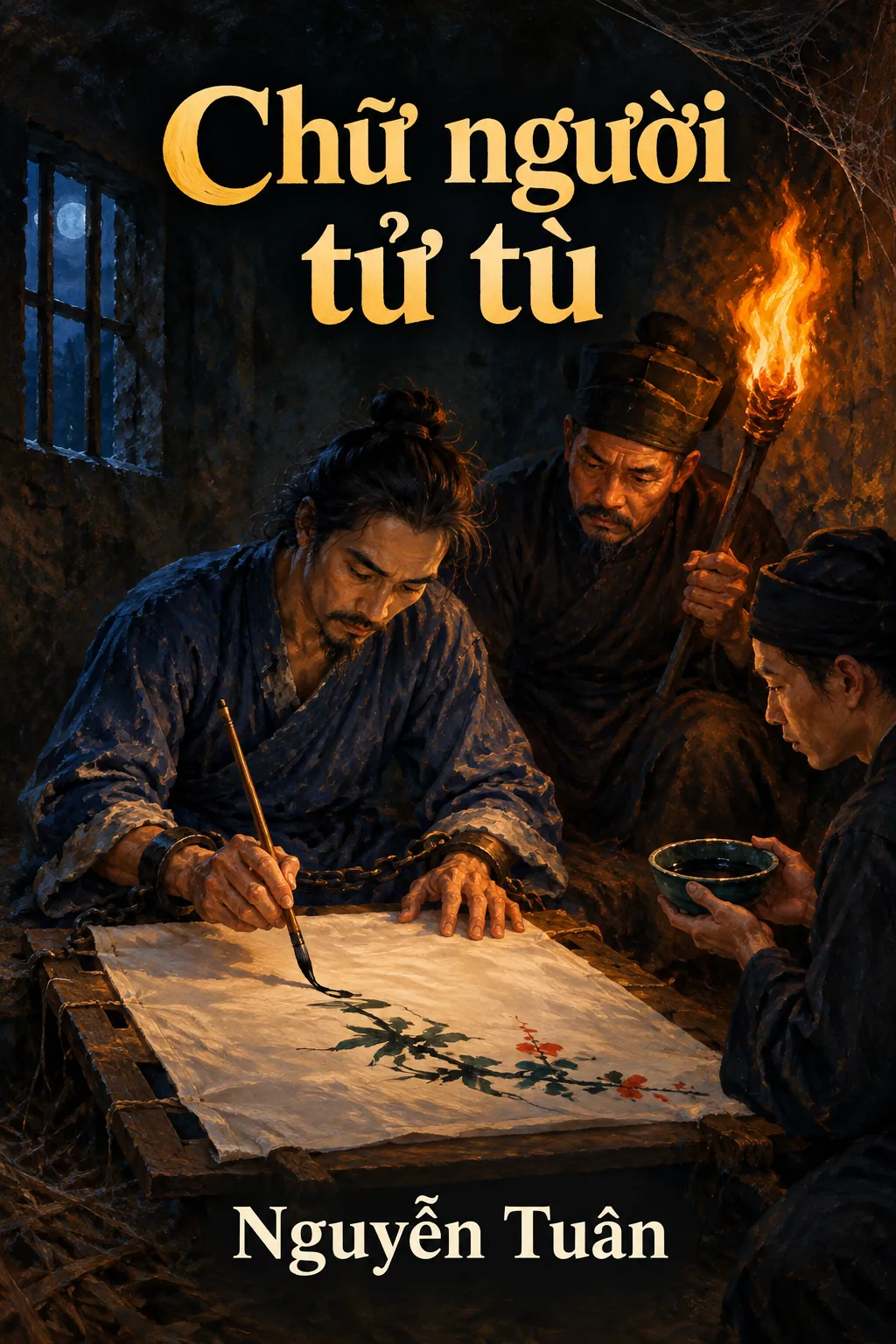
Chữ người tử tù
oleh Nguyễn Tuân
Chữ người tử tù is a short story by Nguyễn Tuân, first printed in 1939 and collected in 1940, set in a provincial prison in old Vietnam. A warden who loves fine calligraphy learns that the greatest calligrapher of his age, the rebel Huấn Cao, is arriving as a death-row prisoner. The warden, a decent man inside a rotten system, wants just a few written characters from a prisoner who bows to no power. The story asks what beauty is worth, and what it asks of the people who love it.
Ide Utama
"A condemned rebel and a prison warden meet over calligraphy, and the story argues that beauty and a pure conscience (thiên lương) can survive, and even grow, in the foulest place."
Wawasan Utama
Beauty and goodness belong together
Huấn Cao refuses to write for people who only want to own his art. He gives it to someone who understands what it means, and then he insists that beauty must not live next to crime and corruption. For Nguyễn Tuân, a person with a fine eye also needs a clean heart. Art is not a decoration but a test of character.
Huấn Cao tells the warden to leave the prison and keep his conscience whole before he collects any more calligraphy.
Thiên lương survives in unlikely places
Thiên lương means a person's inborn goodness, the clear conscience at the centre of the self. The story places it in a prison warden, a man the reader expects to be hardened. His job is cruel, yet his love of beauty has kept something clean inside him. The author suggests that goodness is not decided by position but by what a person protects.
The warden risks his dignity by sending word to a despised prisoner through the clerk, then weeps and bows when he is told to change his life.
Real power is not rank
In the cell the usual order of power turns upside down. The man with chains on his neck commands, and the men with keys bow and obey. Nguyễn Tuân shows that skill, courage and character give a kind of authority that laws and guards cannot take away.
The warden and the clerk hold the torch and the silk while the shackled Huấn Cao writes, and the narrator calls the scene unlike any before it.
A lament for a vanishing world
The story appears in a collection about the fading culture of Confucian scholars, so Huấn Cao is also a symbol of a vanishing way of life. The slow, ceremonial scene of writing, with ink, silk and torchlight, reads like a farewell to the refined skills of the past. This gives the story its serious, nostalgic tone.
The long description of the writing ritual treats a few brushstrokes as something close to a sacred ceremony.
Rincian Bab
Chapter-by-chapter summary
Spoiler warning: this section covers the whole plot, including the ending.
The story has no numbered chapters, so this guide splits it into five natural parts.
Part 1: Two men in a night prison
The story opens at night in a provincial jail, where the warden (quản ngục) and his clerk (thầy thơ lại) discuss a prisoner who is about to arrive. He is Huấn Cao, a leader of a revolt against the court and the most admired calligrapher in the region.
The warden guards criminals for a living, yet he loves beautiful handwriting and has long wished to own a piece by Huấn Cao. He treats the coming prisoner with a respect that no other inmate would get.
Why it matters: the opening sets up the central contrast between a brutal job and a delicate taste, and it makes the reader ask whether such a man deserves what he wants.
Part 2: The prisoner who does not bow
Huấn Cao arrives in chains but calm, with the bearing of a free man. He answers the jailers with cold contempt and wants only one thing from them: that they stay out of his cell.
The warden and the clerk keep sending him wine and food anyway, and Huấn Cao accepts it all as if it were his due. He never thanks them and never asks for anything.
Why it matters: his pride shows that his art cannot be bought or ordered. The warden's patience shows that his respect is not flattery.
Part 3: A message through the clerk
The warden agonises over whether to speak, afraid of being despised and afraid of running out of time. When he learns that Huấn Cao will soon be sent away to face his sentence, he does not dare to ask the prisoner himself and confides in the clerk instead.
The clerk goes to the cell and passes on the warden's feelings and his wish. Huấn Cao realises that this is no ordinary jailer but someone who truly values talent (a quality the text calls biệt nhỡn liên tài), and he agrees to write that very night.
Why it matters: the clerk's errand is the turning point, where contempt gives way to recognition.
Part 4: The night of the writing
In the filthy cell, Huấn Cao writes by torchlight on a sheet of white silk, with a cangue on his neck and shackles on his feet. The warden and the clerk hold the light and steady the silk, standing humbly beside him.
While he works, Huấn Cao says that he has never in his life forced his brush for gold or power, and that he nearly wronged a heart rare in the world.
The narrator calls it a scene never seen before. The prisoner has become the teacher, and the men who hold power over his life have become pupils.
Why it matters: this is the climax. Beauty overturns the order of rank and fills a place of dirt and fear with something sacred.
Part 5: The last advice and the bow
When he has finished, Huấn Cao advises the warden to leave this place, return to a clean life in the countryside and keep his conscience whole, and only then to think about collecting calligraphy. Such beautiful writing, he says, does not belong in a setting of crime and corruption.
The warden is overcome, tears running down his face. He bows to the prisoner and says, in effect, that this foolish man accepts the lesson with gratitude.
Why it matters: the ending turns an exchange of favours into a moral awakening and states the story's creed, that goodness and beauty belong together.
Characters
- Huấn Cao is a rebel leader and the finest calligrapher of his age. He is proud, unbought and generous to those who truly love beauty.
- The warden (quản ngục) is a jailer who loves calligraphy. He is gentle and humble, and he is the one who changes.
- The clerk (thầy thơ lại) is the warden's assistant. He shares the warden's respect for Huấn Cao, carries the warden's request to the cell and stays to help with the writing.
- The calligraphy (chữ) stands for beauty and for the writer's character. It cannot be bought or forced.
- The prison is a place of dirt, fear and power. It is where the story shows how fragile and how strong beauty can be.
Writing about this book
Most exam questions on Chữ người tử tù ask about Huấn Cao, the cho chữ scene (the writing scene), or the ideas of beauty and thiên lương. Choose one clear argument and prove it with scenes.
Good evidence is concrete: the prisoner's calm, his refusal to write for gold or power, the reversal of roles in the cell, and the warden's bow.
- Say what the contrast does. Dark prison against bright torch and white silk makes beauty stand out.
- Quote briefly. A phrase or two is enough, such as the warden calling himself a foolish man.
- Link the scene to the whole story. Ask why the warden, not a scholar, is the one who is saved.
- Finish with meaning, not just summary: what does the author want readers to value?
The model answers below show three levels, from a basic answer to an excellent one. Use them to compare with your own work, never to copy.
Ambil Tindakan
Langkah praktis yang bisa Anda terapkan hari ini:
-
Protect your conscience first. Talent and taste matter less than the kind of person you are.
-
Notice what people value, not just what job they have. The kindest reader in the story is a prison warden.
-
Give your best work to people who respect it, and do not let money or pressure force it out of you.
-
In an essay, tie every scene to an idea: say what a detail shows, not only what happens.
Kutipan Menarik
"“Thiếu chút nữa, ta đã phụ mất một tấm lòng trong thiên hạ.” (Part 4; roughly, ‘I almost wronged a heart rare in this world.’)"
— Nguyễn Tuân
"“Ta nhất sinh không vì vàng ngọc hay quyền thế mà ép mình viết câu đối bao giờ.” (Part 4; roughly, ‘Never in my life have I forced my brush for gold or power.’)"
— Nguyễn Tuân
"“cảnh tượng xưa nay chưa từng có” (Part 4; ‘a scene never seen before’)"
— Nguyễn Tuân
"“Kẻ mê muội này xin bái lĩnh.” (Part 5; roughly, ‘This foolish man humbly accepts.’)"
— Nguyễn Tuân
Siapa yang Harus Membaca Ini
Students in Vietnamese upper-secondary school, and learners of Vietnamese literature, who need to study Nguyễn Tuân for class or an exam. It also suits any reader aged 15 and over who likes short, richly written stories about art, honour and moral courage.
Tentang Nguyễn Tuân
Nguyễn Tuân (1910–1987) was a Vietnamese writer born in Hanoi, known for ornate prose and a lifelong devotion to beauty and refined skill. His 1940 collection Vang bóng một thời (Echoes of a Vanished Time) mourns the fading world of Confucian scholars. Chữ người tử tù is its most studied story and a fixture of Vietnamese high-school literature.
Ringkasan Ditulis Oleh

Software Engineer & Writer
Software engineer with a passion for distilling complex ideas into actionable insights. Writes about finance, investment, entrepreneurship, and technology.
Lihat semua ringkasan →Ulasan
Belum ada ulasan. Jadilah yang pertama berbagi pemikiran Anda!
Tulis Ulasan
Lanjut membaca
Jelajahi topik: Panduan BelajarRingkasan
Animal Farm karya George Orwell — Ringkasan & Analisis
George Orwell
Hewan-hewan di Peternakan Manor memberontak melawan petani kejam Mr. Jones untuk mendirikan masyarakat utopia berdasarkan kesetaraan. Namun, kepemimpinan babi yang…
The Outsiders oleh S.E. Hinton
S.E. Hinton
Novel ini mengikuti kehidupan Ponyboy Curtis dan kelompok 'Greasers' yang terjebak dalam perang saudara dengan kelompok 'Socs' yang kaya. Melalui…
The Great Gatsby karya F. Scott Fitzgerald — Ringkasan & Analisis
F. Scott Fitzgerald
Diceritakan oleh Nick Carraway, novel ini mengikuti Jay Gatsby, seorang jutawan misterius yang berusaha memenangkan kembali cinta Daisy Buchanan. Di…
tikus dan Manusia oleh John Steinbeck
John Steinbeck
Kisah tentang dua buruh tani migran, George dan Lennie, yang bermimpi memiliki tanah sendiri untuk hidup mandiri. Namun, keterbatasan mental…
Artikel
Kisah Penebang Bambu (Taketori Monogatari)
Kisah Penebang Bambu (Taketori Monogatari) bercerita tentang Putri Kaguya, gadis yang ditemukan di dalam batang bambu yang bersinar. Ia tumbuh…

Ragnarok: Akhir Dunia dan Kiamat Para Dewa Nordik
Ragnarök adalah akhir dunia dalam mitologi Nordik: pertempuran terakhir tempat para dewa, raksasa, dan monster saling membinasakan, bumi tenggelam ke…
Unsur Intrinsik Cerpen dan Novel
Unsur intrinsik adalah bagian yang membangun cerita dari dalam: tema, tokoh dan penokohan, alur, latar, sudut pandang, gaya bahasa, dan…