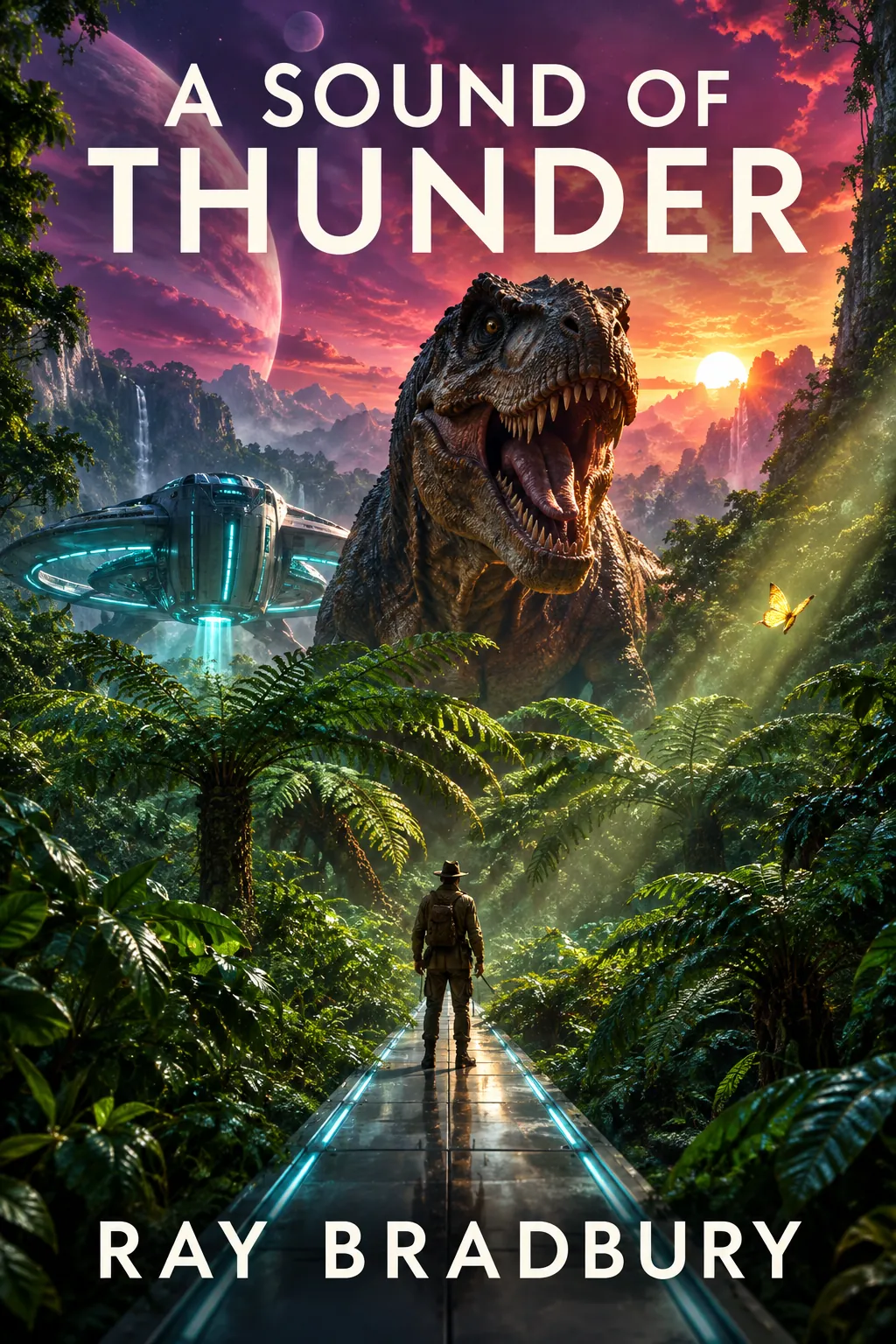
A Sound of Thunder
by Ray Bradbury
A Sound of Thunder is Ray Bradbury's 1952 short story about a wealthy hunter named Eckels who pays to travel back sixty million years and shoot a Tyrannosaurus. The company's one strict rule is to stay on a floating path so that nothing in the past is disturbed. Bradbury uses the trip to ask how much a tiny action can change, and what a single careless step might cost the world Eckels comes home to.
Try Audible · As an Amazon Associate we earn from qualifying purchases. Details
The Big Idea
"In Bradbury's story, one frightened step in the distant past shows how tiny actions can reshape everything that follows."
Key Insights
Small actions, large consequences
The story's central claim is that no event is too small to matter. Bradbury builds this through the rule about the Path and the speech about a single mouse, which prepare the reader for a final shock. It is the idea behind the phrase butterfly effect, though the story itself is simpler and more dramatic than the science. The story's strength is that it makes the claim feel physical: one crushed insect, one changed sign, one different leader.
Eckels steps off the Path for only a moment in the jungle, yet the world he returns to is different.
The cost of treating history as a product
Time Safari, Inc. sells the past as a luxury trip, as though history were a place to be consumed. Bradbury suggests that this attitude is dangerous, because it treats the past as something that belongs to the customer. The company tries to control the risk, but it cannot control the people it sells to. The story invites readers to ask who is responsible when a business sells an experience that no one fully understands.
Eckels pays a large sum to kill a dinosaur, and the company assumes the rules will be enough to protect the future.
Fear can undo preparation
All the planning in the story fails at the exact point where a human being panics. Travis has thought of every rule, but he cannot stop Eckels's body from running. The story argues that systems are only as safe as the people inside them. This is why the warning speeches in the office matter less than the moment of real fear in the jungle.
When the Tyrannosaurus appears, Eckels forgets the warnings and moves off the safe route.
Politics shows how the world changed
By tying the change to an election, Bradbury makes the consequence easy to grasp. A reader may not feel what a different spelling means, but a harsher government is clear at once. The choice also reminds us that history is shaped by many small decisions that make up larger events. It gives the ending a human cost instead of leaving it as a clever puzzle.
Eckels asks about the election before and after the hunt, and the two answers are different.
Chapter Breakdown
Chapter-by-chapter summary
Spoiler warning: this section covers the whole plot, including the ending.
The story has no numbered chapters, so this summary follows six natural parts.
Part 1: The office of Time Safari, Inc.
In the year 2055, a man named Eckels walks into the office of Time Safari, Inc. and pays a huge fee for a hunt in the prehistoric past. Before he signs, he asks who won the presidential election, and he is relieved that the moderate Keith beat the harsh Deutscher.
The question seems like small talk, but it tells us what kind of world Eckels lives in and what he is afraid of. He is a man who worries about politics, yet he is about to treat history as a holiday.
The scene matters because it plants the election early, so the ending can turn on it. A careful reader will remember this moment when the office returns at the close.
Part 2: The warning and the Machine
The staff explain that the hunt is allowed only because the company picks animals that were about to die anyway. Eckels is told that the group will follow a floating Path of anti-gravity metal and must never step off it.
The rule is explained with a chilling idea: even a dead mouse in the distant past could change what comes after. The staff describe how one small death could remove whole families of animals and, in time, whole lines of people.
The setup tells us exactly what to watch for. Bradbury shows the rule and its reason together, so the reader feels the danger before anything goes wrong.
Part 3: Into the jungle
Eckels travels back with the guide Travis, his assistant Lesperance and two other hunters, Billings and Kramer. They step into a jungle sixty million years old, and Eckels is already uneasy.
Travis says the Tyrannosaurus they will shoot would be crushed by a falling tree within minutes, so killing it costs history nothing. The hunters have even marked the exact moment when the animal is due to die.
The detail shows how carefully the company has tried to control the risk. It also raises the tension, because the reader knows that careful plans in stories are made to be tested.
Part 4: The Tyrannosaurus
The great beast crashes out of the forest, and Eckels is overcome by terror and cannot aim. He turns and stumbles away from the Path.
Kramer and Billings bring the dinosaur down, and a tree falls just as Travis had said. For a moment it seems that the plan has worked and the hunt is over.
The scene is the story's hinge: Eckels breaks the one rule while everyone is watching the monster. Bradbury makes the key mistake small and quick, which is exactly why it feels so frightening later.
Part 5: Travis's anger
Travis is furious that Eckels left the Path. He makes Eckels dig the bullets out of the dinosaur's body, because the creature was meant to die under the tree alone and nothing from the future should stay behind.
This moment shows that Travis understands the danger better than the others. His anger is not about a broken rule for its own sake, but about how little anyone can know about the harm already done.
It also tells the reader that something may already have gone wrong. The group begins the trip home carrying a doubt that no one can yet measure.
Part 6: Back in 2055
When the party returns, the world looks slightly wrong, from the spelling on the office sign to the way people speak. Eckels asks who won the election, and the answer is Deutscher, the man he feared.
Looking at the mud on his boot, he sees a crushed butterfly, and he understands what his step has done. Travis raises his rifle, and the story ends on the words "There was a sound of thunder."
The ending is short and open, but it makes the cost of the lost butterfly impossible to ignore. Bradbury leaves the final act unseen, so the reader supplies the rest.
Characters
Eckels
A rich man who wants the thrill of killing a dinosaur. He is the protagonist, and his panic in the jungle is the turning point of the plot.
He is not a villain, only an ordinary customer who is weaker than he thought. That is what makes his mistake easy to understand.
Travis
The safari leader and the voice of the rules. He is calm and stern, and he understands what is at stake in the past better than any of his clients.
His fury after the hunt shows how much he knows about the risks.
Lesperance
Travis's assistant on the hunt. He supports the group and helps hold the discipline of the trip.
He has little to say, but he reminds us that the safari is run as a business with a crew and a routine.
Billings and Kramer
Two fellow hunters who go with Eckels. When he freezes, they are the ones who bring down the Tyrannosaurus.
They act as a contrast to Eckels, showing steadier nerves under the same fear.
Keith and Deutscher
The two presidential candidates of 2055. They never appear in person, but their names act as a signal of how much the world has changed.
One stands for a gentler future and the other for a harsher one.
The Tyrannosaurus
The monster of the hunt and a symbol of wild power. Bradbury makes it a huge, living presence, not just a trophy.
Its size and noise help explain why Eckels loses control of himself.
Writing about this book
Start with a clear claim about what the story argues, such as that small actions have large consequences. Then pick two or three scenes as evidence: the election question in the office, Eckels leaving the Path, and the changed world on his return.
Look closely at how Bradbury plants details early, because they become important later. The speech about the mouse and the opening conversation about the election are both set-ups that pay off at the end.
Compare the story with ideas such as the butterfly effect and the grandfather paradox, which we explain in our articles on time travel. Say what each idea explains about time travel and where the story agrees or differs.
Finish by asking whether Eckels is truly responsible. One strong paragraph can weigh his panic against the company's choice to sell a dangerous trip to a man who wanted a trophy.
A short thesis can give you a model to follow. For example: Bradbury argues that history is fragile, and he shows it by making one frightened step undo a world.
You can also use these questions to plan your own paragraph:
- Which detail in the opening office scene is repeated at the end?
- How does Travis's anger change the mood after the hunt?
- Who is most to blame: Eckels, Travis or the company?
Take Action
Practical steps you can implement today:
-
Look for the setup: Bradbury plants the election and the mouse speech early so the ending feels earned.
-
Argue about responsibility: decide whether Eckels, Travis or the company is most to blame, and give evidence.
-
Link the story to the butterfly effect, but note that this is fiction, not a scientific model.
-
Practise writing about how a short story creates tension in very few pages.
Notable Quotes
""There was a sound of thunder." (Part 6)"
— Ray Bradbury
Who Should Read This
Readers aged about 12 and up who like short, fast science fiction. It suits middle-school and high-school English classes that study cause and effect, plot structure or the ethics of time travel, and it takes only a few minutes to read. It is also a good first Bradbury story for anyone about to try longer books such as Fahrenheit 451.
Frequently Asked Questions
What is A Sound of Thunder about?
It is a short story about a rich hunter, Eckels, who pays for a time-travel safari to kill a dinosaur. He is told to stay on a floating path so as not to change the past. When he panics and steps off it, the world he returns to is different, and the story asks how small a change can be and still matter.
When was A Sound of Thunder written?
Ray Bradbury published it in 1952, and it was later collected in The Golden Apples of the Sun (1953). It is one of the best-known time-travel stories in science fiction, and it is often taught because it is short and easy to analyse.
What is the ending of A Sound of Thunder?
Eckels returns to 2055 and finds that small details, and the winner of the election, have changed. He sees a crushed butterfly on his boot and realises why. Travis raises his rifle, and the story ends with the words "There was a sound of thunder."
How does the story relate to the butterfly effect?
Many readers see the crushed butterfly as an early picture of the butterfly effect, the idea that a tiny change can cause large results later. The phrase itself became popular later, and the story is fiction, not a scientific model. You can use it in an essay as a vivid example, not as proof.
What is the main theme of A Sound of Thunder?
The main theme is that small actions can have huge consequences. The story also looks at human fear, responsibility, and what happens when people treat the past as something to buy. Students often write about how these themes connect through the character of Eckels.
Who are the main characters in A Sound of Thunder?
Eckels is the hunter at the centre of the story, and Travis is the guide who enforces the rules. Lesperance, Billings and Kramer also join the trip, and the candidates Keith and Deutscher appear only by name. The Tyrannosaurus is not a person, but it plays a major role as the cause of Eckels's fear.
Check Your Understanding
Pick an answer for each question to see if you were right.
-
What is the one rule the hunters must follow in the past?
Stay on the floating Path — The Path floats above the ground so that the hunters leave the past undisturbed.
-
Why is the Tyrannosaurus a safe target for the hunt?
It would die moments later anyway — Travis says a falling tree would kill it, so shooting it should not change history.
-
What does Eckels do when he sees the dinosaur?
He panics and leaves the Path — Fear overwhelms him, which sets the whole consequence in motion.
-
What detail on Eckels's boot explains the change?
A crushed butterfly — The butterfly is the small piece of the past that Eckels destroyed.
-
Which election result does Eckels fear when he returns?
Deutscher wins — He asked about the election at the start, so the changed answer shows the world has altered.
Want the full book?
Read or listen to A Sound of Thunder in full.
Try Audible · As an Amazon Associate we earn from qualifying purchases. Details
About Ray Bradbury
Ray Bradbury (1920–2012) was an American writer who made his name with science fiction, fantasy and horror stories. His best-known books include The Martian Chronicles, Fahrenheit 451 and The Illustrated Man. A Sound of Thunder shows why he is loved for short fiction: a small, vivid idea that stays with you.
Summary Written By

Software Engineer & Writer
Software engineer with a passion for distilling complex ideas into actionable insights. Writes about finance, investment, entrepreneurship, and technology.
View all summaries →Reviews
No reviews yet. Be the first to share your thoughts!
Write a Review
Keep reading
Explore the topic: Sci-Fi Authors & AwardsSummaries

Out of My Mind
Sharon M. Draper
“Out of My Mind” by Sharon M. Draper is a poignant narrative that explores the life of Melody Brooks, a…

Ender’s Game
Orson Scott Card
“Ender’s Game” by Orson Scott Card is a riveting science fiction novel that transports readers into a future where humanity…

Pachinko
Min Jin Lee
“Pachinko”, a spellbinding multigenerational historical saga by Min Jin Lee, explores the lives of a Korean family trying to make…

The Perks of Being a Wallflower
Stephen Chbosky
The Perks of Being a Wallflower by Stephen Chbosky is a profound coming-of-age novel, told through the intimate letters of…
Articles

Ray Bradbury
Ray Bradbury (1920–2012) was an American writer who turned science fiction into poetry about people. He is best known for…

Time Travel Paradoxes
A time travel paradox is a situation where going into the past seems to make history contradict itself. The best-known…

Butterfly effect
The butterfly effect is the idea that a tiny change at the start can lead to a very different result…