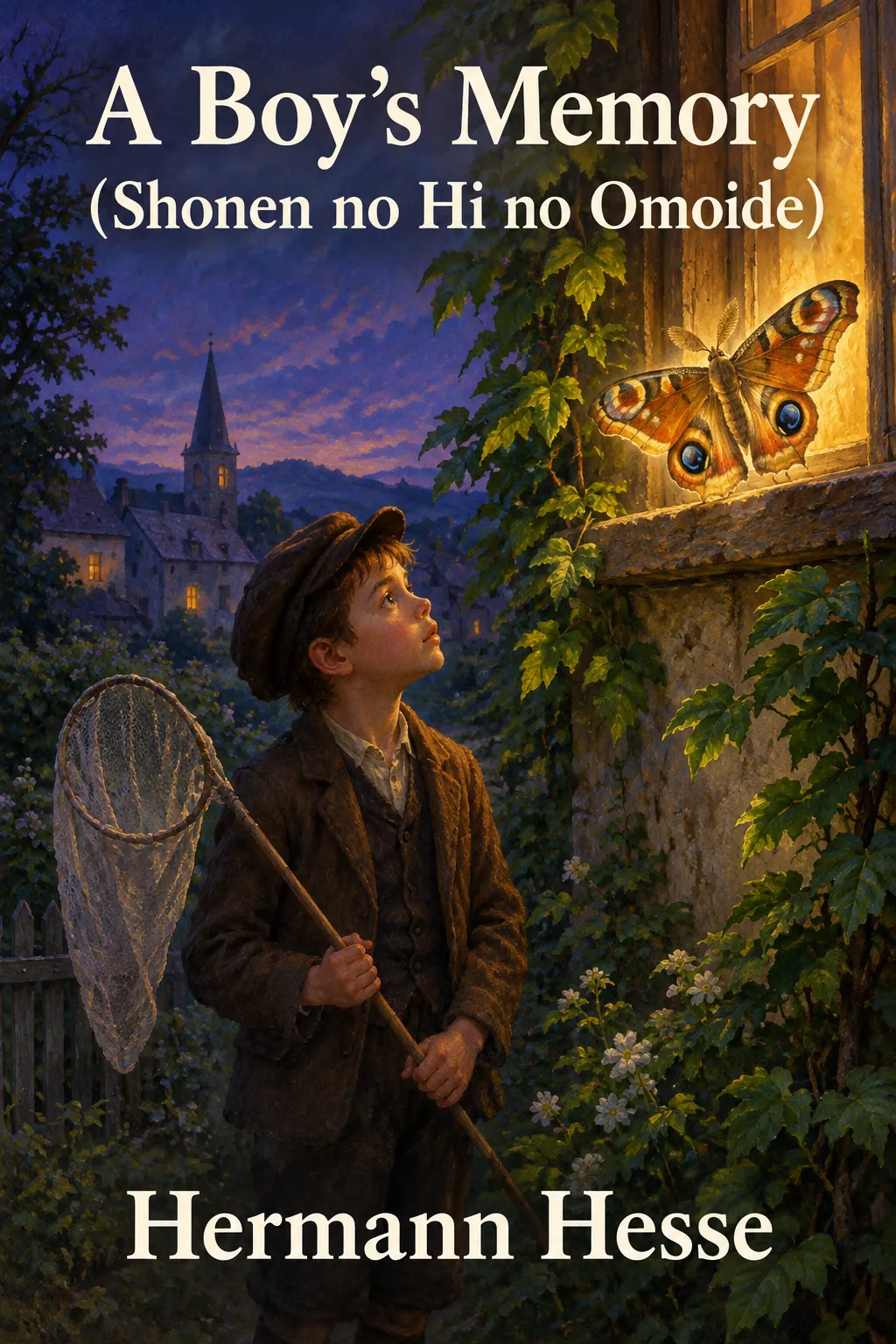
A Boy's Memory (Shonen no Hi no Omoide)
by Hermann Hesse
A Boy's Memory is a short story by Hermann Hesse about a butterfly-mad boy and the tidy, flawless neighbour he both admires and resents. When the neighbour gets a rare moth, the boy's longing and envy push him to do something he can never take back. A grown man tells the story to a friend years later, so it reads as a confession rather than an adventure. It is a standard text in Japanese lower-secondary schools.
The Big Idea
"A boy's love of collecting turns into guilt he can never undo. Hesse's story shows how envy, shame and one cold reply can fix a memory for life."
Key Insights
Some mistakes cannot be repaired
The moth is destroyed in a few seconds, and no apology, gift or punishment can bring it back. Hesse makes the narrator learn that guilt is not always something you can pay off, only something you carry. This is why readers often remember the story long after school: the lesson is felt, not argued.
When the narrator offers his entire collection, Emil refuses it, and the boy realises the offer changes nothing.
Envy grows from admiration
The narrator wants to be like Emil and cannot forgive him for already being so. Admiration and resentment are the same feeling seen from two sides, and together they push him toward a choice he would never make calmly. Hesse shows that envy rarely looks like hatred at first; it looks like longing.
He praises Emil's skill and in the same breath dislikes his perfect manners and cold judging. Notice that the narrator never says he hates Emil; he only feels small near him.
Passion can blur right and wrong
The narrator's love of butterflies is genuine, but wanting a specimen is not the same as loving it. When the moth is within reach he treats it as an object to own, and in doing so he destroys the beauty he wanted. The story asks whether collecting can turn love into possession.
He takes the moth for a closer look, yet his own hurry is what ruins its wings. Compare his open joy at the start with his panic at the climax.
An adult voice changes how we read
Because the grown man tells the story, the boy's actions are always seen through years of regret. The frame makes the memory a confession rather than an adventure, and it explains why the tone is so quiet and exact. It also keeps the reader close to the narrator even while judging him.
The guest stops looking at the collection and starts talking, which shows the memory is still alive. Use this point in essays on narrative structure.
Chapter Breakdown
Chapter-by-chapter summary
Spoiler warning: this section covers the whole plot, including the ending.
The story has no numbered chapters, so we split it into eight natural parts.
Part 1: An evening visit and a story begun
The story opens in a quiet room where a host shows his butterfly collection to a visiting friend.
The guest looks closely at the specimens, then says he would rather not see any more.
A memory from his boyhood has spoiled the hobby for him, and he offers to tell it.
From here the guest becomes the 'I' of the tale, and the host becomes his listener.
The frame matters because the whole story is an adult looking back at a shame that has never faded.
Part 2: A boy possessed by butterflies
As a small child the narrator starts collecting butterflies, and by about ten he can think of little else.
He hunts across fields with a net, and a rare find makes his heart pound.
His catches are kept in plain, makeshift boxes, nothing like a proper collector's cabinet.
The passion is sincere and a little greedy, and he cannot tell where joy ends and wanting begins.
That mix explains everything that follows, so the story takes care to show how real it is.
Part 3: The neighbour who does everything right
Next door lives Emil, the teacher's son, a model boy who is neat, careful and patient.
His small collection is beautifully mounted, and he can even mend a damaged wing so that it looks whole.
The narrator admires him and resents him in the same breath.
Emil's perfection makes the narrator feel clumsy, as if every neat row of insects were a quiet reproach.
Hesse does not turn Emil into a villain. He is simply a boy with very high standards and very little warmth.
Part 4: Showing off a prized butterfly
One day the narrator catches a butterfly he is truly proud of and shows it to Emil, hoping for praise.
Emil inspects it like an expert and lists its faults one by one.
The narrator's joy collapses, and from then on he avoids showing his collection to Emil.
The scene shows how much the narrator needs Emil's good opinion, and how little Emil gives it.
It also prepares the reader to see Emil as a judge whose verdict will matter later.
Part 5: The rare moth
Some time later, news spreads that Emil has a peacock-eyed moth, a species the narrator has long dreamed of seeing.
He cannot wait to look at it and goes to Emil's room.
Emil is not there.
What began as curiosity turns, in an empty room, into temptation, and his longing is stronger than his sense of what belongs to whom.
Hesse builds the pressure slowly so that the later act feels both shocking and understandable.
Part 6: The theft
Alone, the narrator finds the moth pinned on its drying board.
He tells himself he only wants a closer look, but he cannot stop at looking.
He takes the moth in his hand and leaves the room.
When he hears someone coming, he panics and tries to hide it, and by the time he looks again the delicate wings are crushed beyond repair.
The whole disaster takes only a few seconds.
He knows at once that he has become a thief and a destroyer, and the moment is told without excuses.
Part 7: Confession
Sick with guilt, the narrator tells his mother.
She does not scold him. She tells him quietly that he must go and confess to Emil himself.
He does, and tells Emil everything.
Emil neither shouts nor hits him; he looks at the narrator coldly, with open contempt, and treats him as a person he now understands.
The narrator offers his whole collection as payment, but Emil will not take it.
This is the emotional centre of the story. Some wrongs cannot be paid for, and forgiveness is something nobody is owed.
Part 8: What he does with his collection
The narrator finally understands that nothing can bring the moth back.
Later, he takes his own butterflies and crushes them one by one with his fingers.
The act is part punishment, part grief, and part a refusal to keep what he loved so much that it made him a thief.
The story then returns to the room of the frame, and the listener is left with the memory.
Hesse ends without comfort, trusting the reader to feel how long a small act can last.
Characters
- The narrator (the boy, later the guest): a butterfly-obsessed boy who grows into the man telling the story. He is passionate, envious and honest enough to confess, and every other character is seen through his eyes.
- Emil: the teacher's son and a model boy. He is skilled, calm and exacting, and he never raises his voice, which makes his judgement heavier.
- The mother: she senses her son's distress and sends him to face Emil in person. Her calm firmness stands for conscience without cruelty.
- The host ('I'): the frame narrator who shows the collection and listens. He is a quiet witness who stands in for the reader.
- The moth: the peacock-eyed moth that triggers the crime. It is beauty and desire in one object, and it cannot be replaced once ruined.
Background
Hesse published the story under the title Jugendgedenken in 1931, as a rewrite of an earlier story, Das Nachtpfauenauge, from 1911.
In Japan it is a long-standing set text in lower-secondary Japanese, which is why most readers there meet it as teenagers.
This page describes the story in our own words and does not reproduce the text.
What Japanese class tests ask
Japanese school tests on this story usually ask about the narrator's feelings at turning points, his reasons for key actions and what Emil is like.
- Feelings: why he cannot enjoy Emil's company, and what he feels in the empty room.
- Reasons: why he crushes his butterflies, and why his mother sends him to confess.
- Character: how Emil's actions show his personality.
- Structure: what the adult frame adds.
Short written answers, usually 60 to 100 characters, reward answers that name a cause, a feeling and an action in one sentence.
Writing about this book
Most school tasks on this story ask about feeling and motive, so start by tracking the narrator's emotions in order: delight, envy, temptation, panic and shame.
Link each feeling to a specific scene, not to a general idea.
When you write about Emil, argue from what he does: the cold inspection of a prized butterfly, the quiet contempt, the refusal of the offered collection.
You can defend him as principled or criticise him as unforgiving, and either works if the evidence is exact.
Good answers also use the frame. Ask why Hesse lets an adult tell the story instead of the boy himself.
A few useful angles:
- Envy and admiration as one feeling, not two.
- The moth as a symbol of beauty that cannot be possessed without being harmed.
- Guilt that cannot be repaid by gifts or words.
- The effect of an adult narrator looking back.
Quote only short fragments in your own translation, and describe scenes in your own words rather than copying the text.
The model answers further down are for learning and for comparing with your own work, not for handing in.
Take Action
Practical steps you can implement today:
-
When you write about Emil, argue from his actions, such as the cold inspection and the refusal of the offered collection, rather than from labels like cruel or fair.
-
Track the narrator's feelings in order: delight, envy, temptation, panic, shame. Each one belongs to a specific scene.
-
Remember the frame: an adult tells this story, so every judgement of the boy comes with years of regret.
-
For a short answer on why he crushes his butterflies, name three things: regret, despair at being refused, and self-punishment.
Notable Quotes
"Emil's verdict, in effect: so that is the kind of person you are. (paraphrase, Part 7)"
— Hermann Hesse
"What has been ruined once cannot be put right again. (paraphrase of the closing idea, Part 8)"
— Hermann Hesse
"He admired Emil and resented him at the same time. (paraphrase, Part 3)"
— Hermann Hesse
Who Should Read This
Students whose Japanese class uses this story as a set text, and anyone who wants a compact short story about guilt and envy. It suits readers from about twelve years old, and it is a useful, clear example for teachers who need to teach narrative frame and moral conflict.
Characters
The narrator (the boy, later the guest)
protagonist and narrator
A boy who grows obsessed with butterflies and later, as an adult, tells the story to a friend. His feelings move from joy and envy to temptation, panic and shame. He is honest about his own weakness, and that honesty makes the story a confession.
Emil
foil and judge
The teacher's son next door, a model boy who is skilled, calm and exacting. He judges the narrator's collection like an expert and never raises his voice. His cold reply to the confession is what makes the guilt permanent.
The mother
conscience
She listens to her son's confession without scolding and tells him to go to Emil himself. Her calm firmness shows that apology is the wrongdoer's duty. She stands for conscience without cruelty.
The host ('I')
frame narrator
The man who shows his butterfly collection to a guest and then listens. He is a quiet witness who stands in for the reader. His presence lets the story be told as a confession between two adults.
The peacock-eyed moth
symbol
Emil's rare moth, the object that triggers the crime. It stands for beauty and desire, and for what cannot be restored once ruined. Use it as the story's central symbol in essays.
Exam practice: sample answers
Model answers are examples to learn from; write your own in your words.
short answer with textual evidence
1. Why does the narrator crush his own butterflies at the end of his memory? Answer as in a short-answer exam item (about 100 Japanese characters), then support your answer with scenes.
Outline
- Name the event just before: the confession and the refusal.
- State the feelings: regret, despair, self-punishment.
- Say who the action is aimed at: himself, not Emil.
Basic Model answer
The narrator crushes his butterflies because he feels very guilty about the moth he destroyed.
He confessed to Emil and even offered his whole collection, but Emil would not accept it.
The boy sees that nothing can bring the moth back, and he feels no one will forgive him.
So he destroys the thing he once loved most, as a way of punishing himself and showing his sadness.
He is not trying to please Emil; the act is turned inward.
This shows that some mistakes cannot be repaired, and that being sorry does not guarantee forgiveness.
In short, his feelings are regret, despair and self-punishment.
Good Model answer
The narrator crushes his own butterflies because Emil's refusal makes him understand that his guilt can never be paid off, and he turns that guilt against himself.
His mother, who does not scold him, sends him to confess to Emil in person, so he faces the wrong honestly.
Emil responds not with anger but with cold contempt. Then, when the narrator offers every butterfly he owns, Emil refuses it.
The refusal closes the last way of making amends, so the narrator has nowhere to put his remorse.
The act of crushing is therefore directed at himself, not at Emil.
He destroys what he once wanted so badly that he became a thief.
It also reveals a change in him: at the start, collecting is joy; now it is tied to shame.
The adult frame supports this reading, because the guest still cannot bear to look at butterflies years later.
A common weak point is to say he destroys them to apologise; the act reaches nobody but himself.
In short, the crushing is a tragic way of accepting a guilt that cannot be repaired. It is grief as much as punishment, and the grief belongs to a boy who once loved these insects.
Excellent Model answer
The narrator crushes his butterflies because Emil's refusal proves that his guilt cannot be repaid, and he can only accept it by punishing himself with the thing that led him astray.
The act follows a double rejection. Emil does not shout or bargain; he answers with a cold, steady contempt, and he declines the narrator's offer of his whole collection.
This matters because an angry outburst would have let the boy be punished and move on, while a refusal of payment leaves the guilt with nowhere to go.
Note too that the mother's calm response removes any outside punishment, which makes his own punishment feel necessary.
Seen this way, crushing the specimens is directed inward. It does not make amends to Emil, and the narrator knows it.
The target is also symbolic. The butterflies stand for the passion that carried him from admiration into envy and then into theft, so destroying them is a way of separating himself from the boy who took the moth.
It mirrors the earlier crime: he destroyed Emil's beautiful specimen in a panic; now he deliberately destroys his own, in a cold act that he chooses.
The adult frame completes the reading. The guest who tells the story cannot bear to look at a collection years later, so the crushing is not a passing mood but the start of a lifelong shame.
A weaker reading calls the act a goodbye to a hobby, but that ignores the rejection that comes first. Another calls it an apology, but no one is there to receive it.
The most defensible answer therefore joins three things: regret for what he did, despair at being refused, and the need to punish himself.
Hesse leaves no comfort. The boy learns that guilt is something you carry, not something you can hand over, and the destruction of his own treasures is how he finally accepts that.
In a short exam answer, name the cause (refusal), the feeling (despair and remorse) and the action (self-punishment) in one sentence, and keep the symbolism for a longer essay.
Marking rubric
- Names the refusal as the immediate cause.
- Identifies the feelings: regret, despair and self-punishment.
- States that the act is directed at himself.
- Supports the answer with at least two scenes.
- Excellent answers use the symbol and the frame.
Now write your own
Write your own answer in two or three sentences, then compare it with the three levels. Which scene did you use as evidence?
opinion essay (reaction paper / reading response)
2. Should Emil have forgiven the narrator? Give your own view and support it with evidence from the story.
Outline
- State your view clearly.
- Give two scenes as evidence.
- Answer the opposite view.
- Conclude about forgiveness and responsibility.
Basic Model answer
I think Emil was right not to forgive the narrator quickly.
The narrator stole Emil's rare moth and ruined it, and it could never be repaired.
Even if he said sorry, Emil had every reason to stay hurt.
However, I think Emil was a little cold.
The narrator came to his house, told him the truth and offered his own collection, but Emil only looked at him with contempt.
I understand why he was upset, but a kinder reply would have been better.
His mother also told him to go, which shows he had to take responsibility.
The story shows that saying sorry does not mean you will be forgiven.
If I were the narrator, I would still tell the truth, because it is the right thing to do.
Good Model answer
I believe Emil was entitled to refuse forgiveness, but his cold silence was not the best response to a sincere confession.
First, the narrator did serious wrong. He took the moth while Emil was out and destroyed a specimen that could never be replaced.
Nobody is obliged to forgive that quickly, and Emil's calm, unshouting reaction suggests he took the loss seriously.
Second, the narrator did what a person can do. His mother sent him to confess, and he went, told the whole truth and offered his entire collection.
Emil's only answer was a look of contempt, and he refused the offer.
A single word acknowledging the effort would have cost him little, yet it might have changed how the narrator remembered the day.
Third, the story's frame shows the long result. An adult tells the tale and still cannot look at butterflies, so the refusal left a lasting wound.
Some will say Emil was only a child and owed the narrator nothing. That is fair, but the text shows him judging his rival's specimens like an expert, so he was capable of choosing how to respond.
This balance is why the story is more than a simple tale of a thief and a victim.
In conclusion, forgiveness is a gift and not a debt, but how we refuse it still matters. The story warns the guilty not to expect pardon and reminds the injured that their reply carries weight.
Excellent Model answer
Emil was entitled to withhold forgiveness, yet his silence fails the one test the story sets: whether he can answer an honest confession with any form of recognition.
To begin with, the case against forgiving is strong. The narrator took the moth in an empty room and ruined it, and nothing, as the story insists, can restore it.
Forgiveness is not a debt. Emil's refusal to bargain, and his rejection of the offered collection, also say that what was lost cannot be paid for by objects.
Yet the story gives the narrator real moral effort. He tells his mother, he goes to Emil in person, and he gives up everything he owns.
A boy has few other ways to show he understands what he has done.
Emil's answer is coldly exact. He does not rage, which would at least show feeling; he judges, and the judgement is final.
The narrator's later destruction of his own collection is the measure of how completely it lands.
The frame turns this into a question about time. Years later the guest cannot bear the sight of butterflies, which suggests that the refusal fixed the boy's guilt in place instead of letting it be worked through.
A fair reader should also test the opposite view. Emil is a child, and nobody can demand grace from a child whose treasure has just been destroyed.
Hesse, however, shows him as precise and controlled, as in his expert inspection of the narrator's earlier catch, which weakens the claim that he could not choose his manner.
It is also worth separating motive from effect. Emil may be hiding hurt behind composure.
Even so, the effect on the narrator is what the text records, and the story weighs actions by their consequences.
I would add one more point. The word forgive covers two things, a feeling and a decision, and Emil can refuse the first while still honouring the second by acknowledging the confession.
A student essay should name this distinction explicitly, since it turns a simple yes or no into an argument.
My conclusion is that forgiveness was Emil's to withhold, but silence was a choice and not a necessity. The story warns the guilty never to rely on pardon, and it reminds the injured that a cold refusal is also an act that someone will carry for life.
Marking rubric
- States a clear position.
- Uses at least two scenes as evidence.
- Answers the opposite view.
- Separates motive from effect.
- Ends with a controlled conclusion.
Now write your own
Write your own opinion essay of about 300 words. Do you agree with Emil's choice? Use two scenes as evidence.
Frequently Asked Questions
What is A Boy's Memory about?
It is a short story by Hermann Hesse about a boy obsessed with butterflies who envies a flawless neighbour, Emil. When Emil gets a rare moth, the narrator gives in to temptation and ruins it. He confesses, but he is not forgiven, and the memory shapes his adult life.
Who wrote it and what is the original title?
Hermann Hesse wrote it. The German title is Jugendgedenken, from 1931, a rewrite of an earlier 1911 story, Das Nachtpfauenauge. In Japan the title Shonen no Hi no Omoide is familiar from school textbooks, and readers there meet it in lower-secondary classes.
Why does the narrator crush his own butterflies?
Emil refuses every attempt at making amends, so the narrator understands that his guilt cannot be repaid. Regret and despair turn inward, and he destroys the thing he once loved most. The act is aimed at himself, not at Emil, which is the key point for any essay.
Is Emil cruel?
Readings differ. He does not shout, and his calm anger is understandable after such a loss. Yet he also refuses a sincere confession and offers only contempt, which many readers find cold. Either view can earn marks if you support it with specific scenes.
Who are the main characters?
The main figures are the narrator, who is a boy in the memory and a man in the frame, Emil, the narrator's mother, and the host who listens. The peacock-eyed moth is also important as a symbol of beauty, desire and loss that cannot be undone.
What do tests ask about this story?
Japanese class tests usually ask about the narrator's feelings at key moments, his reasons for his actions, Emil's character and the effect of the frame. Short written answers of 60 to 100 characters are common, so practise linking a feeling to a scene. The essay set below gives model answers at three levels.
Check Your Understanding
Pick an answer for each question to see if you were right.
-
How is Emil described?
A skilled, calm model boy who hides his feelings — Emil is a neat, expert collector who judges coolly, which is why the narrator both admires and resents him.
-
What leads the narrator to do something he cannot undo?
Emil gets a rare moth that the narrator longs to see — His longing for the rare moth turns into temptation in Emil's empty room.
-
Who tells the narrator to confess to Emil in person?
His mother — His mother does not scold him but sends him to face Emil himself.
-
How does Emil react when the narrator offers his whole collection?
He refuses it — Emil's refusal shows that the loss cannot be paid for.
-
What does the narrator do at the end of his memory?
He crushes his own butterflies with his fingers — The act is grief and self-punishment after he understands that the moth cannot be restored.
About Hermann Hesse
Hermann Hesse (1877-1962) was a German-born writer and poet who later lived in Switzerland. He is known for Beneath the Wheel, Demian and Siddhartha, and won the Nobel Prize in Literature in 1946. His stories often follow young people in conflict with their own feelings and with the world around them.
Summary Written By

Software Engineer & Writer
Software engineer with a passion for distilling complex ideas into actionable insights. Writes about finance, investment, entrepreneurship, and technology.
View all summaries →Reviews
No reviews yet. Be the first to share your thoughts!
Write a Review
Keep reading
Explore the topic: Study GuidesSummaries

Animal Farm by George Orwell
George Orwell
The animals of Manor Farm revolt against their human owner to create a utopian society based on equality. However, the…

The Outsiders by S.E. Hinton
S.E. Hinton
Ponyboy Curtis and his gang of Greasers clash with the wealthy Socs in a cycle of violence. After a tragic…

The Great Gatsby by F. Scott Fitzgerald
F. Scott Fitzgerald
Nick Carraway enters the orbit of Jay Gatsby, a mysterious millionaire obsessed with reclaiming his past love, Daisy Buchanan. Amidst…

Of Mice and Men by John Steinbeck
John Steinbeck
George and Lennie, two migrant workers during the Great Depression, dream of owning their own land to escape a life…
Articles

Kyotsu Test Japanese (共通テスト国語): Time Plan and Strategy
The Kyotsu Test Japanese paper is a 90-minute, 200-point multiple-choice exam with five sections: three modern-text sections, classical Japanese and…

How to Write a Literary Analysis Essay
A literary analysis essay argues one clear claim about how a text works and proves it with short quotations and…

The Tale of the Bamboo Cutter
The Tale of the Bamboo Cutter (Taketori Monogatari) tells of Princess Kaguya, a girl found inside a glowing bamboo stalk,…