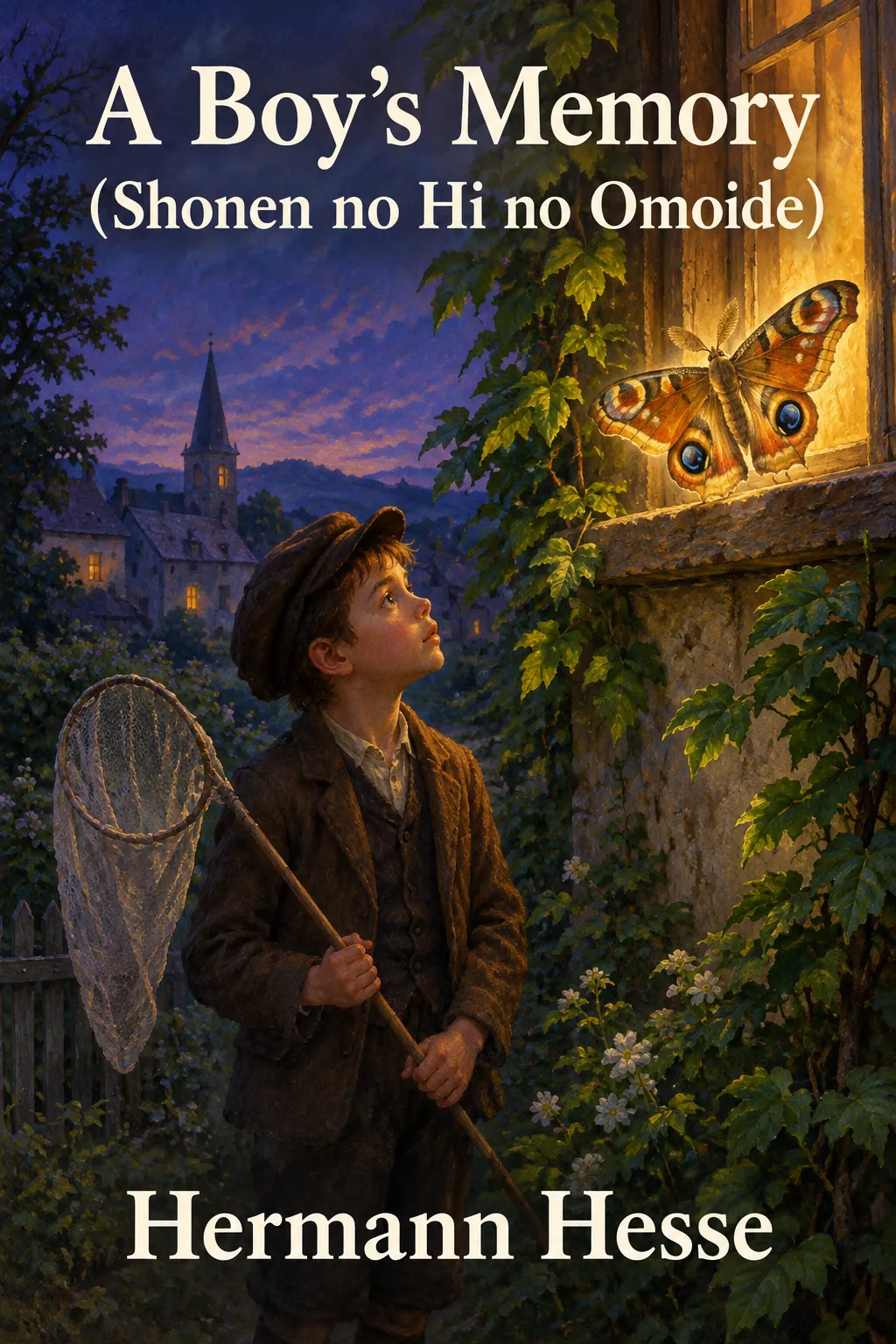
A Boy's Memory (Shonen no Hi no Omoide)
oleh Hermann Hesse
A Boy's Memory is a short story by Hermann Hesse about a butterfly-mad boy and the tidy, flawless neighbour he both admires and resents. When the neighbour gets a rare moth, the boy's longing and envy push him to do something he can never take back. A grown man tells the story to a friend years later, so it reads as a confession rather than an adventure. It is a standard text in Japanese lower-secondary schools.
Ide Utama
"A boy's love of collecting turns into guilt he can never undo. Hesse's story shows how envy, shame and one cold reply can fix a memory for life."
Wawasan Utama
Some mistakes cannot be repaired
The moth is destroyed in a few seconds, and no apology, gift or punishment can bring it back. Hesse makes the narrator learn that guilt is not always something you can pay off, only something you carry. This is why readers often remember the story long after school: the lesson is felt, not argued.
When the narrator offers his entire collection, Emil refuses it, and the boy realises the offer changes nothing.
Envy grows from admiration
The narrator wants to be like Emil and cannot forgive him for already being so. Admiration and resentment are the same feeling seen from two sides, and together they push him toward a choice he would never make calmly. Hesse shows that envy rarely looks like hatred at first; it looks like longing.
He praises Emil's skill and in the same breath dislikes his perfect manners and cold judging. Notice that the narrator never says he hates Emil; he only feels small near him.
Passion can blur right and wrong
The narrator's love of butterflies is genuine, but wanting a specimen is not the same as loving it. When the moth is within reach he treats it as an object to own, and in doing so he destroys the beauty he wanted. The story asks whether collecting can turn love into possession.
He takes the moth for a closer look, yet his own hurry is what ruins its wings. Compare his open joy at the start with his panic at the climax.
An adult voice changes how we read
Because the grown man tells the story, the boy's actions are always seen through years of regret. The frame makes the memory a confession rather than an adventure, and it explains why the tone is so quiet and exact. It also keeps the reader close to the narrator even while judging him.
The guest stops looking at the collection and starts talking, which shows the memory is still alive. Use this point in essays on narrative structure.
Rincian Bab
Chapter-by-chapter summary
Spoiler warning: this section covers the whole plot, including the ending.
The story has no numbered chapters, so we split it into eight natural parts.
Part 1: An evening visit and a story begun
The story opens in a quiet room where a host shows his butterfly collection to a visiting friend.
The guest looks closely at the specimens, then says he would rather not see any more.
A memory from his boyhood has spoiled the hobby for him, and he offers to tell it.
From here the guest becomes the 'I' of the tale, and the host becomes his listener.
The frame matters because the whole story is an adult looking back at a shame that has never faded.
Part 2: A boy possessed by butterflies
As a small child the narrator starts collecting butterflies, and by about ten he can think of little else.
He hunts across fields with a net, and a rare find makes his heart pound.
His catches are kept in plain, makeshift boxes, nothing like a proper collector's cabinet.
The passion is sincere and a little greedy, and he cannot tell where joy ends and wanting begins.
That mix explains everything that follows, so the story takes care to show how real it is.
Part 3: The neighbour who does everything right
Next door lives Emil, the teacher's son, a model boy who is neat, careful and patient.
His small collection is beautifully mounted, and he can even mend a damaged wing so that it looks whole.
The narrator admires him and resents him in the same breath.
Emil's perfection makes the narrator feel clumsy, as if every neat row of insects were a quiet reproach.
Hesse does not turn Emil into a villain. He is simply a boy with very high standards and very little warmth.
Part 4: Showing off a prized butterfly
One day the narrator catches a butterfly he is truly proud of and shows it to Emil, hoping for praise.
Emil inspects it like an expert and lists its faults one by one.
The narrator's joy collapses, and from then on he avoids showing his collection to Emil.
The scene shows how much the narrator needs Emil's good opinion, and how little Emil gives it.
It also prepares the reader to see Emil as a judge whose verdict will matter later.
Part 5: The rare moth
Some time later, news spreads that Emil has a peacock-eyed moth, a species the narrator has long dreamed of seeing.
He cannot wait to look at it and goes to Emil's room.
Emil is not there.
What began as curiosity turns, in an empty room, into temptation, and his longing is stronger than his sense of what belongs to whom.
Hesse builds the pressure slowly so that the later act feels both shocking and understandable.
Part 6: The theft
Alone, the narrator finds the moth pinned on its drying board.
He tells himself he only wants a closer look, but he cannot stop at looking.
He takes the moth in his hand and leaves the room.
When he hears someone coming, he panics and tries to hide it, and by the time he looks again the delicate wings are crushed beyond repair.
The whole disaster takes only a few seconds.
He knows at once that he has become a thief and a destroyer, and the moment is told without excuses.
Part 7: Confession
Sick with guilt, the narrator tells his mother.
She does not scold him. She tells him quietly that he must go and confess to Emil himself.
He does, and tells Emil everything.
Emil neither shouts nor hits him; he looks at the narrator coldly, with open contempt, and treats him as a person he now understands.
The narrator offers his whole collection as payment, but Emil will not take it.
This is the emotional centre of the story. Some wrongs cannot be paid for, and forgiveness is something nobody is owed.
Part 8: What he does with his collection
The narrator finally understands that nothing can bring the moth back.
Later, he takes his own butterflies and crushes them one by one with his fingers.
The act is part punishment, part grief, and part a refusal to keep what he loved so much that it made him a thief.
The story then returns to the room of the frame, and the listener is left with the memory.
Hesse ends without comfort, trusting the reader to feel how long a small act can last.
Characters
- The narrator (the boy, later the guest): a butterfly-obsessed boy who grows into the man telling the story. He is passionate, envious and honest enough to confess, and every other character is seen through his eyes.
- Emil: the teacher's son and a model boy. He is skilled, calm and exacting, and he never raises his voice, which makes his judgement heavier.
- The mother: she senses her son's distress and sends him to face Emil in person. Her calm firmness stands for conscience without cruelty.
- The host ('I'): the frame narrator who shows the collection and listens. He is a quiet witness who stands in for the reader.
- The moth: the peacock-eyed moth that triggers the crime. It is beauty and desire in one object, and it cannot be replaced once ruined.
Background
Hesse published the story under the title Jugendgedenken in 1931, as a rewrite of an earlier story, Das Nachtpfauenauge, from 1911.
In Japan it is a long-standing set text in lower-secondary Japanese, which is why most readers there meet it as teenagers.
This page describes the story in our own words and does not reproduce the text.
What Japanese class tests ask
Japanese school tests on this story usually ask about the narrator's feelings at turning points, his reasons for key actions and what Emil is like.
- Feelings: why he cannot enjoy Emil's company, and what he feels in the empty room.
- Reasons: why he crushes his butterflies, and why his mother sends him to confess.
- Character: how Emil's actions show his personality.
- Structure: what the adult frame adds.
Short written answers, usually 60 to 100 characters, reward answers that name a cause, a feeling and an action in one sentence.
Writing about this book
Most school tasks on this story ask about feeling and motive, so start by tracking the narrator's emotions in order: delight, envy, temptation, panic and shame.
Link each feeling to a specific scene, not to a general idea.
When you write about Emil, argue from what he does: the cold inspection of a prized butterfly, the quiet contempt, the refusal of the offered collection.
You can defend him as principled or criticise him as unforgiving, and either works if the evidence is exact.
Good answers also use the frame. Ask why Hesse lets an adult tell the story instead of the boy himself.
A few useful angles:
- Envy and admiration as one feeling, not two.
- The moth as a symbol of beauty that cannot be possessed without being harmed.
- Guilt that cannot be repaid by gifts or words.
- The effect of an adult narrator looking back.
Quote only short fragments in your own translation, and describe scenes in your own words rather than copying the text.
The model answers further down are for learning and for comparing with your own work, not for handing in.
Ambil Tindakan
Langkah praktis yang bisa Anda terapkan hari ini:
-
When you write about Emil, argue from his actions, such as the cold inspection and the refusal of the offered collection, rather than from labels like cruel or fair.
-
Track the narrator's feelings in order: delight, envy, temptation, panic, shame. Each one belongs to a specific scene.
-
Remember the frame: an adult tells this story, so every judgement of the boy comes with years of regret.
-
For a short answer on why he crushes his butterflies, name three things: regret, despair at being refused, and self-punishment.
Kutipan Menarik
"Emil's verdict, in effect: so that is the kind of person you are. (paraphrase, Part 7)"
— Hermann Hesse
"What has been ruined once cannot be put right again. (paraphrase of the closing idea, Part 8)"
— Hermann Hesse
"He admired Emil and resented him at the same time. (paraphrase, Part 3)"
— Hermann Hesse
Siapa yang Harus Membaca Ini
Students whose Japanese class uses this story as a set text, and anyone who wants a compact short story about guilt and envy. It suits readers from about twelve years old, and it is a useful, clear example for teachers who need to teach narrative frame and moral conflict.
Tentang Hermann Hesse
Hermann Hesse (1877-1962) was a German-born writer and poet who later lived in Switzerland. He is known for Beneath the Wheel, Demian and Siddhartha, and won the Nobel Prize in Literature in 1946. His stories often follow young people in conflict with their own feelings and with the world around them.
Ringkasan Ditulis Oleh

Software Engineer & Writer
Software engineer with a passion for distilling complex ideas into actionable insights. Writes about finance, investment, entrepreneurship, and technology.
Lihat semua ringkasan →Ulasan
Belum ada ulasan. Jadilah yang pertama berbagi pemikiran Anda!
Tulis Ulasan
Lanjut membaca
Jelajahi topik: Panduan BelajarRingkasan

Animal Farm karya George Orwell — Ringkasan & Analisis
George Orwell
Hewan-hewan di Peternakan Manor memberontak melawan petani kejam Mr. Jones untuk mendirikan masyarakat utopia berdasarkan kesetaraan. Namun, kepemimpinan babi yang…

The Outsiders oleh S.E. Hinton
S.E. Hinton
Novel ini mengikuti kehidupan Ponyboy Curtis dan kelompok 'Greasers' yang terjebak dalam perang saudara dengan kelompok 'Socs' yang kaya. Melalui…

The Great Gatsby karya F. Scott Fitzgerald — Ringkasan & Analisis
F. Scott Fitzgerald
Diceritakan oleh Nick Carraway, novel ini mengikuti Jay Gatsby, seorang jutawan misterius yang berusaha memenangkan kembali cinta Daisy Buchanan. Di…

tikus dan Manusia oleh John Steinbeck
John Steinbeck
Kisah tentang dua buruh tani migran, George dan Lennie, yang bermimpi memiliki tanah sendiri untuk hidup mandiri. Namun, keterbatasan mental…
Artikel

Kisah Penebang Bambu (Taketori Monogatari)
Kisah Penebang Bambu (Taketori Monogatari) bercerita tentang Putri Kaguya, gadis yang ditemukan di dalam batang bambu yang bersinar. Ia tumbuh…

Ragnarok: Akhir Dunia dan Kiamat Para Dewa Nordik
Ragnarök adalah akhir dunia dalam mitologi Nordik: pertempuran terakhir tempat para dewa, raksasa, dan monster saling membinasakan, bumi tenggelam ke…
Unsur Intrinsik Cerpen dan Novel
Unsur intrinsik adalah bagian yang membangun cerita dari dalam: tema, tokoh dan penokohan, alur, latar, sudut pandang, gaya bahasa, dan…