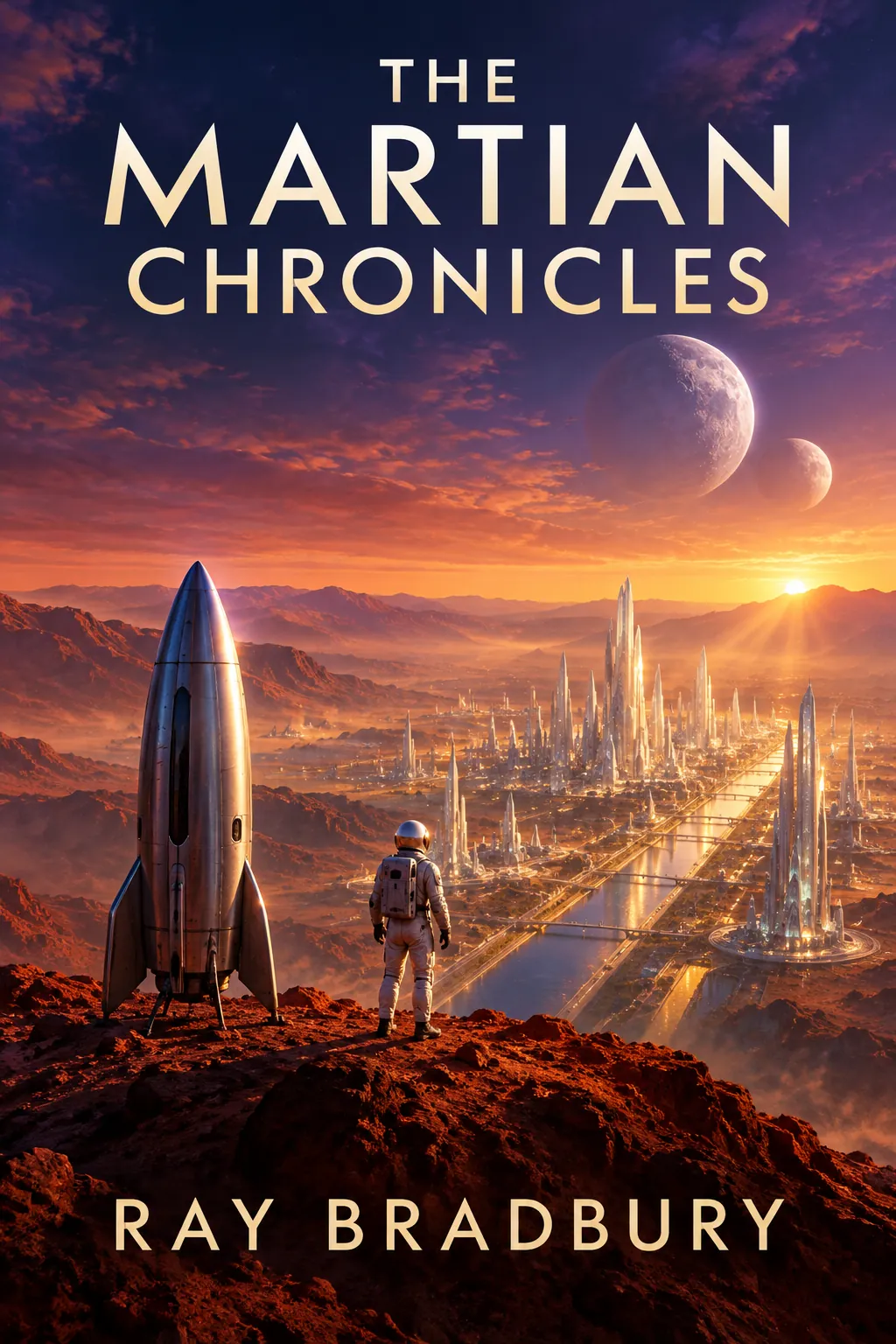
The Martian Chronicles
by Ray Bradbury
The Martian Chronicles is Ray Bradbury's 1950 collection of linked stories about humans colonising Mars over roughly a quarter of a century. The first expeditions meet the telepathic Martians and fail, then settlers arrive in waves, bringing towns, businesses and old prejudices with them. Bradbury uses the red planet to ask what people do with a second chance, and whether they deserve one. It reads as short scenes rather than one plot, and each story works on its own.
Try Audible · As an Amazon Associate we earn from qualifying purchases. Details
The Big Idea
"Bradbury's linked stories follow humans settling Mars in waves, and show that people carry their fears, prejudices and wounds with them, so a new world becomes a mirror of the old one."
Key Insights
A new world mirrors the old one
Every wave of settlers brings its habits to Mars: fear, prejudice, greed and nostalgia. The planet is a stage on which Earth's problems repeat in new costumes.
In the story of the Southern families, racism follows people into the rocket age, and the Mars rush becomes a way of leaving that world behind.
Colonisation destroys what it admires
The Martians are not defeated in a war. They die of a disease the visitors carry, and their cities become museums for people who never knew them. Bradbury suggests that carelessness can be as deadly as cruelty.
Jeff Spender, standing in the empty cities, is the character who says this out loud, and his anger drives the fourth expedition's tragedy.
Imagination needs defending
Bradbury cared about books, stories and dreams as things a society can lose if it stops trusting them. Mars becomes a place where imagination can live, and also where it must be protected.
William Stendahl builds a Poe-style house and uses it to answer a government that bans fantasy.
Technology outlasts the people who made it
The last stories show machines and nature carrying on after human beings have vanished. The warning is quiet: progress without wisdom leaves a perfect house with nobody in it.
In the story of the automated California house, breakfast is cooked and poems are read aloud to empty rooms until the fire comes.
Chapter Breakdown
Chapter-by-chapter summary
Spoiler warning: this section covers the whole plot, including the ending.
The book is a set of linked stories rather than one continuous novel, so this guide takes the main stories in order. It follows the dates of the original 1950 edition, which runs from 1999 to 2026 and falls into three stretches: the first expeditions, the settlement, and the aftermath of a war on Earth.
February 1999: Ylla
Ylla, a Martian wife, keeps dreaming of a tall Earth man named Nathaniel York who is about to arrive on her world. Her husband Yll grows jealous and tense as she talks about the dream.
When the first rocket lands, Yll goes out with a weapon and shoots the visitor before he can say a word. The story shows what first contact looks like in this book: fear on one side, curiosity on the other, and a death nobody can undo.
August 1999: The Earth Men
The second expedition, led by Captain Williams, lands expecting a hero's welcome. A Martian woman greets the crew politely but sends them from one official to the next, because Martians believe they must be hallucinations from a sick mind.
The men are passed on to a doctor who treats them as patients, and the visit does not end well for them. The joke about misunderstanding makes a serious point: the explorers matter far less to Mars than they imagine.
April 2000: The Third Expedition
Captain John Black's crew land and find a quiet town that looks exactly like the small American towns of their childhood. Soon they meet their dead parents and brothers, and they settle into their old homes with relief.
It is a trap. The Martians read the men's minds, build the scene from their memories and kill the crew in their sleep, so homesickness becomes a weapon and every comfort in the book starts to look suspicious.
June 2001: …And the Moon Be Still as Bright
The fourth expedition finds the Martian cities empty. Most Martians have died of chickenpox brought by the earlier visitors, and Jeff Spender, a crew member who knows the dead civilisation's remains well, cannot bear what humans have done.
Spender turns against his crewmates and starts shooting them to keep Mars unspoiled. Captain Wilder understands his anger but hunts him down and kills him, which leaves the book's strongest argument against careless colonisation hanging over everything after it.
December 2001: The Green Morning
Benjamin Driscoll, a settler who struggles to breathe the thin Martian air at first, begins planting tree seeds everywhere he goes. People laugh at him, because the air seems far too thin for trees to grow.
In time young trees rise across the land and the air grows richer for everyone. This is Bradbury at his most hopeful: one stubborn person can make a hard world livable.
August 2002: Night Meeting
Tomás Gomez, a young road worker, meets a Martian driving a strange vehicle across the desert. They talk in a friendly, puzzled way, and each one takes the other for a ghost from a different time.
They wave goodbye and drive on, each wondering whether the other was ever really there. After so much violence, the quiet scene hints that the two peoples might have shared one planet if they had met without fear.
June 2003: Way in the Middle of the Air
Black families in the American South hear that rockets are leaving for Mars, and they begin to leave in large numbers. Samuel Teece, a white store owner, watches angrily as the people he has looked down on prepare to go, and he cannot stop them.
Bradbury uses the rush to Mars to face American racism directly, because the people who were held down choose a new life elsewhere. Teece's rage shows how empty his power was, and the story makes Mars both an escape from Earth's problems and a mirror of them.
April 2005: Usher II
William Stendahl, a rich man who loves horror stories, builds a copy of Poe's haunted house on Mars to protest a government that bans fantasy and burns such books. Officials who enforce the ban come to inspect it.
Stendahl welcomes them inside, and one by one they meet ends borrowed from Poe's tales, until the house falls into ruin. The story defends imagination against censorship and shares its concern with Fahrenheit 451.
December 2005: The Silent Towns
After atomic war breaks out on Earth, almost every settler rushes home, and Walter Gripp is left alone in empty Martian towns. He phones numbers at random until he reaches Genevieve Selsor, who also stayed behind.
They arrange to meet, but Gripp cannot stand her manner and runs away. The tale is funny and bitter at once: even when two people are the only ones left, loneliness does not solve itself.
August 2026: There Will Come Soft Rains
In a California town, an automated house goes on with an ordinary day even though its family is gone. It cooks breakfast, reads the date and a poem aloud, and sends small machines to clean the rooms.
The outlines of the family are burned into an outside wall, a quiet sign of the blast that killed them. A fire starts, the house fights it and loses, and all that survives is a voice repeating the date, which makes this the book's calmest and most chilling scene.
October 2026: The Million-Year Picnic
A father tells his wife and three sons that they are going on a fishing trip, but the rocket is taking them to Mars to escape a ruined Earth. On arrival he burns papers from the old world and promises the boys they will meet Martians.
At a canal he shows them their own reflections in the water. The ending offers hope, with a human family becoming the new Martians, and closes the long sequence on a quiet note.
Characters
- Ylla: a Martian wife who dreams of the first Earth visitor. Her dream brings her husband's jealousy down on the man she imagined.
- Captain John Black: leader of the third expedition. He is uneasy about the perfect little town, and his suspicion proves right.
- Jeff Spender: a crew member of the fourth expedition who falls for dead Martian culture. He becomes the book's angriest critic of human greed.
- Captain Wilder: the fourth expedition's commander. He sympathises with Spender but accepts that he must stop him.
- Benjamin Driscoll: a settler who plants trees to give Mars breathable air. He stands for patient hope.
- William Stendahl: a wealthy book lover who builds a Poe-style house as protest. He fights censorship with imagination.
- Walter Gripp: the lonely man in the silent towns. His story shows that company alone does not cure isolation.
Writing about this book
Do not try to cover the whole book. Pick one idea and two or three stories that prove it.
- Choose a claim. For example: Mars shows how colonisers repeat the faults of the place they left.
- Anchor it in stories. Spender's anger in the fourth expedition and Teece's rage in the story of the Southern families both show the same blindness in different forms.
- Use brief quotes. A phrase such as “One minute it was winter in Ohio” (Rocket Summer) can show how fast Earth's life reaches Mars.
- Explain the structure. The book is linked stories, so say how the order builds a larger picture.
- End with a question. The final scene, with the family looking at their reflections, is a good place to ask who counts as a Martian.
Avoid retelling every story. Examiners and teachers look for what each scene means, not for a list of events.
Related reading
For the author, see Ray Bradbury.
For a book with the same worry about burning ideas, read Fahrenheit 451.
For the real science behind Driscoll's trees, see Terraforming.
Take Action
Practical steps you can implement today:
-
Read the stories as a sequence: each one answers the question the one before it leaves open.
-
When you meet a new place or group, ask what you are bringing with you before you ask what you will find.
-
Treat comfort that appears too easily with a little suspicion, as Captain Black does.
-
Notice who is missing from a utopia, and ask what it would take to include them.
Notable Quotes
"“One minute it was winter in Ohio.” (Rocket Summer)"
— Ray Bradbury
"“Today is August 4, 2026.” (There Will Come Soft Rains)"
— Ray Bradbury
"“The Martians were there.” (The Million-Year Picnic)"
— Ray Bradbury
Who Should Read This
Students from about age 14 who want a short, atmospheric entry into science fiction, and readers of Fahrenheit 451 who want more of Bradbury's voice. It suits high school and college classes on American literature, colonialism or the short story, and anyone who prefers ideas and images to hard science.
Frequently Asked Questions
Is The Martian Chronicles a novel or a short story collection?
It is both in a way. Bradbury wrote separate stories and linked them with dates and recurring ideas into one sequence, a form often called a fix-up novel. Each story can be read alone, but the order builds a larger picture.
When is The Martian Chronicles set?
In the original 1950 edition the stories run from January 1999 to October 2026. Some later editions moved the dates about three decades later, so check which edition you are using before you quote a year in an essay.
Is the book hard science fiction?
No. Bradbury's Mars has breathable air, canals and telepathic Martians, which real science has long ruled out. The book is closer to myth and social commentary, and it is meant to be read for its ideas and mood.
Is The Silver Locusts the same book?
Yes. The Silver Locusts was the title of the British edition published in 1951. It contains the same linked stories, though the contents of different editions have varied slightly over the years.
Do I need to read the stories in order?
You can read a single story alone, such as There Will Come Soft Rains. Reading in order is better for study, because later stories echo earlier ones and the larger theme of repeating mistakes becomes clearer.
Check Your Understanding
Pick an answer for each question to see if you were right.
-
Who wrote The Martian Chronicles?
Ray Bradbury — Ray Bradbury published the book in 1950.
-
What mainly destroys the Martian population in the fourth expedition story?
Chickenpox brought by humans — Earth visitors carried the disease, which killed most Martians.
-
Why do Captain Black's men feel at home in the third expedition story?
The Martians built a replica of their childhood town from their memories — The Martians used telepathy to create a trap from the men's memories.
-
What is left running at the end of There Will Come Soft Rains?
A voice repeating the date — The burning house ends with a voice announcing the date to nobody.
-
What do the boys see in the canal at the end of the book?
Their own reflections — The father shows the family their reflections to say that they are the new Martians.
Want the full book?
Read or listen to The Martian Chronicles in full.
Try Audible · As an Amazon Associate we earn from qualifying purchases. Details
About Ray Bradbury
Ray Bradbury (1920–2012) was an American writer born in Waukegan, Illinois. He is best known for Fahrenheit 451, The Martian Chronicles and Dandelion Wine. He wrote science fiction, fantasy and horror in a lyrical, nostalgic style, and he made the short story a respected form for ideas about technology and memory.
Summary Written By

Software Engineer & Writer
Software engineer with a passion for distilling complex ideas into actionable insights. Writes about finance, investment, entrepreneurship, and technology.
View all summaries →Reviews
No reviews yet. Be the first to share your thoughts!
Write a Review
Keep reading
Explore the topic: Sci-Fi Authors & AwardsSummaries

Out of My Mind
Sharon M. Draper
“Out of My Mind” by Sharon M. Draper is a poignant narrative that explores the life of Melody Brooks, a…

Ender’s Game
Orson Scott Card
“Ender’s Game” by Orson Scott Card is a riveting science fiction novel that transports readers into a future where humanity…

Pachinko
Min Jin Lee
“Pachinko”, a spellbinding multigenerational historical saga by Min Jin Lee, explores the lives of a Korean family trying to make…

The Perks of Being a Wallflower
Stephen Chbosky
The Perks of Being a Wallflower by Stephen Chbosky is a profound coming-of-age novel, told through the intimate letters of…
Articles

Ray Bradbury
Ray Bradbury (1920–2012) was an American writer who turned science fiction into poetry about people. He is best known for…

A Christmas Carol themes: generosity, isolation and responsibility
Dickens's novella is usually read as a story about a man who changes his mind. Its themes are sharper than…
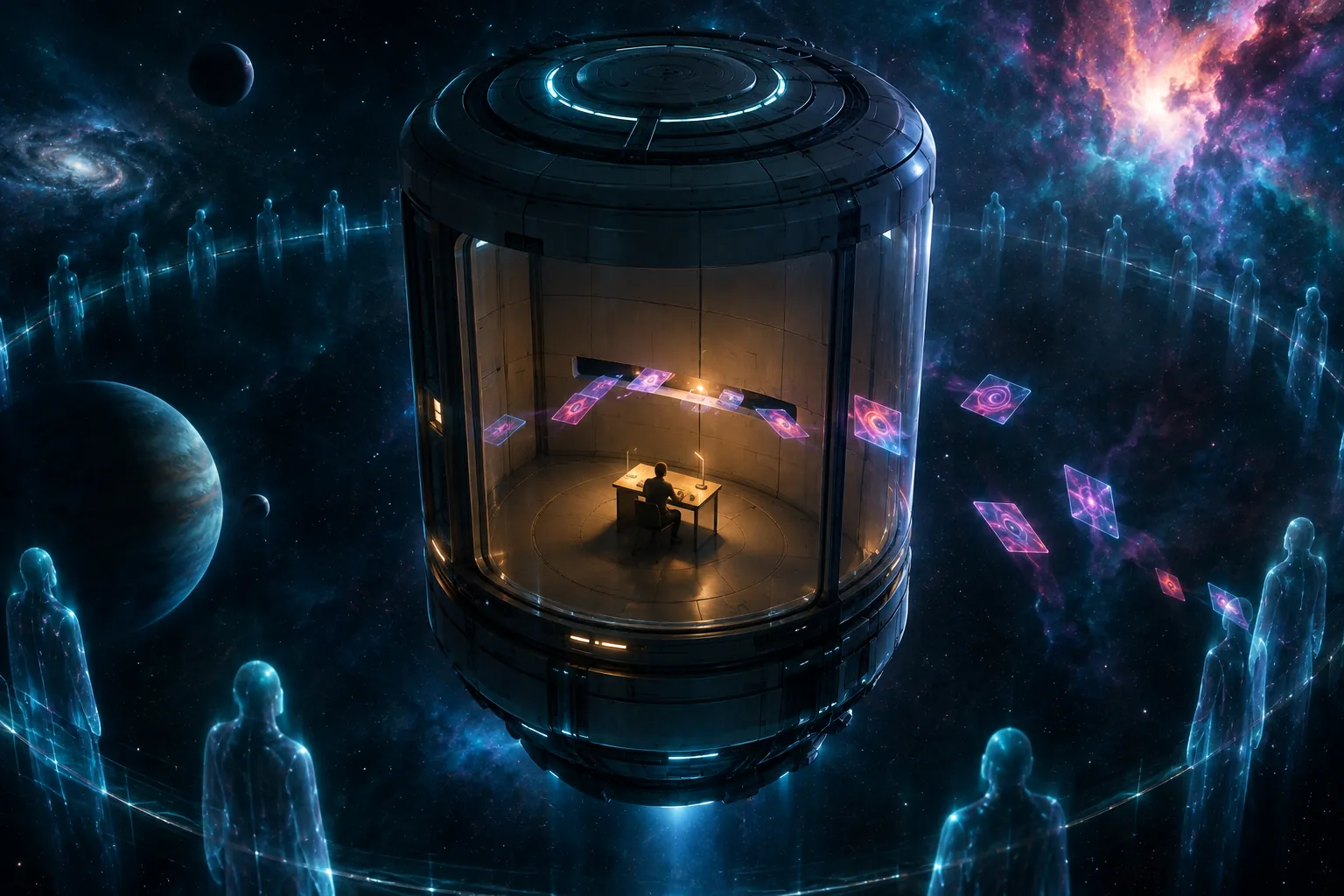
Chinese Room Argument
The Chinese room argument is a thought experiment by philosopher John Searle, published in 1980. It says a computer that…