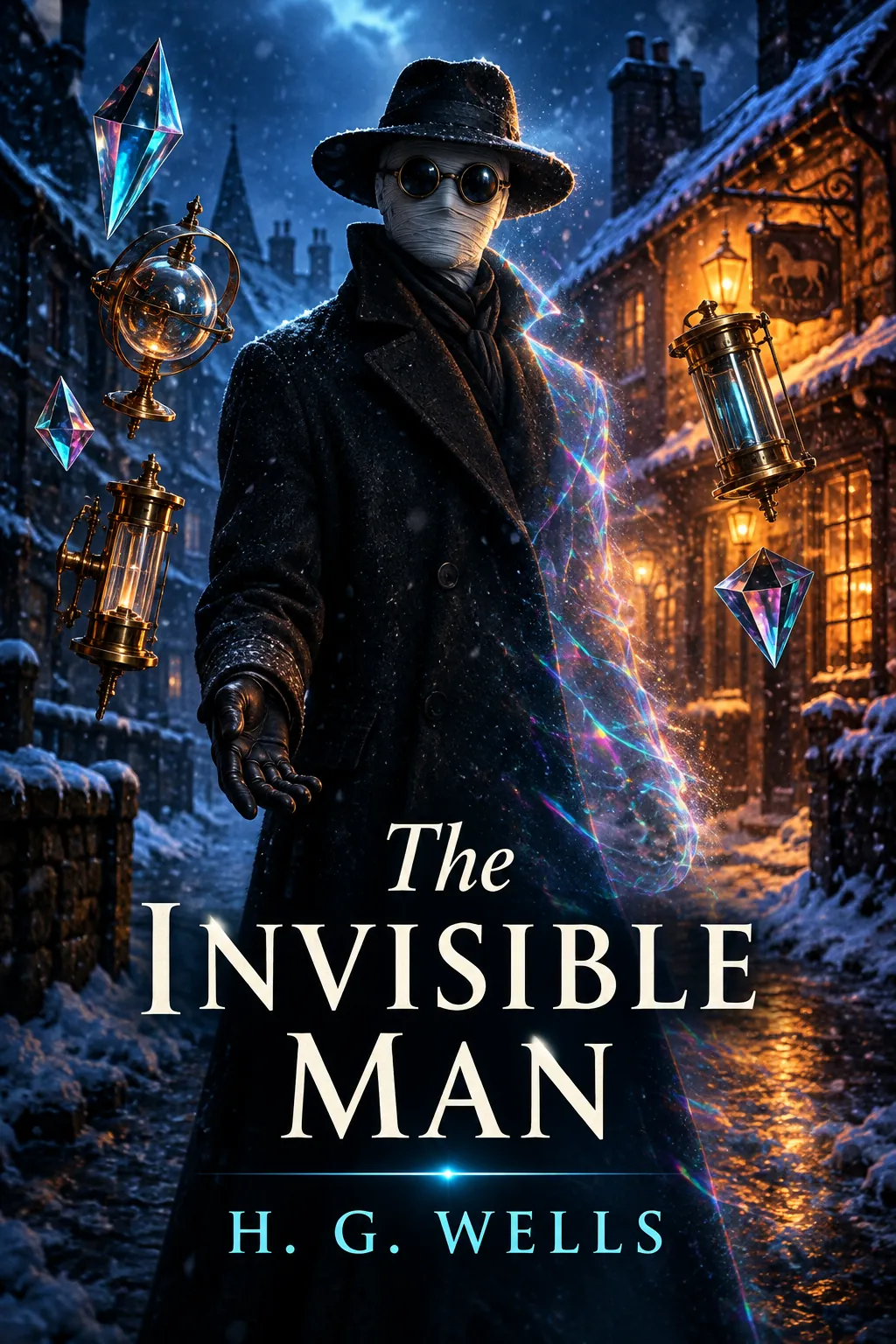
The Invisible Man
by H. G. Wells
The Invisible Man is H. G. Wells's 1897 science-fiction novel about Griffin, a brilliant young scientist who discovers how to make a body invisible and then struggles to live with it. A bandaged stranger arrives in an English village in winter, and the villagers cannot work out who he is or what he is hiding. As his secret comes out, the book turns from a village mystery into a chase, and asks what a person will do when no one can see him. It is short, fast and darker than its reputation.
Try Audible · As an Amazon Associate we earn from qualifying purchases. Details
The Big Idea
"Power that no one can see answers to no one. Wells shows a gifted scientist whose invisibility frees him from every rule and, step by step, cuts him off from every other person."
Key Insights
Power without witnesses
Griffin believes invisibility will make him free, but it removes the one check that keeps most people in line: being seen. Wells shows how quickly a clever, proud man turns to theft, threats and murder when nobody can hold him to account.
In Chapter 24 Griffin plans to terrify and rule a whole town, as if other people were only an obstacle.
Science without conscience
The novel does not argue against science. It argues against a scientist who treats his discovery as private property and gives no thought to its effects. Griffin's formula is brilliant, but he uses it to hide, steal and threaten, and he never asks whether he should.
Griffin sets fire to his lodging to hide his work, and does not think about the people who live around him.
The cost of being unseen
Invisibility sounds like a superpower, but Wells makes it a form of loneliness. Griffin cannot walk in a crowd, eat in public or ask for help without being noticed or hurt. The better he hides, the less he can belong anywhere.
In London he is cold, barefoot and constantly bumped into, and he steals clothes just to look human.
Fear of the unexplained
The Iping villagers know nothing about science, so they fill the gap with rumour and suspicion. Wells is gently comic about them, but the same fear later drives a crowd to kill. The book shows how a strange visitor, with no explanation, becomes an enemy.
The village gossips about the bandaged stranger long before anyone knows what he has done.
Chapter Breakdown
Chapter-by-chapter summary
This page covers H. G. Wells's 1897 novel, not any film. It is not Ralph Ellison's Invisible Man, which has its own page at /books/invisible-man-by-ralph-ellison/.
Spoiler warning: this section covers the whole plot, including the ending.
Part 1 (Chapters 1–4): The Stranger in Iping
On a snowy February day a stranger wrapped in bandages, with dark goggles and a thick coat, takes a room at the Coach and Horses inn in the village of Iping. He pays well, asks to be left alone, and fills the room with bottles and instruments.
Mrs Hall, the landlady, grows uneasy, and the village starts to gossip. Dr Cuss visits out of curiosity and leaves shaken after an odd encounter with the man's empty-looking sleeve.
The point of these chapters is atmosphere. Wells lets a small community's suspicion build before the reader learns what is under the bandages.
Part 2 (Chapters 5–8): The Unveiling
A burglary at the vicarage and a night of furniture moving by itself frighten the village, and the stranger falls behind with his rent. When the constable and villagers try to arrest him, he tears off his bandages and clothes, and there is nothing underneath.
He escapes into the countryside, now naked, cold and hunted. The village mystery is solved, but the book has only changed gears.
These chapters mix comedy and menace: the villagers are funny in their panic, yet the stranger's temper is already dangerous.
Part 3 (Chapters 9–13): The Tramp and the Books
The invisible man forces a tramp, Thomas Marvel, to become his helper and carry his money and the notebooks that hold his research. Marvel is terrified and has no real choice.
Back in Iping the invisible man loses his temper, and the violence grows worse. In Chapter 13 Marvel decides to be free of him and runs off with the books and the money.
The notebooks matter because they hold the only record of how the experiment was done. Whoever has them controls the secret.
Part 4 (Chapters 14–18): Port Burdock and Dr Kemp
Marvel flees to the coast, with the invisible man in pursuit. After a fight at an inn in Port Burdock, the invisible man is wounded and stumbles into the house of Dr Kemp, a scientist he once knew.
He gives his name: Griffin. Kemp is alarmed but treats him kindly, and Griffin sleeps in his house.
The story moves from a village comedy of manners to a city thriller. Kemp becomes the book's moral centre.
Part 5 (Chapters 19–20): Griffin Tells His Story
Griffin explains that he studied light and pigments, and that one idea came to him suddenly and completely. He spent years in secret experiments, ran out of money, and cut himself off from everyone who might have helped.
His father died after Griffin used money that was not his, and Griffin hardly paused to grieve. He then made himself invisible in rented rooms in Great Portland Street and set fire to the house to hide his work.
This is the only time Griffin speaks for himself, and his pride and his coldness are plain to see.
Part 6 (Chapters 21–23): Invisible in London
Griffin's first days of freedom turn out to be miserable. He is cold and barefoot, he is bumped and nearly trodden on in the crowded streets, and he cannot eat or shelter without being noticed.
He hides in a department store, then steals clothes, a false nose and glasses from a theatrical supplier to look human again. Wells makes invisibility a handicap as much as a gift.
Part 7 (Chapters 24–26): The Plan That Failed
Griffin asks Kemp to be his partner in a campaign of fear, to dominate a town and then more. Kemp says yes aloud but secretly sends a note to the police.
When Griffin finds out, he escapes and declares a reign of terror. He kills an old man, Mr Wicksteed, in a lonely field, and the panic spreads through the country.
Part 8 (Chapters 27–28 and Epilogue): The Hunter Hunted
Griffin attacks Kemp's house and Kemp flees through the streets. In the end a crowd catches Griffin and beats him to death.
As he dies his body becomes visible: he is a pale, white-haired young man. In the Epilogue, the tramp Marvel is running a pub with Griffin's notebooks, and he cannot read them.
Characters
- Griffin (the Invisible Man): a gifted young scientist and the novel's central figure. He is brilliant and proud, he ignores the harm he does, and he sees other people only as tools or enemies.
- Dr Kemp: a scientist who knew Griffin at university and takes him in. He is cautious and decent, and he decides he must stop him.
- Thomas Marvel: a talkative tramp who is forced to serve Griffin. He is cowardly and funny, but he is the only one who really understands what Griffin's power costs.
- Mrs Hall: the landlady of the Coach and Horses. She is practical and nosy, and her suspicions start the village's gossip.
- Mr Hall: her husband, the innkeeper, who is slower to doubt his guest. He takes part in the attempt to arrest the stranger.
- Dr Cuss: the local doctor, curious and eager, who is among the first to sense something is wrong.
- The Rev. Bunting: the village vicar, whose house is burgled and who suspects the stranger of being behind it.
- Colonel Adye: the chief of police in Port Burdock. Kemp calls on him when the danger becomes clear.
- Mr Wicksteed: an elderly man killed by Griffin in a field. His death shows how far the violence has gone.
Writing about this book
Start with one clear question, such as: is Griffin a victim of his own invention, or was he always dangerous?
Strong essays make a claim and then test it. For example, argue that invisibility does not change Griffin but only removes the checks that had held him back.
Look at how Wells builds the book. The first chapters are comic and local, the middle gives Griffin's own account, and the last chapters are a chase, and each shift changes how we judge him.
Use short quotes. Griffin's plan to terrify a town in Chapter 24 is a good moment to show his attitude to other people.
Compare the villagers with Kemp. The villagers fear what they cannot explain, while Kemp understands the science and still chooses to act.
You can also connect the novel to its time. In 1897 science was changing daily life quickly, and Wells asks what happens when knowledge is separated from responsibility.
Finally, remember that the samples on this site are for learning. Write your own answer from your own reading.
Take Action
Practical steps you can implement today:
-
Ask what a character would do if no one were watching, and see whether the book answers it.
-
Notice how Wells moves from comedy to menace by changing the pace and the point of view.
-
Separate Griffin's idea, which is clever, from his choices, which are harmful.
-
When you write about the book, quote briefly and always explain what the quote shows.
Notable Quotes
"“He must take some town like your Burdock and terrify and dominate it.” (Chapter 24)"
— H. G. Wells
"“I can walk round a man, whatever weapon he has, choose my point, strike as I like.” (Chapter 24)"
— H. G. Wells
"“It came suddenly, splendid and complete into my mind.” (Chapter 19)"
— H. G. Wells
Who Should Read This
Readers of about 12 and up who like short, fast science fiction, and students studying Wells, the Victorian novel or the ethics of science. It is also a good first step from The Time Machine to his other early novels, and it reads quickly in a weekend.
Frequently Asked Questions
What is The Invisible Man about?
It follows Griffin, a scientist who finds a way to make himself invisible. He arrives as a bandaged stranger in an English village, and as his secret comes out the story becomes a chase and a study of what unchecked power does to a person.
Is it the same as Ralph Ellison's Invisible Man?
No. H. G. Wells's novel of 1897 is science fiction about a literal invisible man. Ralph Ellison's Invisible Man (1952) is a different book about race and identity in the United States, and it has its own page on this site.
How does Griffin become invisible?
Griffin says he found a way to change how a body bends light so that it neither reflects nor absorbs it. Wells gives only a sketch, and the science is imaginary, so the book works as a thought experiment rather than a method.
When was The Invisible Man published?
It first appeared in 1897, as a magazine serial and then as a book. It has 28 chapters and an epilogue, which is short enough to read in a few sittings.
Who is the villain of the book?
Most readers see Griffin as the antagonist, because he steals, threatens and kills. Wells also lets us see his loneliness, so he is closer to a tragic figure than a simple villain.
What themes should I write about?
Good topics are power and responsibility, the loneliness of invisibility, science without ethics, and the way a community reacts to a stranger. Choose one and support it with short quotes and scenes.
Check Your Understanding
Pick an answer for each question to see if you were right.
-
Who wrote The Invisible Man?
H. G. Wells — H. G. Wells published the novel in 1897.
-
In which village does the stranger first take a room?
Iping — He takes a room at the Coach and Horses inn in Iping.
-
What is the name of the scientist who becomes invisible?
Griffin — The invisible man is Griffin, who tells his story to Dr Kemp.
-
Who carries Griffin's notebooks after he is forced to serve him?
Thomas Marvel — The tramp Thomas Marvel carries the books, then runs away with them.
-
What does Griffin say he wants to establish in Chapter 24?
A reign of terror — He tells Kemp that the Invisible Man must establish a reign of terror.
Want the full book?
Read or listen to The Invisible Man in full.
Try Audible · As an Amazon Associate we earn from qualifying purchases. Details
About H. G. Wells
Herbert George Wells (1866–1946) was an English writer who helped shape modern science fiction. His early novels The Time Machine (1895), The Island of Doctor Moreau (1896), The Invisible Man (1897) and The War of the Worlds (1898) set one startling scientific idea inside an ordinary English world. He also wrote social novels, histories and essays about the future.
Summary Written By

Software Engineer & Writer
Software engineer with a passion for distilling complex ideas into actionable insights. Writes about finance, investment, entrepreneurship, and technology.
View all summaries →Reviews
No reviews yet. Be the first to share your thoughts!
Write a Review
Keep reading
Explore the topic: Sci-Fi Authors & AwardsSummaries

Out of My Mind
Sharon M. Draper
“Out of My Mind” by Sharon M. Draper is a poignant narrative that explores the life of Melody Brooks, a…

Ender’s Game
Orson Scott Card
“Ender’s Game” by Orson Scott Card is a riveting science fiction novel that transports readers into a future where humanity…

Pachinko
Min Jin Lee
“Pachinko”, a spellbinding multigenerational historical saga by Min Jin Lee, explores the lives of a Korean family trying to make…

The Perks of Being a Wallflower
Stephen Chbosky
The Perks of Being a Wallflower by Stephen Chbosky is a profound coming-of-age novel, told through the intimate letters of…
Articles

H. G. Wells
H. G. Wells (1866–1946) was an English writer who helped found modern science fiction. His 1890s novels The Time Machine,…

History of Science Fiction
The history of science fiction runs about 200 years, from Mary Shelley's Frankenstein in 1818. Jules Verne and H. G.…

A Christmas Carol themes: generosity, isolation and responsibility
Dickens's novella is usually read as a story about a man who changes his mind. Its themes are sharper than…