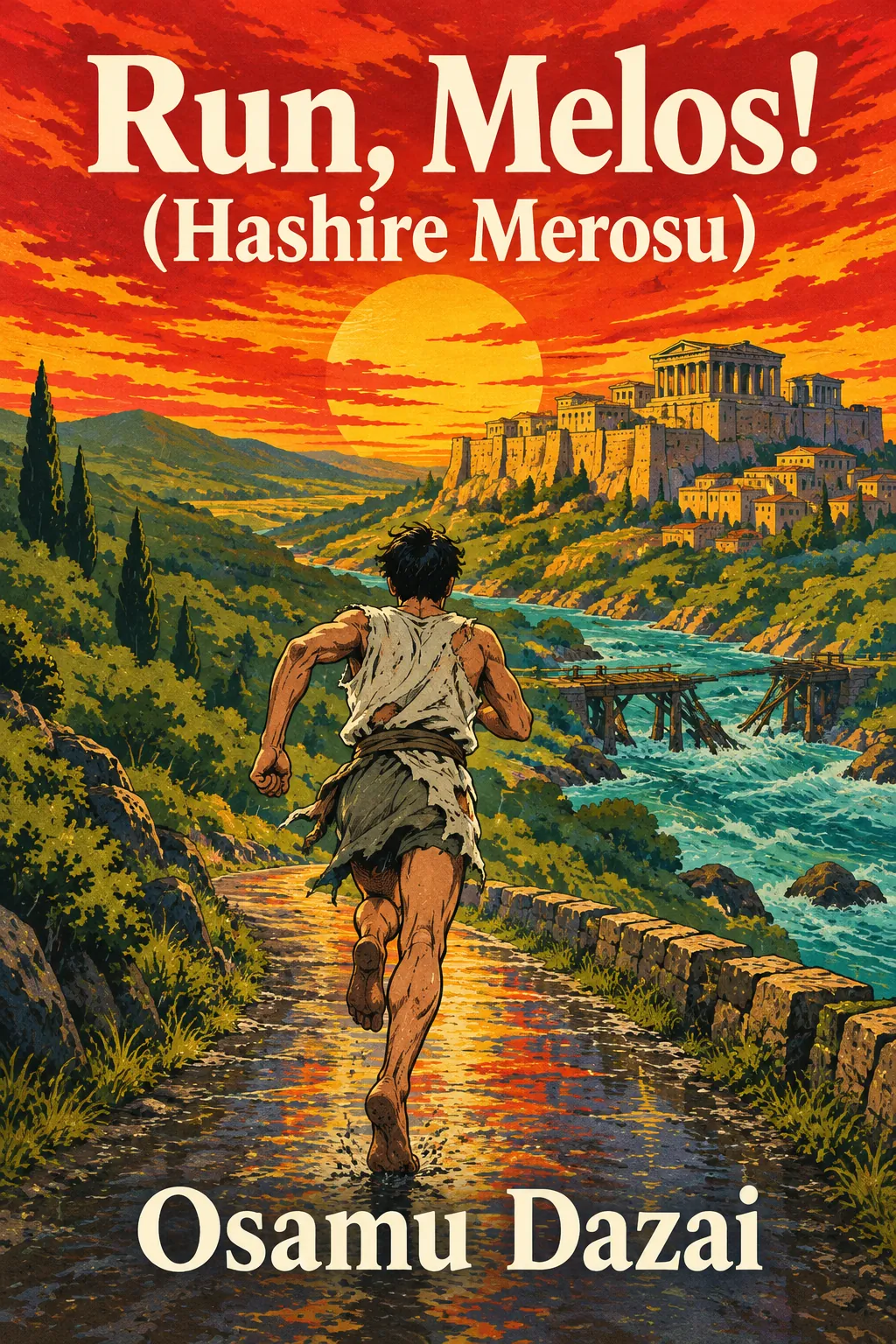
Run, Melos! (Hashire Merosu)
by Osamu Dazai
Run, Melos! is a short story by Osamu Dazai, first published in 1940. Melos, a simple shepherd, storms into the city of Syracuse to kill its tyrant and is caught. He is given three days to attend his sister's wedding, on one condition: his best friend Selinuntius stays behind as a hostage. If Melos is not back by sunset on the third day, the friend will die. Flood, bandits and exhaustion stand in his way.
The Big Idea
"A shepherd leaves his best friend as a hostage and races back against the sunset to keep a promise. The story asks whether trust can survive doubt."
Key Insights
Trust is offered before it is proved
Neither friend can know that the other will keep his word. They choose to trust anyway, and the story sets this choice against the king's belief that people only act from self-interest. The king's world is the opposite: he demands proof, finds none and so kills.
Selinuntius hears the plan, asks nothing and nods. That silent nod is the starting point of the whole plot, and Melos spends the story trying to deserve it.
Weakness makes the hero believable
Melos can swim a flooded river and beat bandits, yet the scene readers remember is him lying by the road making excuses. The story does not hide his weakness. It shows that he recovers from it. Readers who expect a flawless hero may be surprised, but this is where the story becomes honest.
A small sound of water, not a grand speech, brings him back. He then reminds himself that he is trusted, and he runs on.
Trust that has met doubt is stronger
At the end both friends confess that they doubted the other once. The doubt is not erased but admitted, and the trust is then rebuilt on equal terms. This is why the final scene feels earned and not sentimental.
The blows they exchange are both punishment and forgiveness. Seeing this, even the king changes his mind about people.
The purpose of the run changes
At first Melos runs to arrive before sunset. By the end he runs because he is trusted, whether or not he arrives in time. Teachers often call this the shift from a race against time to a test of character.
When Philostratus says it is too late, Melos answers that being in time does not matter. Running becomes a statement of how he wants to live.
Chapter Breakdown
Chapter-by-chapter summary
Spoiler warning: this section covers the whole plot, including the ending.
Part 1: Melos Is Furious
Melos is a shepherd who lives with his young sister in a village. He plays his pipe, looks after his sheep and knows nothing about politics.
He has come to Syracuse to shop for his sister's wedding, and he finds the city strangely quiet. He learns that King Dionysius has been executing people, even relatives and loyal ministers, because he trusts no one.
Melos is outraged. He walks into the palace with a dagger and is arrested at once.
Nothing in his walk to the palace is planned, which shows how anger moves him faster than thought.
Why it matters: the opening shows a hero driven by simple, pure anger, which makes his later doubts all the more striking.
Part 2: The Bargain
Brought before the king, Melos says he wanted to free the city from a tyrant. The king answers coldly that people are selfish and cannot be trusted.
Melos accepts that he will be crucified, but he asks for three days to hold his sister's wedding. As a guarantee he offers his old friend Selinuntius, a stonemason, as a hostage.
The king agrees, half hoping that Melos will fail and prove his point. Selinuntius hears the plan, nods without a word and lets himself be tied up.
The conversation between the two men is really a debate: one side stands for doubt, the other for trust.
Why it matters: the whole story rests on this wager, trust against doubt, played for a human life.
Part 3: The Wedding
Melos hurries through the night to his village and persuades his shy sister and her reluctant groom to hold the wedding without delay. The ceremony goes ahead as rain begins to fall.
Among the happy guests Melos catches himself wishing he could stay for the rest of his life. At dawn he forces himself up and sets out for Syracuse.
The calm of the village shows what he is risking, and the happier it is, the heavier his decision to leave becomes.
Why it matters: his reluctance to leave shows that he is a real person with something to lose, not a symbol.
Part 4: Flood and Bandits
The night's rain has swollen the river and swept away the bridge. Melos prays to the river gods, throws himself into the current and swims across.
On the far side a band of bandits blocks the road. He seizes a club, knocks several of them down and runs on.
The scene sets the power of nature against one small human being, and the human being still crosses.
Why it matters: nature and violence test his body in turn, but both are obstacles from outside. The hardest test is still to come, inside him.
Part 5: The Collapse
As the sun climbs, Melos's strength runs out. He falls and cannot get up.
He begins to make excuses: he did his best, no one can blame him, perhaps he should simply live on as a villain. Then he hears a thin trickle of water from a crack in a rock.
He drinks, and his body and his sense of duty return together. He tells himself that he is trusted and that his own life hardly matters, and he runs again.
This is the passage in which his inner voice is heard most clearly, so it is worth asking whom the excuses are addressed to.
Why it matters: this is the low point of the story, and it proves that Melos is no flawless hero.
Part 6: Philostratus
As the sun sinks, Melos is chased down the road by Philostratus, a young disciple of Selinuntius. The young man begs him to stop, saying it is too late and that Melos should save himself.
Melos answers that he runs precisely because he is trusted, and that being on time is not the point. He feels he is running for something far larger than himself.
Philostratus also speaks for the reader, who fears by now that the run is hopeless.
Why it matters: his goal changes from winning a race to answering a trust.
Part 7: The Execution Ground
Just before sunset Melos staggers into the execution ground as Selinuntius is being hauled up onto the cross. He shouts that he is the one who must die.
He then confesses that on the road he had a bad dream and nearly gave up, and he asks his friend to strike him. Selinuntius hits him hard.
Selinuntius admits that in three days he doubted Melos just once, and he asks to be struck in return. Melos hits him.
Why it matters: each man admits a doubt before anyone celebrates, so the reunion is built on honesty.
Part 8: The Embrace and the Red Cloak
The two friends weep in each other's arms. The king, who has watched it all, says that trust was never an empty dream and asks to join their friendship, and the crowd cheers.
A girl offers Melos a red cloak, since he is almost naked after the river and the fight. Selinuntius points it out, and the hero blushes deeply.
Why it matters: the ending admits doubt and still chooses trust, which is the point of the whole story.
Characters
Melos: a village shepherd who lives with his sister. He is honest, hot-tempered and brave, and he is changed by his own moment of weakness.
Selinuntius: a stonemason and Melos's old friend. He accepts the hostage's role without a word.
King Dionysius: the tyrant of Syracuse, who believes that no human being can be trusted. He is the opposing view the story argues against.
Melos's sister: a shy girl of sixteen whose wedding sets the plot in motion.
Philostratus: Selinuntius's young disciple, who tries to stop Melos and so shows how hopeless the situation looks.
The bridegroom: a young shepherd who first asks for more time but agrees to marry at once.
Background and context
Dazai published Run, Melos! in 1940, when he was in his early thirties. The story is set in ancient Syracuse in Sicily, but its voice and feelings belong to modern Japanese fiction.
The plot comes from an ancient Greek legend about two friends and a tyrant, which the German poet Schiller turned into a ballad. Dazai kept the outline and gave it his own rhythm, short sentences and a hero who can be tired, shy and proud.
Dan Kazuo's memoir of Dazai records that Dazai once left Dan waiting at an inn in Atami while he went to fetch money. Readers often link that episode to the idea for this story.
The story is short, can be read in about half an hour and appears in many Japanese school textbooks. That is why teachers use it to practise reading feelings and writing short answers.
Style and language
Dazai uses short sentences, repetition and direct statements, so the reader feels the rhythm of running. The opening line, which names Melos's anger in one short sentence, is a good example.
The narrator speaks with warmth and sometimes with a gentle joke, most clearly in the final line about the red cloak. This lightness keeps the heavy theme from becoming preachy.
Notice also how often the story names the sun. Its position works like a clock and gives each scene a sense of urgency.
Exam tips
Japanese tests on this story usually ask for feelings, reasons and short written answers. Practise by marking the sentence before each underlined phrase.
For a reason question, look at what happened just before. For a feeling question, look at the words for the body, such as falling, tears or blushing.
For a theme question, link two scenes, such as the collapse and the exchange of blows. A link between scenes is what separates a good answer from a basic one.
Practise counting characters too. A 60-character answer holds one idea, and a 100-character answer holds two ideas joined by a cause.
Writing about this book
Start with one scene that moved or surprised you, not with the plot. The collapse by the road and the exchange of blows at the end both work well, because they can be tied to your own experience.
Look at how Melos is built. He is brave, but he is also tired, tempted and ashamed, and readers trust him more for it.
Compare the two views of people in the story. The king thinks humans are selfish, while Melos and Selinuntius act on trust, and the ending shows both sides changing a little.
Use short quotations only, and explain what each one shows. A good paragraph makes a claim, gives one piece of evidence from the text and then comments on it.
For a reflective report, connect the story to something you have lived, such as keeping a promise when it was hard. Keep your own voice, and use the sample answers on this page only to compare with your own work.
Take Action
Practical steps you can implement today:
-
When you are asked to trust someone, ask whether you can take the first step without waiting for proof.
-
Notice the excuses you make when a promise becomes hard. Spotting them is the first step to keeping the promise.
-
Admitting a doubt honestly can bring people closer rather than push them apart.
-
For exam questions about feelings, set out the cause, the feeling and the action in that order.
Notable Quotes
"“Melos was furious.” (Part 1, opening line)"
— Osamu Dazai
"“Whether I make it in time is not the question.” (Part 6)"
— Osamu Dazai
"“Trust was never an empty dream.” (Part 8, the king)"
— Osamu Dazai
"“The hero blushed deeply.” (Part 8, last line)"
— Osamu Dazai
Who Should Read This
Students in junior and senior high school who study this story in Japanese class, and anyone who wants a short, strong story about friendship and trust. It is quick to read, and this guide helps with tests, 記述 questions and book reports.
Characters
Melos
protagonist
A village shepherd who lives with his sister. He is honest and quick to anger, and he is tested by his own weakness more than by flood or bandits.
Selinuntius
foil
Melos's old friend, a stonemason in Syracuse. He becomes a hostage without a word of complaint and shows trust in its quietest form.
King Dionysius
antagonist
The tyrant of Syracuse, who executes people because he trusts nobody. He stands for the belief that human beings are selfish, and the ending proves him partly wrong.
Melos's sister
supporting
A shy girl of sixteen. Her wedding is the reason Melos asks for three days, so she sets the plot in motion without ever knowing its risks.
The bridegroom
supporting
A young shepherd who asks for more time to prepare but agrees to marry at once. He shows how ordinary people pull Melos back toward ordinary happiness.
Philostratus
messenger
A young disciple of Selinuntius who meets Melos late on the road. He begs Melos to give up, which makes Melos explain why he keeps running.
Exam practice: sample answers
Model answers are examples to learn from; write your own in your words.
記述問題 (reason explanation)
1. Melos collapses at the roadside and almost gives up. Why does this happen? (Japanese original: a written answer of about 60 characters.)
Outline
- Name the physical cause: river and bandits
- Name the inner cause: wish to live, excuses
- Link to the recovery at the spring
Basic Model answer
Melos nearly gives up because he is exhausted. He has swum across a flooded river and fought off a gang of bandits, so his body has nothing left.
He falls down and cannot get up. He feels that it is no longer possible to keep his promise.
He has also been running since dawn, and the sun is climbing higher. He is afraid that he cannot reach the city in time.
His mind is tired as well, and the thought that it is impossible takes over. This is why he stops trying, even though he still wants to save his friend.
Short answer for the exam: he has used up all his strength after the river and the bandits, and he loses the will to run.
Good Model answer
Melos collapses for two connected reasons, one physical and one mental.
First, his body is spent. He has crossed a flooded river and fought bandits, and he has been running since dawn.
Second, his mind starts to give way. When he left his sister's wedding he already wished he could stay with the happy guests, so a wish to live was waiting under his sense of duty.
Once he is exhausted, that wish comes out. He begins to excuse himself: he has done his best, and if he is late it is not his fault.
He even imagines living on as a villain. The thought shows how far his resolve has slipped from the angry, certain man of the opening.
So Melos is caught between saving his friend and saving himself. The collapse is the point where those two pulls meet.
A 60-character answer should join these ideas in order: exhaustion, then the pull of his own life, then the excuses. It should end on the result, that he nearly stops running.
This matters because the spring scene that follows only makes sense if he has fallen first. The water does not create his will; it lets the will return.
A common weakness is an answer that stops at tiredness. It is correct but thin, because the question asks for the reason behind his state of mind as well.
A model answer therefore names the cause, the feeling and the result in one line.
Excellent Model answer
Melos collapses because physical exhaustion releases a doubt that has been growing since the wedding: he would like to live, and his sense of duty is no longer strong enough to hide it.
The text offers three pieces of evidence. The river and the bandits drain his strength.
The wish to stay among happy people shows that his life matters to him. His excuses then show him preparing to treat failure as bad luck.
These form a chain: exhaustion is the trigger, the wish to live is the background and the self-defence is the result. A strong 60-character answer packs this chain into one sentence and ends on the outcome, that he nearly drops his will to run.
The scene also changes how we read the story. At the start Melos is a simple man driven by anger.
Here he becomes aware of his own selfishness, and the story stops being a plain tale of heroism. A hero who never doubts would make the ending hollow.
This sets up the ending. The outside obstacles are over, and now the obstacle is inside him.
When the two friends later confess their doubts, the scene by the road shows that doubt is part of what makes the trust real. Selinuntius's single doubt during the three days mirrors Melos's doubt on the road.
Notice also what the answer must not claim. The text never says Melos fears the king, so adding fear of punishment would invent a reason.
Wording matters too. 'Gave up' is too strong, because he never decides to stop for good, while 'nearly gave up' keeps the question's own limit.
A useful exam routine has four steps. Find the event just before the underlined line, name the physical cause, name the inner cause, and close on the result.
For a multiple-choice version, the same chain helps. A wrong option usually keeps the first half of the chain but adds a reason the text does not give.
Beware answering only with tiredness, which is too thin.
Finally, compare your own answer with these three. If yours has the cause but not the chain, you are at good level, and if it also explains why the scene matters to the whole story, you are close to excellent.
Marking rubric
- States the physical cause with text evidence
- States the inner cause (wish to live, excuses)
- Orders the reasons logically and ends on the result
- Does not add reasons that are not in the text
Now write your own
Answer the question yourself in one sentence of about 60 Japanese characters, then compare it with the three samples.
記述問題 (100 characters)
2. Why do Melos and Selinuntius strike each other's cheeks at the end? (Japanese original: explain in 100 characters or fewer, using both men's feelings.)
Outline
- Melos's confession
- Selinuntius's confession
- What the blows mean
- What it shows about trust
Basic Model answer
The two friends strike each other because they are happy to meet again and want to show that they are still friends.
Melos asks to be hit first, and Selinuntius agrees. Then they hug.
In the story the blows come just after Melos arrives at the execution ground. He has run all day, and his friend is nearly on the cross.
So the blows are a way of showing their friendship after a hard time. They do not mean that the two men are angry.
Short answer: they hit each other to confirm their friendship. It earns some marks, but it does not yet say what they confess.
To improve, look for what each man says just before the blows.
Good Model answer
The blows come after a double confession, so the answer must cover both men.
Melos tells his friend that on the road he almost gave up and nearly betrayed him. He wants to be hit as a punishment.
Selinuntius also admits that during the three days he doubted Melos once. He agrees to strike Melos and asks Melos to strike him back.
The wording of the question helps. It asks for both men's feelings, so an answer about Melos alone loses marks.
The blows are therefore a way of paying for their doubts and forgiving each other. Both men are ashamed of the same weakness, and each takes the other's hand as the way to put it right.
Notice that neither man is blamed by the other. Melos is struck first, then Selinuntius asks to be struck in return, so the exchange is equal.
Their feelings are shame at their own doubt and relief that the other has come through. Shame explains why they ask for punishment, and relief explains why they then weep and embrace.
Ordinary violence would hurt someone who had done wrong. Here the blows come from love, so the cause of the act is friendship and its purpose is repair.
A model answer in 100 characters would name both doubts, say that the blows are punishment and forgiveness, and end with the renewed trust.
This works well because it follows the order of the scene and does not skip either man.
Excellent Model answer
The blows work only because the confession is mutual. Neither man forgives from above.
Each admits one moment of doubt and asks for punishment, and in this way they stand as equals.
The scene rests on a paradox. Striking someone is normally an attack, yet here each man hands his guilt to the other and takes the other's pain on himself.
It is a ritual of atonement and forgiveness at once.
The structure of the scene supports this reading. Melos confesses his bad dream and is struck first; only then does Selinuntius admit his own single doubt and ask to be struck in return.
The order matters because Selinuntius has already punished Melos and could have stayed silent, playing the faithful friend. Instead he chooses honesty, and he accepts the same blow himself.
The act is physical in a story that is otherwise about distance and running. After days of separation the first contact between the friends is a blow and then an embrace.
This also deepens the meaning of trust. If neither had ever doubted, their trust would be innocent and untested.
Because they admit doubt and choose each other again, the trust becomes something stronger than a feeling of certainty.
Compare this with the king's world, where people are killed on suspicion. Here two men hurt each other on purpose, in the open, and the hurt ends the suspicion instead of causing more.
The king reads the scene the same way. He is moved not by two perfect friends but by two people who were honest about weakness, and so he says that trust is no empty dream.
The red cloak at the very end turns the same scene toward gentle humour, so the story closes on warmth, not on violence.
A strong 100-character answer would run in this order: each man doubted once, each confessed, the blows forgave the doubt, and the trust was reaffirmed on equal terms.
In practice, draft the long version first, then cut it to the limit, keeping the nouns for the two confessions and the verb for the forgiveness.
Avoid saying that they were making up after a quarrel. They never quarrelled, and that reading hides the point.
Marking rubric
- Names Melos's doubt and Selinuntius's doubt
- Explains the blows as punishment and forgiveness
- States the result: renewed, equal trust
- Keeps within the character limit
Now write your own
Write your own 100-character answer, then underline the words that show both men's feelings.
book report / reflection
3. Write a short reflection (a book-report paragraph) on one scene in Run, Melos! that stayed with you, and connect it to your own experience. (Japanese original: 読書感想文.)
Outline
- Choose one scene
- Say what surprised you
- Give one short piece of evidence
- Connect it to your own life
- State how your view changed
Basic Model answer
Reading Run, Melos! taught me how important it is to trust friends. Melos leaves his friend as a hostage so that he can go to his sister's wedding.
On the way back there is a flood and there are bandits, but he keeps running. I thought that was great.
I have also found it hard to keep a promise to a friend. Once I was nearly late for a club meeting, but I ran and arrived on time, and my friend was glad.
I want to be a person who keeps promises like Melos.
Good Model answer
The scene that stayed with me most is Melos lying by the road, ready to give up. I expected a perfect hero, so his excuses surprised me, but I soon felt he was more human for them.
What brings him back is only the sound of water from a rock. After drinking, he decides he must run because he is trusted.
That idea reminded me of a relay race. I was chosen as the last runner, and my leg hurt just before the start.
I almost refused.
Then I remembered that my teammates had trusted me with the baton, and I ran. We came second, but I had no regrets.
From this I learned that trust is not only comfort for the one who is trusted. It also gives that person strength.
Melos could run because a friend was waiting.
Looking back, I think the scene matters because it shows the cost of trust. Being trusted is not only a gift, because it is also a weight that has to be carried.
I used to think that a promise was easy to keep if you cared enough. The story made me see that even a good person wants to quit when he is tired.
That is a more honest view, and it makes me less hard on myself when I struggle.
I will also try to say thank you to people who trust me, since they carry a risk as well.
Next time someone trusts me, I want to answer with action.
Excellent Model answer
The turning point of Run, Melos!, I think, is not the run but the exchange of blows. After saving his friend, Melos does not celebrate.
He confesses that he almost gave up, and Selinuntius confesses that he doubted once too.
At first I did not understand why a story about trust would show doubt. The reason became clear when I returned to the scene by the road.
There Melos considers living on as a villain, and what brings him back is the resolve that whether he is on time is not the point.
So trust in this story does not mean having no doubt. It means choosing again, with the doubt in plain sight.
I also noticed how carefully the story is built around this idea. The first half is about distance, flood and bandits, and the second half is about the voice in his own head.
That shift from outside to inside is why the exchange of blows feels earned rather than sudden.
This changed how I read an experience of my own. On a school committee I told a friend I would take care of a task, then wanted to run away when it became heavy.
I told myself I had done enough.
When I recognised that voice as Melos's, I told my friend the truth the next day and we finished the work together. We became closer than before.
Another detail surprised me on a second reading. The last line has Melos blushing because he is almost naked, which turns a heavy scene into a gentle joke.
I think this matters because it keeps the hero human to the very end. He is praised by a king and a crowd, and the story still lets him feel embarrassed.
Writing this report also changed how I think about promises. I used to treat them as a test of strength, and now I treat them as a test of honesty.
If I am tired and cannot keep a promise, the brave thing may be to say so early, as Melos and Selinuntius do in the end.
Perhaps Dazai is saying that people may be trusted even when they are weak. I want to know my own weakness and still be someone who can trust and be trusted.
Marking rubric
- Chooses and explains one specific scene
- Links the scene to the student's own experience
- Uses short evidence from the text
- Shows how the student's view changed or deepened
Now write your own
Write your own reflection of 200 to 300 words on a scene you chose yourself. Do not copy the samples.
Frequently Asked Questions
What is Run, Melos! about?
A shepherd named Melos is caught trying to kill a tyrant and is given three days to attend his sister's wedding. His friend Selinuntius stays behind as a hostage, and Melos must return by sunset on the third day or the friend will be killed. The story follows his race back through a flood, bandits and exhaustion.
Who are the main characters?
The three central figures are Melos, his friend Selinuntius and King Dionysius of Syracuse. Smaller roles are Melos's sister, her groom and Selinuntius's disciple Philostratus, who tries to stop Melos near the end.
What is the theme of Run, Melos!?
The main theme is trust and friendship. The story also explores how doubt and weakness test trust, and how the king's belief that people cannot be trusted is answered by the two friends.
Where does the story come from?
Dazai built it on an ancient legend that the German poet Schiller also used in a ballad, Die Bürgschaft, often called The Hostage in English and known in Japanese as 『人質』. Dazai retold the material as a short Japanese story and published it in 1940.
How do I answer a Japanese feelings question on this story?
Set out three things: what happens, what the character feels because of it, and what he then does. For the collapse scene, for example, give the exhaustion after the river and the bandits, the thought of giving up and the recovery at the spring.
Which scene is good for a book report?
Choose one scene and start from what surprised you. The collapse by the road and the exchange of blows at the end are both good, because they link easily to your own experience.
Check Your Understanding
Pick an answer for each question to see if you were right.
-
Whom does Melos leave as a hostage?
Selinuntius — His old friend Selinuntius, a stonemason, stays in the city as a hostage.
-
How long does the king give Melos?
Three days — Melos is given three days to hold his sister's wedding and return.
-
By when must Melos return?
Sunset on the third day — If he is not back by sunset on the third day, Selinuntius will be put to death.
-
What helps Melos get up after he collapses?
The sound and taste of spring water — He hears water trickling from a rock, drinks and regains his strength and his resolve.
-
What does the king ask for at the end?
That he be allowed to join their friendship — Moved by the two men, the king asks to be accepted as a third friend.
About Osamu Dazai
Osamu Dazai (1909–1948) was a Japanese novelist born in Aomori Prefecture. He is best known for the novels The Setting Sun and No Longer Human, and for short stories such as Run, Melos! His plain, intimate voice made him one of the most widely read writers of modern Japan.
Summary Written By

Software Engineer & Writer
Software engineer with a passion for distilling complex ideas into actionable insights. Writes about finance, investment, entrepreneurship, and technology.
View all summaries →Reviews
No reviews yet. Be the first to share your thoughts!
Write a Review
Keep reading
Explore the topic: Study GuidesSummaries
Animal Farm by George Orwell
George Orwell
The animals of Manor Farm revolt against their human owner to create a utopian society based on equality. However, the…

The Outsiders by S.E. Hinton
S.E. Hinton
Ponyboy Curtis and his gang of Greasers clash with the wealthy Socs in a cycle of violence. After a tragic…

The Great Gatsby by F. Scott Fitzgerald
F. Scott Fitzgerald
Nick Carraway enters the orbit of Jay Gatsby, a mysterious millionaire obsessed with reclaiming his past love, Daisy Buchanan. Amidst…
Of Mice and Men by John Steinbeck
John Steinbeck
George and Lennie, two migrant workers during the Great Depression, dream of owning their own land to escape a life…
Articles
Dokusho Kansobun for High School: How to Write a Japanese Book Reflection
A dokusho kansobun is a Japanese book reflection: not a plot summary, but your own thinking about a book, backed…
Kyotsu Test Japanese (共通テスト国語): Time Plan and Strategy
The Kyotsu Test Japanese paper is a 90-minute, 200-point multiple-choice exam with five sections: three modern-text sections, classical Japanese and…
How to Write a Literary Analysis Essay
A literary analysis essay argues one clear claim about how a text works and proves it with short quotations and…