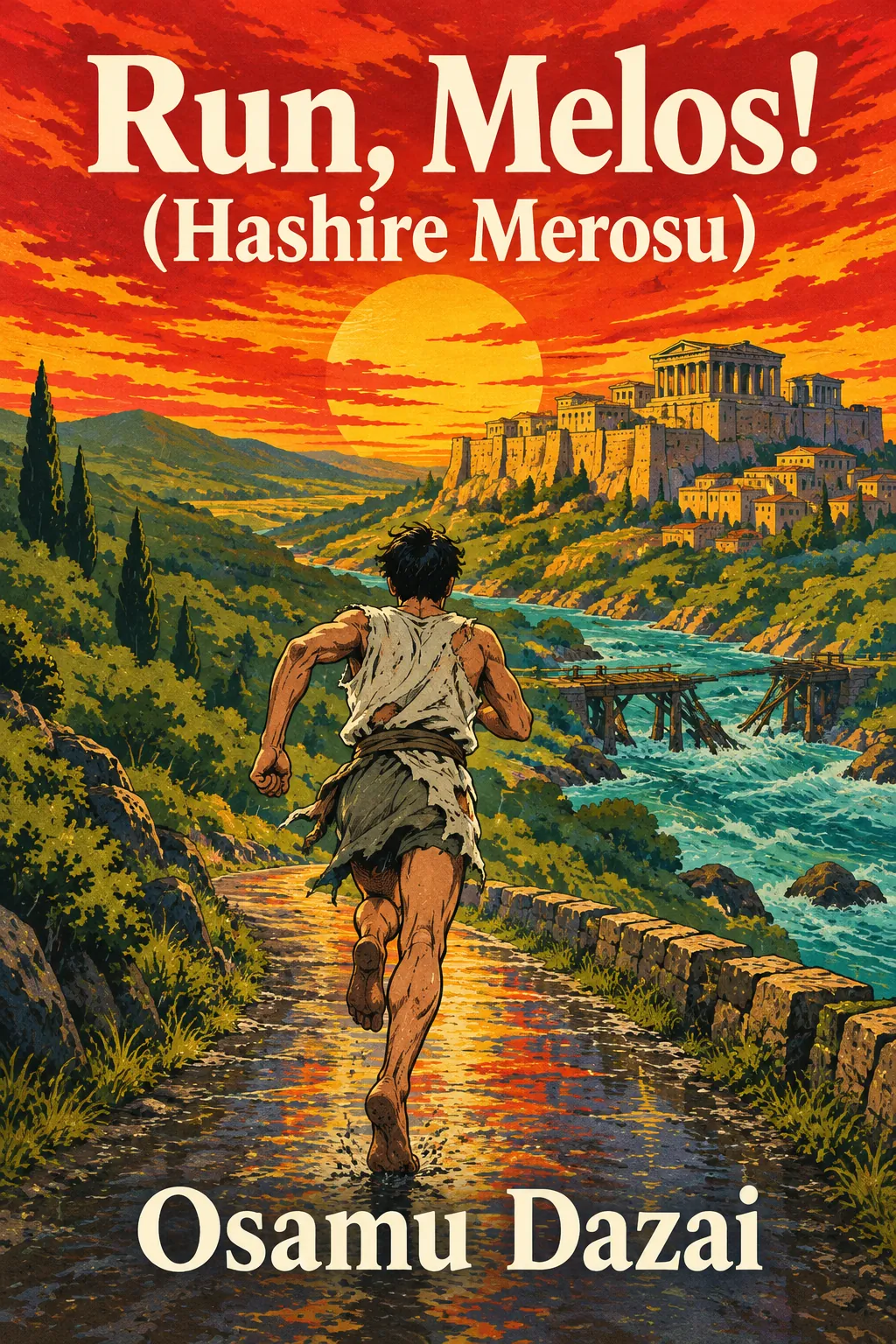
Run, Melos! (Hashire Merosu)
oleh Osamu Dazai
Run, Melos! is a short story by Osamu Dazai, first published in 1940. Melos, a simple shepherd, storms into the city of Syracuse to kill its tyrant and is caught. He is given three days to attend his sister's wedding, on one condition: his best friend Selinuntius stays behind as a hostage. If Melos is not back by sunset on the third day, the friend will die. Flood, bandits and exhaustion stand in his way.
Ide Utama
"A shepherd leaves his best friend as a hostage and races back against the sunset to keep a promise. The story asks whether trust can survive doubt."
Wawasan Utama
Trust is offered before it is proved
Neither friend can know that the other will keep his word. They choose to trust anyway, and the story sets this choice against the king's belief that people only act from self-interest. The king's world is the opposite: he demands proof, finds none and so kills.
Selinuntius hears the plan, asks nothing and nods. That silent nod is the starting point of the whole plot, and Melos spends the story trying to deserve it.
Weakness makes the hero believable
Melos can swim a flooded river and beat bandits, yet the scene readers remember is him lying by the road making excuses. The story does not hide his weakness. It shows that he recovers from it. Readers who expect a flawless hero may be surprised, but this is where the story becomes honest.
A small sound of water, not a grand speech, brings him back. He then reminds himself that he is trusted, and he runs on.
Trust that has met doubt is stronger
At the end both friends confess that they doubted the other once. The doubt is not erased but admitted, and the trust is then rebuilt on equal terms. This is why the final scene feels earned and not sentimental.
The blows they exchange are both punishment and forgiveness. Seeing this, even the king changes his mind about people.
The purpose of the run changes
At first Melos runs to arrive before sunset. By the end he runs because he is trusted, whether or not he arrives in time. Teachers often call this the shift from a race against time to a test of character.
When Philostratus says it is too late, Melos answers that being in time does not matter. Running becomes a statement of how he wants to live.
Rincian Bab
Chapter-by-chapter summary
Spoiler warning: this section covers the whole plot, including the ending.
Part 1: Melos Is Furious
Melos is a shepherd who lives with his young sister in a village. He plays his pipe, looks after his sheep and knows nothing about politics.
He has come to Syracuse to shop for his sister's wedding, and he finds the city strangely quiet. He learns that King Dionysius has been executing people, even relatives and loyal ministers, because he trusts no one.
Melos is outraged. He walks into the palace with a dagger and is arrested at once.
Nothing in his walk to the palace is planned, which shows how anger moves him faster than thought.
Why it matters: the opening shows a hero driven by simple, pure anger, which makes his later doubts all the more striking.
Part 2: The Bargain
Brought before the king, Melos says he wanted to free the city from a tyrant. The king answers coldly that people are selfish and cannot be trusted.
Melos accepts that he will be crucified, but he asks for three days to hold his sister's wedding. As a guarantee he offers his old friend Selinuntius, a stonemason, as a hostage.
The king agrees, half hoping that Melos will fail and prove his point. Selinuntius hears the plan, nods without a word and lets himself be tied up.
The conversation between the two men is really a debate: one side stands for doubt, the other for trust.
Why it matters: the whole story rests on this wager, trust against doubt, played for a human life.
Part 3: The Wedding
Melos hurries through the night to his village and persuades his shy sister and her reluctant groom to hold the wedding without delay. The ceremony goes ahead as rain begins to fall.
Among the happy guests Melos catches himself wishing he could stay for the rest of his life. At dawn he forces himself up and sets out for Syracuse.
The calm of the village shows what he is risking, and the happier it is, the heavier his decision to leave becomes.
Why it matters: his reluctance to leave shows that he is a real person with something to lose, not a symbol.
Part 4: Flood and Bandits
The night's rain has swollen the river and swept away the bridge. Melos prays to the river gods, throws himself into the current and swims across.
On the far side a band of bandits blocks the road. He seizes a club, knocks several of them down and runs on.
The scene sets the power of nature against one small human being, and the human being still crosses.
Why it matters: nature and violence test his body in turn, but both are obstacles from outside. The hardest test is still to come, inside him.
Part 5: The Collapse
As the sun climbs, Melos's strength runs out. He falls and cannot get up.
He begins to make excuses: he did his best, no one can blame him, perhaps he should simply live on as a villain. Then he hears a thin trickle of water from a crack in a rock.
He drinks, and his body and his sense of duty return together. He tells himself that he is trusted and that his own life hardly matters, and he runs again.
This is the passage in which his inner voice is heard most clearly, so it is worth asking whom the excuses are addressed to.
Why it matters: this is the low point of the story, and it proves that Melos is no flawless hero.
Part 6: Philostratus
As the sun sinks, Melos is chased down the road by Philostratus, a young disciple of Selinuntius. The young man begs him to stop, saying it is too late and that Melos should save himself.
Melos answers that he runs precisely because he is trusted, and that being on time is not the point. He feels he is running for something far larger than himself.
Philostratus also speaks for the reader, who fears by now that the run is hopeless.
Why it matters: his goal changes from winning a race to answering a trust.
Part 7: The Execution Ground
Just before sunset Melos staggers into the execution ground as Selinuntius is being hauled up onto the cross. He shouts that he is the one who must die.
He then confesses that on the road he had a bad dream and nearly gave up, and he asks his friend to strike him. Selinuntius hits him hard.
Selinuntius admits that in three days he doubted Melos just once, and he asks to be struck in return. Melos hits him.
Why it matters: each man admits a doubt before anyone celebrates, so the reunion is built on honesty.
Part 8: The Embrace and the Red Cloak
The two friends weep in each other's arms. The king, who has watched it all, says that trust was never an empty dream and asks to join their friendship, and the crowd cheers.
A girl offers Melos a red cloak, since he is almost naked after the river and the fight. Selinuntius points it out, and the hero blushes deeply.
Why it matters: the ending admits doubt and still chooses trust, which is the point of the whole story.
Characters
Melos: a village shepherd who lives with his sister. He is honest, hot-tempered and brave, and he is changed by his own moment of weakness.
Selinuntius: a stonemason and Melos's old friend. He accepts the hostage's role without a word.
King Dionysius: the tyrant of Syracuse, who believes that no human being can be trusted. He is the opposing view the story argues against.
Melos's sister: a shy girl of sixteen whose wedding sets the plot in motion.
Philostratus: Selinuntius's young disciple, who tries to stop Melos and so shows how hopeless the situation looks.
The bridegroom: a young shepherd who first asks for more time but agrees to marry at once.
Background and context
Dazai published Run, Melos! in 1940, when he was in his early thirties. The story is set in ancient Syracuse in Sicily, but its voice and feelings belong to modern Japanese fiction.
The plot comes from an ancient Greek legend about two friends and a tyrant, which the German poet Schiller turned into a ballad. Dazai kept the outline and gave it his own rhythm, short sentences and a hero who can be tired, shy and proud.
Dan Kazuo's memoir of Dazai records that Dazai once left Dan waiting at an inn in Atami while he went to fetch money. Readers often link that episode to the idea for this story.
The story is short, can be read in about half an hour and appears in many Japanese school textbooks. That is why teachers use it to practise reading feelings and writing short answers.
Style and language
Dazai uses short sentences, repetition and direct statements, so the reader feels the rhythm of running. The opening line, which names Melos's anger in one short sentence, is a good example.
The narrator speaks with warmth and sometimes with a gentle joke, most clearly in the final line about the red cloak. This lightness keeps the heavy theme from becoming preachy.
Notice also how often the story names the sun. Its position works like a clock and gives each scene a sense of urgency.
Exam tips
Japanese tests on this story usually ask for feelings, reasons and short written answers. Practise by marking the sentence before each underlined phrase.
For a reason question, look at what happened just before. For a feeling question, look at the words for the body, such as falling, tears or blushing.
For a theme question, link two scenes, such as the collapse and the exchange of blows. A link between scenes is what separates a good answer from a basic one.
Practise counting characters too. A 60-character answer holds one idea, and a 100-character answer holds two ideas joined by a cause.
Writing about this book
Start with one scene that moved or surprised you, not with the plot. The collapse by the road and the exchange of blows at the end both work well, because they can be tied to your own experience.
Look at how Melos is built. He is brave, but he is also tired, tempted and ashamed, and readers trust him more for it.
Compare the two views of people in the story. The king thinks humans are selfish, while Melos and Selinuntius act on trust, and the ending shows both sides changing a little.
Use short quotations only, and explain what each one shows. A good paragraph makes a claim, gives one piece of evidence from the text and then comments on it.
For a reflective report, connect the story to something you have lived, such as keeping a promise when it was hard. Keep your own voice, and use the sample answers on this page only to compare with your own work.
Ambil Tindakan
Langkah praktis yang bisa Anda terapkan hari ini:
-
When you are asked to trust someone, ask whether you can take the first step without waiting for proof.
-
Notice the excuses you make when a promise becomes hard. Spotting them is the first step to keeping the promise.
-
Admitting a doubt honestly can bring people closer rather than push them apart.
-
For exam questions about feelings, set out the cause, the feeling and the action in that order.
Kutipan Menarik
"“Melos was furious.” (Part 1, opening line)"
— Osamu Dazai
"“Whether I make it in time is not the question.” (Part 6)"
— Osamu Dazai
"“Trust was never an empty dream.” (Part 8, the king)"
— Osamu Dazai
"“The hero blushed deeply.” (Part 8, last line)"
— Osamu Dazai
Siapa yang Harus Membaca Ini
Students in junior and senior high school who study this story in Japanese class, and anyone who wants a short, strong story about friendship and trust. It is quick to read, and this guide helps with tests, 記述 questions and book reports.
Tentang Osamu Dazai
Osamu Dazai (1909–1948) was a Japanese novelist born in Aomori Prefecture. He is best known for the novels The Setting Sun and No Longer Human, and for short stories such as Run, Melos! His plain, intimate voice made him one of the most widely read writers of modern Japan.
Ringkasan Ditulis Oleh

Software Engineer & Writer
Software engineer with a passion for distilling complex ideas into actionable insights. Writes about finance, investment, entrepreneurship, and technology.
Lihat semua ringkasan →Ulasan
Belum ada ulasan. Jadilah yang pertama berbagi pemikiran Anda!
Tulis Ulasan
Lanjut membaca
Jelajahi topik: Panduan BelajarRingkasan
Animal Farm karya George Orwell — Ringkasan & Analisis
George Orwell
Hewan-hewan di Peternakan Manor memberontak melawan petani kejam Mr. Jones untuk mendirikan masyarakat utopia berdasarkan kesetaraan. Namun, kepemimpinan babi yang…
The Outsiders oleh S.E. Hinton
S.E. Hinton
Novel ini mengikuti kehidupan Ponyboy Curtis dan kelompok 'Greasers' yang terjebak dalam perang saudara dengan kelompok 'Socs' yang kaya. Melalui…

The Great Gatsby karya F. Scott Fitzgerald — Ringkasan & Analisis
F. Scott Fitzgerald
Diceritakan oleh Nick Carraway, novel ini mengikuti Jay Gatsby, seorang jutawan misterius yang berusaha memenangkan kembali cinta Daisy Buchanan. Di…
tikus dan Manusia oleh John Steinbeck
John Steinbeck
Kisah tentang dua buruh tani migran, George dan Lennie, yang bermimpi memiliki tanah sendiri untuk hidup mandiri. Namun, keterbatasan mental…
Artikel

Dokusho Kansobun for High School: How to Write a Japanese Book Reflection
A dokusho kansobun is a Japanese book reflection: not a plot summary, but your own thinking about a book, backed…
Kisah Penebang Bambu (Taketori Monogatari)
Kisah Penebang Bambu (Taketori Monogatari) bercerita tentang Putri Kaguya, gadis yang ditemukan di dalam batang bambu yang bersinar. Ia tumbuh…
Ragnarok: Akhir Dunia dan Kiamat Para Dewa Nordik
Ragnarök adalah akhir dunia dalam mitologi Nordik: pertempuran terakhir tempat para dewa, raksasa, dan monster saling membinasakan, bumi tenggelam ke…