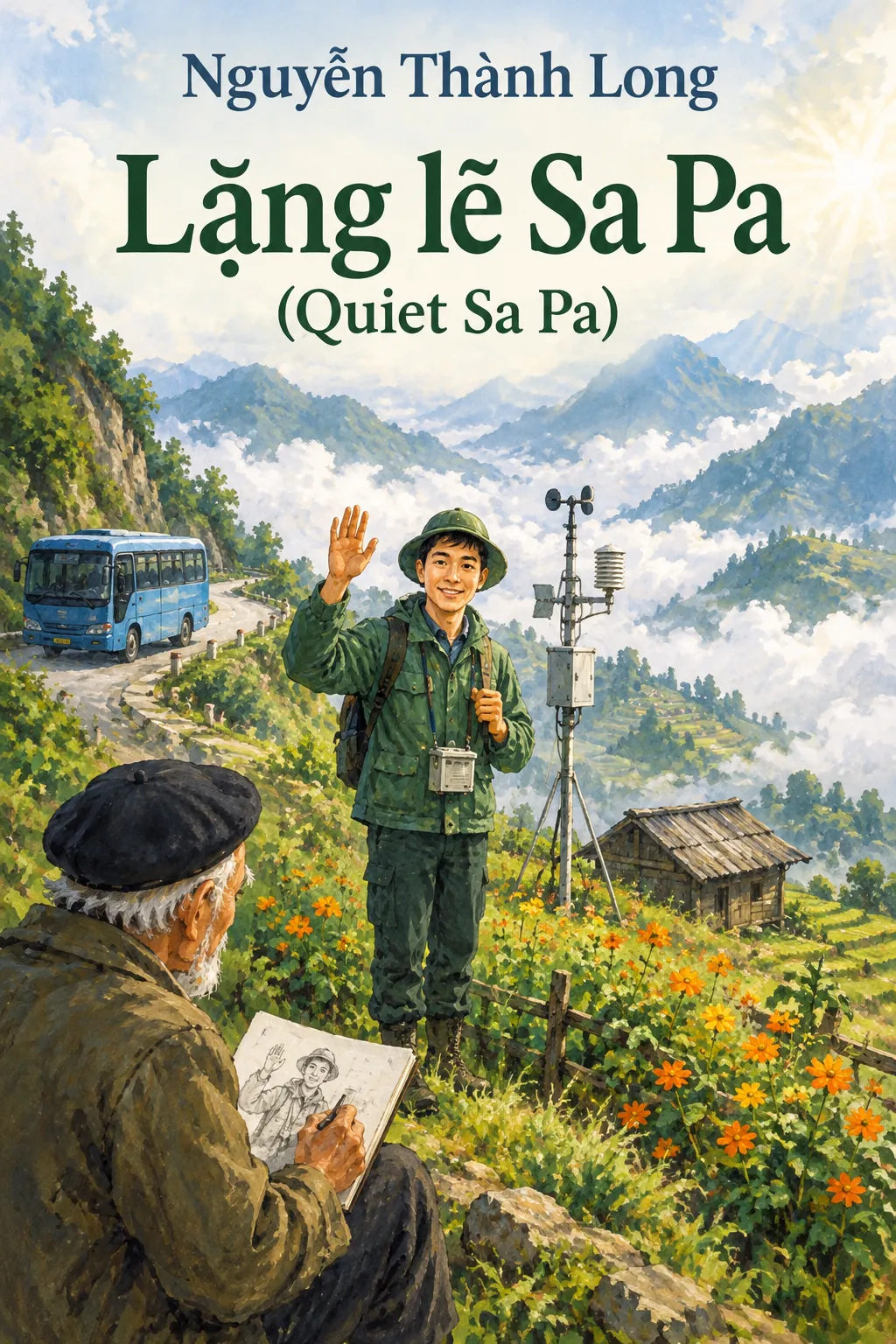
Lặng lẽ Sa Pa (Quiet Sa Pa)
by Nguyễn Thành Long
Lặng lẽ Sa Pa is a short story by Nguyễn Thành Long about a half-hour meeting on a mountain road in northern Vietnam. A painter, a young woman engineer and a bus driver stop near Sa Pa and meet a twenty-seven-year-old man who works alone at a weather station on Yen Son peak. Through this brief encounter, the story shows how steady, unseen work gives a person purpose, and how it changes the people who notice it.
The Big Idea
"Lặng lẽ Sa Pa argues that a life of unnoticed, steady work for others can be rich and beautiful, even when it is lived alone on a cold mountain."
Key Insights
Work as companionship
The young man says that when we work, we and the work are a pair, so we cannot call ourselves alone. This turns the idea of solitude upside down: loneliness is not removed, but it is given purpose. The story suggests that meaning does not need an audience, and that dedication can be a form of company.
At the station he measures the weather, tends flowers and reads, and he insists that his days are full, not empty.
The quiet hero
Nguyễn Thành Long avoids battle scenes and grand speeches. His hero is a weather worker whose achievements are invisible unless someone looks closely. The story praises ordinary people whose steady work supports the whole country, and the title's word lặng lẽ becomes a form of praise, not a lack.
The young man points the painter to other quiet workers, the vegetable-garden engineer and the lightning researcher.
Seeing and being seen
The painter wants to draw the young man, but the young man doubts that he is worth drawing. The gap between them is the story's quiet argument about art: real value is often hidden, and an artist, like any reader, has to learn to look.
The painter sketches him anyway, and the travellers leave aware that a sketch holds only part of the man.
A lyrical encounter
The story has little plot. It is held together by a short meeting, gentle description of the Sa Pa mountains and the characters' feelings. This lyrical mood suits its subject: a calm and clear style that treats modest work with tenderness.
The thirty-minute stop and the departure of the bus give the story its emotion without any dramatic conflict.
Chapter Breakdown
Chapter-by-chapter summary
Spoiler warning: this section covers the whole plot, including the ending.
The story has no numbered chapters, so this guide follows its six natural parts.
Part 1: The bus to Sa Pa
The story opens on a bus climbing the road to Sa Pa in the mountains of northern Vietnam. Three travellers are on board: an elderly painter, a young woman engineer on her first posting, and the driver.
At a rest stop the driver mentions a young man who lives alone on a peak nearby. He speaks of him with real affection, which makes the painter curious.
Why it matters: the whole story is one half-hour encounter, seen through the painter's eyes, so the reader discovers the young man exactly as the travellers do.
Part 2: The young man appears
The young man arrives and the driver greets him like an old friend. He is twenty-seven and works at a meteorological and geophysical station on Yen Son peak, about 2,600 metres up.
He is shy and a little hurried, as if he has saved up things to say and has very little time to say them.
Why it matters: his ordinary manner is deliberate. The author makes the hero someone you might walk past, so that the reader has to look closely to see his worth.
Part 3: His work and his small world
He leads the visitors to his little house and shows them his life. He measures wind, rain, sun and tremors in the ground, sends reports, and gets up in the freezing night to read instruments that cannot wait.
Around the hut he keeps flowers, vegetables and chickens, and he reads books. When the painter asks about loneliness, he answers that a person at work is never really alone.
Why it matters: this is the heart of the story. His solitude is real, but he turns it into meaning through work and through care for small things.
Part 4: The sketch and the other quiet workers
The painter asks to draw him. The young man is reluctant, because he does not think he is special, but the painter sketches him anyway.
While they talk, the young man speaks of others who work quietly in the mountains, such as the engineer in the Sa Pa vegetable gardens and a researcher who studies lightning.
Why it matters: the hero is not an exception. He stands for a whole group of people whose work goes unseen.
Part 5: Gifts and a silent reaction
Before the bus leaves, the young man sends something from his small world with each traveller. He gives the young woman a bunch of flowers and a medicinal root, tam thất, for the driver's sick wife.
The young woman, who has been watching quietly, is moved and a little confused, and she shakes his hand.
Why it matters: the gifts show a man who gives from very little, and her reaction hints that she is already learning from him.
Part 6: The bus pulls away
The thirty minutes are over. The driver starts the engine, the travellers climb in, and the young man stays behind on his mountain.
The painter is left thinking about how much a quick sketch can hold of such a person. The young woman, too, leaves a little changed.
Why it matters: the ending is a picture of a man alone on a mountain who is still tied to people he will never meet.
Characters
The young man (anh thanh niên) is the hero, twenty-seven and unnamed. He runs a weather station alone, loves his work, grows flowers, reads, and gives generously while refusing praise.
The painter (ông họa sĩ) is an older artist who looks for a subject worth drawing. His eyes guide the story, and his admiration shapes how we see the young man.
The young engineer (cô kỹ sư) has just graduated and is heading to her first job. She is a foil for the young man: she is at the beginning of her working life and he shows her what a calling can be.
The driver (bác lái xe) knows the road and the young man well. He is the bridge between the travellers and the hero, and he is the first to describe him as someone cut off from people.
The vegetable-garden engineer and the lightning researcher are only mentioned. They show that the young man belongs to a larger group of people who work quietly.
Context and style
Nguyễn Thành Long wrote the story in 1970, after a trip to Lào Cai, while Vietnam was at war. In that period, literature often praised people who served the country, and this story does so through a worker rather than a soldier.
The author chose a gentle, lyrical voice instead of a heroic one. The mountains, the mist and the flowers carry as much feeling as the dialogue.
The setting matters. Sa Pa is cold, high and far from towns, so every detail of the young man's routine, from night readings to his small garden, shows effort and choice.
The title uses the word lặng lẽ, meaning quiet. It describes the place, and it also describes the people whose work is done without noise or reward.
Main ideas in brief
First, work gives life meaning. The young man does not feel alone because he sees his job as a bond with people he will never meet.
Second, quiet people deserve notice. The story asks us to look past ordinary appearances and to value what is done faithfully and without show.
Third, giving does not depend on wealth. He has little, yet he offers flowers, a medicinal root and his time.
Fourth, art and life learn from each other. The painter wants to capture the young man, and the young man shows the painter what is worth drawing.
Finally, the encounter changes those who listen. The engineer leaves ready for her first post, and the painter leaves with a new thought about his craft.
What the ending leaves open
The story does not tell us what happens to anyone after the bus leaves. That silence is deliberate, because the point is the impression of the meeting, not a plot that closes neatly.
The reader is left with an image: a small figure on a green peak, still working, still waving. The question the story leaves behind is who else in our own lives works this quietly.
Writing about this book
Start from one clear claim, such as “the young man shows that meaningful work can overcome isolation,” and prove it with two or three scenes.
Good evidence is easy to find: his night readings, his garden and books, his gifts, and his reluctance to be drawn.
Always explain what a detail shows, not only what it is. A flower bed on a cold peak shows a mind that refuses to go empty.
Use the point of view. The painter sees the young man, so you can write about how the story leads us to admire him, not only what he does.
Add the context in one sentence: the story was written in 1970, in wartime, when quiet work for the country was highly valued.
Avoid common mistakes. Do not retell the whole plot, do not call him simply sad, and keep quotations short.
For Vietnamese exams, use the mở bài, thân bài and kết bài structure, and give most of your time to the body. The sample answers below are for learning and for comparing with your own work.
Quick revision checklist
Before a test, be able to state in one sentence who, where, when and why: four people at a bus stop, Yen Son peak, about thirty minutes, and quiet devotion.
Learn evidence for each trait: responsibility (night readings), love of life (flowers and books), generosity (the gifts) and modesty (reluctance to be drawn).
Practise linking each detail to the theme in a sentence that begins “This shows that”.
Remember the techniques: a chance-meeting situation, the painter's point of view, lyrical description and dialogue that reveals character.
Compare the story with another one you study, and note how its situation or point of view differs.
Take Action
Practical steps you can implement today:
-
Do your work properly even when nobody is checking, because steady effort is a kind of respect for others.
-
Make a small routine that feeds your mind, as the young man does with books and flowers.
-
Notice the quiet people around you, such as cleaners, nurses and teachers, and thank them.
-
Use short, exact details as evidence when you write about a story.
Notable Quotes
"“Khi ta làm việc, ta với công việc là đôi, sao gọi là một mình được?” (the young man, the meeting at the station)"
— Nguyễn Thành Long
"“…một trong những người cô độc nhất thế gian, thèm người.” (the driver, introducing the young man)"
— Nguyễn Thành Long
"“thèm người” (the driver's key phrase for the young man, the stop on the road)"
— Nguyễn Thành Long
Who Should Read This
Lặng lẽ Sa Pa suits Grade 9 students in Vietnam preparing for class tests and the entry exam for Grade 10, and any reader who wants a short, gentle story about work and purpose. It reads in about ten minutes and needs no background beyond the war-time setting.
Characters
The young man (anh thanh niên)
protagonist
A twenty-seven-year-old meteorological worker who lives alone on Yen Son peak. He is hard-working, warm and modest, and he turns solitude into purpose through work, books and a small garden.
The painter (ông họa sĩ)
observer and viewpoint
An older artist who stops on the road and sketches the young man. His curiosity and admiration frame how the reader sees the hero.
The young engineer (cô kỹ sư)
foil
A young woman who has just graduated and is on her way to her first post. She is moved by the young man and learns from his example of dedication.
The driver (bác lái xe)
connector
A man who knows the road and the young man well. He introduces the hero to the others and speaks of him as someone who lives far from people.
The vegetable-garden engineer
symbol of quiet work
A figure the young man mentions, who works in the Sa Pa vegetable gardens. He shows that the hero is one of many dedicated workers.
The lightning researcher
symbol of quiet work
Another figure the young man mentions, who studies lightning in the mountains. He shows how unseen research supports the country.
Exam practice: sample answers
Model answers are examples to learn from; write your own in your words.
nghị luận văn học: character analysis
1. Analyse the character of the young man in Lặng lẽ Sa Pa by Nguyễn Thành Long. (Nghị luận văn học, about 600 chữ in the Vietnamese exam.)
Outline
- Introduce the author, the story and the character.
- Show his work and responsibility.
- Show his view of work and loneliness.
- Show his warmth and modesty.
- Note the art of the portrait and close with the message.
Basic Model answer
Nguyễn Thành Long's story shows a young man who lives alone on Yen Son peak. He is twenty-seven and works at a weather station, measuring the weather and sending reports.
The young man is hard-working and responsible. He gets up at night in the cold to do his job, and he never complains.
He also keeps his life cheerful by growing flowers, vegetables and reading books.
He is kind to other people. He gives flowers to the girl and a medicinal root to the driver's wife.
He is also modest, because he does not think he is worth a portrait.
In conclusion, the young man is a quiet hero who loves his work and other people. The author wants us to respect people like him.
Good Model answer
In Lặng lẽ Sa Pa, Nguyễn Thành Long presents a young man who works alone at a weather station 2,600 metres up. His character shows that ordinary work done well can give a life meaning.
First, he has a deep sense of responsibility. His job demands measurements, reports and getting up in the freezing night, yet he treats it as something that cannot be skipped.
When he says that people at work are never truly alone, because we and the work are a pair, he shows how he turned isolation into purpose.
Second, he organises his life with care. He grows flowers, keeps chickens and vegetables and reads, so loneliness never defeats him.
These details show a cheerful, thoughtful mind.
Third, he is warm and modest. He is eager to talk with visitors, gives gifts to the girl and to the driver's sick wife, and refuses to be treated as special.
The painter admires him because he does not seek praise.
The young man is therefore the story's centre. Through him, the author praises people who build the country quietly, and shows that the “lặng lẽ” of the title hides great value.
Excellent Model answer
Nguyễn Thành Long's young meteorologist is memorable because the author never lets him become a slogan. He appears for thirty minutes, through the eyes of strangers, and gains depth precisely because the story works by suggestion.
Thesis: the young man embodies the idea that meaning comes from work done for others, and the story gives that idea force by pairing it with shyness, modesty and human warmth.
The setting makes his job heroic without saying so. Alone near the peak of Yen Son, at about 2,600 metres, he measures wind, rain and tremors, and wakes in the freezing night to take readings.
The narrator keeps this plain, so the reader feels the cost.
His answer to loneliness is the key idea. When he says “ta với công việc là đôi”, he rejects the idea that solitude is emptiness.
Work is a companion that links him to people he will never meet. This is also why he grows flowers and reads: he builds a life, not just a duty.
The portrait is also shaped by contrast. The painter, a man of experience, seeks an image to capture; the girl is at the start of her working life; the driver is at ease with the road.
Next to each, the young man is a mirror: he shows the painter what art should look for, and the girl what a calling can be. His reluctance to be drawn fits this, because he cares about the job, not about being seen.
The point of view matters too. Because the painter's eyes filter the story, the young man is both a real person and a figure the older man reflects on.
The quiet workers he mentions, the vegetable-garden engineer and the lightning researcher, widen him into the type of a generation.
In conclusion, the young man is persuasive because he is gentle, not perfect. The title's “lặng lẽ” describes a quality of character, not a lack of importance, and the story asks us to notice such people.
Marking rubric
- Clear thesis about the character
- Evidence from named scenes
- Analysis of how the author builds the portrait
- Short, exact quotations
- Structure and language
Now write your own
Write your own analysis in about 600 chữ, then compare it with the three samples. Which level are you closest to, and what would raise it?
literary argument: story situation
2. Explain how the central situation of Lặng lẽ Sa Pa, a thirty-minute meeting on a mountain road, helps the author convey his message. (Nghị luận văn học: tình huống truyện.)
Outline
- Name the situation.
- Show how it reveals the character.
- Show how it expresses the theme.
- Show the effect of the ending.
- Close with an evaluation.
Basic Model answer
The story is built on one situation. A bus stops for thirty minutes, and three travellers meet a young man who lives alone on a mountain.
This situation is useful because it is short and simple. The reader meets the young man like the travellers do and learns about his work and his life quickly.
It also helps the message. The painter and the girl learn from the young man that people can be happy when they work for others.
The meeting also shows his kindness, because he gives gifts.
So the situation is good for showing a quiet hero in a short space. It makes the story clear and moving.
Good Model answer
Nguyễn Thành Long builds Lặng lẽ Sa Pa on one small situation: a thirty-minute stop on a mountain road where three travellers meet a young weather worker. This lets the message arrive through an experience, not a lecture.
The brevity of the encounter first creates concentration. In half an hour the young man can only show the essentials: his work, his garden, his words about solitude and his gifts.
Every detail therefore carries weight.
Second, the situation creates discovery. The driver introduces him, the painter watches and the girl is moved.
The reader follows this process and arrives at the same respect, so the message feels earned.
Third, the meeting sets movement against stillness. The travellers are passing through, while the young man remains on his peak, which highlights how steady his commitment is.
In short, the situation lets the author praise a quiet worker without sentimentality. It is economical, it directs attention and it supports the idea that the unnoticed deserve notice.
Excellent Model answer
The thirty-minute stop on the Sa Pa road is not a convenient frame; it is the engine of the story's argument. Nguyễn Thành Long uses a chance meeting to reveal a character, widen him into a type and teach the reader how to look.
First, concentration. Because the encounter is so short, nothing is wasted.
His warm welcome, his hurried hospitality, his account of waking in the freezing night and his remark “ta với công việc là đôi” all appear in one scene, and each speaks for years. The shortness leaves the rest to the reader, which is how the story suggests rather than preaches.
Second, several pairs of eyes. The painter looks for a subject and finds one that resists a portrait; the girl, at the start of her career, is moved to a silent handshake; the driver, who knows him, is the bridge.
This keeps the young man from being an idealised statue, because we see him as people see each other.
Third, a wider theme. He mentions other quiet workers, such as the vegetable-garden engineer and the lightning researcher.
The meeting stops being private and becomes a glimpse of a whole generation whose labour is unseen. The title's “lặng lẽ” now describes a country, not one man.
Fourth, the pull of departure. A passing meeting ends, and that ending produces the emotion: the travellers leave, and he stays.
The reader feels both the warmth of the contact and the size of his solitude.
In conclusion, the situation is the story's argument in miniature. By staging a brief meeting, the author shows that quiet devotion cannot be grasped at once, yet leaves a lasting mark.
Marking rubric
- Identifies the situation precisely
- Explains effects on character and theme
- Uses specific moments
- Considers the ending
- Clear structure
Now write your own
Choose a different short story you know and write about its central situation in the same way. What does its situation make possible?
nghị luận xã hội: link to the text
3. From the young man in Lặng lẽ Sa Pa, write about the meaning of quiet contribution in life. (Nghị luận xã hội with a literature link-up.)
Outline
- Introduce the issue through the character.
- Explain quiet contribution.
- Argue its value for society and for the person.
- Raise and answer a counter-argument.
- Give a lesson for students.
Basic Model answer
Many people think that a good life needs fame, but the young man in Lặng lẽ Sa Pa shows another way. He works alone on a mountain and never asks for praise.
Quiet contribution matters because society depends on it. Weather reports, clean streets and teaching are all done by people we rarely notice.
Their work helps many others.
It also makes the worker happy. The young man says his work keeps him company, so he does not feel lonely.
Today, students can follow this idea by doing their tasks well, helping others and not waiting for praise.
Good Model answer
A meaningful life is often measured by fame or money, yet Nguyễn Thành Long's young meteorologist suggests a different measure: how faithfully we serve others, even when no one is watching.
Quiet contribution means doing useful work without looking for a reward. In the story, the young man measures the weather alone at 2,600 metres, in cold and fog, and his reports reach people he will never meet.
His devotion is invisible, but society relies on it.
This matters for two reasons. First, communities work because of countless unseen jobs: nurses, cleaners, teachers and engineers.
Real life offers many examples. A nurse on a night shift, a teacher in a remote village and a cleaner who opens the school before dawn all hold the community together, and few people thank them.
The young man's reports work the same way: nobody notices them until the weather turns.
Second, devotion gives the worker meaning. The young man says that when we work, we are not alone, and his flower bed and books show a full life, not an empty one.
Of course, public recognition is not wrong, and a person also needs rest and support. But a life built only on being seen is fragile, because it depends on others.
Young people can apply this lesson in small ways: finish group tasks properly, keep promises and help without posting about it. A meaningful life is built from steady, honest work, and the quiet ones carry a great deal.
Excellent Model answer
Thesis: a meaningful life is built less by being seen than by being useful, and the young man of Lặng lẽ Sa Pa is Nguyễn Thành Long's proof.
Explain. Quiet contribution is work done to a high standard for the benefit of others, without waiting for applause.
It differs from passivity: the quiet worker is active, disciplined and often brave. The young man at the weather station wakes in the freezing night to take readings, and does it as a matter of course.
Why it matters. Society runs on unseen labour: the researcher who studies lightning, the engineer in the vegetable garden, the nurse on a night shift.
Their work is a form of trust, because others build their plans on it. The story makes the point by showing a man whose forecasts matter exactly because they are reliable.
There is also a personal reward. His line that a person at work is not alone, “ta với công việc là đôi”, captures a truth that purpose protects against emptiness.
His garden and books show that he keeps his mind alive.
Counter-argument. Some may say that in an age of social media, quiet work is wasted and that visibility brings opportunity.
This is partly true: recognition can bring support, and no one should be ashamed of success. But visibility is not the same as value, and a life chasing attention is at the mercy of other people's opinions.
The young man's reluctance to be drawn suggests that dignity comes from the work, not from the portrait.
Moreover, quiet contribution does not mean staying silent about unfair treatment or never asking for fair pay. It means that the quality of the work, not the applause, is the measure, so a person can be both modest and properly respected.
The story supports this balance: the painter does draw him, and the reader is invited to honour him, so recognition arrives without being sought.
Application. A student can follow this by doing homework honestly, helping a classmate without telling anyone, or volunteering regularly rather than for one photograph.
Conclusion. The reader leaves the story respecting those who work in silence, and perhaps ready to become one: someone whose value shows in what keeps working because of them.
Marking rubric
- Defines the issue
- Uses the literary link accurately
- Gives social and personal reasons
- Handles a counter-argument
- Draws a lesson
Now write your own
Write a 200-chữ paragraph on quiet contribution using a person from your own life as the example, then compare it with the samples.
Frequently Asked Questions
Who wrote Lặng lẽ Sa Pa and when?
Nguyễn Thành Long wrote it in 1970 after a trip to Lào Cai. It was later collected in Giữa trong xanh and has become a Grade 9 set text.
What is the story about?
It is about a thirty-minute meeting on the road to Sa Pa between a painter, a young engineer, a driver and a young man who works alone at a weather station on Yen Son peak.
What does the title mean?
Lặng lẽ means quiet. The title points to the calm of Sa Pa and to the quiet people whose daily work supports the country without recognition.
Who is the main character?
The young man at the weather station, who is unnamed, is the hero. The painter is the viewpoint through which we see him.
How do I write an analysis of Lặng lẽ Sa Pa?
Choose a claim, such as the hero's view of work, and support it with scenes: his night readings, his garden, his gifts and his modesty. End with the message about quiet dedication.
Check Your Understanding
Pick an answer for each question to see if you were right.
-
Where does the young man work?
A weather station on Yen Son peak — He is a meteorological worker at a station on Yen Son peak, about 2,600 metres high.
-
Who guides the point of view of the story?
The painter — We see the meeting mainly through the painter's eyes.
-
How long does the meeting last?
About thirty minutes — The bus stops for roughly half an hour, which is the story's whole situation.
-
What does the young man say about work and being alone?
A person at work is never really alone — He says that in work, we and the work are a pair.
-
What does the word lặng lẽ in the title suggest?
Quiet dedication — It points to people who work without noise or praise.
About Nguyễn Thành Long
Nguyễn Thành Long (1925–1991) was a Vietnamese short-story writer who also used the pen name Lê Quang Vịnh. He is best known for Lặng lẽ Sa Pa, written in 1970 after a trip to Lào Cai and collected in Giữa trong xanh. The story is a Grade 9 set text in Vietnam.
Summary Written By

Software Engineer & Writer
Software engineer with a passion for distilling complex ideas into actionable insights. Writes about finance, investment, entrepreneurship, and technology.
View all summaries →Reviews
No reviews yet. Be the first to share your thoughts!
Write a Review
Keep reading
Explore the topic: Study GuidesSummaries

Animal Farm by George Orwell
George Orwell
The animals of Manor Farm revolt against their human owner to create a utopian society based on equality. However, the…

The Outsiders by S.E. Hinton
S.E. Hinton
Ponyboy Curtis and his gang of Greasers clash with the wealthy Socs in a cycle of violence. After a tragic…

The Great Gatsby by F. Scott Fitzgerald
F. Scott Fitzgerald
Nick Carraway enters the orbit of Jay Gatsby, a mysterious millionaire obsessed with reclaiming his past love, Daisy Buchanan. Amidst…

Of Mice and Men by John Steinbeck
John Steinbeck
George and Lennie, two migrant workers during the Great Depression, dream of owning their own land to escape a life…
Articles

Kyotsu Test Japanese (共通テスト国語): Time Plan and Strategy
The Kyotsu Test Japanese paper is a 90-minute, 200-point multiple-choice exam with five sections: three modern-text sections, classical Japanese and…

How to Write a Literary Analysis Essay
A literary analysis essay argues one clear claim about how a text works and proves it with short quotations and…
The Tale of the Bamboo Cutter
The Tale of the Bamboo Cutter (Taketori Monogatari) tells of Princess Kaguya, a girl found inside a glowing bamboo stalk,…