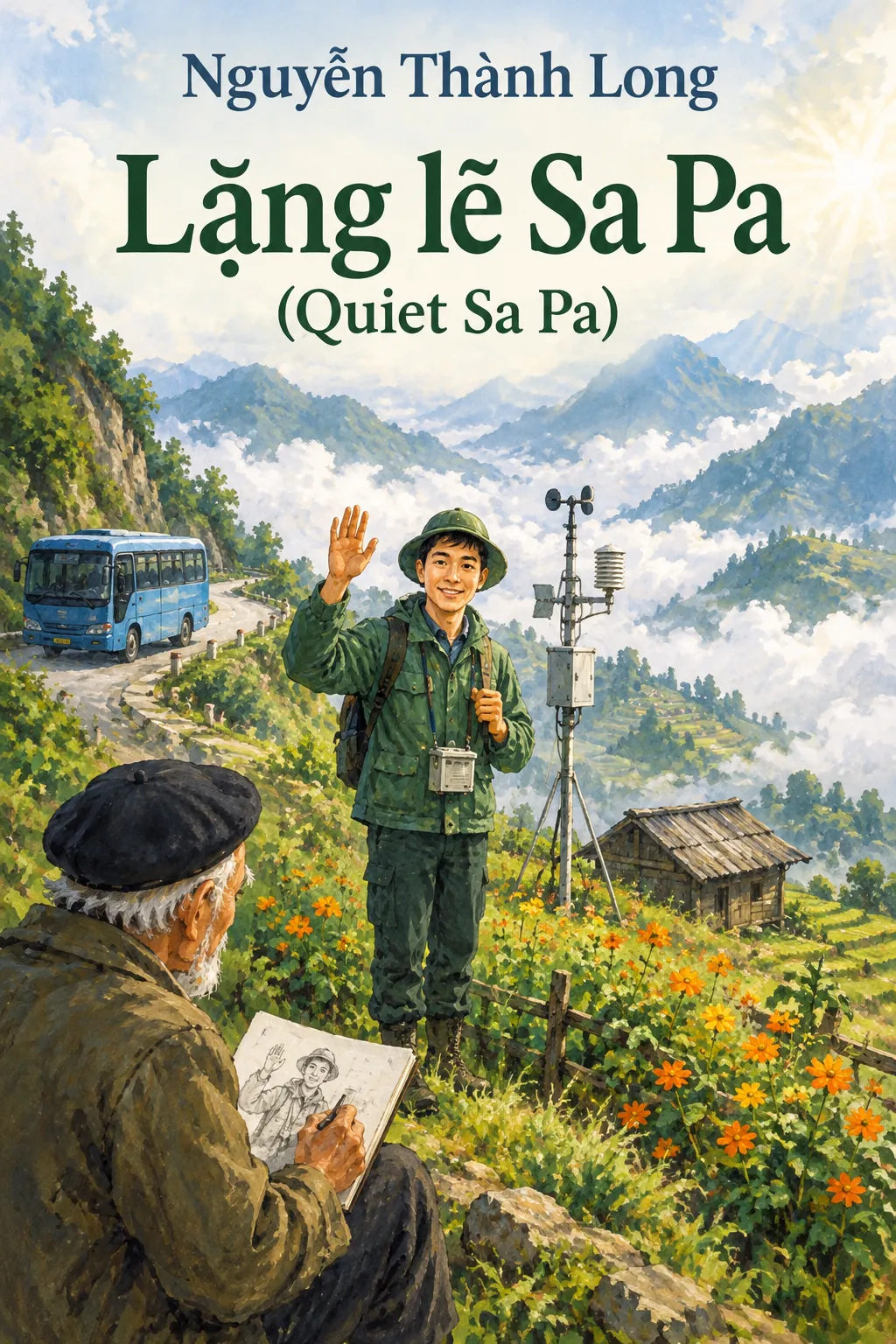
Lặng lẽ Sa Pa (Quiet Sa Pa)
oleh Nguyễn Thành Long
Lặng lẽ Sa Pa is a short story by Nguyễn Thành Long about a half-hour meeting on a mountain road in northern Vietnam. A painter, a young woman engineer and a bus driver stop near Sa Pa and meet a twenty-seven-year-old man who works alone at a weather station on Yen Son peak. Through this brief encounter, the story shows how steady, unseen work gives a person purpose, and how it changes the people who notice it.
Ide Utama
"Lặng lẽ Sa Pa argues that a life of unnoticed, steady work for others can be rich and beautiful, even when it is lived alone on a cold mountain."
Wawasan Utama
Work as companionship
The young man says that when we work, we and the work are a pair, so we cannot call ourselves alone. This turns the idea of solitude upside down: loneliness is not removed, but it is given purpose. The story suggests that meaning does not need an audience, and that dedication can be a form of company.
At the station he measures the weather, tends flowers and reads, and he insists that his days are full, not empty.
The quiet hero
Nguyễn Thành Long avoids battle scenes and grand speeches. His hero is a weather worker whose achievements are invisible unless someone looks closely. The story praises ordinary people whose steady work supports the whole country, and the title's word lặng lẽ becomes a form of praise, not a lack.
The young man points the painter to other quiet workers, the vegetable-garden engineer and the lightning researcher.
Seeing and being seen
The painter wants to draw the young man, but the young man doubts that he is worth drawing. The gap between them is the story's quiet argument about art: real value is often hidden, and an artist, like any reader, has to learn to look.
The painter sketches him anyway, and the travellers leave aware that a sketch holds only part of the man.
A lyrical encounter
The story has little plot. It is held together by a short meeting, gentle description of the Sa Pa mountains and the characters' feelings. This lyrical mood suits its subject: a calm and clear style that treats modest work with tenderness.
The thirty-minute stop and the departure of the bus give the story its emotion without any dramatic conflict.
Rincian Bab
Chapter-by-chapter summary
Spoiler warning: this section covers the whole plot, including the ending.
The story has no numbered chapters, so this guide follows its six natural parts.
Part 1: The bus to Sa Pa
The story opens on a bus climbing the road to Sa Pa in the mountains of northern Vietnam. Three travellers are on board: an elderly painter, a young woman engineer on her first posting, and the driver.
At a rest stop the driver mentions a young man who lives alone on a peak nearby. He speaks of him with real affection, which makes the painter curious.
Why it matters: the whole story is one half-hour encounter, seen through the painter's eyes, so the reader discovers the young man exactly as the travellers do.
Part 2: The young man appears
The young man arrives and the driver greets him like an old friend. He is twenty-seven and works at a meteorological and geophysical station on Yen Son peak, about 2,600 metres up.
He is shy and a little hurried, as if he has saved up things to say and has very little time to say them.
Why it matters: his ordinary manner is deliberate. The author makes the hero someone you might walk past, so that the reader has to look closely to see his worth.
Part 3: His work and his small world
He leads the visitors to his little house and shows them his life. He measures wind, rain, sun and tremors in the ground, sends reports, and gets up in the freezing night to read instruments that cannot wait.
Around the hut he keeps flowers, vegetables and chickens, and he reads books. When the painter asks about loneliness, he answers that a person at work is never really alone.
Why it matters: this is the heart of the story. His solitude is real, but he turns it into meaning through work and through care for small things.
Part 4: The sketch and the other quiet workers
The painter asks to draw him. The young man is reluctant, because he does not think he is special, but the painter sketches him anyway.
While they talk, the young man speaks of others who work quietly in the mountains, such as the engineer in the Sa Pa vegetable gardens and a researcher who studies lightning.
Why it matters: the hero is not an exception. He stands for a whole group of people whose work goes unseen.
Part 5: Gifts and a silent reaction
Before the bus leaves, the young man sends something from his small world with each traveller. He gives the young woman a bunch of flowers and a medicinal root, tam thất, for the driver's sick wife.
The young woman, who has been watching quietly, is moved and a little confused, and she shakes his hand.
Why it matters: the gifts show a man who gives from very little, and her reaction hints that she is already learning from him.
Part 6: The bus pulls away
The thirty minutes are over. The driver starts the engine, the travellers climb in, and the young man stays behind on his mountain.
The painter is left thinking about how much a quick sketch can hold of such a person. The young woman, too, leaves a little changed.
Why it matters: the ending is a picture of a man alone on a mountain who is still tied to people he will never meet.
Characters
The young man (anh thanh niên) is the hero, twenty-seven and unnamed. He runs a weather station alone, loves his work, grows flowers, reads, and gives generously while refusing praise.
The painter (ông họa sĩ) is an older artist who looks for a subject worth drawing. His eyes guide the story, and his admiration shapes how we see the young man.
The young engineer (cô kỹ sư) has just graduated and is heading to her first job. She is a foil for the young man: she is at the beginning of her working life and he shows her what a calling can be.
The driver (bác lái xe) knows the road and the young man well. He is the bridge between the travellers and the hero, and he is the first to describe him as someone cut off from people.
The vegetable-garden engineer and the lightning researcher are only mentioned. They show that the young man belongs to a larger group of people who work quietly.
Context and style
Nguyễn Thành Long wrote the story in 1970, after a trip to Lào Cai, while Vietnam was at war. In that period, literature often praised people who served the country, and this story does so through a worker rather than a soldier.
The author chose a gentle, lyrical voice instead of a heroic one. The mountains, the mist and the flowers carry as much feeling as the dialogue.
The setting matters. Sa Pa is cold, high and far from towns, so every detail of the young man's routine, from night readings to his small garden, shows effort and choice.
The title uses the word lặng lẽ, meaning quiet. It describes the place, and it also describes the people whose work is done without noise or reward.
Main ideas in brief
First, work gives life meaning. The young man does not feel alone because he sees his job as a bond with people he will never meet.
Second, quiet people deserve notice. The story asks us to look past ordinary appearances and to value what is done faithfully and without show.
Third, giving does not depend on wealth. He has little, yet he offers flowers, a medicinal root and his time.
Fourth, art and life learn from each other. The painter wants to capture the young man, and the young man shows the painter what is worth drawing.
Finally, the encounter changes those who listen. The engineer leaves ready for her first post, and the painter leaves with a new thought about his craft.
What the ending leaves open
The story does not tell us what happens to anyone after the bus leaves. That silence is deliberate, because the point is the impression of the meeting, not a plot that closes neatly.
The reader is left with an image: a small figure on a green peak, still working, still waving. The question the story leaves behind is who else in our own lives works this quietly.
Writing about this book
Start from one clear claim, such as “the young man shows that meaningful work can overcome isolation,” and prove it with two or three scenes.
Good evidence is easy to find: his night readings, his garden and books, his gifts, and his reluctance to be drawn.
Always explain what a detail shows, not only what it is. A flower bed on a cold peak shows a mind that refuses to go empty.
Use the point of view. The painter sees the young man, so you can write about how the story leads us to admire him, not only what he does.
Add the context in one sentence: the story was written in 1970, in wartime, when quiet work for the country was highly valued.
Avoid common mistakes. Do not retell the whole plot, do not call him simply sad, and keep quotations short.
For Vietnamese exams, use the mở bài, thân bài and kết bài structure, and give most of your time to the body. The sample answers below are for learning and for comparing with your own work.
Quick revision checklist
Before a test, be able to state in one sentence who, where, when and why: four people at a bus stop, Yen Son peak, about thirty minutes, and quiet devotion.
Learn evidence for each trait: responsibility (night readings), love of life (flowers and books), generosity (the gifts) and modesty (reluctance to be drawn).
Practise linking each detail to the theme in a sentence that begins “This shows that”.
Remember the techniques: a chance-meeting situation, the painter's point of view, lyrical description and dialogue that reveals character.
Compare the story with another one you study, and note how its situation or point of view differs.
Ambil Tindakan
Langkah praktis yang bisa Anda terapkan hari ini:
-
Do your work properly even when nobody is checking, because steady effort is a kind of respect for others.
-
Make a small routine that feeds your mind, as the young man does with books and flowers.
-
Notice the quiet people around you, such as cleaners, nurses and teachers, and thank them.
-
Use short, exact details as evidence when you write about a story.
Kutipan Menarik
"“Khi ta làm việc, ta với công việc là đôi, sao gọi là một mình được?” (the young man, the meeting at the station)"
— Nguyễn Thành Long
"“…một trong những người cô độc nhất thế gian, thèm người.” (the driver, introducing the young man)"
— Nguyễn Thành Long
"“thèm người” (the driver's key phrase for the young man, the stop on the road)"
— Nguyễn Thành Long
Siapa yang Harus Membaca Ini
Lặng lẽ Sa Pa suits Grade 9 students in Vietnam preparing for class tests and the entry exam for Grade 10, and any reader who wants a short, gentle story about work and purpose. It reads in about ten minutes and needs no background beyond the war-time setting.
Tentang Nguyễn Thành Long
Nguyễn Thành Long (1925–1991) was a Vietnamese short-story writer who also used the pen name Lê Quang Vịnh. He is best known for Lặng lẽ Sa Pa, written in 1970 after a trip to Lào Cai and collected in Giữa trong xanh. The story is a Grade 9 set text in Vietnam.
Ringkasan Ditulis Oleh

Software Engineer & Writer
Software engineer with a passion for distilling complex ideas into actionable insights. Writes about finance, investment, entrepreneurship, and technology.
Lihat semua ringkasan →Ulasan
Belum ada ulasan. Jadilah yang pertama berbagi pemikiran Anda!
Tulis Ulasan
Lanjut membaca
Jelajahi topik: Panduan BelajarRingkasan

Animal Farm karya George Orwell — Ringkasan & Analisis
George Orwell
Hewan-hewan di Peternakan Manor memberontak melawan petani kejam Mr. Jones untuk mendirikan masyarakat utopia berdasarkan kesetaraan. Namun, kepemimpinan babi yang…
The Outsiders oleh S.E. Hinton
S.E. Hinton
Novel ini mengikuti kehidupan Ponyboy Curtis dan kelompok 'Greasers' yang terjebak dalam perang saudara dengan kelompok 'Socs' yang kaya. Melalui…

The Great Gatsby karya F. Scott Fitzgerald — Ringkasan & Analisis
F. Scott Fitzgerald
Diceritakan oleh Nick Carraway, novel ini mengikuti Jay Gatsby, seorang jutawan misterius yang berusaha memenangkan kembali cinta Daisy Buchanan. Di…
tikus dan Manusia oleh John Steinbeck
John Steinbeck
Kisah tentang dua buruh tani migran, George dan Lennie, yang bermimpi memiliki tanah sendiri untuk hidup mandiri. Namun, keterbatasan mental…
Artikel
Kisah Penebang Bambu (Taketori Monogatari)
Kisah Penebang Bambu (Taketori Monogatari) bercerita tentang Putri Kaguya, gadis yang ditemukan di dalam batang bambu yang bersinar. Ia tumbuh…

Ragnarok: Akhir Dunia dan Kiamat Para Dewa Nordik
Ragnarök adalah akhir dunia dalam mitologi Nordik: pertempuran terakhir tempat para dewa, raksasa, dan monster saling membinasakan, bumi tenggelam ke…
Unsur Intrinsik Cerpen dan Novel
Unsur intrinsik adalah bagian yang membangun cerita dari dalam: tema, tokoh dan penokohan, alur, latar, sudut pandang, gaya bahasa, dan…