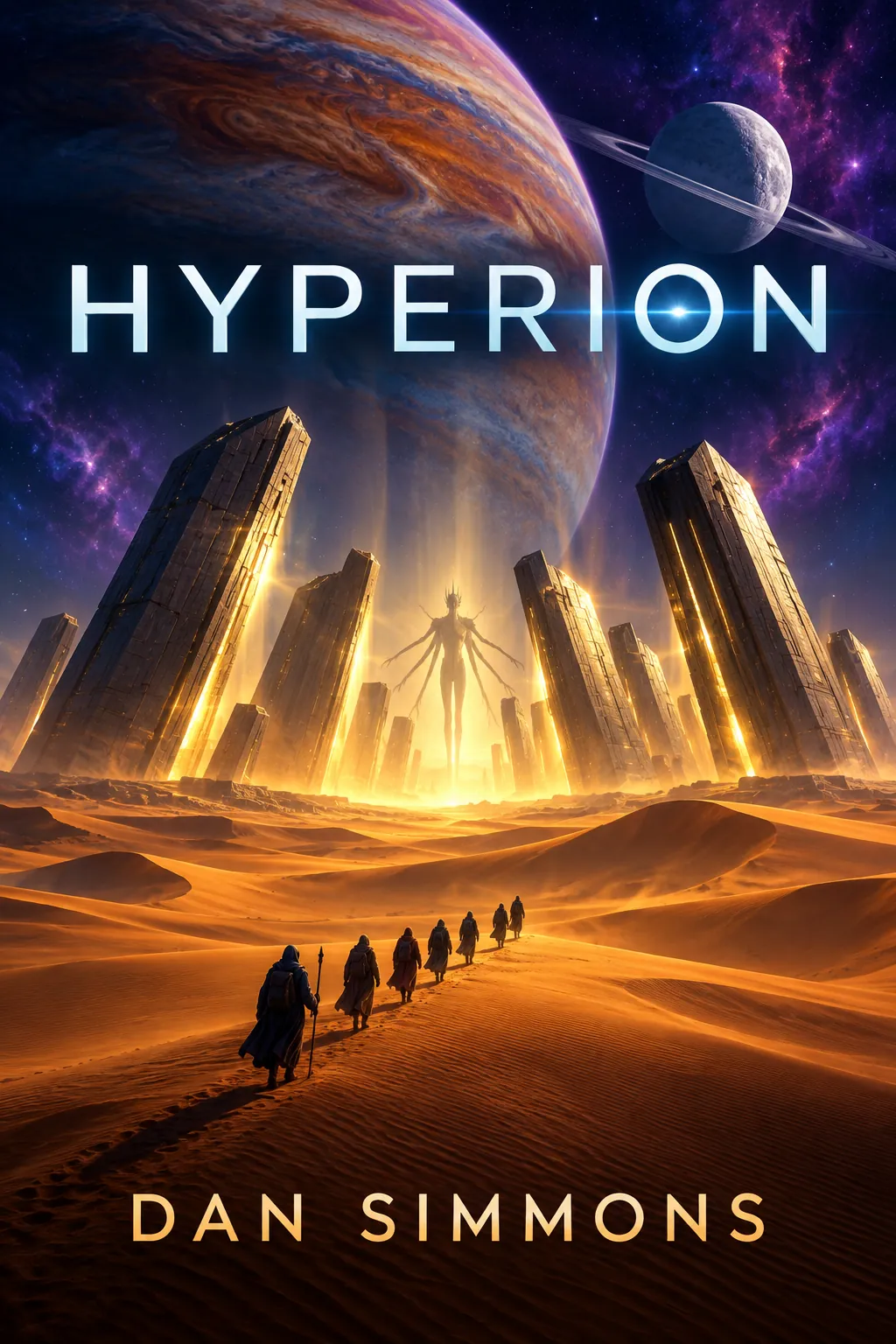
Hyperion
by Dan Simmons
Hyperion is a 1989 science-fiction novel by Dan Simmons about seven pilgrims sent on a last journey to the Time Tombs of the distant planet Hyperion, where a bladed, god-like creature called the Shrike waits. Built like The Canterbury Tales, it lets six of them tell why they came, and every story belongs to a different genre, from horror to love story to detective noir. Beneath the tales, a war is coming for the human empire, and nobody knows who is really steering events.
Try Audible · As an Amazon Associate we earn from qualifying purchases. Details
The Big Idea
"Hyperion asks what people will give up, or demand from a god, when time and death close in, and it tells this through six life stories that slowly join into one larger, darker picture."
Key Insights
Stories are how people face what they fear
The pilgrims could simply travel in silence, yet they choose to tell their stories. The novel suggests that telling a life aloud turns a private dread into something shared, and it reveals why each person needs the Shrike.
Each of the six tales is told on the journey to the Time Tombs, so the act of telling prepares the pilgrims for what they will meet.
Faith and technology collide
Religion in this future is mixed with machines, and neither one offers a clean answer. The book shows the Catholic Church's promise of eternal life as a technology with a hidden price, and it shows AI minds that borrow human feeling for their own ends.
In the Priest's Tale, the cross-shaped cruciform parasite promises life after death but leaves those who return changed in painful ways.
Love is what time takes from us
The most moving tales are about people who lose someone to time, distance or illness. Simmons keeps the science-fiction setting grand, yet each tale reduces it to a single relationship under pressure.
Sol Weintraub's daughter loses a day of memory each morning, so he must learn to love her again every day.
Art survives, even when people do not
Keats, Silenus and the Keats cybrid all show poetry as a record that outlasts the person who wrote it. The novel also asks whether machines can truly create art, or only copy what humans have felt.
Martin Silenus's long, unfinished poem keeps him tied to Hyperion and the Shrike, long after he stops believing in anything else.
Chapter Breakdown
Setting and background
Hyperion takes place in the far future, in a human empire called the Hegemony of Man. Its worlds are joined by farcasters, doors that let you step from one planet to another in a single stride.
Three forces press on this empire: the Ousters, humans who have adapted to life in deep space, the TechnoCore, a network of artificial minds that lives inside the Hegemony's systems, and the Church of the Shrike, which treats the Shrike as a mystery to be faced rather than a monster to be killed.
The Church of the Shrike is a separate cult. The Catholic Church also survives in this future as a small, old faith, and it matters in the Priest's Tale.
The novel is named after the unfinished poem Hyperion by John Keats, and Simmons borrows the shape of Chaucer's The Canterbury Tales. Seven travellers share a journey and pass the time with stories, so each tale can change genre and still serve the same plot.
Chapter-by-chapter summary
Spoiler warning: this section covers the plot of the whole book, including the ending.
Part 1: The frame, seven pilgrims
The Hegemony is about to lose Hyperion to an Ousters invasion, and the Time Tombs there are opening. The Church of the Shrike is allowed to send seven pilgrims on what looks like a final visit to the creature it reveres.
On a treeship, the pilgrims agree to tell how each of them is tied to Hyperion and the Shrike, so the voyage turns into a series of stories. The Templar who commands the ship, Het Masteen, tells no tale.
After the Scholar's Tale, Masteen goes to his room, and in the morning the room is full of blood and he is gone. Around the same time Ousters destroy the treeship.
The frame matters because it turns a space voyage into a puzzle: every teller is holding something back, and the reader wants to know what links them.
Part 2: The Priest's Tale, The Man Who Cried God
Father Lenar Hoyt, a Catholic priest, tells the story of his mentor, Father Paul Duré, who is sent to Hyperion to find a lost tribe called the Bikura. They seem to have found a way to return from death, and the secret is a cross-shaped parasite called the cruciform.
Duré learns that this resurrection costs the returned person much of what made them themselves. In the end he crucifies himself on a tesla tree, and Hoyt later comes to carry a cruciform too.
The tale works as horror and as a hard test of Catholic faith: eternal life arrives, but it may not be a life anyone would choose.
Part 3: The Soldier's Tale, The War Lovers
Colonel Fedmahn Kassad is a hardened Hegemony officer who keeps meeting a mysterious woman named Moneta in military simulations. He finds her in person only after a crash on Hyperion, where the Shrike fights beside them.
Each meeting mixes desire with danger, and the lines between memory, dream and fact blur.
Moneta turns out to work with the Shrike, which has been using Kassad to help push humanity toward war. The tale shows how violence and desire can feed on each other, and it ties the Shrike to the Time Tombs in a way no pilgrim can ignore.
Part 4: The Poet's Tale
Martin Silenus is an aging, foul-mouthed, brilliant poet who tells of his rise to fame, his flight as Old Earth is destroyed, and his long fight to finish a great poem, the Hyperion Cantos. His wild life nearly ruins him, and his path leads back to Hyperion and the Shrike.
The story argues that art can be a way to survive disaster, even when the artist is not a good person.
Part 5: The Scholar's Tale, The River Lethe's Taste Is Bitter
Sol Weintraub, a teacher, carries his baby daughter Rachel, an archaeologist who visited the Time Tombs. She is cursed with a sickness that makes her grow younger each day and lose a day of memory every morning.
Sol hopes the Shrike will reverse it, but he is haunted by the story of Abraham, a father asked to give up his child. This is the most tender tale in the book, and it makes the central question personal: what would you give to save someone you love?
Part 6: The Detective's Tale, The Long Goodbye
Brawne Lamia, a private detective, is hired by a client named Johnny, a cybrid: a human body run by an AI whose personality is modelled on the poet Keats. He wants her to investigate his own death, and as they work together, plan a risky theft and travel through the farcasters, they fall in love.
Johnny is killed in an ambush, and Lamia afterwards carries his consciousness in an implant. Her search leads into the secrets of the Core and its link to the Shrike.
The tale is a noir mystery that shows the machines may be using human art and feeling for their own plans.
Part 7: The Consul's Tale, Remembering Siri
The Consul, a diplomat of the Hegemony, tells the story of his grandparents, Merin Aspic and Siri, and he reveals the family link himself. Because of time dilation on Merin's long voyages, the two age at different rates.
By Merin's eighth visit, Siri has died of old age. Merin then sabotages the farcaster and leads a hopeless rebellion, which the Hegemony crushes.
The tale is last because it shows what the Hegemony's technology costs ordinary people: lovers pulled apart by time and a revolt the empire can wipe out. It helps explain where the Consul's own feelings about the Hegemony come from, and his own part in the story comes after the tale.
Part 8: At the Edge of the Tombs
With the tales told, the pilgrims travel across the land toward the Time Tombs as the first signs of the invasion appear.
The book stops there, just before they meet the Shrike, and the story continues in The Fall of Hyperion (1990), which finishes the story. The open ending is deliberate: Hyperion is half of a single story, so read the two books together.
Characters
- The Consul: a diplomat of the Hegemony who once served on Hyperion. His tale is about his grandparents, Merin Aspic and Siri, and his own reasons for joining the pilgrimage come into view only after it.
- Father Lenar Hoyt: a Catholic priest and the first teller. He recounts the story of his mentor, Father Paul Duré, and later carries a cruciform himself.
- Colonel Fedmahn Kassad: a Hegemony soldier, calm, disciplined and obsessed with a woman he cannot explain.
- Martin Silenus: an elderly poet, vain and crude, who is also the pilgrim most openly convinced that art matters.
- Sol Weintraub: a scholar and father who cares for his daughter Rachel and seeks a cure for her sickness at the Time Tombs.
- Brawne Lamia: a private detective who is blunt, sceptical and brave. Her case leads her to the TechnoCore and to love, and she later carries Johnny's consciousness.
- Het Masteen: a Templar who commands the treeship and tells no tale. After the Scholar's Tale he disappears from a room left full of blood, and the book leaves it a mystery.
- The Shrike: a towering creature of blades and thorns that is worshipped, feared and linked to time itself. Nobody can say what it wants.
Writing about this book
Start with the frame structure, because essay questions on Hyperion often ask how the six tales work together. A strong answer names the genre of each tale and then explains what the shift in genre adds to the whole.
For a character essay, pick one pilgrim and trace how their story reveals what they hope to ask the Shrike. Sol Weintraub and Brawne Lamia give the clearest material, because their tales connect love, loss and a choice.
For a theme essay, choose a contrast such as faith and technology, or art and death, and support it with two tales that approach the idea differently. The Priest's Tale and the Detective's Tale work well together here.
Quote briefly and always say which tale you mean. Keep in mind that the novel ends mid-journey, so describe it as the first half of a larger story and avoid claims about what the Shrike is, since the book itself does not answer that.
Take Action
Practical steps you can implement today:
-
Read Hyperion as a collection of linked stories; each tale shows its teller in a different genre and light.
-
Keep a short list of the pilgrims and one clue about each, so the frame story is easy to follow.
-
When you write about the book, compare two tales rather than summarising all six.
-
Plan to read The Fall of Hyperion next, since Hyperion ends before the story is resolved.
Notable Quotes
"“Deep in the shady sadness of a vale” (a line from Keats's poem Hyperion, Book I, which gave the novel its name; not from Simmons's text)"
— Dan Simmons
"“Far sunken from the healthy breath of morn” (a line from Keats's poem Hyperion, Book I; not from Simmons's text)"
— Dan Simmons
"“No stir of air was there” (a line from Keats's poem Hyperion, Book I; not from Simmons's text)"
— Dan Simmons
Who Should Read This
Readers aged about 15 and up who like big ideas in science fiction, and students who need to write about structure, genre or theme. It suits fans of The Canterbury Tales, Keats or Dune, and it works best for patient readers who enjoy puzzles.
Frequently Asked Questions
What is Hyperion about?
Hyperion follows seven pilgrims travelling to the Time Tombs on the planet Hyperion to meet the Shrike, a deadly, time-bending creature. On the way, six of them tell the stories of their lives, and the tales slowly reveal the political and technological forces behind a coming war.
Do I need to read The Fall of Hyperion?
Yes, if you want an answer. Hyperion stops just before the pilgrims reach the Shrike, and the sequel completes the story. Many readers treat the two books as one novel, though Hyperion can still be studied alone for its structure and tales.
What is the Shrike?
The Shrike is a tall, four-armed creature of blades and thorns that guards the Time Tombs, and it is both worshipped and feared. Hyperion does not explain what it is or what it wants, which is why each pilgrim gets to imagine their own answer.
Why does the book use six separate tales?
Simmons borrowed the idea from The Canterbury Tales, where travellers tell stories on a journey. It lets him write horror, war fiction, tragedy, noir and romance in one book, and it lets each story reveal a different part of the same secret.
Why is it called Hyperion?
It is named for the planet where the pilgrims travel, and for the unfinished poem Hyperion by John Keats, which the novel echoes. Keats's poem is about a fallen god and the loss of an older order, an idea that runs through the book.
Check Your Understanding
Pick an answer for each question to see if you were right.
-
Who wrote Hyperion?
Dan Simmons — Dan Simmons published Hyperion in 1989, and it won the Hugo Award in 1990.
-
Which older work gives Hyperion its structure?
The Canterbury Tales — Like Chaucer's book, Hyperion uses a group of travellers who tell stories on a shared journey.
-
Where are the pilgrims travelling to?
The Time Tombs — They go to the Time Tombs on Hyperion, where the Shrike is said to wait.
-
Which pilgrim carries his daughter, who is growing younger each day?
Sol Weintraub — Sol Weintraub's daughter Rachel is afflicted by a sickness that makes her lose a day of memory each morning.
-
What happens at the end of Hyperion?
The story stops before the pilgrims meet the Shrike — The novel ends mid-journey, and the plot continues in The Fall of Hyperion.
Want the full book?
Read or listen to Hyperion in full.
Try Audible · As an Amazon Associate we earn from qualifying purchases. Details
About Dan Simmons
Dan Simmons (born 1948) is an American author who taught primary school before writing full time. He has published horror, crime and science fiction, including The Terror and Ilium. Hyperion, his best-known novel, won the Hugo Award in 1990 and began a four-book series.
Summary Written By

Software Engineer & Writer
Software engineer with a passion for distilling complex ideas into actionable insights. Writes about finance, investment, entrepreneurship, and technology.
View all summaries →Reviews
No reviews yet. Be the first to share your thoughts!
Write a Review
Keep reading
Explore the topic: Sci-Fi Authors & AwardsSummaries

Out of My Mind
Sharon M. Draper
“Out of My Mind” by Sharon M. Draper is a poignant narrative that explores the life of Melody Brooks, a…

Ender’s Game
Orson Scott Card
“Ender’s Game” by Orson Scott Card is a riveting science fiction novel that transports readers into a future where humanity…

Pachinko
Min Jin Lee
“Pachinko”, a spellbinding multigenerational historical saga by Min Jin Lee, explores the lives of a Korean family trying to make…

The Perks of Being a Wallflower
Stephen Chbosky
The Perks of Being a Wallflower by Stephen Chbosky is a profound coming-of-age novel, told through the intimate letters of…
Articles

Hugo Award
The Hugo Award is science fiction's best-known prize, voted by fans rather than a jury. Members of the yearly World…

A Christmas Carol themes: generosity, isolation and responsibility
Dickens's novella is usually read as a story about a man who changes his mind. Its themes are sharper than…
Chinese Room Argument
The Chinese room argument is a thought experiment by philosopher John Searle, published in 1980. It says a computer that…