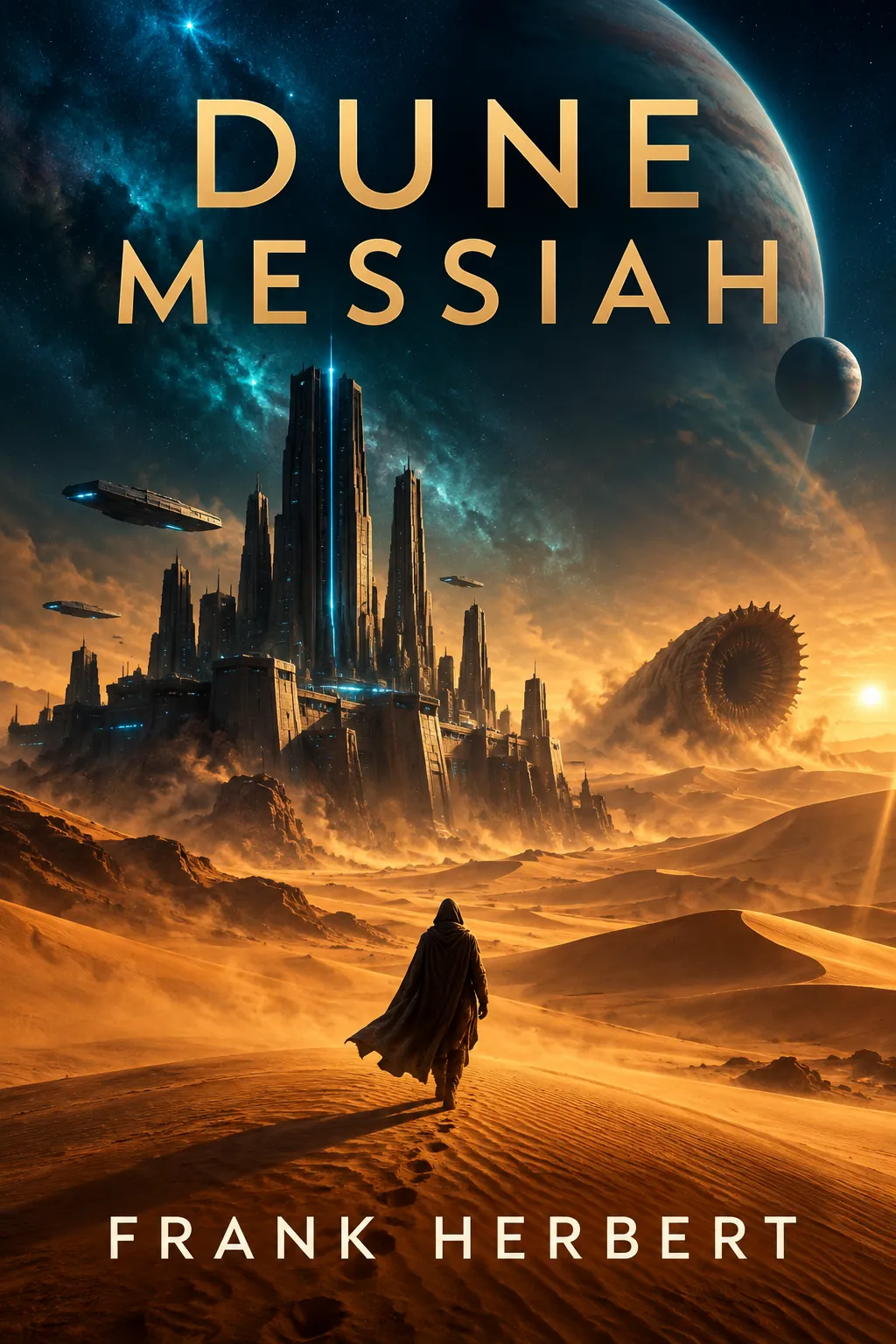
Dune Messiah
by Frank Herbert
Dune Messiah is the second novel in Frank Herbert's Dune series. It takes place twelve years after Paul Atreides became emperor, when a religious war fought in his name has already killed billions of people. Paul can see possible futures, but that gift now feels like a cage. A group of enemies, including the Bene Gesserit, the Spacing Guild and the Tleilaxu, plot to bring him down, and they offer him a strange gift: a dead friend brought back to life.
Try Audible · As an Amazon Associate we earn from qualifying purchases. Details
The Big Idea
"Dune Messiah asks what happens after the hero wins: Paul Atreides rules the universe, yet seeing the future leaves him trapped inside it."
Key Insights
Victory can become a trap
The first Dune ends with Paul's triumph. This sequel asks what that triumph costs. The empire he won is held together by a religious war he cannot stop, and every choice he makes feeds it. Herbert suggests that reaching a goal is not the end of the story, because success brings duties and consequences that the winner never chose. The reader is left to wonder whether a victory that harms billions can still be called a win.
Twelve years in, billions have died in the jihad fought in his name, and Paul is unable to call it off. Power has not given him freedom, and the throne has become the place where he is least able to act.
Prescience is a cage, not a gift
Paul can see possible futures, but seeing them does not let him change them. Herbert shows that knowing what will happen can leave a person more helpless, not less, because every path looks closed. Knowledge becomes a weight instead of a tool, and the more Paul sees, the fewer choices he feels he has. The book turns a classic fantasy power into a source of dread.
Paul sees the dangers around Chani long before they arrive, yet the vision does not make him able to avoid them. He watches events approach and still walks toward them.
Worship turns a person into a symbol
Paul is no longer treated as a man but as a messiah. The priests and armies who use his name want a symbol, and a symbol cannot be kind, tired or wrong. Herbert points out the irony that devotion, which seems to raise a person up, can strip away everything human about him. Paul's own wishes slowly stop mattering to the movement that carries his name.
The religious order that spreads his word acts in ways Paul never approved, and he cannot turn it back. His image has grown larger than his will.
Love is the one thing power cannot fix
The most powerful figure in the galaxy is shaken by an ordinary fear: losing someone he loves. The book places a private feeling against an empire and lets the feeling carry real weight. It asks whether the fate of a state can matter more than one person, and it leaves that question open for the reader. Strength of command does nothing to protect what is most dear.
Paul's love for Chani, and his fear for her, matters more to him than any political victory over the plotters. When the plot finally succeeds in hurting him, it does so through her.
Chapter Breakdown
Chapter-by-chapter summary
Spoiler warning: this section covers the whole plot, including the ending.
The novel has no named parts, so this guide splits it into six natural stages.
Part 1: Twelve years of victory
Twelve years after Dune, Paul Atreides is emperor, and the Fremen jihad fought in his name has spread across the galaxy and killed billions of people. Paul hates what his name has become, but he cannot stop the machine that his own rise set in motion.
His gift of prescience lets him glimpse the futures ahead, and in most of them the plots against him succeed. A conspiracy forms among the Bene Gesserit, the Spacing Guild, the Tleilaxu and his own political wife, Princess Irulan.
Each group wants something different, but they agree on one point: Paul has to be removed, or at least controlled. Their reasons give the plot its shape, because none of them is simply evil in its own eyes.
This opening matters because it turns the first book's triumph upside down: winning has made Paul a prisoner.
Part 2: A friend returns
The Tleilaxu present Paul with a gift, a ghola named Hayt, grown from the body of his dead friend Duncan Idaho. Hayt has the face and the fighting skills of the old Duncan, yet he remembers nothing of his earlier life.
Paul suspects a trap, but he keeps Hayt close anyway. Hayt has been conditioned to turn against him, and nobody knows yet which side of him will win.
Paul's choice to accept the gift is a risk, and it also shows how lonely he has become. The old friend he lost is the one person he might still trust, even in a borrowed body.
The scene matters because it poses the book's central question: can a person built as a weapon choose to become someone else?
Part 3: Chani and Irulan
Paul loves Chani, the Fremen woman who is his companion, but the empire needs an heir and his marriage to Irulan has produced no child. Irulan secretly works to keep Chani from conceiving.
Chani becomes pregnant anyway, and Paul's visions show him that the birth will cost her life. He is pulled between protecting her and protecting the empire he rules.
The political marriage and the love match sit side by side in the same palace. Neither woman is a pawn, and each pursues her own idea of what is best for Paul and for the throne.
This part matters because the most powerful man in the galaxy fears one thing above all: losing the person he loves.
Part 4: The blast and the dark
The conspirators strike with a stone burner, a weapon that releases atomic force, hidden in a trap meant for Paul. The blast leaves him blind.
Even so, Paul keeps seeing through prescience, and the irony is plain: losing his eyes barely changes what he knows. He also learns that enemies sit close to him inside his own court.
The attack shows how fragile a ruler's safety is, even when he can foresee danger. A vision of a threat is not the same as a way to stop it.
The part matters because in a world where sight is power, Paul's greatest strength is attacked at its root.
Part 5: Hayt remembers
Hayt was shaped to kill Paul, but as he lives near the emperor, memories of Duncan Idaho begin to rise. He struggles between the order planted in his mind and a loyalty that feels like his own.
Paul's young sister Alia, who was born with the memories of her ancestors, is drawn to Hayt. Their bond adds one more thread that no one in the palace can predict.
Hayt's inner fight is one of the most human parts of the book, because it is a fight over who gets to decide what he is. The plotters built him, but they cannot fully control what a mind chooses to become.
The question of whether a made creature can win back his own will is at its sharpest here.
Part 6: The twins and the desert
Chani gives birth to twins, Leto and Ghanima, and dies soon afterwards, just as Paul had foreseen. Knowing the future does nothing to soften the grief.
The conspirators have already taken what Paul valued most, while Hayt refuses to be used as their tool. The plot has done its damage, but it has not made Paul its puppet.
Paul gives up the throne and walks alone into the desert, as a blind Fremen is expected to do, leaving the empire and the twins in Alia's hands. The ending reads as a man called a messiah running from the name.
It is a quiet end for a book about empires, and that quiet is deliberate. Herbert lets the hero leave the stage instead of giving him a final victory.
Characters
- Paul Atreides (Muad'Dib): the emperor and Fremen leader, tormented by visions of futures he cannot change. He is the protagonist and the book's tragic centre, a man who wanted to save people and now carries the blame for a war.
- Chani: Paul's Fremen companion, the person he loves most. Her pregnancy is the personal heart of the story, and her fate gives the political plot a human cost.
- Alia Atreides: Paul's sister, a child with the memories of many ancestors. She holds real power and carries an unsettling inner crowd of voices that she cannot fully control.
- Princess Irulan: Paul's political wife and an author who records his reign. She works against Chani but is more complicated than a simple villain, because she is also trapped by the marriage.
- Hayt (Duncan Idaho): a ghola grown from Paul's dead friend. He is a weapon who may become a man again, and his struggle mirrors Paul's own wish to escape a role.
- Stilgar: the Fremen leader who stays loyal to Paul. He shows how faith can blur into obedience, and how a good man can serve something he no longer fully understands.
- Scytale: a Tleilaxu Face Dancer and a chief schemer behind the plot. He represents the cold, patient side of the conspiracy and its readiness to use people as tools.
- Edric: a Spacing Guild navigator who helps the plotters. He lives half-changed by spice and sees a different way of thinking about time and space.
- Reverend Mother Mohiam: the Bene Gesserit elder who wants Paul's bloodline to serve her order's long breeding plan. She stands for a slow, patient power that works across generations.
Writing about this book
The easiest mistake is to treat Dune Messiah as a sequel that simply repeats Dune with more fighting. A stronger essay explains how it reverses the first book.
Start with a clear claim, such as: Herbert uses Paul's victory to show that a saviour can become a prisoner of his own legend.
Then choose two or three scenes as evidence, for example the gift of Hayt, Paul's blindness and his relationship with Chani. For each one, say what happens, what it shows about power, and how it links to the claim.
You can compare Paul at the end of Dune with Paul here. Ask who is really in control: the emperor, the priests who spread his name or the future he sees.
Quote briefly and in your own framing, and avoid retelling the plot. Always name the book you are writing about and keep the film versions out of it.
A good essay also looks at structure, such as how the short, tense chapters push the story toward a quiet ending. Notice how Herbert withholds the usual rewards of a hero story, and say what that choice does to the reader.
If your task is personal reflection, think about a time when someone's image mattered more than the person, and whether that has ever happened to you.
Take Action
Practical steps you can implement today:
-
Ask what a victory will cost before you chase it, because success can create duties you did not want.
-
Notice when other people see your role instead of you, and decide how much of that role to accept.
-
Treat a warning about the future as a reason to act, not as a reason to feel helpless.
-
Judge a leader by the harm that follows their name, not only by their intentions.
Notable Quotes
"“The power to destroy a thing is the absolute control over it.” (Dune Messiah)"
— Frank Herbert
Who Should Read This
Readers who finished Dune and want to see what comes next, and students writing about heroes, power or religion in fiction. It suits ages 14 and up and works well for upper high school or university literature courses. Read Dune first, because many events here depend on it.
Frequently Asked Questions
Do I need to read Dune before Dune Messiah?
Yes. Dune Messiah continues directly from the first novel, and its events, characters and the jihad all depend on what happened there. A reader who starts here will miss the weight of Paul's rise and of Duncan Idaho's earlier death.
How long after Dune does Dune Messiah take place?
About twelve years later. Paul Atreides is already emperor, and the Fremen jihad launched in his name has spread across the known universe and killed billions of people.
What is a ghola in Dune Messiah?
A ghola is a person grown by the Tleilaxu from the cells of someone who has died. Hayt, the ghola of Duncan Idaho, looks like Paul's old friend but has none of his memories, which is why he is both a gift and a danger.
Is Dune Messiah a hero story?
Not in the usual sense. Herbert uses the sequel to question the idea of the heroic saviour, showing how Paul's victory brings war, worship and loss rather than peace.
What are the main themes of Dune Messiah?
The main themes are the burden of power, fate and free will, the danger of religious devotion, and the clash between love and politics. The novel keeps these ideas close to Paul's personal choices.
Check Your Understanding
Pick an answer for each question to see if you were right.
-
How long after the first novel does Dune Messiah begin?
About twelve years — The story begins roughly twelve years after Paul became emperor.
-
What is Hayt?
A ghola of Duncan Idaho — Hayt is a ghola grown from the body of Paul's dead friend Duncan Idaho.
-
Who is Paul's political wife?
Princess Irulan — Paul married Princess Irulan for political reasons; Chani is the person he loves.
-
Which weapon is used in the attack that blinds Paul?
A stone burner — The conspirators use a stone burner, an atomic weapon, in the trap.
-
What are the names of Paul and Chani's twins?
Leto and Ghanima — The twins are Leto and Ghanima.
Want the full book?
Read or listen to Dune Messiah in full.
Try Audible · As an Amazon Associate we earn from qualifying purchases. Details
About Frank Herbert
Frank Herbert (1920–1986) was an American writer, born in Tacoma, Washington, who worked as a journalist before turning to fiction. His novel Dune (1965) won the Hugo Award and the first Nebula Award for best novel, and Dune Messiah continued the story of Paul Atreides.
Summary Written By

Software Engineer & Writer
Software engineer with a passion for distilling complex ideas into actionable insights. Writes about finance, investment, entrepreneurship, and technology.
View all summaries →Reviews
No reviews yet. Be the first to share your thoughts!
Write a Review
Keep reading
Explore the topic: Science FictionSummaries

Out of My Mind
Sharon M. Draper
“Out of My Mind” by Sharon M. Draper is a poignant narrative that explores the life of Melody Brooks, a…

Ender’s Game
Orson Scott Card
“Ender’s Game” by Orson Scott Card is a riveting science fiction novel that transports readers into a future where humanity…

Pachinko
Min Jin Lee
“Pachinko”, a spellbinding multigenerational historical saga by Min Jin Lee, explores the lives of a Korean family trying to make…

The Perks of Being a Wallflower
Stephen Chbosky
The Perks of Being a Wallflower by Stephen Chbosky is a profound coming-of-age novel, told through the intimate letters of…
Articles

A Christmas Carol themes: generosity, isolation and responsibility
Dickens's novella is usually read as a story about a man who changes his mind. Its themes are sharper than…
Proxima Centauri
Proxima Centauri is the nearest star to the Sun, about 4.25 light-years away. It is a small red dwarf, too…
Time dilation
Time dilation is the effect, predicted by Einstein's relativity and measured, that clocks tick at different rates depending on speed…