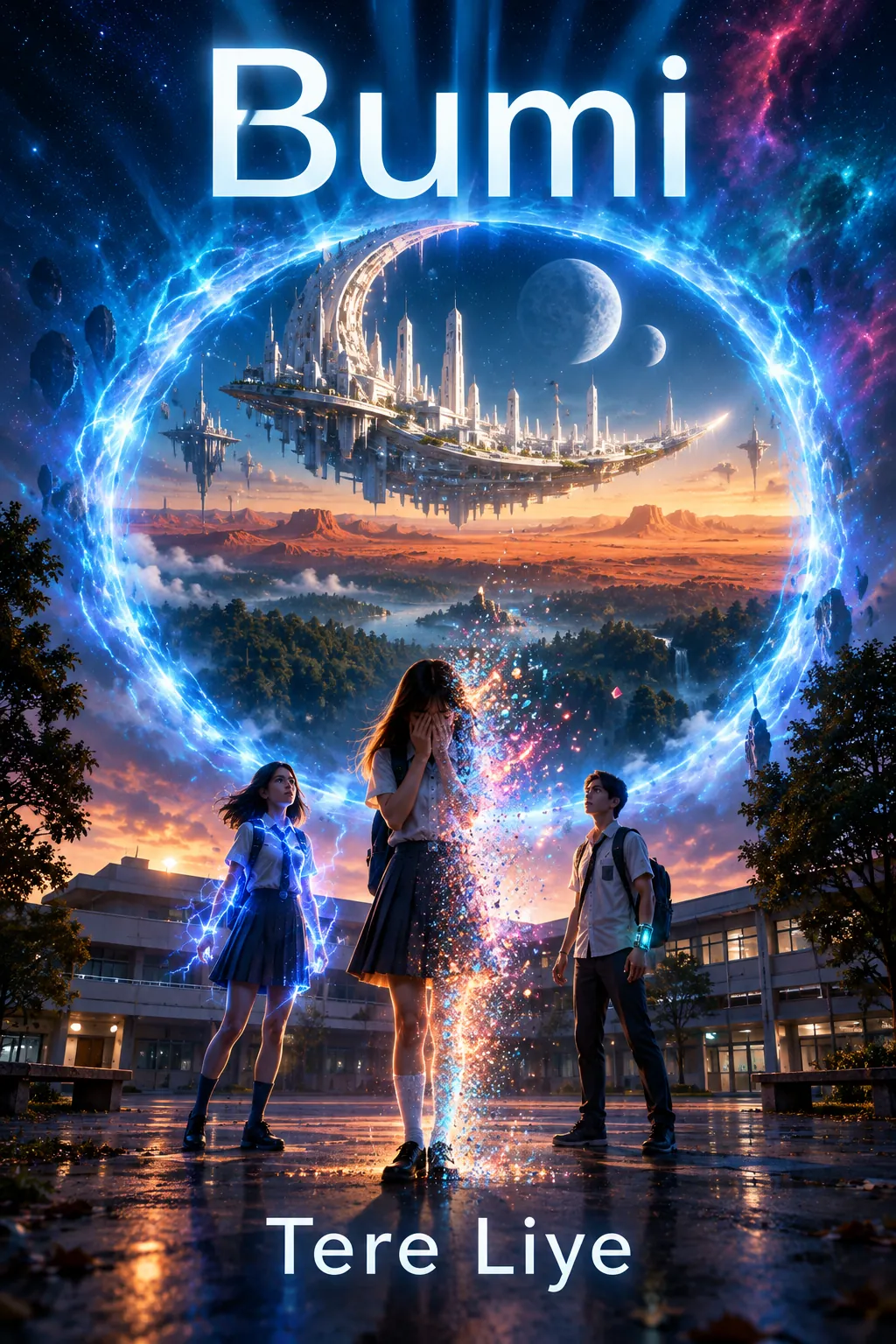
Bumi
by Tere Liye
Bumi (English edition: Earth) is an Indonesian young-adult fantasy by Tere Liye, published in 2014 as the first book of a long series. It follows Raib, a shy fifteen-year-old who can make herself vanish, and her classmates Seli and Ali. When their abilities come to light, the three are drawn into a parallel world beside our own and face a dangerous figure named Tamus. It is a story about friendship, courage and what you do with a gift that sets you apart.
Try Audible · As an Amazon Associate we earn from qualifying purchases. Details
The Big Idea
"Three ordinary schoolmates discover hidden powers and a parallel world, and learn that being different is not a flaw but a responsibility that friends carry together."
Key Insights
Different gifts, one group of friends
The three heroes are very different people. Raib can vanish, Seli is linked to lightning, and Ali is a clever classmate with a mind of his own. The series puts these three side by side from the start, so strength is shown as something friends share rather than something they compete over. A reader can see that each of them would be weaker alone.
A girl who hides, a girl who crackles with energy and a boy who thinks for himself sit in the same classroom, which is the premise of the whole series.
Friendship comes before the fantasy
The novel opens with a school and three classmates, not with a battlefield. Because the reader meets Raib, Seli and Ali as friends first, the later adventure carries emotional weight. The magic is exciting, but the reason to keep turning pages is whether these three will stay loyal to each other.
The bond between the friends exists long before the parallel world appears, and the plot keeps testing it.
A parallel world as a mirror
The other world sits beside our own, and the clan names Earth, Moon, Sun and Star turn the cosmos into a family of places. This gives the author room to talk about power and belonging without lecturing. The reader sees ordinary life from outside, as one place that can be protected or threatened.
A student who walks the same school corridor every day is suddenly asked to think about worlds she never knew existed.
Power attracts dangerous people
Tamus is the figure who stands against the children, and the story sets his menace against their inexperience. They are still learning what their abilities mean, while he is already dangerous. The book suggests that what you do with a gift matters more than having it, and that responsibility is learned, not given.
The trio's first real test comes from an enemy, not from a school exam, and it forces them to act as a group.
Ordinary and special depend on where you stand
At school Raib is a quiet student who tries not to be noticed. Her ability means that once the wider world opens up, the same person matters a great deal. The story suggests that how others see you depends on the place you are standing in, and that a present setting does not define a whole person.
Shy, careful Raib is the one who can make herself vanish, and that secret is at the centre of the book.
Chapter Breakdown
Chapter-by-chapter summary
Spoiler warning: this section covers the setup of the first volume and does not go beyond the opening of the series.
The part titles below are our own labels, not the book's chapter titles. The story is told in our own words and in outline, as a guide to reading the novel and not a replacement for it.
Part 1: Three schoolmates
The story begins in an ordinary school with three classmates: Raib, Seli and Ali. Raib is fifteen, shy and brave, and she keeps a secret to herself: she can make herself vanish.
Seli is her close friend, a girl the series links to lightning, and she belongs to the Sun clan (Klan Matahari). Ali is the third of the group, a clever classmate who goes his own way.
The author lets us know these three as friends before any other world appears. That is why the later adventure feels personal: we already care who stands next to whom.
A quiet girl hiding something about herself, with friends close by, is a situation many students recognise from their own class.
Part 2: When the secret comes out
The three friends' unusual abilities cannot stay private for long. Once other people notice them, school stops being a safe and predictable place, and the friends have to decide whom to trust.
A teacher, Miss Selena, belongs to the circle of adults around them, and the series later gives her a book of her own. A dangerous figure named Tamus also enters the story at this stage.
This is the hinge of the first volume, where the school story turns into an adventure with an enemy. Reading for the exact point where everyday life breaks makes the rest of the plot easier to follow.
Part 3: A world beside ours
The three are drawn out of their everyday life and into a parallel world. The novel presents it as a real place that exists alongside our Earth, not as a dream or a spell.
This is where the book borrows from science fiction as well as fantasy. The other world has its own people and its own rules, and the friends must learn them quickly.
A parallel world next to ours also changes how the reader sees the familiar one. The school corridor and the street outside become one place among several.
Part 4: Four clans and their names
The series is built around four clans: Bumi, Bulan, Matahari and Bintang. All four are everyday Indonesian words, meaning Earth, Moon, Sun and Star.
Bumi is the title of the first book and of the whole series, and the next three titles are named after the other clans. Seli, as noted above, comes from the Sun clan.
The names work as a quiet map. If you remember them, you also remember the order in which the sequels appear.
Part 5: Tamus as the threat
Tamus is the main antagonist of the first book. The novel makes him a danger to the three friends and to the worlds they are drawn into.
A clear opponent gives the group a shared problem, and a shared problem is what turns three separate students into a team. Watch how each friend responds to the pressure, because their reactions show their personalities.
Part 6: What the first volume sets up
Bumi works as the opening of a much larger story. The sequels continue with Bulan, Matahari and Bintang, and later books widen the map of the series.
By the end of the first volume you know the three heroes, the four clan names and the central enemy. That is the foundation the rest of the series builds on.
Characters
- Raib: a shy and brave fifteen-year-old and the heart of the story. She can make herself vanish, a gift she keeps private.
- Seli: Raib's close friend, from the Sun clan. She is loyal and strong-willed, and the series links her to lightning.
- Ali: the third friend, a clever classmate who goes his own way. He completes the trio and balances the other two.
- Tamus: the main antagonist of the first book. He turns a school story into a story with real danger.
- Miss Selena: a teacher at the school and one of the adults around the trio. The series later gives her a book of her own.
Writing about this book
If you have to write a review, a reading journal entry or a book talk about Bumi, start from one clear question instead of retelling the plot. Good questions are how the author uses clans and worlds to show different ways of belonging, or what the friendship between Raib, Seli and Ali says about being different.
Open with one sentence that names the book, the author and the year, and say that it is the first of a series.
Then choose two scenes and explain what each one shows about a character. For example, you can compare how Raib hides and how Seli stands out.
Link one idea to your own life, such as a time you were afraid to show what made you different and what a friend did about it.
Keep quotations very short and always name the scene. If you read the English edition, Earth (2019), quote from it; if you read the Indonesian original, say that any English wording is your own translation.
Finish with a short personal judgement: did the parallel world make the school story richer, and why? You could also ask why the author begins at a school desk, and which friend changes most.
Take Action
Practical steps you can implement today:
-
Start a book talk with one question about friendship or power, not a full retelling of the plot.
-
Notice how each character's ability matches their personality, and use that in your analysis.
-
Read the series in order: Bumi, then Bulan, Matahari and Bintang.
-
If you quote the English edition Earth, name the scene; if you work from the Indonesian original, mark any wording as your own translation.
Who Should Read This
Bumi suits readers from about twelve upwards who enjoy school-based fantasy and science fiction, and it is a good fit for students of Indonesian who want a long, popular novel. It is also useful for fans of young-adult series who want to read beyond English-language books. It is a first volume, so be ready to continue.
Frequently Asked Questions
What is Bumi by Tere Liye about?
Bumi is the first novel of an Indonesian young-adult fantasy series. It follows Raib, Seli and Ali, three schoolmates with hidden abilities who are drawn into a parallel world beside ordinary Earth and face a dangerous figure named Tamus.
Who are the main characters in Bumi?
The three heroes are Raib, who can vanish, Seli, who belongs to the Sun clan and is linked to lightning, and Ali, a clever classmate. The main villain of the first book is Tamus, and a teacher, Miss Selena, is one of the adults around them.
When was Bumi published, and by whom?
Bumi was published in 2014 in Indonesia by Gramedia Pustaka Utama. It is the first book of the Bumi series, which continues with Bulan, Matahari and Bintang.
Is there an English or Japanese edition of Bumi?
Yes, there is an English edition titled Earth, published by Gramedia Pustaka Utama as a 368-page paperback on 11 March 2019; no translator is listed. No Japanese edition is known at present.
Is Bumi science fiction or fantasy?
It is both. The hidden powers and the clans feel like fantasy, while a parallel world that exists beside ours gives it a science-fiction side.
In what order should the Bumi series be read?
Start with Bumi, then continue with Bulan, Matahari and Bintang. Later books build on the same world, so they work best after the main series.
Check Your Understanding
Pick an answer for each question to see if you were right.
-
What does the Indonesian word bumi mean?
Earth — Bumi means Earth, and it is both the title of the first book and the name of one clan.
-
Which clan does Seli belong to?
The Sun clan — Seli belongs to the Sun clan (Klan Matahari), one of the clans of the series.
-
Who is the main villain of the first book?
Tamus — Tamus is the main antagonist of the first book.
-
In what year was Bumi first published?
2014 — Bumi was first published in 2014.
-
Which book follows Bumi in the series?
Bulan — The second book of the series is Bulan.
Want the full book?
Read or listen to Bumi in full.
Try Audible · As an Amazon Associate we earn from qualifying purchases. Details
About Tere Liye
Tere Liye is the pen name of an Indonesian novelist who has published dozens of books, from realistic family stories to fantasy and science fiction. His Bumi series, which began in 2014 with Gramedia Pustaka Utama, is among his best-known work for young readers in Indonesia.
Summary Written By

Software Engineer & Writer
Software engineer with a passion for distilling complex ideas into actionable insights. Writes about finance, investment, entrepreneurship, and technology.
View all summaries →Reviews
No reviews yet. Be the first to share your thoughts!
Write a Review
Keep reading
Explore the topic: Sci-Fi Authors & AwardsSummaries

Out of My Mind
Sharon M. Draper
“Out of My Mind” by Sharon M. Draper is a poignant narrative that explores the life of Melody Brooks, a…

Ender’s Game
Orson Scott Card
“Ender’s Game” by Orson Scott Card is a riveting science fiction novel that transports readers into a future where humanity…

Pachinko
Min Jin Lee
“Pachinko”, a spellbinding multigenerational historical saga by Min Jin Lee, explores the lives of a Korean family trying to make…

The Perks of Being a Wallflower
Stephen Chbosky
The Perks of Being a Wallflower by Stephen Chbosky is a profound coming-of-age novel, told through the intimate letters of…
Articles

Jules Verne
Jules Verne (1828–1905) was a French novelist who turned science and travel into adventure stories. His Extraordinary Voyages series, including…

A Christmas Carol themes: generosity, isolation and responsibility
Dickens's novella is usually read as a story about a man who changes his mind. Its themes are sharper than…
Chinese Room Argument
The Chinese room argument is a thought experiment by philosopher John Searle, published in 1980. It says a computer that…