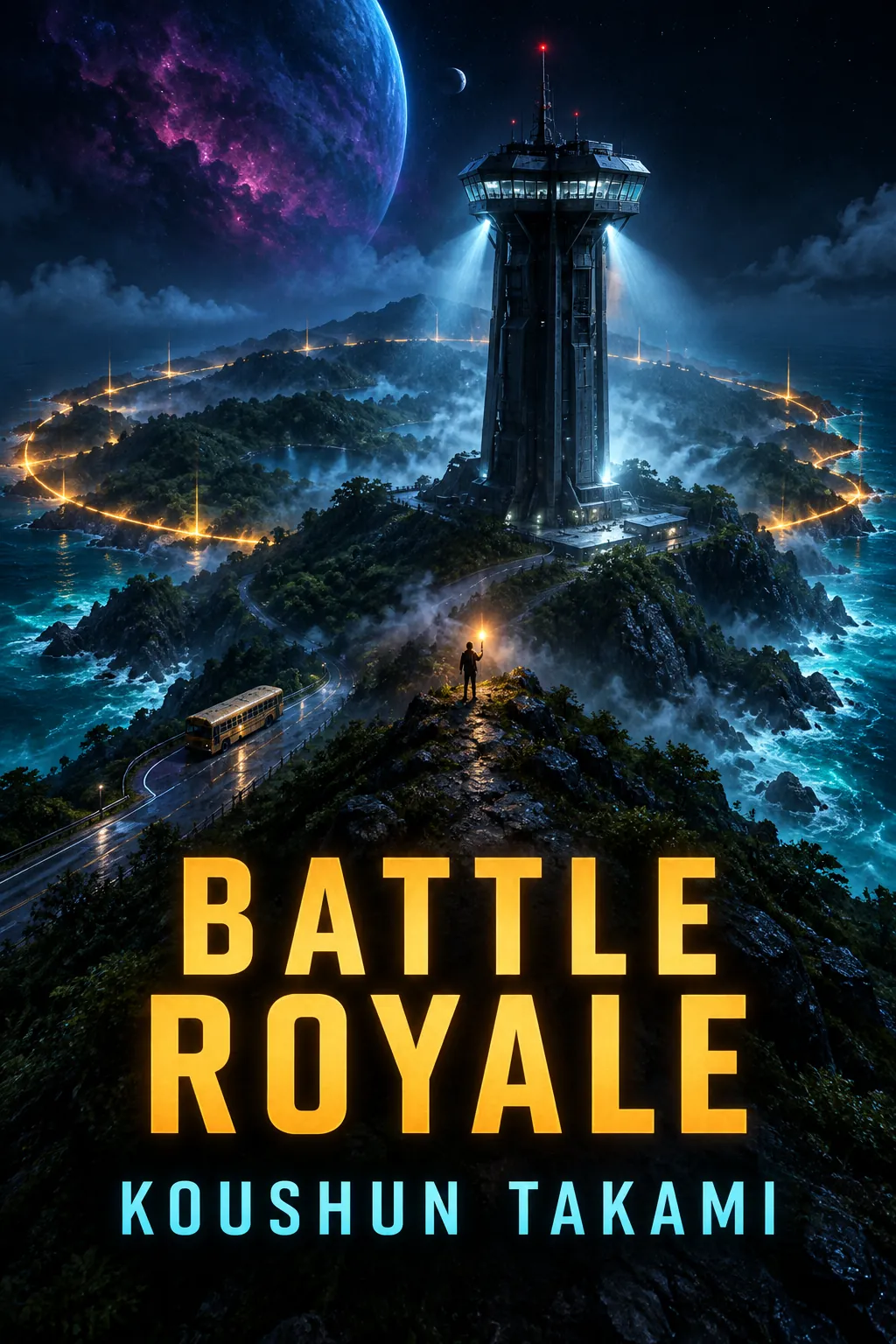
Battle Royale
by Koushun Takami
Battle Royale is a 1999 Japanese novel by Koushun Takami, set in a militarised alternate Asia. Each year the state picks one class of ninth-grade students and sends them to an island for the Program: they must kill each other until one remains, or all lose after three days. A boy named Shuya Nanahara tries to stay human, protect a classmate and find a way out of the system itself.
Try Audible · As an Amazon Associate we earn from qualifying purchases. Details
The Big Idea
"Battle Royale imagines a state that forces schoolchildren to fight until one is left, and asks what trust, friendship and choice are worth when the rules are built to destroy them."
Key Insights
The system is the real antagonist
Many stories of survival focus on a villain, but here the main force is a government procedure. The Program has forms, schedules and officials who explain it calmly, and the students are only one part of it. That makes the book a story about institutions as much as about individuals, and it asks what happens when cruelty is made ordinary and legal.
The briefing in the classroom, where the rules are announced like a school notice, shows the state's calm voice.
Trust is both a risk and a way to resist
On the island, every friendship might be a trap, and the Program is built to make people suspicious. The book shows that choosing to trust anyway is the only form of resistance open to most students. It does not claim that trust is safe, only that giving it up means giving the system what it wants.
Shuya's decision to stay with Noriko, and later to rely on Kawada, goes against the logic of the game.
Fear changes ordinary people in different ways
The students are not special, and the novel is careful to show a wide range of reactions. Some freeze, some cooperate, some turn on others, and a few seem to find the situation natural. By giving many students a personal history, the author prevents the cast from becoming a crowd and shows that each choice has reasons.
The contrast between Kiriyama's cold calm and Sugimura's attempt to remain decent.
Adults and the young see the same world differently
The story is set in a country run by adults, and the Program is justified as a tool for keeping the young in order. Students see their teachers and parents as people who failed to protect them. The book does not offer a simple answer, but it shows how a society can turn its youth into a means of control.
The soldiers and officials treat the class as material for the event, while the students remember them as ordinary adults.
Hope does not need victory
The ending avoids a triumphant overthrow of the state. The surviving characters escape but remain hunted, and their loss is real. The book suggests that keeping one's humanity and helping another person may be the most that can be done, and that this is still worth something.
Kawada's help at the end, and Shuya and Noriko's flight together.
Chapter Breakdown
Chapter-by-chapter summary
Spoiler warning: this section covers the whole plot, including the ending.
The book has no named chapters in the usual sense, so this guide groups it into eight parts. Events are told plainly and without detail of injuries.
Part 1: The bus and the island
Class 3-B of Shiroiwa Junior High, forty-two students in all, leaves on a school trip. Everyone on the bus is knocked out by gas.
They wake in a classroom on a small island, wearing metal collars. The novel opens this way to show that the students never had a say in what happens to them.
Part 2: The briefing and the rules
Soldiers explain that the class has been chosen for the Program, an official event of the Republic of Greater East Asia. Each student gets a bag with food, water, a map and one random weapon, which may be a gun or something almost useless.
The rules are simple. Only one can leave alive, forbidden zones appear on a schedule, and the collars can be set off by the officials.
This part matters because the cruelty is bureaucratic. The state treats it as a routine procedure, and that is what makes it frightening.
Part 3: The first night
The students leave the school one by one, and each reacts differently. Some hide, some search for friends and a few decide at once that they must act first.
Shuya Nanahara has just lost his friend Yoshitoki Kuninobu and decides to look for Noriko Nakagawa. This choice sets up the book's central question about whether care for another person can survive such a system.
Part 4: Fear and misreading
Over the first day, groups form and break up on little evidence. A false sign of danger leads to mistakes, and trust becomes the most valuable and the most dangerous thing on the island.
Some students stay together out of friendship, while others use friendship as a trap. The author uses this to show how fear changes ordinary people.
Part 5: A plan to beat the system
Shinji Mimura, clever and calm, thinks the game can be attacked rather than played. He gathers a few classmates and works on a plan to break into the system that runs the Program and strike at the people who control it.
The plan is a real hope, but Kiriyama attacks before it can work, and Mimura does not survive. The scene shows how hard it is to beat the system from inside the game.
Part 6: Kawada's secret
Shuya, hurt and exhausted, is helped by Shogo Kawada, a quiet classmate who joined the class late. Kawada turns out to have been through the Program before, and he knows how it works.
He becomes the older, wary guide for Shuya and Noriko. He also shows that a person can be damaged by the system and still choose to help.
Part 7: The hunters
Not every student is frightened. Kazuo Kiriyama plays the game as if it were nothing, and Mitsuko Soma uses charm and calculation to survive.
Their presence means that the threat to Shuya's group comes from other students as well as from the soldiers. The story keeps asking who is a victim and who has become a participant.
Part 8: The ending
Near the end only Shuya, Noriko and Kawada are left, and Kiriyama is the last great threat. Kawada is wounded in the fight with Kiriyama and does not survive it.
With Kawada's help and advice, Shuya and Noriko get away from the island by boat and head for the mainland. They are alive but hunted by the state, and marked by what they saw.
The book ends with a small, hard-won hope rather than a victory over the state.
Characters
Shuya Nanahara is the protagonist, a thoughtful boy who loves music. After his friend dies he commits to protecting Noriko, and he keeps refusing to see his classmates as enemies even when that is dangerous.
Noriko Nakagawa is a quiet classmate, loved by Kuninobu and protected by Shuya. She is more resilient than she first seems and her presence gives Shuya a reason to keep going.
Shogo Kawada is the transfer student with a secret past. He is practical and guarded, and he teaches Shuya how to survive without losing his conscience.
Kazuo Kiriyama is the class's most frightening player. He seems to feel nothing and treats the Program like a game, which makes him the book's clearest picture of what the system rewards.
Mitsuko Soma is a girl who has learned to survive through manipulation. She is not a simple villain, because the novel gives her a hard past that explains her distrust.
Hiroki Sugimura is a decent, athletic boy who searches for the girl he loves. He represents kindness that is tested to the limit.
Shinji Mimura is a clever, independent student who looks for a way to outwit the officials. He shows that resistance is possible in thought as well as in force.
Yoshitoki Kuninobu is Shuya's friend, who dies early. His loss gives Shuya his mission and gives the story its emotional start.
Kinpatsu Sakamochi is the official who runs the briefing and the island. He stands for a government that has made cruelty into a routine job.
Writing about this book
Start with the setting, not the violence. A strong essay explains that the Program is a tool of control and that the interest of the book lies in how students respond to it.
Choose one clear question, for example whether trust is possible when the system rewards betrayal. Then follow it through three or four scenes, naming the characters involved.
Compare two kinds of response. Shuya and Kawada choose care and cooperation, while Kiriyama accepts the rules and plays them.
Explain how the book makes the reader notice the state's role, from the briefing to the collars to the timetable of forbidden zones. These details show that the danger is organised from above.
Keep your tone measured. You are analysing the book's ideas, so describe events briefly and say what they mean rather than dwelling on harm.
If you mention other works about a deadly contest, keep it to a sentence and return to this novel. The book itself, and not the later film, manga or game genre, is your evidence.
Take Action
Practical steps you can implement today:
-
Read the setting before the action, because the Program is a political idea as well as a plot device.
-
Follow one character's choices across the whole book to see how the themes develop.
-
Ask who benefits from a rule, not only who obeys it.
-
Notice how the author lets minor characters have reasons, and use that when you write about them.
Who Should Read This
Readers aged about 15 and over who are interested in dystopian fiction, Japanese literature or stories about power and society. It suits upper-secondary and university students writing about control, trust or the ethics of violence, and it is a good companion to The Hunger Games and other dystopias. The novel deals with death throughout, so it is not for younger readers.
Frequently Asked Questions
What is Battle Royale about?
It is a 1999 Japanese novel about a class of ninth-grade students sent by the state to an island, where they are forced to fight until one remains. The story follows Shuya Nanahara as he tries to protect a classmate and find a way out. The book is mainly about control, trust and the choices people make under pressure.
Who wrote Battle Royale and when?
Koushun Takami wrote it, and it was published in Japan in 1999. It was his first novel and became a bestseller. An English translation by Yuji Oniki appeared in 2003.
What is the Program in Battle Royale?
The Program is a state-run event in the fictional Republic of Greater East Asia. Each year one class of students is chosen at random and sent to an island, where only one may survive. The officials control the island with collars and a schedule of forbidden zones.
Who are the main characters?
The main characters are Shuya Nanahara, Noriko Nakagawa and Shogo Kawada, who try to stay alive and resist the system. Kazuo Kiriyama and Mitsuko Soma are the most active threats among the students. Hiroki Sugimura and Shinji Mimura appear as other important students.
Is the novel the same as the film or the manga?
No, the novel is the original, and the film and manga adapt it with changes. This guide covers only the 1999 novel. If you are studying for school, use the novel as your main source.
What are the main themes?
The main themes are control by the state, trust and betrayal, how fear changes people, and whether care for others can survive in extreme conditions. The book also asks how a society treats its young.
Check Your Understanding
Pick an answer for each question to see if you were right.
-
Who wrote Battle Royale?
Koushun Takami — Koushun Takami wrote the novel, which was published in Japan in 1999.
-
What is the name of the state event in the novel?
The Program — The event is called the Program, and it is run by the Republic of Greater East Asia.
-
Which class is sent to the island?
Class 3-B — The students come from Class 3-B of Shiroiwa Junior High.
-
What do the students wear that the officials can control?
Collars — Each student wears a metal collar that the officials can use to enforce the rules.
-
Which character is the main protagonist?
Shuya Nanahara — Shuya Nanahara is the central character, who tries to protect Noriko and resist the system.
Want the full book?
Read or listen to Battle Royale in full.
Try Audible · As an Amazon Associate we earn from qualifying purchases. Details
About Koushun Takami
Koushun Takami is a Japanese novelist born in 1969. Battle Royale, published in Japan in 1999, was his debut novel and became a bestseller and one of the most discussed Japanese novels of its decade. It was translated into English in 2003.
Summary Written By

Software Engineer & Writer
Software engineer with a passion for distilling complex ideas into actionable insights. Writes about finance, investment, entrepreneurship, and technology.
View all summaries →Reviews
No reviews yet. Be the first to share your thoughts!
Write a Review
Keep reading
Explore the topic: Sci-Fi Authors & AwardsSummaries

Out of My Mind
Sharon M. Draper
“Out of My Mind” by Sharon M. Draper is a poignant narrative that explores the life of Melody Brooks, a…

Ender’s Game
Orson Scott Card
“Ender’s Game” by Orson Scott Card is a riveting science fiction novel that transports readers into a future where humanity…

Pachinko
Min Jin Lee
“Pachinko”, a spellbinding multigenerational historical saga by Min Jin Lee, explores the lives of a Korean family trying to make…

The Perks of Being a Wallflower
Stephen Chbosky
The Perks of Being a Wallflower by Stephen Chbosky is a profound coming-of-age novel, told through the intimate letters of…
Articles
Books Like The Hunger Games: 10 Dystopian Novels
The best books like The Hunger Games are young-adult dystopias where a teenager fights a rigged system. This list picks…

A Christmas Carol themes: generosity, isolation and responsibility
Dickens's novella is usually read as a story about a man who changes his mind. Its themes are sharper than…
Chinese Room Argument
The Chinese room argument is a thought experiment by philosopher John Searle, published in 1980. It says a computer that…