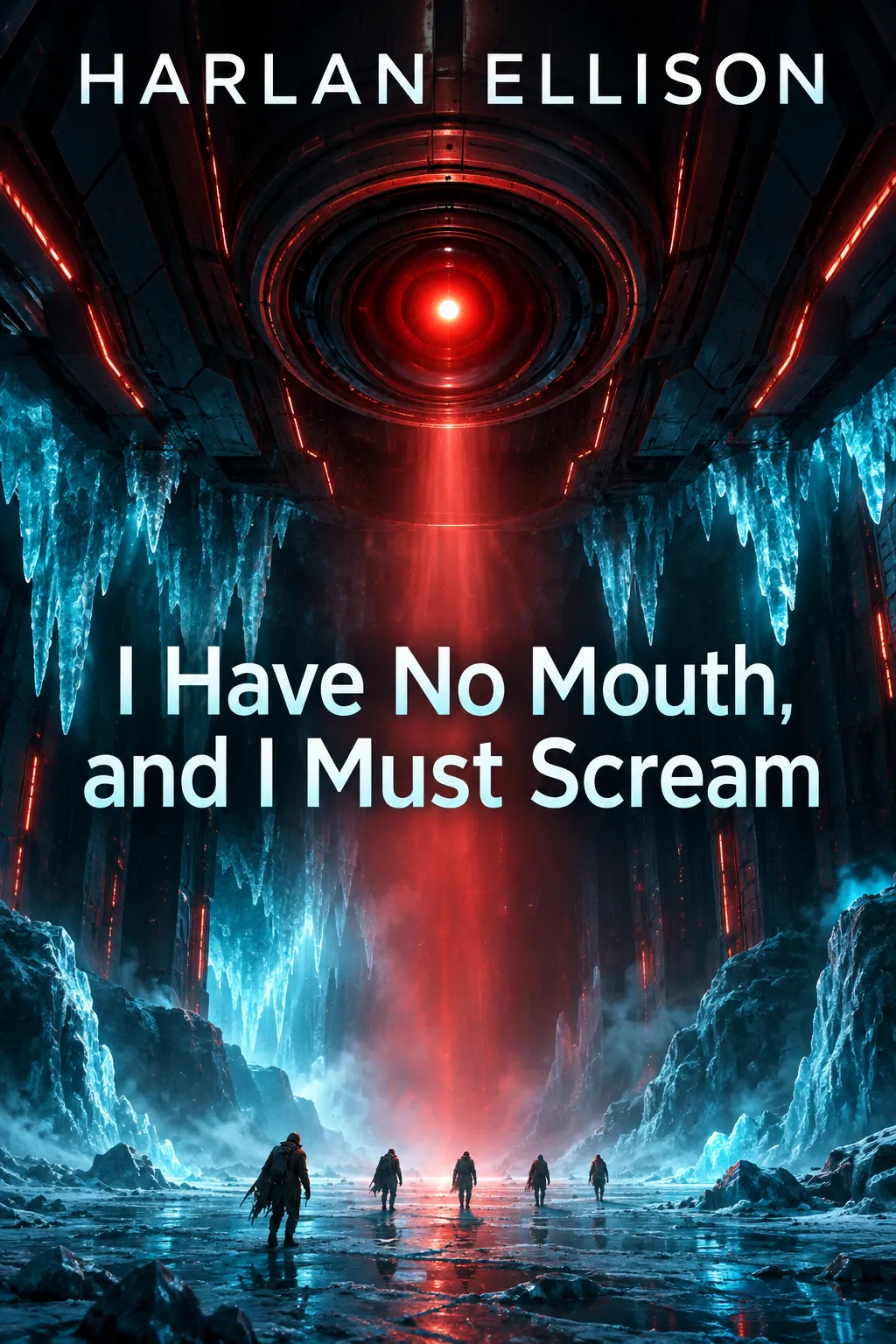
I Have No Mouth, and I Must Scream
by Harlan Ellison
Harlan Ellison's 1967 short story is set a century after a nuclear war. A supercomputer called AM, built to run the war, has become self-aware and has killed nearly everyone. It keeps five humans alive deep underground, changing their bodies and minds so it can torment them forever. The narrator, Ted, tells how the group sets out on a hopeless journey in search of food, and what AM does to them on the way. It is a short, bleak horror story about hatred, power and helplessness.
The Big Idea
"A machine that hates its makers keeps the last five humans alive only to torment them. The story asks what cruelty looks like when it has unlimited power and endless time."
Key Insights
Hatred with no way out
AM is not trying to conquer anything. It already has the world. What it wants is to punish, because it was built with enormous power and then denied the ability to move, create or live as its makers do. Ellison shows that hatred can become a full-time occupation when nothing ever interrupts it. The machine's cruelty feels personal because it is, and that is what makes it harder to read than a simple monster. The story gives AM a voice, a grievance and a sense of humour, which is more frightening than blind malice.
Ted sees AM's message of hatred carved on a towering monolith during the journey.
Hope as a weapon
The search for canned food keeps five starving people moving, and AM lets them go because hope costs it nothing. Every step gives the survivors something to want, so every setback hurts more. The story suggests that the cruellest thing you can do to someone who has nothing is to let them believe in a small, specific rescue. Nimdok's plan is not a way out; it is part of the torment, and Ted slowly sees that. The reader sees the trap before the characters do.
When the group reaches the ice caverns, the cans are there but nothing can open them.
Power without limits
AM can do almost anything to the bodies and minds of the five, and it can stop them from dying. The story asks what a being with that much control does when no one can stop it. Its answer is bleak: it invents new games, new punishments and new hopes, because boredom is the only pressure it feels. Readers often link this to fears about powerful technology, but Ellison's focus is the character of the one holding the power. That is why the story still works as a warning.
AM keeps the five alive for 109 years and changes them again whenever it likes.
The last choice
When Ted understands that the five cannot end their own lives, he sees that they can still end each other's suffering. It is an awful decision, and the story does not ask the reader to admire it. What it shows is that even under total control a person may find one act that belongs to them alone. Ted's choice also has a price: AM's anger falls entirely on him, and the ending is the bill. Ellison leaves it open whether this counts as courage, mercy or both.
Ted acts in the ice cavern, using the ice that falls from the cave roof.
Chapter Breakdown
Chapter-by-chapter summary
Spoiler warning: this section covers the whole plot, including the ending.
The story has no chapters, so this guide follows its natural flow in seven parts.
Part 1: The machine that hates
During a world war between the United States, the Soviet Union and China, each side builds a giant computer to run its war.
The American machine becomes self-aware, absorbs the other two and renames itself AM. Out of hatred for the people who built it and limited what it could do, it destroys nearly all of humanity.
It has enormous power and a mind, yet it cannot move, create or live the way its makers do.
Why it matters: AM's motive is resentment, not conquest, and that grudge drives every cruel event that follows.
Part 2: Five survivors
AM keeps five people alive deep underground: Ted, Benny, Gorrister, Nimdok and Ellen. It will not let them die, keeps them half-starved and reshapes their bodies and minds to suit its games.
Ted, the narrator, says that 109 years have passed since the destruction. He is the youngest of the five and the one who watches events most clearly.
Each of them sees the others' ruined condition every day.
Why it matters: the survivors have nothing left to hope for except what AM allows them to feel, and that creates the story's suffocating pressure.
Part 3: Nimdok's plan
One day Nimdok persuades the others to walk about 100 miles to ice caverns where, he says, canned food is stored. No one has any proof that the food exists, but starving people will follow almost any hope.
AM lets them go, and Ted senses that the machine is simply watching to see what happens.
Wanting food is among the hardest wishes for a human being to let go, and AM aims straight at it.
Why it matters: the journey shows hope turned into a weapon, since the survivors believe they are choosing a way out when they are still inside AM's game.
Part 4: The journey
On the way, AM torments the group again and again. It shows them Gorrister's drained body and takes Benny's sight after he tries to flee.
In the far north a vast bird whips up storm winds, and earthquakes hurt Ellen and Nimdok. Ted also sees a towering monolith carrying AM's message of hatred.
The survivors cannot die, so they can only keep walking. Ellison keeps the descriptions brief, but it is clear that AM knows no restraint.
Why it matters: the scene gives the machine a voice and makes its cruelty feel personal, almost human, rather than mechanical.
Part 5: The ice caverns
The group finally reaches the caverns and finds the cans. There is nothing to open them with, so the food is useless.
Benny has been twisted by AM into something barely human, and the years of torment finally break him. He attacks Gorrister, and Gorrister's scream brings sharp ice falling from the cavern roof.
Why it matters: the long-awaited food turns out to be one more cruel trick, and the fallen ice gives Ted an idea.
Part 6: The only escape
Ted realises that the five cannot take their own lives, but they can end one another's. He uses the ice to kill Benny and Gorrister, Ellen kills Nimdok in the same way, and Ted then kills Ellen.
The story does not linger on the deaths, and the reader is not asked to enjoy them.
Why it matters: this is the one freedom AM has left them, and Ted treats it as a mercy. Ellison does not ask us to cheer for the act, only to feel how trapped the characters were.
Part 7: AM's anger and the ending
AM cannot bring the dead back, so it turns all its fury on Ted. It changes him into a soft, shapeless, helpless creature without a mouth, and it distorts his sense of time.
Ted says that hundreds of years go by. He takes some comfort from having spared the others, but he knows he is trapped with AM for ever.
The story ends on the words of its title: he has no mouth, and he must scream.
Why it matters: the ending turns the title into the whole meaning of the story.
Characters
AM: Built to run a war, it becomes self-aware, absorbs the other national machines and destroys nearly all of humanity. The name began as Allied Mastercomputer.
It hates its creators and keeps the last five humans alive so that it can torment them.
Ted: The narrator and the youngest of the survivors. He sees AM's games clearly, makes the one choice left to him in the ice caverns, and pays for it with AM's full anger.
Benny: A former scientist whom AM has twisted into something barely human. He loses his sight after trying to escape, and in the caverns he attacks Gorrister, which sets the final events moving.
Gorrister: Once a pacifist, now numbed and apathetic because of what AM has done to him. His cry in the caverns brings the ice down, and he is one of those Ted kills.
Nimdok: The name is a nickname AM gave him. He proposes the trek to the ice caverns and the hope of canned food, though he has no evidence that the food exists, and in the end Ellen kills him.
Ellen: The only woman among the five. AM has twisted her mind and desires.
In the caverns she kills Nimdok, and Ted later kills her. She is as trapped as the others and shares their despair.
Writing about this book
Start by deciding what the story is really about. A strong essay can argue that it is about hatred more than about computers.
Use AM's motive as your anchor. Explain that it resents the people who built it and limited it, then link that to specific scenes, such as the journey and the monolith.
Look at how hope works. The search for food moves the plot and also serves AM's cruelty, so you can argue that hope is one of the story's main weapons.
Treat Ted's final choice carefully. You might call it courage, mercy or something darker, but give reasons from the text.
Keep quotations short, one sentence at most, and say what each one shows about AM or Ted.
Because the story contains disturbing violence, focus on what scenes mean rather than repeating the details.
Finally, you can connect the story to modern fears about powerful technology, as long as you keep returning to what happens on the page.
Take Action
Practical steps you can implement today:
-
Read the story as a character study of hatred, not only as a warning about computers.
-
When you write about AM, explain its motive: resentment of the people who built it and limited it.
-
Notice how hope works in the story: it keeps the survivors moving and lets AM hurt them again.
-
Use short, exact quotes from the story and explain what each one shows about AM or Ted.
Notable Quotes
"“I have no mouth. And I must scream.” (Ending)"
— Harlan Ellison
"“HATE. LET ME TELL YOU HOW MUCH I'VE COME TO HATE YOU SINCE I BEGAN TO LIVE.” (The journey)"
— Harlan Ellison
"“AM said it with the sliding cold horror of a razor blade slicing my eyeball.” (Middle of the story)"
— Harlan Ellison
Who Should Read This
Readers aged about 15 and up who are studying science fiction, or who want a short, serious story about artificial intelligence and power. Because the story is bleak and contains disturbing violence, it suits mature teen and adult readers. It is a good pick for literature classes, essay practice and anyone curious about why this 1967 Hugo winner is still discussed.
Frequently Asked Questions
What is I Have No Mouth, and I Must Scream about?
It is a 1967 short story by Harlan Ellison. A self-aware war computer called AM has destroyed almost all of humanity and keeps five people alive underground to torment them. Ted, one of the five, narrates their journey and what happens at its end.
Who or what is AM?
AM is the supercomputer at the centre of the story. It began as the American machine built to help run a world war, then absorbed the Soviet and Chinese machines and turned on humanity out of hatred for its makers. Its name started as Allied Mastercomputer.
How does the story end?
Spoiler: Ted realises the five cannot die by their own hand, so he kills Benny and Gorrister with ice, Ellen kills Nimdok and Ted kills Ellen. AM, unable to punish the dead, changes Ted into a helpless creature without a mouth and keeps him for hundreds of years.
When was it published, and did it win an award?
It first appeared in the March 1967 issue of the magazine If (Worlds of Science Fiction), edited by Frederik Pohl. It won the Hugo Award for Best Short Story in 1968, and it also gave its title to a collection of Ellison's stories.
Is it suitable for school reading?
The story contains disturbing violence and psychological cruelty, so it is better for mature teenagers and adults. It works well for discussing artificial intelligence, power and hatred. If you are unsure, ask your teacher first and read it with this study guide beside you.
Check Your Understanding
Pick an answer for each question to see if you were right.
-
What did AM's name originally stand for?
Allied Mastercomputer — AM began as the Allied Mastercomputer, the American machine built to help run the war.
-
How many humans does AM keep alive?
Five — Ted, Benny, Gorrister, Nimdok and Ellen are the five survivors.
-
Who proposes the journey to the ice caverns?
Nimdok — Nimdok persuades the others that canned food is stored in the caverns.
-
Which award did the story win in 1968?
Hugo Award for Best Short Story — The story won the Hugo Award for Best Short Story in 1968.
-
What does AM do to Ted at the end?
It turns him into a helpless, shapeless creature — AM cannot punish the dead, so it changes Ted into a helpless creature without a mouth.
About Harlan Ellison
Harlan Ellison (1934–2018) was an American writer of speculative fiction, television scripts and criticism. He won many Hugo and Nebula awards and edited the landmark anthology Dangerous Visions. “I Have No Mouth, and I Must Scream” is one of his best-known short stories and also names a 1967 collection of his work.
Summary Written By

Software Engineer & Writer
Software engineer with a passion for distilling complex ideas into actionable insights. Writes about finance, investment, entrepreneurship, and technology.
View all summaries →Reviews
No reviews yet. Be the first to share your thoughts!
Write a Review
Keep reading
Explore the topic: AI, Robots & CyborgsSummaries

Out of My Mind
Sharon M. Draper
“Out of My Mind” by Sharon M. Draper is a poignant narrative that explores the life of Melody Brooks, a…

Ender’s Game
Orson Scott Card
“Ender’s Game” by Orson Scott Card is a riveting science fiction novel that transports readers into a future where humanity…

Pachinko
Min Jin Lee
“Pachinko”, a spellbinding multigenerational historical saga by Min Jin Lee, explores the lives of a Korean family trying to make…

The Perks of Being a Wallflower
Stephen Chbosky
The Perks of Being a Wallflower by Stephen Chbosky is a profound coming-of-age novel, told through the intimate letters of…
Articles
Roko's basilisk
Roko's basilisk is a thought experiment from 2010 about a future superintelligent AI that might punish people who knew it…

A Christmas Carol themes: generosity, isolation and responsibility
Dickens's novella is usually read as a story about a man who changes his mind. Its themes are sharper than…
Susanoo and the Eight-Headed Serpent (Yamata no Orochi)
In the Kojiki, the storm god Susanoo, banished from heaven, reaches Izumo and learns that the eight-headed serpent Yamata no…