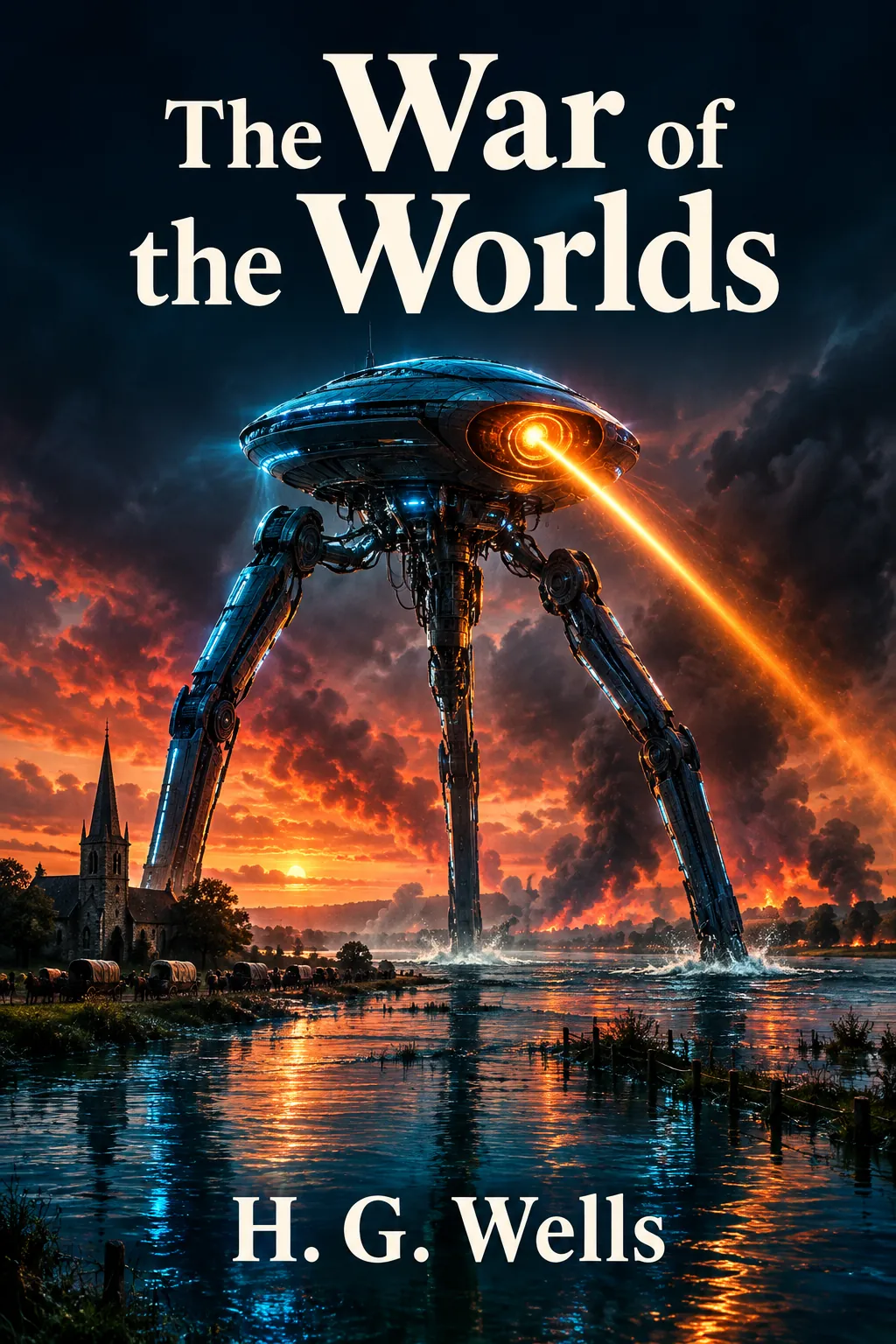
The War of the Worlds
by H. G. Wells
The War of the Worlds is an 1898 novel in which Martians land in the English countryside and sweep toward London in towering walking machines. An unnamed narrator in Woking watches the first cylinder fall, then flees as the army, the trains and the whole social order collapse. He is separated from his wife and ends up hiding, hungry and frightened, while the invaders settle in. Wells turns an alien-invasion thriller into a sharp look at empire, panic and survival.
The Big Idea
"Martians invade Victorian England with technology far beyond ours, and Wells uses the invasion to ask how an empire feels when it becomes the one conquered, and how fragile human order really is."
Key Insights
The conqueror becomes the conquered
Wells wrote at the height of the British Empire. His Martians treat England the way empires treated distant lands: with far better machines and no interest in the people who live there. By reversing the roles, he asks readers to imagine how colonised peoples might have felt.
Early on, the narrator recalls how European settlers wiped out the people of Tasmania, and he asks whether humans have any right to complain about being treated the same way.
Order is thinner than it looks
Within days the newspapers, trains, army and church stop working, and ordinary people are left to decide for themselves what to do. The book suggests that civilisation depends on everyone believing it will continue. When that belief breaks, panic spreads faster than any weapon.
The exodus from London shows hundreds of thousands of people crowding the roads, pushing and abandoning one another in the rush to get away.
Nature has the last word
Wells studied biology under the scientist T. H. Huxley, and it shows. The Martians have machines humans cannot match, but they have not met the diseases of Earth. The book argues that no technology fully escapes the living world around it.
The red weed from Mars spreads quickly across the English landscape and then fades, and the Martians themselves meet the same fate in dead London.
Intelligence is not the same as kindness
The Martians have big brains and clever hands and show little feeling. Wells uses them to warn that a purely rational mind can still be cruel. Humans are not shown as better by default; the curate and the artilleryman reveal how fear and fantasy can twist people too.
The Martians feed on human blood without any sign of guilt, while the curate's panic puts the narrator in danger inside the ruined house.
Chapter Breakdown
Chapter-by-chapter summary
Spoiler warning: this section covers the whole plot, including the ending.
The novel has 27 short chapters in two books. They are grouped here into eight parts.
Part 1: Falling Stars on Horsell Common (Book I, Chapters 1–4)
The narrator, a writer living in Woking, hears from the astronomer Ogilvy that strange flashes have been seen on Mars. Days later a shooting star falls on nearby Horsell Common and turns out to be a metal cylinder. Crowds gather to stare. Slowly the lid unscrews, and a grey, bear-sized creature with huge dark eyes and a tentacled mouth drags itself out, clearly struggling under Earth's gravity. The onlookers back away in fear. This part matters because Wells makes first contact slow, curious and almost ordinary, which makes the violence that follows land harder.
Part 2: The Heat-Ray (Book I, Chapters 5–9)
A small group led by Ogilvy and carrying a white flag walks toward the pit to greet the visitors. The Martians answer with the Heat-Ray, an invisible beam that sets people, trees and houses on fire. Ogilvy is among the dead. The narrator runs home while soldiers surround the common, sure that they have the creatures trapped. They are wrong: the Martians climb out in tall three-legged fighting machines, and more cylinders keep falling. It matters because the first act of peace is met with slaughter, and the authorities still do not grasp the danger.
Part 3: The Storm and the Battle on the Thames (Book I, Chapters 10–12)
After taking his wife to safety at Leatherhead, the narrator drives back home. That night a violent storm breaks, and in the flashes of lightning he watches the machines stride across Surrey. The next day he heads for the Thames at Weybridge and Shepperton. There the army fights back and brings down one machine, but the others answer with the Heat-Ray and clouds of poisonous black smoke, and the towns burn. The narrator survives by hiding in the river and under a boat. The lesson is that courage and artillery can hurt the Martians but cannot stop them.
Part 4: The Curate and the News from London (Book I, Chapters 13–15)
By the river the narrator falls in with a curate, a young clergyman whose faith turns into panic and who soon becomes a burden rather than a help. The story then switches to the narrator's younger brother, a medical student in London. He reads vague, calm newspaper reports while the Martians use black smoke to break the defences around the capital. Wells shows how a modern city hears about disaster: late, in pieces, and in a tone far calmer than the facts deserve.
Part 5: The Exodus and the Thunder Child (Book I, Chapters 16–17)
The brother is swept up in the flight of hundreds of thousands of Londoners on foot and in carts. On the way he helps two women, and the three reach the Essex coast and board a steamer packed with refugees. Then the ironclad Thunder Child charges the Martian machines to protect the ships, destroys two of them, and is destroyed by the Heat-Ray. The steamer slips away to sea. It is the book's rare moment of heroism, and Wells keeps it short and sad rather than triumphant.
Part 6: The Ruined House (Book II, Chapters 1–4)
Book II returns to the narrator, who is trapped with the curate in a ruined house beside a Martian landing pit. Through a gap in the wall he watches the invaders assemble machines and feed on the fresh blood of captured people. Days pass in hunger and fear. The curate loses his grip, starts shouting, and the narrator knocks him down to keep him quiet. A tentacle then reaches in and drags the curate away. Wells shows how faith and reason can crack under pressure, and the Martians' cold intelligence stands out sharply beside it.
Part 7: The Red Weed and Putney Hill (Book II, Chapters 5–7)
After about fifteen days the Martians move away and the narrator creeps out. The landscape has changed: a red plant brought from Mars is spreading along rivers and fields, and the towns are silent. On Putney Hill he meets an artilleryman who describes a grand plan to build a hidden human society underground and one day take the machines back. The narrator soon sees that the man prefers dreaming to digging, and leaves him, disappointed. The part captures how people in despair swing between practical sense and fantasy.
Part 8: Dead London and the Epilogue (Book II, Chapters 8–10)
Ready to give up, the narrator walks into London. The streets are empty, and the only sound is a Martian cry that repeats “ulla, ulla.” Following it, he finds the fighting machines standing still and the Martians dead, killed by ordinary disease bacteria that their bodies had never met. Humanity is saved by the smallest living things. He makes his way home and is reunited with his wife, who survived. In the epilogue he reflects on how the event changed human thinking and on the uneasy possibility of another attack.
Characters
The narrator
An unnamed writer who lives near Woking and takes an interest in science and philosophy. He is calm, observant and honest about his own fear. He acts as the reader's eyes for the invasion.
The narrator's wife
She is sent to Leatherhead when the danger begins and is absent for most of the book. Her safety is the quiet reason the narrator keeps pushing to survive.
Ogilvy
An astronomer near Horsell Common who first tells the narrator about the flashes on Mars. He walks toward the cylinder under a white flag and is killed by the Heat-Ray, which shows how little the Martians care about peace.
The curate
A young clergyman who talks of faith and judgment but falls apart under strain. In the ruined house his fear endangers them both, and Wells uses him to show how fear can overwhelm belief.
The artilleryman
A soldier met on Putney Hill who dreams of an underground human colony. He is clever and bold in speech, yet lazy in practice, and his plan highlights the gap between ideas and action.
The narrator's brother
A medical student in London whose story runs in parallel. Through him we see the flight from the capital, the rescue of two women and the escape by sea.
The Martians
Large, grey, tentacled beings with big brains and little emotion, who travel in cylinders and fight from tall tripod machines. Wells gives them cold logic rather than hatred, which makes them frightening.
Writing about this book
Start with the question Wells keeps asking: what happens when a powerful society meets one more powerful? Compare the way the Martians treat humans with the way European empires treated the people they conquered. Wells makes that link himself early in the book.
Questions to explore:
- Why does Wells leave the narrator unnamed, and how does that shape what you feel?
- Which scene shows human society at its best, and which at its worst: the Thunder Child, the exodus from London or the ruined house?
- The Martians are intelligent but show no kindness. Is that more frightening than a simple monster?
- What does the ending say about humanity's place in nature?
Useful angles for an essay: the book as a warning about empire, as a study of panic, as an early pattern for invasion stories, or as a story you can compare with a modern disaster film you know. For every point, name one specific scene, and write the argument in your own words.
Take Action
Practical steps you can implement today:
-
Read the opening chapters slowly: the calm, curious tone before the first attack is what gives the later scenes their force.
-
Notice that the narrator is nameless and ordinary. Wells wants you to imagine yourself in his place.
-
Compare each human reaction to the invasion, from the curate to the artilleryman to the crowds, and decide which seems most realistic.
-
Use the empire reversal as a lens, and ask who in history stood where the humans stand in this book.
Notable Quotes
"“No one would have believed in the last years of the nineteenth century that this world was being watched keenly and closely” (Book I, Chapter 1)"
— H. G. Wells
"“intellects vast and cool and unsympathetic” (Book I, Chapter 1)"
— H. G. Wells
"“the humblest things that God, in his wisdom, has put upon this earth” (Book II, Chapter 8)"
— H. G. Wells
Who Should Read This
Ideal for students aged about 13 and up who are reading the novel for school, and for anyone curious about the book behind the famous radio broadcast and films. It is also a good first step into classic science fiction, because it is short and fast, though the Victorian sentences can feel long at first.
Frequently Asked Questions
What is The War of the Worlds about?
It is about Martians who land in southern England in cylinders and attack with walking machines, a Heat-Ray and poisonous smoke. An unnamed narrator tells how he survives the invasion, loses touch with his wife and watches society collapse around him.
Who tells the story, and is he named?
A single unnamed narrator tells most of the book. He is a writer living near Woking. A few chapters switch to what his younger brother experienced in London, which the narrator retells from the brother's account.
Why do the Martians invade Earth?
The book says Mars is older and cooling, so the Martians are looking for a warmer planet to live on. They show no interest in talking with humans and treat them as an obstacle, or a source of food.
Is the novel the same as the radio broadcast or the films?
No. In 1938 Orson Welles's radio drama moved the story to New Jersey, and the 1953 and 2005 films also change the setting and the plot. The book itself is set in Victorian England, mostly around Surrey and London.
Is the book hard to read?
It is short and fast-moving, but the 1898 English has long sentences and some old words. Reading in short sessions or alongside a summary helps. Most readers find the second half, set in the ruined house, slower but more thoughtful.
Check Your Understanding
Pick an answer for each question to see if you were right.
-
Where does the first Martian cylinder land?
Horsell Common near Woking — The first cylinder lands on Horsell Common, close to the narrator's home in Woking.
-
What weapon do the Martians use on the group carrying the white flag?
The Heat-Ray — The Heat-Ray is an invisible beam that burns people and objects, and it kills Ogilvy and others.
-
What is the name of the ironclad ship that attacks the Martian machines?
Thunder Child — The Thunder Child destroys two machines to protect the refugee ships, then is destroyed itself.
-
Who does the narrator meet on Putney Hill?
An artilleryman — The artilleryman has a plan for an underground human society but little will to carry it out.
-
What finally defeats the Martians?
Earth's disease bacteria — The Martians had no immunity to Earth's bacteria and died, which is how humanity survives.
About H. G. Wells
H. G. Wells (1866–1946) was an English writer who trained as a biologist and became one of the founders of science fiction. The Time Machine (1895), The Invisible Man (1897) and The War of the Worlds (1898) made his name. Later he wrote widely on history, politics and the future of society.
Summary Written By

Software Engineer & Writer
Software engineer with a passion for distilling complex ideas into actionable insights. Writes about finance, investment, entrepreneurship, and technology.
View all summaries →Reviews
No reviews yet. Be the first to share your thoughts!
Write a Review
Keep reading
Explore the topic: Sci-Fi Authors & AwardsSummaries

Out of My Mind
Sharon M. Draper
“Out of My Mind” by Sharon M. Draper is a poignant narrative that explores the life of Melody Brooks, a…

Ender’s Game
Orson Scott Card
“Ender’s Game” by Orson Scott Card is a riveting science fiction novel that transports readers into a future where humanity…

Pachinko
Min Jin Lee
“Pachinko”, a spellbinding multigenerational historical saga by Min Jin Lee, explores the lives of a Korean family trying to make…

The Perks of Being a Wallflower
Stephen Chbosky
The Perks of Being a Wallflower by Stephen Chbosky is a profound coming-of-age novel, told through the intimate letters of…
Articles
H. G. Wells
H. G. Wells (1866–1946) was an English writer who helped found modern science fiction. His 1890s novels The Time Machine,…
First Contact in Fiction and Science
First contact is the moment humans and another intelligent species first learn of each other. It has never happened: no…

History of Science Fiction
The history of science fiction runs about 200 years, from Mary Shelley's Frankenstein in 1818. Jules Verne and H. G.…