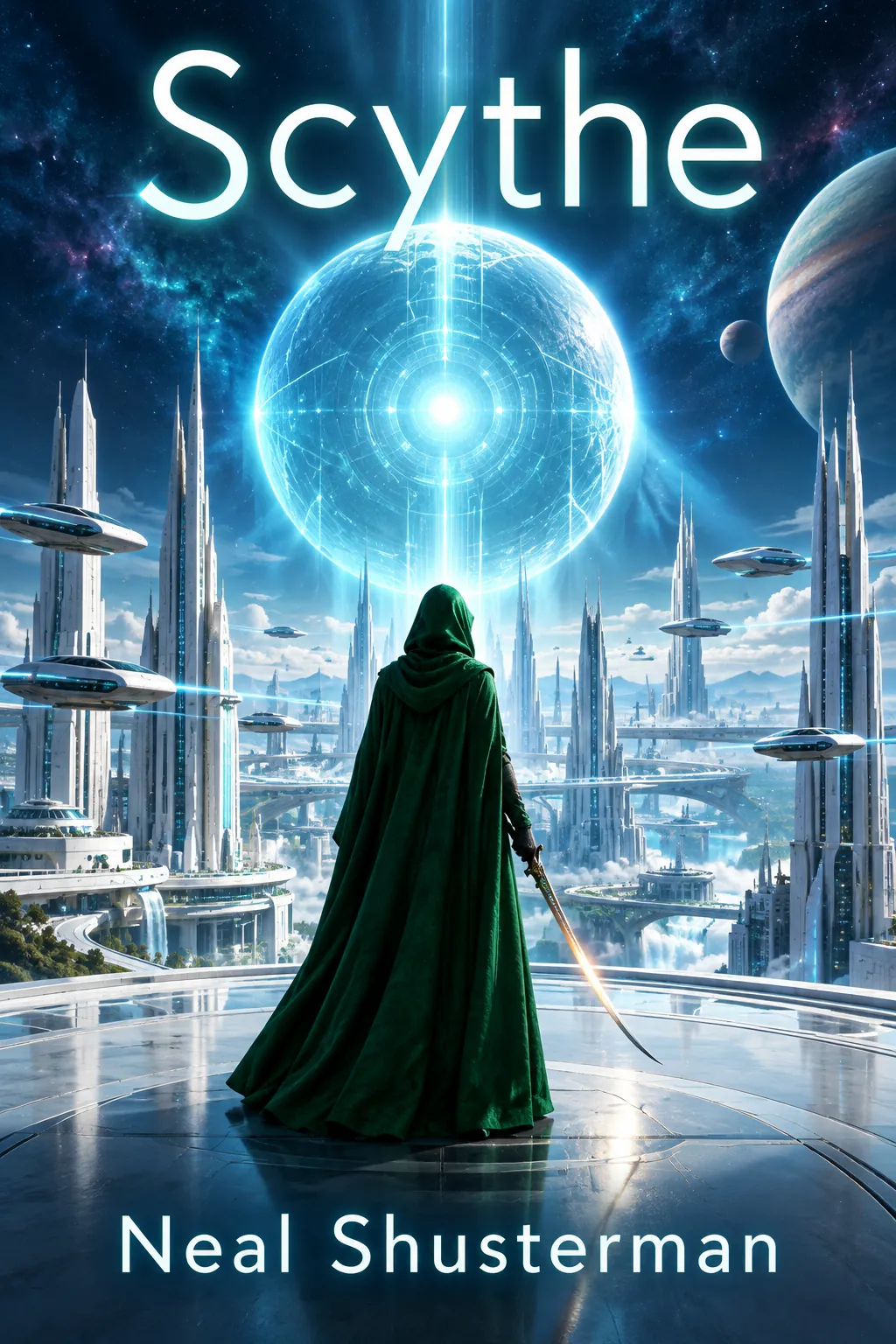
Scythe
by Neal Shusterman
Scythe is a 2016 young adult novel set in a future where an AI called the Thunderhead has ended disease, war and death by age. To keep the population in check, human “scythes” are allowed to end lives, and two teenagers, Citra and Rowan, are chosen as apprentices to one. The book asks what a world without death would cost, and who can be trusted with the power to take a life.
The Big Idea
"If death is abolished, someone must still decide who dies. Scythe asks whether any person, or any machine, can hold that power without being corrupted by it."
Key Insights
Power should not belong to those who enjoy it
Faraday chooses Citra and Rowan because they do not want to kill. The novel argues that the people most fit to hold deadly power are the ones who feel its weight, and that people who relish it should never be given it. This turns an old question about who should rule into a very personal one about who should be trusted with a blade.
Goddard, who enjoys gleaning in large numbers, is the opposite of Faraday and Curie. The contrast makes the book's moral line easy to see, and it gives readers a simple test they can apply to real leaders.
A perfect system still needs human judgment
The Thunderhead is wise and caring but must stay out of the Scythedom's affairs. Shusterman uses this gap to show that even a flawless machine cannot solve questions that people have deliberately kept for themselves. The more perfect the machine, the more obvious it becomes which decisions people refuse to hand over.
The Thunderhead can watch events unfold but cannot intervene when the scythes break their own rules, so its goodness has no power exactly where it is most needed.
Rules fail when no one outside can check them
The Scythedom is answerable only to itself, so a charismatic faction can bend its code from within. The book shows how institutions without outside oversight drift toward the interests of their members. The commandments stay on the wall while their meaning quietly changes.
Goddard's followers adopt the old robes and commandments while ignoring their spirit, and the old guard has nobody to appeal to.
Ending death does not give life meaning
Without the fear of dying, many people in the novel drift. The book suggests that meaning comes from limits, and that removing them can leave a world comfortable and strangely empty. It does not claim that death is good, only that a life without any ending loses some of its shape.
The apprentices find purpose only when forced to make life-and-death choices, which is a troubling answer the book does not fully resolve.
Chapter Breakdown
The world of Scythe in brief
Scythe is set in a future that its characters call the post-mortal age. Humanity has beaten disease, hunger, war and old age, so the only deaths that remain are accidents that cannot be repaired and the deaths that scythes carry out on purpose.
An artificial intelligence called the Thunderhead looks after everyone. It is kind, wise and nearly all-knowing, yet one part of society is closed to it: the Scythedom.
The Scythedom is a small order of people who are allowed to end lives, which the book calls “gleaning”. They answer to no government and to no machine, and they follow a set of commandments that they have written for themselves.
That one gap in an otherwise perfect system is the engine of the whole story. Everything that follows depends on whether people can be trusted with a power that nobody else is allowed to check.
Chapter-by-chapter summary
Spoiler warning: this section covers the whole plot, including the ending.
The novel is told in short numbered chapters, each opening with a diary entry from a scythe. This guide groups them into seven parts.
Part 1: A world without death
The story begins in what the book calls the post-mortal age. An AI called the Thunderhead runs the world, and disease, hunger, war and natural death are gone; the injured can be revived, and the old can “turn the corner” back to a younger body.
Because nobody dies naturally, the human Scythedom was created to end lives on purpose and keep the population steady. Scythes answer to no government, and the Thunderhead is forbidden to interfere with them.
Citra Terranova and Rowan Damisch, two teenagers, are each approached by Scythe Faraday. He picks them because they do not want the job, and the point of this opening is that a person who dreads killing is the safest person to give the power.
The scene also shows how ordinary people feel about scythes. They are respected and feared at once, and nobody wants one to knock on their door.
Part 2: The apprentices
After some hesitation, Citra and Rowan accept the apprenticeship. Faraday takes them from town to town and trains them in anatomy, history, ethics and the many ways to end a life quickly.
He insists that gleaning must be done with care, and he gives each victim a choice of how it happens. The training matters because it shows the ideal the Scythedom claims to follow, which the rest of the book will test.
During these lessons the two teenagers begin to rely on each other. Their growing trust is what makes the later twist so painful.
Part 3: The old guard and the new
The apprentices meet other scythes at conclave, where the order gathers to settle its business. Scythe Curie and Faraday represent the older, sombre tradition, while Scythe Goddard and his followers treat the work as a privilege.
Goddard's group kills in large, showy numbers and enjoys its power. This split turns a quiet training story into a political one, because the Scythedom has no outside body to correct it.
The conclave also shows that the order's solemn rituals can be used for different ends. The same ceremonies that honour duty can also be used to flatter vanity.
Part 4: Faraday's death and new masters
At the conclave, the scythes take up a cruel rule: only one of the two apprentices will be made a scythe, and that scythe must glean the other. Faraday objects, but he cannot stop it.
To free his apprentices from the contest, Faraday fakes his death by gleaning himself. The attempt fails, because the order simply assigns them new masters, with Citra going to Scythe Curie and Rowan to Scythe Goddard.
The friendship that began the story now has to survive on opposite sides of a divided order.
Part 5: Two masters, two methods
Citra learns from Curie how a careful scythe works. She also comes to suspect that Faraday was murdered, and she suspects Goddard.
Rowan's training under Goddard is brutal. He is beaten, his body's pain relief is switched off, and he is taken along on mass gleanings, where he quietly helps some of the victims get away.
The two apprentices now face the same moral problem from opposite ends of the Scythedom, and neither can pretend that the order is simply good.
Part 6: Accused and found
Citra searches the Thunderhead's records for proof that Goddard killed Faraday. Curie urges her to become a scythe first and fight corruption from inside.
Citra is then arrested and brought before High Blade Xenocrates, who accuses her of murdering Faraday and points to words from his journal. She jumps from his building and is left close to death.
Days later she wakes beside Curie, who explains that the journal entry was really about her, because she and Faraday had once been lovers. Citra also learns that Faraday is alive, and he begins to train her again.
The reveal shows that the order's most honest member has been pushed aside by its politics.
Part 7: The ring
Goddard's group carries out a killing spree at a Tonist cloister, and Rowan, acting alone, stops it by killing Goddard with fire. Citra, who is cleared of the charges, is then ordained in his place.
She takes the name Scythe Anastasia and receives the jewelled robe and ring of her new office. Her first assignment is to glean Rowan.
Instead, when his DNA touches her ring, she pretends it was an accident and gives him a year of immunity. Rowan is sent to a waiting car, where, to his surprise, Faraday is driving.
The ending leaves open whether a system built on power can ever correct itself.
Characters
- Citra Terranova: a practical, thoughtful teenager who becomes Faraday's apprentice and later Scythe Anastasia. Her arc is about turning a job she did not want into a code she can live with, and she is the reader's main guide through the order.
- Rowan Damisch: a stubborn teenager with a strong conscience, chosen by Faraday for the same reason as Citra. He becomes the book's picture of resistance from outside the system, and his actions grow more dangerous as the story goes on.
- Scythe Faraday: the veteran scythe who recruits both apprentices. He believes the work must stay serious and humane, and he fakes his death by gleaning himself to free his apprentices, only to turn out to be alive.
- Scythe Curie: a scythe named after Marie Curie, who stands for the thoughtful old order. She becomes Citra's master after Faraday and shows her that careful killing is still a moral burden.
- Scythe Goddard: the charismatic leader of the new faction. He treats gleaning as a pleasure and is the book's chief threat to the Scythedom's ideals, partly because he is so persuasive.
- The Thunderhead: the AI that cares for the world and cannot touch the Scythedom. Its helplessness is a quiet comment on what a perfect machine still cannot fix.
- High Blade Xenocrates: a senior scythe who presides over the order's business and accuses Citra of Faraday's murder. He shows how the Scythedom's own leaders can be drawn into its politics.
Writing about this book
Start with a question the book really raises, such as whether power corrupts or whether any institution can police itself. A strong thesis names the idea and the text that proves it, for instance that the novel shows the Scythedom's rules to be only as good as the people who follow them.
For character essays, compare Citra and Rowan, because the book builds them as two answers to the same trap. Look at what each learns from a different mentor, and what they would have done with Faraday alone.
For theme essays, note how the diary entries at the start of chapters show the order's own words and its blind spots. Use short quotes, name the chapter or part, and explain what each quote shows rather than retelling the scene.
For setting essays, ask what the Thunderhead's perfect world does to human meaning, since people with no fear of dying seem to have little to strive for. The book says the Scythedom exists to keep death meaningful, and you can test that claim against the plot.
Keep your opinion separate from the book's argument, and say “the novel suggests” when you are reading between the lines. Plan each paragraph around one claim, one piece of evidence and one sentence of comment.
Finally, use the sample answers on this page as learning examples and compare them with your own work.
Take Action
Practical steps you can implement today:
-
Be wary of anyone who wants power over others too much; the people who hesitate are often the safest to trust.
-
When you read a rule, ask who checks the people who enforce it.
-
Compare two characters facing the same problem to see what the author is arguing.
-
Notice the epigraphs and diary entries, because they show a world's own view of itself.
Notable Quotes
"“Thou shalt kill.” (the first commandment of the Scythedom)"
— Neal Shusterman
"“Thou shalt kill with no bias, bigotry, or malice aforethought.” (the second commandment)"
— Neal Shusterman
Who Should Read This
Scythe suits readers aged about 13 and up, including high school students looking for a sci-fi novel to analyse. It is a good fit for fans of dystopian fiction such as The Hunger Games or Brave New World. Note that it deals with killing and death throughout.
Characters
Citra Terranova
protagonist
A practical, thoughtful teenager who is chosen by Faraday and later becomes Scythe Anastasia. She struggles to turn a job she did not want into a moral code she can live with.
Rowan Damisch
protagonist
A stubborn, conscientious teenager who becomes Faraday's other apprentice. Seeing Goddard's cruelty up close pushes him toward a resistance that runs outside the system.
Scythe Faraday
mentor
A veteran scythe who recruits both apprentices because they do not want the work. He tries to teach them that gleaning must be done with seriousness and mercy, and he fakes his death by gleaning himself to free them.
Scythe Curie
mentor
A scythe named after Marie Curie who stands for the thoughtful old order. She becomes Citra's master after Faraday and shows her that killing carefully is still a heavy moral burden.
Scythe Goddard
antagonist
The charismatic leader of the new faction, who treats gleaning as a pleasure and a status symbol. He is the book's main threat to the Scythedom's ideals.
The Thunderhead
symbol
The caring AI that governs the world but cannot touch the Scythedom. Its helplessness shows that even a perfect machine cannot fix problems humans have kept for themselves.
High Blade Xenocrates
authority figure
A senior scythe who presides over the order's business and accuses Citra of murdering Faraday. He shows how the leaders of a self-governing order can be pulled into its politics.
Exam practice: sample answers
Model answers are examples to learn from; write your own in your words.
character analysis
1. How does Shusterman use the contrast between Scythe Faraday and Scythe Goddard to explore the abuse of power? Write an analytical essay with evidence from the novel.
Outline
- Thesis: the contrast shows that deadly power is safest with those who feel its weight
- Faraday: reluctant, careful, offers choices
- Goddard: enthusiastic, showy, treats gleaning as a privilege
- Link to the Scythedom's lack of outside oversight
Basic Model answer
In Scythe, Faraday and Goddard are very different scythes. Faraday takes his job seriously and does not enjoy killing, while Goddard treats it as something fun and special.
This shows that power can be used well or badly. Faraday tries to be kind when he gleans people, and he trains Citra and Rowan to do the same.
Faraday also chose Citra and Rowan because they did not want the job, which shows that careful people are safer with power.
Goddard gleans many people at once and wants everyone to see his power.
The author wants us to see that people who enjoy power are dangerous, and that people who are careful with it are better. In conclusion, the contrast between Faraday and Goddard shows how power can be abused.
Good Model answer
Shusterman uses Faraday and Goddard to argue that deadly power is safest in the hands of those who feel its weight. The two scythes follow the same commandments, yet they behave very differently, and the novel makes the difference the heart of its moral argument.
Faraday is reluctant and careful. He chooses Citra and Rowan precisely because they do not want to kill, and he teaches them that gleaning must be done with respect.
He gives victims a choice about how they die, which treats them as people rather than numbers.
Goddard, by contrast, treats the work as a privilege and a performance. His faction gleans in large, showy numbers and enjoys the status that comes with it.
Goddard's cruelty is clearest in how his apprentice Rowan is treated, beaten and trained to kill, which shows what the same power does when it is enjoyed.
The same robes and rules now serve vanity instead of duty.
The Scythedom answers only to itself, which explains how Goddard's attitude can spread. Without outside oversight, a charismatic leader can bend the code from within.
The contrast therefore shows that a system's rules are only as good as the character of the people who follow them.
Excellent Model answer
Shusterman builds the contrast between Faraday and Goddard to make a single argument: deadly power is safest with those who feel its weight, and it corrupts those who enjoy it. Both men wear the same robes and swear to the same commandments, which begin with “Thou shalt kill.”
The novel's interest lies in how the same rule produces two opposite moralities.
Faraday represents the old ideal. He recruits Citra and Rowan because they do not want the work, and he insists that gleaning be done with care and mercy.
His habit of letting a victim choose how they die is not a loophole but a principle: it keeps the victim a person rather than a quota.
Goddard turns the same office into theatre. His faction gleans in large, showy numbers and treats the ring as a mark of status, so the ritual language of duty becomes a costume for vanity.
Shusterman does not need Goddard to break the commandments; he only needs him to enjoy them.
That is why the structure of the Scythedom matters. The order answers only to itself, and the Thunderhead, though wise and caring, is forbidden to interfere.
A charismatic faction can therefore win by persuasion alone, and the old guard has no outside body to appeal to.
The two apprentices extend the argument. Citra learns under Curie that careful killing is still a burden, while Rowan sees Goddard's practice up close and refuses it.
Their different responses show that the contrast between the scythes is not just a villain and a hero but a choice every character must face.
In the end, the Faraday–Goddard contrast carries the novel's central warning. A system cannot rely on rules alone to restrain power, because rules are interpreted by people, and the people who want power most are the least likely to give it up.
Marking rubric
- Clear thesis about power and character
- Specific evidence from Faraday and Goddard
- Link to the Scythedom's lack of oversight
- Controlled conclusion
Now write your own
Write your own response to the question, then compare it with the three samples. What does your answer add that they miss?
literary argument
2. AP Literature style (Q3): Many novels show a society that seems perfect but hides a serious flaw. Discuss how the flaw in the world of Scythe contributes to the meaning of the work as a whole.
Outline
- Name the flaw: a world without death still needs killers
- Show how the Scythedom's lack of oversight creates the flaw
- Connect to the novel's argument about power and meaning
Basic Model answer
In Scythe, the world looks perfect because there is no death or disease. An AI called the Thunderhead takes care of everyone.
However, the world has a flaw. People still have to die so there are not too many of them, so scythes were created to kill.
This is a problem because scythes can be cruel, like Goddard.
The two main characters, Citra and Rowan, have to decide how to deal with this problem, and the book follows their choices.
The flaw helps the meaning of the book. It shows that a perfect world is not really perfect, and that even a good society needs to be careful with power.
Good Model answer
Shusterman presents a world that seems to have solved humanity's oldest problems, yet its flaw lies in how it handles death itself. Because nobody dies naturally, the Scythedom exists to end lives on purpose, and the book uses this to argue that no system can escape the need for human judgment.
The flaw is made worse by the Scythedom's independence. Scythes answer to no government, and the Thunderhead, though wise and caring, is forbidden to interfere.
This means a corrupt faction like Goddard's can grow without anyone able to stop it.
Goddard's faction makes the problem visible: it kills in large numbers and meets no real resistance until Rowan acts outside the order.
The apprentices show what the flaw means in human terms. Citra and Rowan are chosen because they do not want to kill, which suggests that the only safe holder of this power is a person who feels its weight.
Rowan's later decision to hunt Goddard down outside the order shows what happens when the system gives no lawful way to stop him.
The flaw therefore shapes the whole meaning of the work. It suggests that a society cannot remove moral responsibility by removing death, and that comfort without accountability invites abuse.
Excellent Model answer
The world of Scythe is built to look like a solution: disease, war and hunger are gone, and an AI called the Thunderhead looks after every person. Shusterman's critical move is to place the flaw not in technology but in what remains.
Someone must still decide who dies, and the novel shows that this single human task undermines the apparent perfection.
The Scythedom is the carrier of that flaw. Scythes answer to no government, and the Thunderhead is forbidden to interfere, so a rule that begins with “Thou shalt kill” is enforced by the very people it empowers.
The commandments sound solemn, but there is no outside check, and a charismatic faction such as Goddard's can empty them of meaning.
The contrast between mentors makes the flaw personal. Faraday and Curie treat gleaning as a moral burden, while Goddard treats it as a privilege.
The same office produces both, so the problem is not a bad rule but the absence of anyone who can hold the rule-keepers to account.
Citra and Rowan test the argument from two sides. Citra learns to work inside the order and bend its rules from within, as when she deliberately grants Rowan a year of immunity and passes it off as an accident, while Rowan sees its worst side and fights it from outside.
Neither path is clean, which suggests that the flaw cannot be solved by a single heroic act.
The flaw also reaches beyond the Scythedom to the world itself. When death no longer limits life, the novel hints that ordinary people drift, and that the scythes exist partly to keep mortality meaningful.
This is the book's most uncomfortable idea, because it makes the solution to the flaw look like another version of it.
The work's overall meaning follows from this. Shusterman argues that perfect systems do not remove moral responsibility but hide it, and that a society's health depends on whether anyone can check those who hold the power of life and death.
Marking rubric
- Defensible claim about the flaw and meaning
- Specific evidence from the Scythedom and characters
- Analysis rather than summary
- Sophisticated, controlled conclusion
Now write your own
Choose another novel you know with a flawed perfect society and write your own response to the same prompt.
Frequently Asked Questions
What is Scythe about?
Scythe is about two teenagers, Citra and Rowan, who are chosen to train as scythes in a world where death has been abolished. Scythes are the only people allowed to end lives, so the book explores power, morality and what a society without death costs. It is also a story about friendship under pressure.
Who are the main characters in Scythe?
The main characters are Citra Terranova and Rowan Damisch, who are apprenticed to Scythe Faraday. Other key figures are Scythe Curie, Scythe Goddard, and the AI known as the Thunderhead. Each one represents a different answer to the question of how power should be used.
What is the Thunderhead?
The Thunderhead is the artificial intelligence that governs the world, an AI that grew out of the old Cloud. It looks after everyone's welfare, but it is forbidden to interfere with the Scythedom, so it cannot stop the scythes. Its limits are a key part of the book's argument.
Is Scythe part of a series?
Yes. Scythe is the first book in the Arc of a Scythe trilogy, followed by Thunderhead (2018) and The Toll (2019). Shusterman has also written further books set in the same world, so readers who enjoy the first novel have plenty to continue with.
What are the main themes of Scythe?
The main themes are the corrupting nature of power, the moral weight of killing, the limits of a perfect system, and what makes life meaningful when death no longer exists. Each theme is linked to the contrast between the old and new scythes.
Is Scythe suitable for school?
Scythe is a young adult novel often read by teens, though it includes violence and death. It works well for analysis essays on theme, character and setting, and parents or teachers may want to read it first.
Check Your Understanding
Pick an answer for each question to see if you were right.
-
What is the name of the AI that governs the world in Scythe?
The Thunderhead — The Thunderhead is the AI that runs the world but may not interfere with the Scythedom.
-
Why does Faraday choose Citra and Rowan?
They do not want to kill — Faraday believes people who dread killing are the safest to trust with the power.
-
What does a scythe do in the novel?
Ends lives to control the population — Scythes “glean” people to keep the population stable.
-
Which scythe leads the faction that treats gleaning as a pleasure?
Scythe Goddard — Goddard leads the new faction that enjoys the power of the role.
-
What name does Citra take when she becomes a scythe?
Scythe Anastasia — Citra becomes Scythe Anastasia.
About Neal Shusterman
Neal Shusterman is an American author of young adult fiction and science fiction. He won the National Book Award for Young People's Literature for Challenger Deep in 2015 and is known for dark, idea-driven novels such as Unwind, the Arc of a Scythe trilogy and Dry.
Summary Written By

Software Engineer & Writer
Software engineer with a passion for distilling complex ideas into actionable insights. Writes about finance, investment, entrepreneurship, and technology.
View all summaries →Reviews
No reviews yet. Be the first to share your thoughts!
Write a Review
Keep reading
Explore the topic: Science FictionSummaries

Out of My Mind
Sharon M. Draper
“Out of My Mind” by Sharon M. Draper is a poignant narrative that explores the life of Melody Brooks, a…

Ender’s Game
Orson Scott Card
“Ender’s Game” by Orson Scott Card is a riveting science fiction novel that transports readers into a future where humanity…

Pachinko
Min Jin Lee
“Pachinko”, a spellbinding multigenerational historical saga by Min Jin Lee, explores the lives of a Korean family trying to make…

The Perks of Being a Wallflower
Stephen Chbosky
The Perks of Being a Wallflower by Stephen Chbosky is a profound coming-of-age novel, told through the intimate letters of…
Articles

A Christmas Carol themes: generosity, isolation and responsibility
Dickens's novella is usually read as a story about a man who changes his mind. Its themes are sharper than…

Kyotsu Test Japanese (共通テスト国語): Time Plan and Strategy
The Kyotsu Test Japanese paper is a 90-minute, 200-point multiple-choice exam with five sections: three modern-text sections, classical Japanese and…
How to Write a Literary Analysis Essay
A literary analysis essay argues one clear claim about how a text works and proves it with short quotations and…