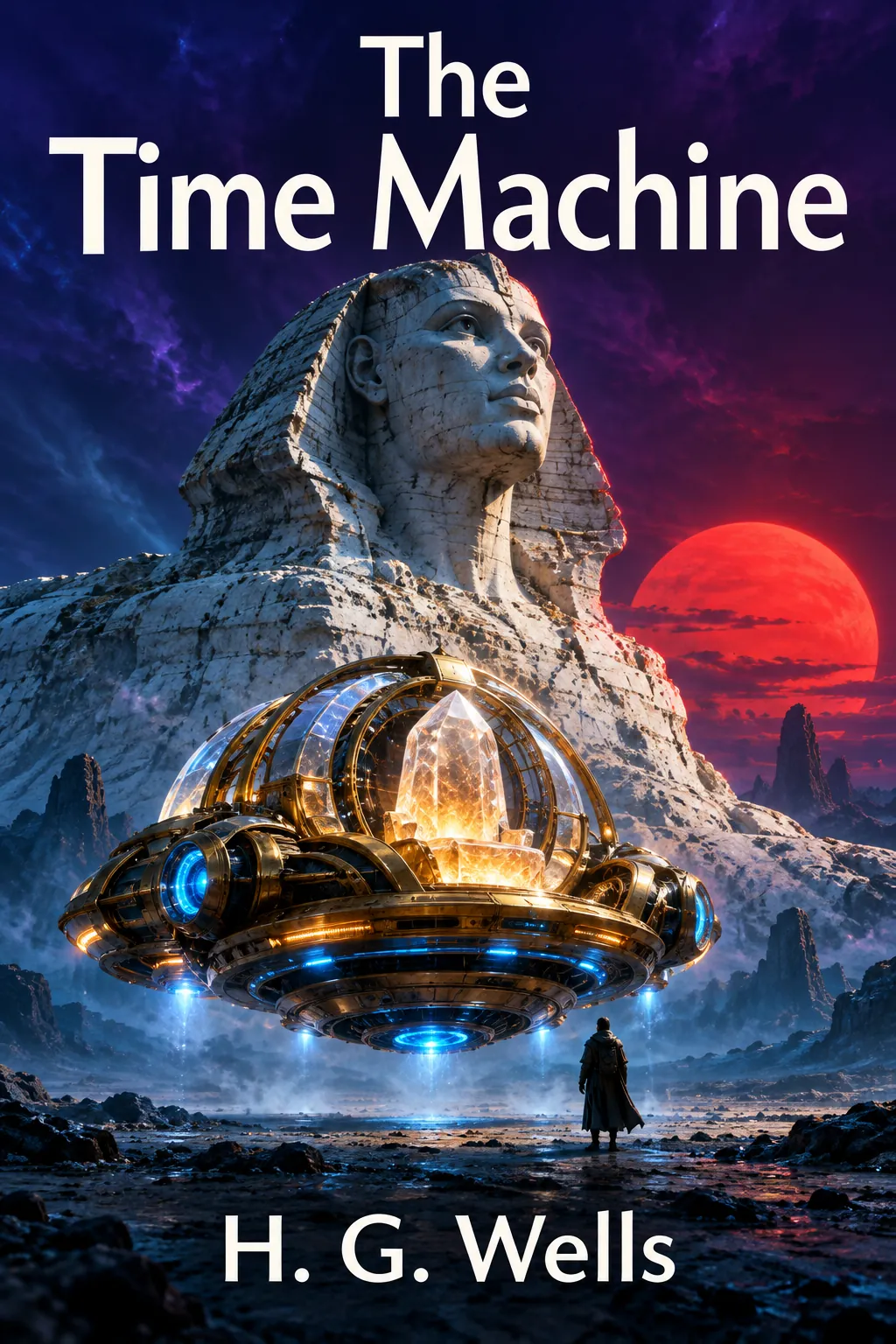
The Time Machine
by H. G. Wells
The Time Machine is H. G. Wells's 1895 novella about a Victorian inventor who builds a machine that moves through time. He tells his dinner guests that he has travelled to the year 802,701, where humanity has changed beyond recognition. Gentle, childlike people play in the sunlight, and something unsettling waits underground. He must find his missing machine before he is stranded there. The story asks what happens to people when life becomes too easy.
The Big Idea
"Wells sends a traveller to the year 802,701 to ask where a society that splits into the comfortable and the hard-working might end up, and what comfort costs the human mind."
Key Insights
Comfort can make people weaker
The Eloi live without danger, and Wells suggests their minds and bodies have shrunk as a result. The Traveller says that strength comes from need. When there is no problem to solve, there is nothing to sharpen the mind. The book treats ease as something with a price, not as a plain reward. The warning is not that comfort is bad, but that a world with no challenges can slowly drain the qualities that built it.
The Eloi lose interest quickly. When the Traveller tries to talk to them, they drift off, and when Weena is in danger, few of them seem to care.
Class division, taken to its extreme
The Eloi and the Morlocks look like two species, but the Traveller concludes they began as one human family. The upper class had leisure, the working class had to live underground. Over time the gap hardened into a biological one. Wells was writing in a Britain of great wealth and great poverty, and he asks what would happen if nobody ever closed that gap. The answer is a society in which both sides are damaged, and in which the 'lower' side is the one holding the power.
The Morlocks run the machines that feed and clothe the Eloi, and they also feed on them at night.
Our best explanations may still be wrong
The Traveller reasons carefully, but he is wrong about the Eloi at first, and again about the Morlocks. Wells shows a scientific mind at work: observe, build a theory, test it, change it. The lesson is not that thinking is useless, but that a clever idea is only a guess until the facts support it. By the end, even the Traveller admits his theories may not be right.
He first believes the Eloi live in a perfected, work-free society, then learns that something darker is going on below ground.
Deep time puts human life in perspective
The last journey takes the Traveller thirty million years ahead, to a dim red sun and a cold beach with a few crawling creatures. Humans are gone, and so is nearly everything familiar. Wells draws on the science of his day, which said that the sun would eventually cool. The scene gives the story its sense of scale and loneliness, and it leaves readers asking what, if anything, our efforts add up to over such a span.
On the final beach, the Traveller sees giant crabs and a sluggish sea, and feels a deep chill that has nothing to do with the cold.
Chapter Breakdown
Chapter-by-chapter summary
Spoiler warning: this section covers the whole plot, including the ending.
Part 1: The dinner party and the little model
On a Thursday evening in Victorian London, a man the narrator calls the Time Traveller explains to his guests that time is simply a fourth dimension, one we move along without choosing to. The Psychologist, the Medical Man, the Provincial Mayor and others are doubtful. He shows them a small working model and sends it into nowhere before their eyes. The following week he arrives late, dishevelled and limping, and begins his story. This opening matters because it makes the reader weigh the argument before the adventure, and it sets up a tale told second-hand.
Part 2: Arrival in the year 802,701
The Traveller describes pushing the lever of his full-size machine and watching days flicker into a blur. He stops in a garden-like landscape under a huge, weathered white sphinx. Small, graceful, childlike people gather around him, laughing and touching his clothes. They live in big, ruined halls and eat only fruit. He soon notes that they seem to have no interest in him or in learning. This part matters because it shows the promised future as a gentle paradise before the cracks appear.
Part 3: The first theory
He learns that the people are called the Eloi and works out a theory: humanity must have conquered nature and ended hardship, so strength and intelligence faded. He thinks he has found the end of struggle, a communist-style comfort in which no one has to work. He befriends a woman named Weena after saving her from drowning, and she grows attached to him. This part matters because the Traveller is confidently wrong, and the book invites us to question quick explanations.
Part 4: The Morlocks and the stolen machine
He finds that the sphinx's pedestal has been forced open and that his machine is gone. Searching, he finds deep round wells with ladders and hears machinery below. Pale, ape-like creatures called Morlocks climb out at night. He realises the Eloi are afraid of the dark for good reason. This part matters because it turns paradise into a trap, and the Traveller must now fight for the one thing that can take him home.
Part 5: Underground and the Palace of Green Porcelain
Convinced the Morlocks took the machine, he goes down a well. He holds off the creatures with matches. He then revises his theory: the human line has split into the idle upper class and the working underclass, and now the Morlocks feed on the Eloi. With Weena he explores a ruined museum, the Palace of Green Porcelain, where he takes an iron lever and finds camphor. This part matters because it shows how the long gap between rich and poor has bent both groups.
Part 6: Fire in the forest and the dying world
Traveller and Weena are caught in the woods at night by Morlocks. His fire gets out of control, Weena is lost in the confusion, and he barely escapes. At dawn he returns to the sphinx and finds the doors open. The Morlocks have set a trap, but he escapes aboard the machine as they close in. He then drifts thirty million years ahead, past huge crabs on a red beach, to a cold, silent sunset. This part matters because it takes the theme of decline to its end and shows a whole world running down.
Part 7: The return and the empty chair
The Traveller comes back to his own time, to the dinner just after he left, and tells his tale. Some guests laugh, some cannot decide, and the narrator watches him closely. The next day the narrator finds the Traveller about to set off again with a camera. He goes, and does not return. The narrator keeps two strange white flowers that Weena gave him. The ending matters because it leaves hope and doubt side by side: three years pass with no word, and the future may still be changed.
Characters
The Time Traveller: the inventor and hero, curious and stubborn. He never gets a name. He builds a theory, tests it, and revises it more than once.
The narrator: a dinner guest who retells the story. His doubt stands in for the reader's, and he is the one who sees what comes after.
Weena: a gentle Eloi woman the Traveller rescues. Her trust shows what is good in her people, and what is fragile.
The Eloi: small, beautiful, carefree descendants of the upper class. They are healthy but tired of thinking, and afraid of the dark.
The Morlocks: pale, light-fearing underground workers. They run the machines and prey on the Eloi at night.
The Psychologist and the Medical Man: two of the sceptical guests. They question the Traveller's claims and represent the educated Victorian mind.
Filby: a guest who argues with the Traveller. He is the most openly doubtful of the group.
Writing about this book
A strong report on The Time Machine starts with a question rather than a plot list. One option is to ask what Wells was warning about. In 1895 Britain, many people lived in comfort while others worked in factories and mines. The book stretches that gap across thousands of centuries. Another is to look at the Traveller himself. He builds one explanation, then another, and is wrong at least once. What does that say about how we judge strange situations? You could also compare the two far futures: a sunny garden full of idle people, and a dying beach under a swollen sun. Which is more frightening, and why does Wells show both? Choose a scene, such as the Palace of Green Porcelain, and explain what it says about knowledge when no one uses it. Use your own examples from today's world, and give your own view. Check the facts of the plot against the book itself, and keep any quotation short and exact.
Take Action
Practical steps you can implement today:
-
Treat your first explanation as a guess, and keep testing it against what you see.
-
Notice where comfort has made you stop learning, and set one small challenge for yourself.
-
When you read about a social problem, ask what happens if nothing ever changes.
-
Read science fiction as a thought experiment: what is the question behind the future it shows?
Notable Quotes
"“There is no difference between Time and any of the three dimensions of Space except that our consciousness moves along it.” (Part 1)"
— H. G. Wells
"“Strength is the outcome of need; security sets a premium on feebleness.” (Part 3)"
— H. G. Wells
"“It is a law of nature we overlook, that intellectual versatility is the compensation for change, danger, and trouble.” (Part 3)"
— H. G. Wells
Who Should Read This
This book suits readers aged about 13 and up, including middle-school, high-school and university students. It is short, so it works well for anyone who wants a first classic of science fiction, or a reading-report topic with plenty to discuss.
Frequently Asked Questions
What is The Time Machine about?
It is about an English inventor who builds a machine that travels through time. He goes to the year 802,701 and finds humanity split into two groups, the Eloi above ground and the Morlocks below. He then has to recover his machine to get home.
Who wrote The Time Machine and when?
H. G. Wells wrote it, and it was published in 1895. It was his first novel and made him famous. It is often counted among the earliest and most influential stories about time travel.
Who are the Eloi and the Morlocks?
They are the two descendants of humanity in the far future. The Eloi are small, gentle and carefree, and live in the sun. The Morlocks are pale, strong and live underground, running machines and hunting the Eloi at night.
What does the ending of The Time Machine mean?
The Traveller sets off on a second journey and does not return, which leaves his fate open. The two white flowers Weena gave him suggest that something of that future is real. Many readers see the ending as a mix of doubt and hope that the future can still be changed.
What are the main themes?
The main themes are the danger of too much comfort, the risk of a permanent gap between social classes, the limits of scientific theories, and the vast scale of time. Wells connects them through one unnamed traveller.
Is The Time Machine a good first science-fiction book?
Yes. It is short, its plot is easy to follow, and the ideas are clear. Many later stories borrow from it, so reading it first makes them easier to understand.
Check Your Understanding
Pick an answer for each question to see if you were right.
-
What year does the Time Traveller reach on his main journey?
The year 802,701 — He stops in the year 802,701 and spends most of the story there.
-
What is the name of the Eloi woman he rescues?
Weena — Weena is the Eloi woman he saves from drowning, and she stays close to him afterwards.
-
Where do the Morlocks live?
Underground — They live below the surface, running machines and coming up at night.
-
What does the Traveller take from the ruined museum?
An iron lever and camphor — In the Palace of Green Porcelain he takes an iron lever and finds camphor to help him survive.
-
What does the Traveller conclude about the Eloi and Morlocks at first and later?
They grew from one human race that split by class — He decides the upper and working classes of his own time drifted into two different kinds of people.
About H. G. Wells
H. G. Wells (1866–1946) was an English writer who trained in science and became one of the founders of modern science fiction. The Time Machine (1895) was his first novel, and it made his name. He went on to write The War of the Worlds and The Invisible Man.
Summary Written By

Software Engineer & Writer
Software engineer with a passion for distilling complex ideas into actionable insights. Writes about finance, investment, entrepreneurship, and technology.
View all summaries →Reviews
No reviews yet. Be the first to share your thoughts!
Write a Review
Keep reading
Explore the topic: Sci-Fi Genres & IdeasSummaries

Out of My Mind
Sharon M. Draper
“Out of My Mind” by Sharon M. Draper is a poignant narrative that explores the life of Melody Brooks, a…

Ender’s Game
Orson Scott Card
“Ender’s Game” by Orson Scott Card is a riveting science fiction novel that transports readers into a future where humanity…

Pachinko
Min Jin Lee
“Pachinko”, a spellbinding multigenerational historical saga by Min Jin Lee, explores the lives of a Korean family trying to make…

The Perks of Being a Wallflower
Stephen Chbosky
The Perks of Being a Wallflower by Stephen Chbosky is a profound coming-of-age novel, told through the intimate letters of…
Articles
Steampunk
Steampunk is a style of science fiction that imagines advanced machines powered by steam, usually in a Victorian-era world. The…
Time Travel Paradoxes
A time travel paradox is a situation where going into the past seems to make history contradict itself. The best-known…
H. G. Wells
H. G. Wells (1866–1946) was an English writer who helped found modern science fiction. His 1890s novels The Time Machine,…