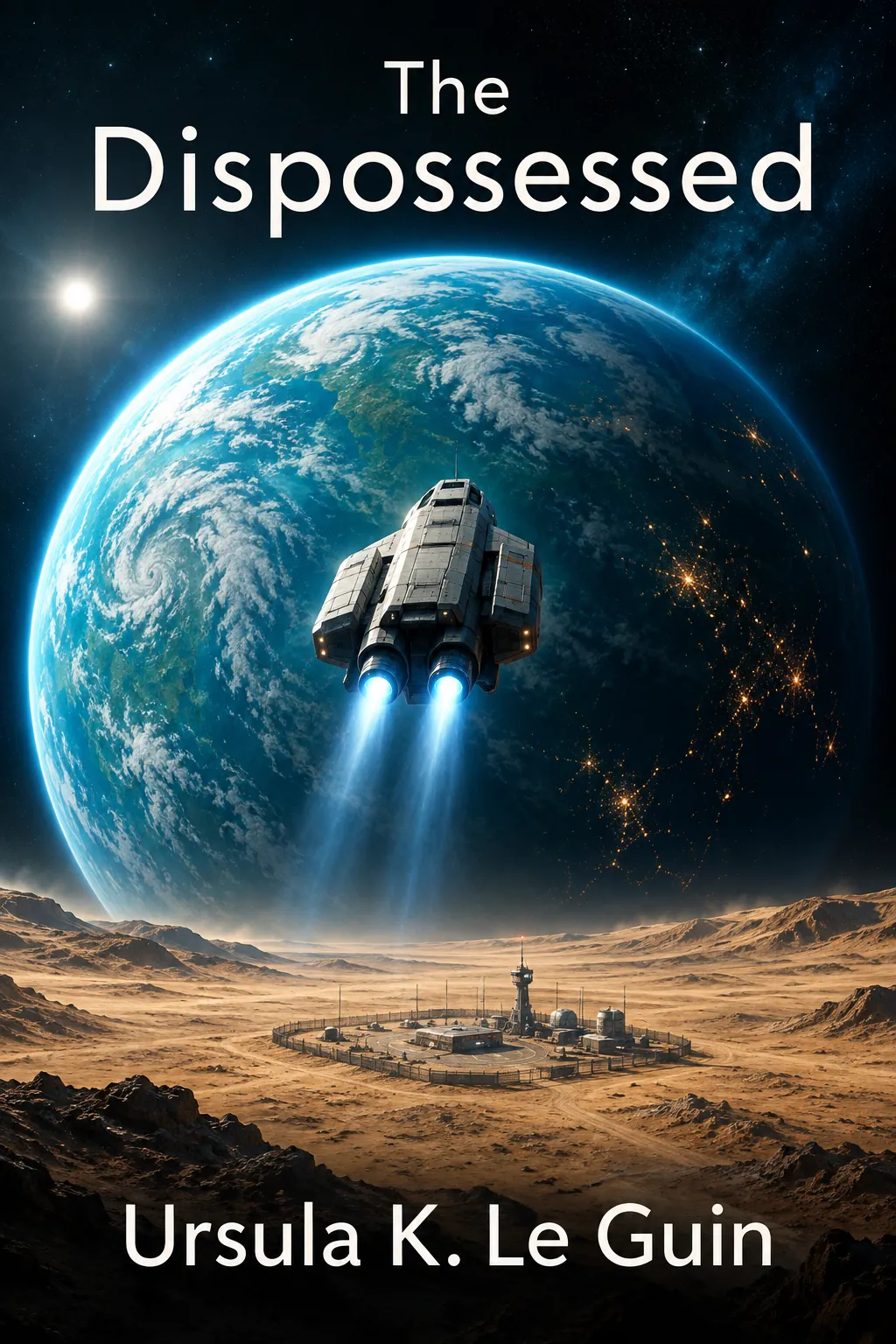
The Dispossessed
by Ursula K. Le Guin
The Dispossessed is a 1974 science-fiction novel about Shevek, a brilliant physicist who grows up on Anarres, a dry moon where people live without government, money or property. Their ancestors left the rich planet Urras, which Anarres circles, to build a society of equals. Shevek's work is stuck at home, so he becomes the first person in generations to travel to Urras. The book asks what freedom costs, and whether any society can stay free.
The Big Idea
"A society built on freedom still has to guard against its own habits of power, and a scientist who shares ideas openly may be the one who keeps it honest."
Key Insights
Freedom needs upkeep
Anarres has no government, but it still has social pressure, unwritten rules and people who guard their small powers. Le Guin suggests that a free society does not stay free by itself. It stays free only if people keep questioning their own habits, even when those habits feel natural. The book treats this as ordinary work that never finishes, and not a failure of the ideal.
Sabul controls publication in the physics lab, and Bedap warns that Anarres is growing its own bureaucracy.
Ownership shapes how we think
On Urras, almost everything is owned: land, labour, ideas and even people's time. On Anarres, people share nearly everything, and even their language leans away from owning. Shevek feels both worlds in his body, and the book invites readers to notice how much their own thinking is shaped by what they are allowed to call theirs.
Shevek is baffled by the luxury of his apartment and the way servants quietly clean up after him.
Ideas belong to everyone
Shevek's theory could change how far and how fast people can communicate. Governments and companies want to own it, but Shevek decides it should be free. This is both a scientific choice and a political one. It shows that the way we share knowledge is part of the kind of society we are building.
In the Terran embassy, Shevek gives his theory to all worlds instead of letting one state own it.
A journey is not complete until you return
Shevek travels to understand Urras, but the real test comes when he goes back. He cannot fix Anarres by himself, and he cannot bring back a ready-made answer. What he brings is experience and the courage to say what he has learned. The ending is open on purpose, and it treats coming home as the harder part.
In the final chapter, aboard the Hainish ship, Shevek looks down at Anarres with empty hands and no gift to bring his daughter.
Chapter Breakdown
Chapter-by-chapter summary
Spoiler warning: this section covers the whole plot, including the ending.
The book has 13 chapters that alternate between two threads. The odd chapters follow Shevek on Urras. The even chapters follow his life on Anarres, moving forward from his childhood to the point just before he leaves. Chapter 1 opens at the departure, and chapter 13 is the voyage home. The chapter labels below are our own short descriptions.
Chapter 1: The wall and the departure
The novel opens at a low stone wall around the only spaceport on Anarres. Shevek is about to board a ship to Urras, and an angry crowd has gathered, some of whom see him as a traitor. Rocks are thrown as he walks to the ship. On board, he talks with an Urrasti doctor named Kimoe, and the two cannot understand each other's ideas about class and property. On landing, Shevek is hailed as the first man from the Moon and taken to a lavish welcome at a university. This matters because the wall can look like protection or like a prison, and the book's central question starts here.
Chapter 2: A childhood on Anarres
The even chapters take place on Anarres, and this one goes back to Shevek's early years. Anarres was settled by followers of the thinker Odo, and children grow up in a shared, communal life where sharing is the rule. Reading it right after the Urras chapter lets us see where Shevek comes from. This matters because the warmth of life without ownership and the narrowness that can come with it are both planted here, and they are where Shevek's doubts about the wall begin.
Chapter 3: A guest at the university
On Urras, Shevek wakes in luxurious rooms and is puzzled by a servant, since Anarres has none and everyone does their own chores. The physicists Pae, Chifoilisk, Oiie and Atro welcome him, and he is thrilled to meet colleagues who know his General Temporal Theory. He is dismayed when they say women do not belong in science. On a city tour he asks to see Odo's grave, where the inscription says that to be whole is to be part and that true voyage is return. His escorts keep him away from ordinary people. This matters because the welcome already hides a wall of its own.
Chapter 4: Abbenay
Back on Anarres, Shevek arrives in the capital, Abbenay, and is given a room of his own at the institute. The senior physicist Sabul tells him to learn Iotic, the language of Urrasti physics, before he can read their work. About half a year in, Shevek writes a critique of the physicist Atro's work. Sabul has it sent to Urras under both their names, and Shevek decides to work with Sabul because Sabul controls how his ideas reach Urras. Later Shevek falls ill and is taken to a clinic. When he wakes, his mother Rulag, whom he barely knows, is at his bedside and offers to guide him. He refuses. This matters because the credit conflict shows how Sabul holds power over Shevek's work, and the scene with Rulag shows how stubbornly Shevek insists on making his own way.
Chapter 5: Warnings and parties
Now a teacher on Urras, Shevek finds that his own work will not move. Shopping with his new salary leaves him sick at what he has become. Chifoilisk, a scientist from the rival state of Thu, warns him that the rooms are bugged, that Pae reports on him and that the state of A-Io will steal his theory. Receptions bore him, but a weekend with Oiie's family gives him some hope. He dreams of walking across a desert with Takver toward a thin, shining barrier. This matters because he begins to see that kindness here comes with a price.
Chapter 6: Bedap, Takver and Tirin
After recovering from his illness, Shevek lives a lonely life at the institute, and his work stalls. He meets his old friend Bedap again, who argues that cooperation on Anarres has turned into obedience. Bedap also tells him that their childhood friend Tirin staged a play, was given one hard job after another and now lives in an asylum. On a hike with Bedap's friends, Shevek meets Takver, and the two agree to become partners. In his third year, his mentor Gvarab dies, and Shevek feels his years there have produced very little. This matters because the book shows that a society without a government can still produce small powers that people fear to challenge.
Chapter 7: Vea's party
On Urras, Shevek is drawn to Vea, Oiie's sister, who flirts with him and gets him to promise to visit her in Nio Esseia. He skips class and takes the train, and they spend a day of expensive meals together. At her party he talks about time and physics, then, having never drunk alcohol before, drinks until he is very drunk. He shouts about the wall and leaves the room feeling ill. In a bedroom he gropes Vea, and when she tells him to stop, he keeps going. She leaves angry and disgusted. Oiie and Pae collect him and put him to bed, and Pae worries that bringing Shevek to Urras has become a serious risk. This matters because it shows a man who despises ownership treating a person as something to take, and it drives his shame in the next chapter.
Chapter 8: Drought and famine
This Anarres chapter covers the hard years of drought and famine. Shevek and Takver are posted to different places, far from each other, and they have a daughter, Sadik. The chapter tests the idea that everyone will carry a shared burden fairly. This matters because the separation, which later chapters say lasts more than four years, shapes the rest of the story, and the work Shevek does in the famine area later weighs on him.
Chapter 9: The morning after and the strike
Shevek wakes after Vea's party sick and ashamed, and he sees that the Ioti state now owns his work. After days of intense work bring a breakthrough on his theory, he falls feverish, and his servant Efor, who nurses him, tells how his daughter died in a filthy hospital. When Atro speaks of the poor as made for war, Shevek sees his cruelty plainly. A note urging him to join his brothers leads Efor to help him slip out to Old Town, where he meets an underground movement planning a strike. At the large demonstration he speaks to the crowd, then police helicopters open fire. He drags a wounded man into a basement and stays with him. This matters because he finally meets the people his hosts hide.
Chapter 10: Famine and the return to Takver
The famine years are over, and Shevek crosses the desert of the Southwest in a truck to find Takver. The driver asks where he worked, and Shevek says that his job had been making lists of who should go without food, and that he quit. In Chakar he finds Takver and their daughter Sadik. They talk about Tirin, who has left the asylum and is rewriting his play, and about how Anarresti believe themselves free while following orders. Shevek decides to return to Abbenay and start a printing syndicate, and to spend his life unbuilding walls. This matters because he stops obeying and starts acting.
Chapter 11: The Terran embassy
Fleeing the crackdown, Shevek reaches the Terran embassy, where staff tell him that he is on Terran soil and safe, and he sleeps for two days. He then meets the ambassador, Keng, and tells her that the Ioti meant to keep him isolated and use his research as a weapon. He asks her to send his equations to all worlds so that no state can own them, and asks for help to go home. This matters because it turns his discovery from a possession into a gift.
Chapter 12: The Syndicate and the decision
Back on Anarres, Bedap presents a project of the Syndicate of Initiative, a group in contact with Urras, at a council meeting. Rulag, Shevek's mother, opposes the group on almost every point. Shevek then decides to go to Urras to open communication, backed only by the Syndicate, and boards an ore freighter past a hostile crowd. This is the last Anarres chapter, and it catches up with the scene that opens chapter 1. It matters because Shevek's journey is a choice made with others.
Chapter 13: The voyage home
Aboard the Hainish ship Davenant, Shevek speaks by radio with the Syndicate, and the news is encouraging. A crew member, Ketho, asks to land on Anarres with him. Shevek warns him that things on Anarres are a little broken loose and that freedom is never very safe, and he calls him brother. At sunrise, he looks at Anarres and imagines being home with his family. He has no gift from Urras, and his hands are empty, as always. This matters because the ending is open, with nothing promised.
Characters
Shevek
A physicist from Anarres who is working on a theory of time. He is quiet, stubborn and more curious than ambitious. He is willing to be unpopular for an idea and to learn from places he disagrees with.
Takver
Shevek's partner and the mother of his daughter. She is a biologist who studies fish, practical and fiercely loyal. She is the person who makes Anarres feel like a home, and not only an idea.
Bedap
Shevek's friend, a sharp critic of life on Anarres. He sees early that rules and habits can turn into new kinds of control, and he pushes Shevek to act on his doubts.
Sabul
A senior physicist in Abbenay who decides which work gets published. He is the main example of how petty power can grow even in a society with no government.
Atro
A famous physicist at the university on Urras. He is courteous and powerful, and he wants Shevek's theory for the benefit of his country.
Oiie
A younger Urrasti physicist who befriends Shevek and enjoys his company. His friendly attitude makes it harder for Shevek to see how closely he is being watched.
Chifoilisk
A scientist from the nation of Thu, A-Io's rival. He is frank and worn out, and he gives Shevek a warning about how the state might use his work.
Keng
The ambassador from Earth on Urras. She listens to Shevek without trying to claim him, and she gives him a safe place to decide what to do.
Ketho
A Hainish crew member who travels back to Anarres with Shevek. He is an outsider who sees both worlds and is curious about the one Shevek calls home.
Odo
A thinker from Urras who died before the settlers left. Her writings inspired the Anarresti, who call themselves Odonians. She appears through the habits and sayings of the people she inspired.
Writing about this book
This is a novel about big ideas, so a good report starts with one clear question and uses one or two scenes as evidence. Here are some starting points that do not give you an answer, only a way in.
- Anarres has no police and no money, yet Shevek feels pressure from other people. Which scene shows that most clearly, and what do you think it means?
- Compare how Shevek feels in his comfortable apartment on Urras with how he felt as a child on Anarres. What does each place give him, and what does it take away?
- Why does the author alternate the chapters between the two worlds? Try describing what you notice when you read a chapter about Anarres straight after a chapter about Urras.
- Shevek decides to share his theory with everyone. Is that an act of freedom, or a way of avoiding responsibility? Argue one side and use a scene to support it.
Remember that the subtitle is An Ambiguous Utopia. A strong report does not decide that Anarres is good and Urras is bad, but looks at what each society gets right and wrong.
Take Action
Practical steps you can implement today:
-
Ask who benefits from a rule, even a friendly one, before you accept it.
-
When you share what you know, notice who gains and who is left out.
-
Compare two ways of living by what each gives and takes, not by which is simply better.
-
Treat a good idea as something that needs ongoing care, not a finished achievement.
Notable Quotes
"“There was a wall.” (Chapter 1)"
— Ursula K. Le Guin
"“Like all walls it was ambiguous, two-faced.” (Chapter 1)"
— Ursula K. Le Guin
"“To be whole is to be part; true voyage is return.” (Chapter 3)"
— Ursula K. Le Guin
Who Should Read This
The Dispossessed suits readers aged about 16 and up, including high school and university students, who enjoy thoughtful science fiction or are curious about politics and economics. It is a slow, reflective novel with some abstract physics talk, so it is best for readers who like ideas as much as plot.
Frequently Asked Questions
What is The Dispossessed about?
It follows Shevek, a physicist from the anarchist moon Anarres, who travels to the rich planet Urras to share his work. He finds that each world has its own kind of unfreedom. The book compares the two societies and asks how people can be free together.
Do I need to read other Hainish Cycle books first?
No. The Dispossessed stands on its own and explains everything you need. It is set in the same universe as other Le Guin novels, including The Left Hand of Darkness, but you can read them in any order.
What does the title mean?
The Anarresti have given up property, so they are the dispossessed in a literal sense. The book suggests that giving up owning things is not the same as being free, and it shows that the Urrasti are dispossessed in other ways, too, such as through poverty and fear.
Is Anarres a utopia?
The subtitle calls it an ambiguous utopia. Anarres is fair and generous in many ways, but it is also poor, harsh and prone to social pressure. Le Guin wants readers to weigh both sides rather than settle on one.
Why does the book alternate between two threads?
The even chapters follow Shevek's life on Anarres from childhood, and the odd chapters follow his stay on Urras. Chapter 1 opens at his departure and chapter 13 is the voyage home. Alternating them lets the reader compare the two worlds as Shevek does.
Check Your Understanding
Pick an answer for each question to see if you were right.
-
What is the name of the moon where Shevek grows up?
Anarres — Shevek is from Anarres, the moon settled by followers of Odo.
-
What is Shevek's job?
Physicist — Shevek is a physicist working on a theory of time.
-
Who is the senior scientist who controls what is published in Abbenay?
Sabul — Sabul holds power over publication in the Anarres physics institute.
-
What does Shevek decide to do with his General Temporal Theory?
Share it freely with everyone — Shevek decides his theory should belong to everyone, not to a single state.
-
Who comes back to Anarres with Shevek at the end?
Ketho — Ketho, a Hainish crew member, travels with Shevek.
About Ursula K. Le Guin
Ursula K. Le Guin (1929–2018) was an American novelist and essayist who wrote science fiction, fantasy, poetry and criticism. She is best known for the Earthsea books and for the Hainish Cycle, which includes The Left Hand of Darkness. The Dispossessed won both the Hugo and Nebula awards for best novel and is her most direct look at politics.
Summary Written By

Software Engineer & Writer
Software engineer with a passion for distilling complex ideas into actionable insights. Writes about finance, investment, entrepreneurship, and technology.
View all summaries →Reviews
No reviews yet. Be the first to share your thoughts!
Write a Review
Keep reading
Explore the topic: Sci-Fi Authors & AwardsSummaries

Out of My Mind
Sharon M. Draper
“Out of My Mind” by Sharon M. Draper is a poignant narrative that explores the life of Melody Brooks, a…

Ender’s Game
Orson Scott Card
“Ender’s Game” by Orson Scott Card is a riveting science fiction novel that transports readers into a future where humanity…

Pachinko
Min Jin Lee
“Pachinko”, a spellbinding multigenerational historical saga by Min Jin Lee, explores the lives of a Korean family trying to make…

The Perks of Being a Wallflower
Stephen Chbosky
The Perks of Being a Wallflower by Stephen Chbosky is a profound coming-of-age novel, told through the intimate letters of…
Articles

Nebula Award: What It Is and Notable Winners
The Nebula Award is an American science fiction and fantasy prize voted on by working writers. The Science Fiction and…

Ursula K. Le Guin
Ursula K. Le Guin (1929–2018) was an American novelist who used science fiction and fantasy to imagine other ways of…

A Christmas Carol themes: generosity, isolation and responsibility
Dickens's novella is usually read as a story about a man who changes his mind. Its themes are sharper than…