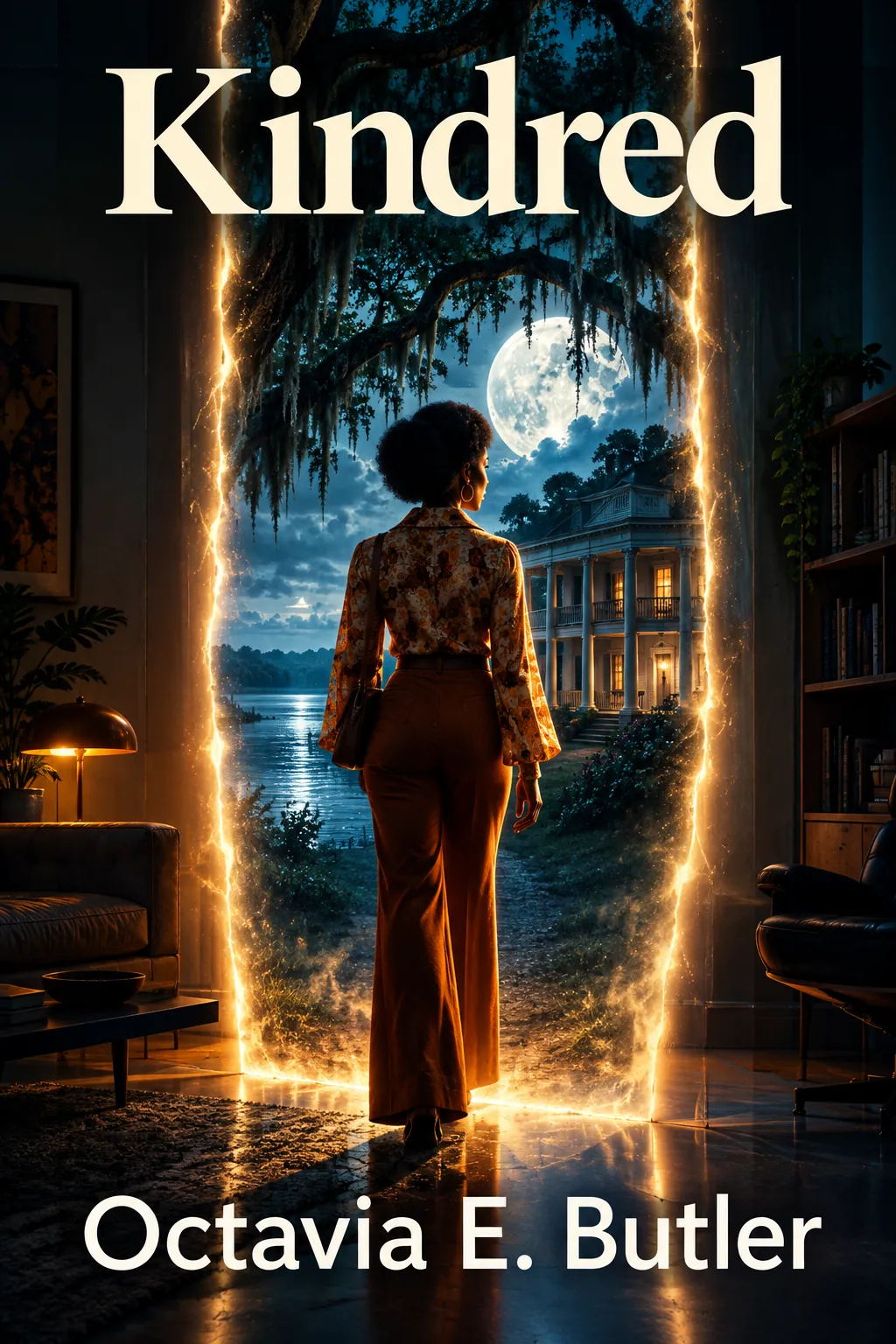
Kindred
by Octavia E. Butler
Kindred is a 1979 novel by Octavia E. Butler about Dana, a Black writer in 1976 California who is pulled back in time to a Maryland plantation in the early 1800s. Each time, the danger is to Rufus, a white boy who will grow up to be a slaveholder and, in time, her own ancestor. Dana must keep him alive long enough for her family to exist, while she lives under the slavery she is trying to survive.
The Big Idea
"Kindred asks what it would really cost to survive slavery, and what survival does to a person, by dropping a modern Black woman into the world her own family came from."
Key Insights
Survival has a price
Dana does not simply fight slavery; she has to live inside it. Butler shows that surviving often means doing small things you hate, such as lying, staying quiet or protecting someone you dislike. The book refuses to treat that as weakness. It treats it as the real cost of staying alive under a system built to break people, and asks us to look at that cost honestly.
Dana keeps saving Rufus even though he is dangerous, because her own family line depends on him.
Slavery was a daily system
The novel is not about one cruel person. Tom Weylin, Margaret and Rufus all benefit from a system that gives them control over other human beings. Dana, as a modern reader's stand-in, sees how ordinary the routine looks from the inside: meals, chores, lessons and punishments. Butler's point is that harm becomes normal when everyone around you treats it as normal.
Dana secretly teaches Nigel to read, and when Weylin finds out he has her whipped.
Family can be bound by violence
Dana's ancestors include both an enslaved woman and the slaveholder who abused her, so her family tree cannot be separated from the history she is trying to survive. The title Kindred points to that uncomfortable link. Butler suggests that Americans often inherit stories of pain and power from the same few families, and that facing this is part of understanding who we are.
Rufus and Alice's daughter Hagar is Dana's direct ancestor, so Dana has to help both of them survive.
The past stays in the body
Dana's lost arm is the book's boldest symbol. History does not end when someone gets home safely; it leaves marks. Butler makes that mark physical so that no reader can treat slavery as a distant story. Kevin's years in the past also leave him changed. Memory, in this book, is something you carry in your body as well as your mind.
The Prologue announces the lost arm before the story begins, so the reader waits for the moment it happens.
Chapter Breakdown
Chapter-by-chapter summary
Spoiler warning: this section covers the whole plot, including the ending.
Prologue
The book opens in a hospital. Dana wakes up missing her left arm. Police officers ask whether her white husband, Kevin, beats her, and Dana insists the injury was an accident and that Kevin is not to blame. Later she and Kevin admit they are afraid to tell what really happened, because nobody would believe them. The Prologue works as a promise and a warning: from the first page the reader knows this journey will cost Dana something permanent, and that she cannot share the truth with anyone.
The River
On June 9, 1976, her twenty-sixth birthday, Dana and Kevin have just moved into a new home. Dana grows dizzy and suddenly finds herself beside a river, where a red-haired boy is drowning. She pulls him out and breathes air into him. His mother attacks her, thinking she has hurt him, and a white man points a gun at her. Dana grows dizzy again and is back at home with Kevin. The chapter sets up the pattern of the novel and shows that her first act in the past is to save a life.
The Fire
Dana is pulled away again, this time to a bedroom where the same boy, Rufus, is older and has set the drapes on fire after a beating from his father. She puts out the fire and learns that she is in Maryland in about 1815. Rufus sends her to Alice Greenwood and her mother, free Black women. White men break in, and one of them tries to rape Dana before she escapes back to 1976. Only minutes have passed for Kevin. The chapter shows how dangerous the past is for her, and it links Rufus and Alice to her own family line.
The Fall
Dana remembers how she met Kevin at a temp job. In 1976 he is working on a way to forge free papers for her when the two of them are carried back together. They find Rufus with a broken leg and send Nigel, a Black boy, for help. Tom Weylin, Rufus's father, invites Kevin to dinner and then hires him to tutor Rufus, and he wants to buy Dana from Kevin. Margaret, Rufus's mother, sends Dana to the cookhouse, where she meets Sarah and Sarah's mute daughter, Carrie. Dana secretly teaches Nigel to read, and Weylin whips her for it. The chapter shows how quickly the household makes her powerless.
The Fight
Eight days after Dana returns home, she is sent back and finds Rufus being beaten by Isaac, Alice's husband, after Rufus tried to rape Alice. Dana talks Isaac out of killing him, and Alice and Isaac run. Five years have passed in the past, and Kevin has left Maryland. Weylin now knows Dana comes from another time. Isaac and Alice are caught; Isaac is mutilated and sold south, and Alice is savaged by dogs and bought by Rufus. Dana, with Carrie's help, nurses Alice and persuades her to submit to Rufus rather than be beaten again. Dana's own escape attempt fails, and she is whipped. Kevin returns to fetch her, and they leave together. The chapter matters because Dana's choices begin to hurt people she cares about.
The Storm
Kevin struggles to settle back into 1976 after five years in the past. Dana returns to the plantation and finds Rufus drunk in the rain. She nurses him through a fever. Alice has borne children to Rufus, and some have died. Weylin dies of a heart attack, and Rufus becomes the master. He sends Dana to the cornfields, where she is whipped. Alice gives birth to Hagar, who is Dana's direct ancestor. Dana teaches children to read. When Rufus plans to sell a boy named Sam, she begs him not to, and when he refuses she slits her wrists to escape home. The chapter shows the limits of her influence over Rufus.
The Rope
Dana tells Kevin everything, spends a stretch at home, and returns to a changed plantation. While she was gone, Alice tried to escape. Rufus whipped her and lied that he had sold her children. Alice hanged herself. After her funeral, Dana persuades Rufus to take her to town to free the children, Joe and Hagar. Then Rufus makes clear that he wants Dana to take Alice's place. When he tries to rape her, Dana stabs him with her knife. Nigel arrives as Rufus dies, and Dana is pulled home. Her left arm is trapped in the wall and left behind. The chapter finally ends her bargain with Rufus.
Epilogue
Back in 1976, Dana and Kevin travel to Baltimore to look for traces of the Weylin household. In old papers they find a notice that Rufus died in a house fire, and a sale listing that includes the Weylin slaves except Nigel, Carrie, Joe and Hagar. Dana suspects that Nigel set the fire to cover up what happened, and she feels responsible for the sale. Kevin tells her she cannot change the past. The ending offers no neat comfort: history gives only fragments, and Dana has to live with what she knows.
Characters
Dana Franklin
A Black writer in 1976 California and the narrator. She is practical, quick-minded and stubborn. In the past she must decide again and again how much she will bend in order to survive, and she loses her left arm on the last trip.
Kevin Franklin
Dana's white husband, also a writer. He is carried into the past with her, is hired by Weylin to tutor Rufus, and is left behind in Maryland for about five years. He returns changed, and the time apart tests the marriage.
Rufus Weylin
The son of a Maryland slaveholder, whom Dana first saves as a small boy. He needs her, but he is shaped by the power he is raised to have, and as a man he assaults and sells the people around him. Dana kills him in self-defence.
Alice Greenwood
A free-born Black girl who becomes Rufus's lifelong obsession. She loses her freedom after a failed escape with her husband Isaac. She bears Rufus's children, including Hagar, Dana's ancestor, and later hangs herself.
Tom Weylin
Rufus's father, who owns the plantation. He is hard and controlling, and he has Dana whipped for teaching Nigel to read. He dies of a heart attack despite Dana's efforts to save him.
Margaret Weylin
Rufus's mother, who runs the house. She sends Dana to work in the cookhouse. She is anxious and harsh toward the enslaved women who serve her.
Sarah
The Weylin cook and the mother of Carrie. She is guarded and sharp-tongued, and she shows Dana what long-term survival costs on the plantation.
Nigel
A young enslaved man Dana first meets when she and Kevin send him for help. Dana secretly teaches him to read. He is the one who arrives when Rufus dies, and he is not among the people sold afterwards.
Carrie
Sarah's mute daughter. Dana meets her in the cookhouse, and Carrie helps care for Dana after her whipping. She is among the people the sale records leave out.
Writing about this book
Kindred gives you many ways in for a book report or essay. Start with a question rather than a thesis. For example: why does Butler send Dana into the past through a time-travel device but never explain how it works? Or: what does it mean that Dana can protect her own family only by protecting the slaveholder who hurts her friends?
You could compare how Dana's choices change from the first trip to the last. Look at what she is willing to say, what she hides, and when she decides to act. You could also write about the arm in the Prologue and why the author put the cost first.
Another angle is the title. Kindred means family and shared bonds. Ask who counts as kin in this book: Kevin, Alice, Rufus, Nigel or Carrie? Use short quotes from your own copy, and put the page numbers in your essay. Plan your own argument from the evidence you find.
Take Action
Practical steps you can implement today:
-
Read slowly and note how Dana's choices change from the first trip to the last.
-
Ask who has power in each scene and what they gain from it before judging a character.
-
Keep apart what the book shows, daily life under slavery, and what it leaves unexplained, how the time travel works.
-
Pair the novel with a history source on Maryland slavery to see what Butler drew on.
Notable Quotes
"“I lost an arm on my last trip home.” (Prologue)"
— Octavia E. Butler
Who Should Read This
Readers aged about 15 and up who want a novel that treats slavery seriously, including students in high school or college literature courses. It suits readers who like character-driven science fiction and does not need technical explanations. The book contains violence and sexual violence.
Frequently Asked Questions
What is Kindred about?
Kindred follows Dana, a Black woman living in 1976 California, who is repeatedly pulled back to a Maryland plantation in the early 1800s. Each time she must save Rufus Weylin, a white boy who is her ancestor and who grows into a slaveholder. The story explores survival, power and family under slavery.
Is Kindred science fiction?
It uses time travel, so it is usually shelved as science fiction, but Butler gives no scientific explanation for it, and she called the book a grim fantasy. What matters is the experience of the character, not the mechanism.
How is Rufus related to Dana?
Rufus Weylin is the white son of a Maryland slaveholder, and Alice Greenwood is a Black woman from the same area. Their daughter Hagar is Dana's ancestor, which is why Dana keeps being pulled to save him. If he dies young, her family line would never exist.
Is Kindred suitable for school?
It is widely taught in high school and college. The novel includes physical violence, sexual violence and racism, written without sensationalism. Teachers and parents may want to prepare students beforehand, and readers around 15 and older are the usual audience.
Has Kindred been adapted?
Yes. A graphic novel adaptation by Damian Duffy and John Jennings appeared in 2017, and a television series based on the book aired in 2022. This study guide covers only the original 1979 novel.
Check Your Understanding
Pick an answer for each question to see if you were right.
-
Where does Dana live in 1976?
California — Dana and Kevin are moving into a new home in California in June 1976.
-
What brings Dana back to the past?
Rufus's life being in danger — She is called to Rufus when he is in danger, and sent home when she fears for her own life.
-
What is Rufus's connection to Dana?
Her ancestor — Rufus and Alice's daughter Hagar is Dana's ancestor, so she must keep him alive long enough for that to happen.
-
Which year was Kindred first published?
1979 — Octavia E. Butler published Kindred in 1979.
-
What does Dana lose on her last trip?
Her left arm — The Prologue opens with her saying she lost an arm, her left arm, on the last trip home.
About Octavia E. Butler
Octavia E. Butler (1947–2006) was an American science fiction writer born in Pasadena, California. She was one of the first Black women to gain wide recognition in the genre and won both the Hugo and Nebula awards. In 1995 she received a MacArthur Fellowship. Kindred (1979) is her best-known novel, alongside Parable of the Sower.
Summary Written By

Software Engineer & Writer
Software engineer with a passion for distilling complex ideas into actionable insights. Writes about finance, investment, entrepreneurship, and technology.
View all summaries →Reviews
No reviews yet. Be the first to share your thoughts!
Write a Review
Keep reading
Explore the topic: Sci-Fi Genres & IdeasSummaries

Out of My Mind
Sharon M. Draper
“Out of My Mind” by Sharon M. Draper is a poignant narrative that explores the life of Melody Brooks, a…

Ender’s Game
Orson Scott Card
“Ender’s Game” by Orson Scott Card is a riveting science fiction novel that transports readers into a future where humanity…

Pachinko
Min Jin Lee
“Pachinko”, a spellbinding multigenerational historical saga by Min Jin Lee, explores the lives of a Korean family trying to make…

The Perks of Being a Wallflower
Stephen Chbosky
The Perks of Being a Wallflower by Stephen Chbosky is a profound coming-of-age novel, told through the intimate letters of…
Articles

Afrofuturism
Afrofuturism is a way of imagining the future, and rethinking the past, through Black experience, using science fiction, music, art…

A Christmas Carol themes: generosity, isolation and responsibility
Dickens's novella is usually read as a story about a man who changes his mind. Its themes are sharper than…

Nebula Award: What It Is and Notable Winners
The Nebula Award is an American science fiction and fantasy prize voted on by working writers. The Science Fiction and…