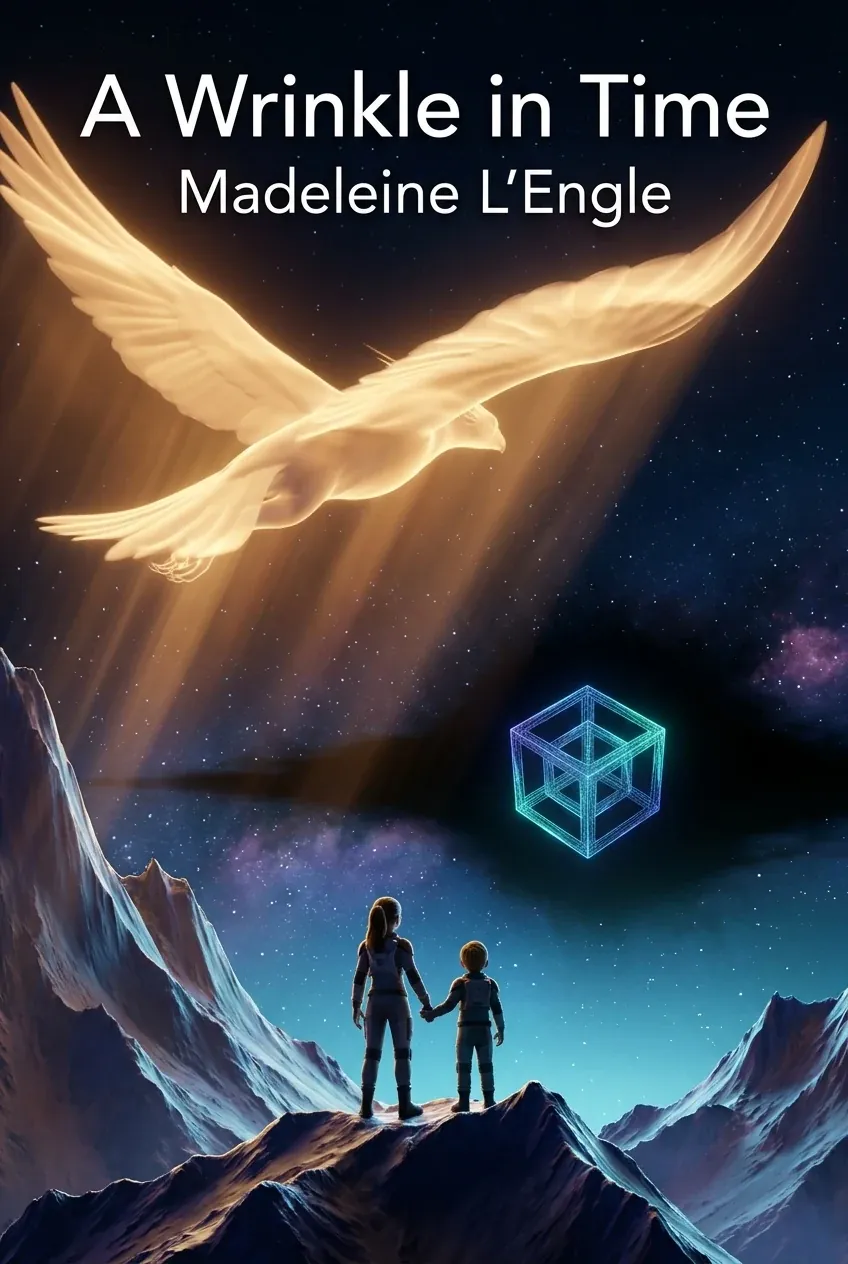
A Wrinkle in Time
by Madeleine L'Engle
A Wrinkle in Time is a 1962 children's science fantasy by Madeleine L'Engle. Schoolgirl Meg Murry, her gifted little brother Charles Wallace and her friend Calvin set out to find Meg's father, a scientist who vanished while working on a secret project. Three strange guides teach them to tesser, folding space to travel between worlds. They find a planet where everyone is forced to be the same, and Meg must face her own weaknesses.
The Big Idea
"Being the same is not the same as being safe or equal. The book says love, and learning what your own flaws are good for, can stand against a world that wants everyone to think alike."
Key Insights
Sameness is not safety
On Camazotz, everyone thinks and acts the same, so nothing seems to go wrong. The book argues that this calm is bought by giving up freedom, curiosity and difference. Meg sees that like and equal are not the same: a fair world treats different people as equally important instead of making them identical.
Children bouncing balls in perfect rhythm, and the quick removal of anyone who breaks it, show how small acts of difference are the first things a controlling society punishes.
Faults can be strengths
Meg is stubborn, quick to anger and unsure of herself, and she wishes she were different. The book suggests that these traits are part of what makes her brave. The task is not to erase flaws but to learn what they are good for.
Her stubbornness, which causes trouble at school, is the same energy that keeps her moving when the journey turns frightening.
Love is a force, not just a feeling
IT is all logic and control, and Meg cannot beat it by arguing. The book places love on the other side of the scale: not a mood, but an act of will that one person chooses for another. L'Engle presents it as something stronger than cleverness.
Charles Wallace is far cleverer than Meg, yet the story treats her fierce care for him as the greater power. Readers can ask what it means to love someone when it is hard.
Adults are not all-powerful
Meg expects that finding her father will fix everything. Instead she meets a man with limits, and has to decide what she herself can do. The book treats this as a painful but necessary part of growing up, not as a betrayal.
The three guides help, but they also tell the children plainly that they can only go so far, and that some steps must be taken by the children themselves.
Chapter Breakdown
Chapter-by-chapter summary
Spoiler warning: this section covers the whole plot, including the ending.
Chapter 1: Mrs Whatsit
It is a stormy night in a New England village, and Meg Murry cannot sleep. She feels clumsy at school, hurt by rumours that her scientist father has run off, and worried about her mother. Her five-year-old brother, Charles Wallace, who seems to understand people better than most adults, brings her down to the kitchen. A strange visitor, Mrs Whatsit, has wandered in from the storm in a heap of odd clothes. Before she leaves she remarks that there is such a thing as a tesseract, and Mrs Murry turns pale, because Meg's father used that word. Why it matters: in one small scene the odd visitor and the missing father are linked, and the mystery begins.
Chapter 2: Mrs Who
The next day Charles Wallace leads Meg to an old house in the woods, where he says Mrs Whatsit is staying with two friends. Calvin O'Keefe, a boy from Meg's school who says he felt a pull to come, joins them. Inside they meet Mrs Who, a woman in thick glasses who speaks mostly in quotations borrowed from other languages and writers. She is odd, but kind. Why it matters: the three children who will travel together are now in place, and the strange women are shown to be friends rather than threats.
Chapter 3: Mrs Which
The third guide, Mrs Which, is barely more than a shimmer, and she speaks slowly, as if every word costs her effort. The women explain that the children will help find Mr Murry, and that a dark shadow over Earth is part of the problem. Their method of travel is to tesser: not to cross distance, but to fold space so the two ends touch. The first trip is rough, and Meg feels it most. Why it matters: the story leaves the kitchen and becomes a journey across the universe, and the danger starts to feel real.
Chapter 4: The Black Thing
The group lands on Uriel, a mountain world where the air seems to sing. Mrs Whatsit shows her true shape, a huge winged creature, and carries the children up the slopes. From the heights they see a spreading darkness in space: the Black Thing, a force of evil that now lies over Earth. The women say great artists and thinkers have fought it for ages, and that Mrs Whatsit was once a star that gave itself up in that fight. Why it matters: the enemy and the stakes are named.
Chapter 5: The Tesseract
Mrs Whatsit explains the tesseract with a simple picture. An ant walking along a stretched skirt needs a long time to reach the other side, but if someone pinches the cloth together, the ant steps across at once. Space can be folded in the same way. Charles Wallace grasps it quickly, while Meg is still unsure, and the children begin to see that the trip has real hazards. Why it matters: a hard idea is made clear through an everyday picture, and the chapter shows Meg caught between her brother's brilliance and her own doubts.
Chapter 6: The Happy Medium
Next the children visit the Happy Medium, a cheerful woman living on another world who can see far-off places in a crystal ball. In it they see Earth wrapped in the Black Thing's shadow. The guides use her to show where Mr Murry is held, and the children learn that he is on a dark planet called Camazotz. Why it matters: the goal and the danger are now both clear, and there is no easy way back.
Chapter 7: The Man with Red Eyes
On Camazotz the children walk past rows of identical houses. Boys and girls bounce balls and skip rope in perfect rhythm, and a child who breaks the beat is hurried away. The children reach CENTRAL Central Intelligence, the heart of the planet's control, where the Man with Red Eyes greets them. He is calm and courteous, and he tries to take over Charles Wallace's mind. Why it matters: Camazotz shows how frightening a world can be when everyone is made the same, and Charles Wallace's pride makes him an easy target.
Chapter 8: The Transparent Column
Deep inside the building, the children find Mr Murry trapped inside a transparent column. Meg has dreamed of this meeting, but the reality is hard: he is thin, dazed and far from all-powerful. The children manage to free him, while Charles Wallace remains under the planet's influence. Why it matters: Meg learns that her father cannot simply fix everything, which is a painful step toward growing up.
Chapter 9: IT
At the center of the building the group meets IT, a huge disembodied brain that runs Camazotz by controlling every mind. Charles Wallace, already under its power, speaks in a flat, cold voice and says that being the same is easier and happier. Meg answers that like and equal are not the same thing at all, but IT's pull is strong and nearly overwhelms her. In the chaos, Mr Murry tessers away with Meg and Calvin, and Charles Wallace is left behind. Why it matters: this is the story's clearest clash between a free mind and forced sameness, and it ends in a loss.
Chapter 10: Absolute Zero
On the way out, Meg passes through the cold of the Black Thing and is badly hurt. The three arrive on a grey planet where she can hardly move. Calvin and her father recover, but Meg, weak and furious, blames her father for leaving Charles Wallace. She had expected a rescue and instead found a father with limits. Why it matters: her anger comes from love and disappointment, and the chapter shows her worst trait and her deepest feeling together.
Chapter 11: Aunt Beast
Meg wakes in the care of tall, furry, blind creatures who use senses other than sight. She calls one of them Aunt Beast, who nurses her with gentle patience. Soon Mrs Whatsit, Mrs Who and Mrs Which return and say that Charles Wallace can only be saved if someone goes back to Camazotz. The one chosen is Meg. Why it matters: after the fear comes rest, and then the hard choice that makes Meg the hero of her own story.
Chapter 12: The Foolish and the Weak
Mrs Whatsit tells Meg that her faults will serve her, and that she has something IT does not. Meg returns alone to Camazotz and faces Charles Wallace under IT's control. She cannot out-argue IT, but she realises she loves her brother, and she aims that love at him. IT cannot bear it. Charles Wallace is freed, and the family is brought home to Earth. Why it matters: it shows that love is a choice and a strength, not just a soft feeling.
Characters
Meg Murry
The heroine. A stubborn, short-tempered girl who struggles at school and dislikes her own looks. She is fiercely loyal to her family, and her anger and persistence turn out to be the tools she needs most.
Charles Wallace Murry
Meg's five-year-old brother, a prodigy who often senses what others are thinking. His confidence is a gift and a weakness: it leads him into danger on Camazotz. Meg cares for him above everyone else.
Calvin O'Keefe
A boy from Meg's school who comes from a large, noisy family where he feels unseen. He finds a real welcome with the Murrys and becomes Meg's steady friend on the journey.
Mrs Murry
Meg's mother, a scientist who works in a laboratory at home. She is warm and calm, and she keeps hoping for her husband's return even when the neighbours do not.
Mr Murry
Meg's father, a physicist whose secret research on the tesseract is tied to his disappearance. Meg expects him to solve everything. The real man is brilliant and loving, but human and limited.
Mrs Whatsit
The youngest and warmest of the three guides. She is a former star who gave up her life fighting the Black Thing, and on Earth she appears as a muddled old woman in a heap of clothes.
Mrs Who
The second guide, who wears thick glasses and speaks mostly in quotations from many languages and writers. Her borrowed words are playful, but they carry real advice for the children.
Mrs Which
The oldest and most powerful guide, who barely has a body and speaks slowly and with great care. She gives the group its hardest orders, and her solemn voice shows how serious the mission is.
IT and the Man with Red Eyes
IT is the huge disembodied brain that rules Camazotz by forcing everyone to think and act alike. The Man with Red Eyes is its calm, polite voice. Together they stand for control that hides behind the promise of safety.
Aunt Beast
A tall, furry, blind creature on a grey planet. She tends to Meg with patience and gentleness, showing a kind of care that works through touch and quiet presence rather than sight or words.
Writing about this book
A good book report picks one scene and says what you felt and why. Start with a question you really care about, then answer it with evidence from the story. Here are some questions to explore:
- Meg thinks of her flaws as problems. Does the book agree with her? Compare this with a quality you wish you could change in yourself.
- Camazotz offers safety in return for sameness. Where do you see pressure to be the same at school or online, and what does it cost?
- The book separates love from being clever. Do you agree that they are different kinds of strength?
- Meg expects her father to solve everything. Have you ever learned that an adult could not? How did it feel?
- How is Meg different in the last chapter from the first?
You could open with a line like “The scene that stayed with me was… because…” and keep the plot summary to a few sentences. Your own experiences and your own words will make the report stronger than any outline.
Take Action
Practical steps you can implement today:
-
Do not rush to erase your flaws. Ask where each one might help you, and use it on purpose.
-
When “being the same as everyone” feels safe, stop and ask what you are giving up for it.
-
Some problems yield to care for another person more than to clever arguments.
-
Ask for help, but be ready to take the steps only you can take.
Notable Quotes
"“There is such a thing as a tesseract.” (Chapter 1)"
— Madeleine L'Engle
"“Wild nights are my glory.” (Chapter 1)"
— Madeleine L'Engle
"“Like and equal are not the same thing at all!” (Chapter 9)"
— Madeleine L'Engle
Who Should Read This
Readers aged about ten and up, and adults who loved it as children. It suits fans of fantasy and space adventure, students looking for a book-report topic, and anyone who has felt out of place at school or at home. No maths is needed: the science is told through simple pictures and stories.
Frequently Asked Questions
What is A Wrinkle in Time about?
It is about Meg Murry, her five-year-old brother Charles Wallace and her friend Calvin, who travel across the universe with three mysterious guides to find Meg's missing father. Along the way they face the Black Thing, a force of evil, and a planet where everyone is forced to be the same.
What is a tesseract in the book?
In the book, a tesseract is a way of travelling by folding space so that two distant points touch, shown with an ant crossing a pinched skirt. In mathematics, a tesseract is a four-dimensional cube. L'Engle borrows the word and uses it as a bridge between science and wonder.
Is A Wrinkle in Time science fiction or fantasy?
It is usually called science fantasy. It uses ideas from physics, such as extra dimensions and travel through folded space, but it also has magical guides and a central battle between good and evil. It is most often read as children's or young-adult fiction.
What age is A Wrinkle in Time for?
It is written for readers of about ten and up, and it won the Newbery Medal in 1963. Younger children can enjoy it read aloud. Some ideas, such as the Black Thing and the loss of free will, can feel scary, so a parent may want to talk about them.
Is there a sequel to A Wrinkle in Time?
Yes. It is the first of five novels known as the Time Quintet: A Wrinkle in Time, A Wind in the Door, A Swiftly Tilting Planet, Many Waters and An Acceptable Time. Several of them return to the Murry family. The first book can be read on its own.
Check Your Understanding
Pick an answer for each question to see if you were right.
-
What is the name of Meg's five-year-old brother?
Charles Wallace — Charles Wallace is Meg's gifted little brother, who senses what others are thinking.
-
How do the three guides take the children across the universe?
By folding space, called tessering — They tesser, folding space so that two far-apart places touch.
-
What is the name of the planet ruled by IT?
Camazotz — Camazotz is the dark planet where everyone is made to think and act alike.
-
What does Mrs Whatsit use to explain the tesseract?
An ant on a stretched skirt — If the skirt is pinched together, the ant can cross it in a single step, just as folded space shortens a journey.
-
What is Meg's father's job?
A physicist — Mr Murry is a physicist whose secret research on the tesseract is linked to his disappearance.
About Madeleine L'Engle
Madeleine L'Engle (1918–2007) was an American author born in New York City. She wrote more than sixty books for children and adults, including the Time Quintet, which begins with A Wrinkle in Time. The novel won the 1963 Newbery Medal and has stayed in print for decades, blending science, faith and family.
Summary Written By

Software Engineer & Writer
Software engineer with a passion for distilling complex ideas into actionable insights. Writes about finance, investment, entrepreneurship, and technology.
View all summaries →Reviews
No reviews yet. Be the first to share your thoughts!
Write a Review
Keep reading
Explore the topic: Science FictionSummaries

Out of My Mind
Sharon M. Draper
“Out of My Mind” by Sharon M. Draper is a poignant narrative that explores the life of Melody Brooks, a…

Ender’s Game
Orson Scott Card
“Ender’s Game” by Orson Scott Card is a riveting science fiction novel that transports readers into a future where humanity…

Pachinko
Min Jin Lee
“Pachinko”, a spellbinding multigenerational historical saga by Min Jin Lee, explores the lives of a Korean family trying to make…

The Perks of Being a Wallflower
Stephen Chbosky
The Perks of Being a Wallflower by Stephen Chbosky is a profound coming-of-age novel, told through the intimate letters of…
Articles

A Christmas Carol themes: generosity, isolation and responsibility
Dickens's novella is usually read as a story about a man who changes his mind. Its themes are sharper than…
Nebula Award: What It Is and Notable Winners
The Nebula Award is an American science fiction and fantasy prize voted on by working writers. The Science Fiction and…

Seiun Award
The Seiun Award is Japan's oldest science fiction award, first given in 1970. Fans who attend the annual Japan SF…