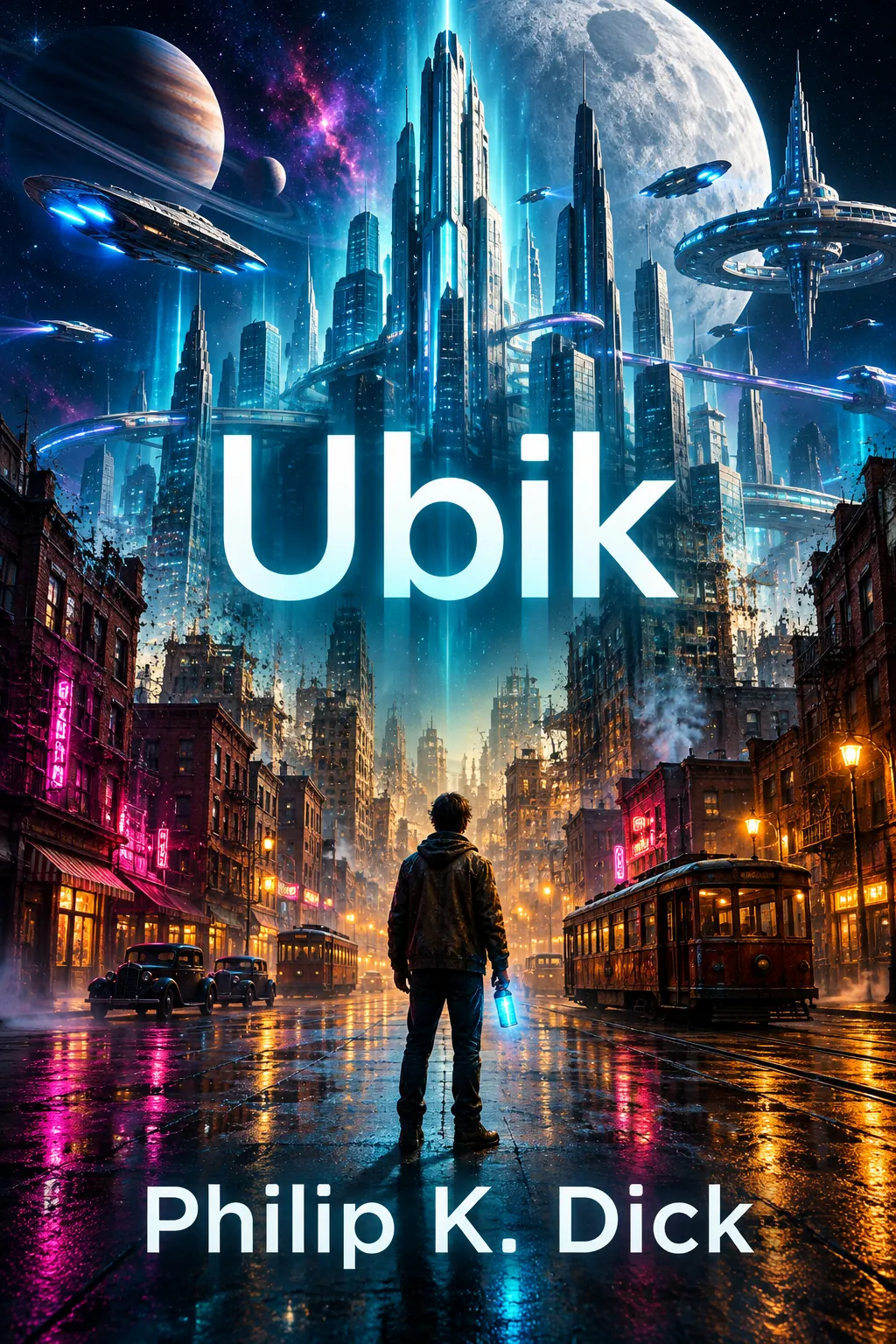
Ubik
by Philip K. Dick
Ubik is a 1969 novel by Philip K. Dick, set in a 1992 where telepaths can spy on anyone and a company of "inertials" sells protection from them. When a job on the Moon goes badly wrong, technician Joe Chip and his colleagues find the world around them turning old and rotten, while strange messages from their boss appear in the most unlikely places. The book asks what is real when you cannot trust your surroundings.
The Big Idea
"In Ubik, the line between the living and the dead blurs, and the one thing that holds a collapsing reality together turns out to be as ordinary as a product sold in a spray can."
Key Insights
Reality is fragile
Dick shows the world as something that can wear away, not as solid ground. When the characters' surroundings begin to age backward, the reader feels how much we rely on the sense that tomorrow will look like today. The book suggests that reality is held together by habit, shared agreement and small details that we rarely notice until they fail.
Joe finds sour milk, stale cigarettes and machines that grow older each day, so even a simple breakfast becomes a sign that something is wrong.
Death is not a clean line
In Ubik, the dead are not simply gone. They linger in cold-pac and half-life, where they can be visited, bargained with or even preyed on. This turns death into a place and a service rather than an ending. The result is a grief story as well as a thriller, because the living cannot tell whether the people they miss are lost or just out of reach.
Runciter visits his wife Ella in Zürich and talks with her, and later Ella becomes Joe's guide when he is in half-life himself.
Everything has a price
Dick fills the book with money. Doors ask for coins, spies are rented, protection is a subscription and even the afterlife is a business. This is both a joke about consumer culture and a serious point, since a world where everything is for sale cannot easily say what is sacred. The product at the heart of the book fits this pattern with a twist.
Joe's front door will not let him leave until he pays, and he has to argue with it as though it were a landlord.
Who is telling you what is real?
The book keeps changing who seems to hold the truth: Hollis, Pat, Runciter, Ella, Jory, or the advertising itself. That keeps the reader as unsure as Joe. The message is not that nothing can be known, but that we should ask who gains from each version of events, and notice how often an ad, a voice or a rumour fills the gap.
Messages in Runciter's voice appear on matchbooks and in a television ad, and Joe must decide whether to believe them.
Chapter Breakdown
Chapter-by-chapter summary
Spoiler warning: this section covers the whole plot, including the ending.
Part 1: Runciter Associates and a broke technician
Dick's 1992 is a world where telepaths and precogs can be hired to snoop on anyone. Glen Runciter runs a firm that sells the cure: inertials, people whose presence blocks psychic powers. His tester Joe Chip is short of money, so short that his apartment door demands payment before it will open. Runciter's rival Ray Hollis runs a competing organisation, and the two firms are quietly at war. Runciter's wife Ella lies in cold-pac, a deep-frozen state in which the recently dead can still be contacted for a short time. Why it matters: from page one, privacy, money and even death are things that can be rented, sold or run out.
Part 2: Pat Conley and the offer from the Moon
Joe tests a new recruit, Pat Conley, a young woman who can change the past. She joins the team, and Joe is drawn to her while doubting whose side she is really on. Then a rich man named Stanton Mick offers Runciter a large job on the Moon, guarding against telepaths. Runciter picks a team of inertials, including Joe and Pat, and takes them to Luna. Why it matters: Pat's power and Mick's generous offer are both set up early, so the reader senses something is wrong before the characters do.
Part 3: The explosion
The Moon job is a trap. A bomb goes off, and Runciter is badly hurt. The survivors rush him back to Earth, to a moratorium in Zürich, where the dying are kept in cold-pac. Joe is left to lead the group, and the others look to him with a nervous trust. Why it matters: this is the hinge of the book. After the blast, the reader can no longer be sure who is alive, who is not, and which version of events is real.
Part 4: Zürich and the first wrong details
At the moratorium, the staff cannot find Runciter's half-life, the faint afterlife that cold-pac is meant to keep. Back among the living, small things go wrong. Milk goes sour within hours, cigarettes turn stale, and objects look older than they should. Then messages in Runciter's voice appear on matchbooks, in a television ad and on walls, as if he were trying to reach Joe. Why it matters: Dick turns ordinary objects into clues, and the unease grows without any big special effect.
Part 5: The world rolls backward
Members of the group start to die one at a time, their bodies shrivelled as if aged by decades overnight. Meanwhile the surroundings regress. Modern machines become older models, then older still, and the town slides back toward the 1930s. Joe and the others argue about whether Hollis's people, Pat's strange ability or something stranger is to blame. Why it matters: the decay is the book's central image. Reality here is not solid, and it wears away like a photograph left in the sun.
Part 6: Jory Miller and Ubik
Joe works out that the group is not in the real world at all. The Moon blast killed them, and they now live in half-life, while Runciter, still alive, tries to reach them from outside. Their enemy is Jory Miller, a dead teenager in half-life who feeds on the life-force of others to keep himself going. The only defence is Ubik, a product that appears in a different form in each era, from a beer to a hair spray. With help from Ella Runciter, Joe finds a can of the spray and learns that it can hold the decay back, though not forever. Why it matters: the strange rules of half-life explain the earlier clues, and the advertising takes on a surprising weight.
Part 7: Coins in Zürich
The story cuts back to Runciter, who is alive and grieving his team. He soon finds strange coins in his pocket carrying Joe Chip's face, and sees Ubik-like messages appearing in his own world. The book ends with the voice of Ubik itself, claiming to be the word behind all things. The reader is left unsure which side of the line Runciter is really on. Why it matters: the ending refuses a neat answer and leaves the very question of reality open.
Characters
- Joe Chip: Runciter's tester and the main viewpoint. He is broke, tired and decent, and his sense of what is real is the one the book keeps testing.
- Glen Runciter: the head of Runciter Associates. He is blunt and proud of his firm, and he sits at the centre of the book's mystery about who is alive.
- Pat Conley: a new inertial who can change the past. She is clever and guarded, and Joe never quite knows where her loyalties lie.
- Ella Runciter: Glen's wife, kept in cold-pac. In half-life she becomes a guide who helps Joe against the book's threat.
- Ray Hollis: Runciter's rival, who leads a competing organisation. His rivalry gives the Moon trap its first suspect.
- Stanton Mick: the wealthy client who offers the Moon job. His offer starts the chain of disaster.
- Jory Miller: a dead teenager in half-life who drains other people's life-force. He is the book's strangest and most frightening villain.
- Wendy Wright: one of Runciter's inertials, whose early death shows the group that something is badly wrong.
Writing about this book
Ubik works well for a report because it offers open questions rather than a single "correct" meaning. Start by choosing one question the book raises and tracking it through three scenes. For example, what makes something real: memory, touch, other people's agreement, or what you can buy? Compare how Joe Chip's small, everyday worries (his money, his door, his cigarettes) sit beside huge questions about life and death. You could also look at the chapter openings, which present Ubik as an advertisement. Why might Dick use the language of selling for something so serious? Another angle is tone: the book is frightening and funny at once. Ask yourself where the humour makes the fear stronger. Finally, consider the ending. Is it better for a story like this to leave the answer open? Use short quotes of your own choosing with chapter references, and say in your own words why they matter.
Take Action
Practical steps you can implement today:
-
Notice small details around you, because they are often how you tell what is real and what is a convincing copy.
-
When a confident voice offers a simple fix, ask who benefits from it before you accept it.
-
Treat loyalty and trust as things you check over time, not things you assume from a job title.
-
Read slowly in the strange scenes; Dick plants clues in ordinary objects and throwaway lines.
Notable Quotes
""I am Ubik. Before the universe was, I am." (Chapter 17)"
— Philip K. Dick
""I am. I shall always be." (Chapter 17)"
— Philip K. Dick
Who Should Read This
Ubik suits readers from about 15 up who like short, odd, fast-moving science fiction, and anyone curious about Philip K. Dick before trying longer books. It is a good pick for high school and university classes on 1960s sci-fi, and for readers who enjoy mysteries where the setting itself is the puzzle.
Frequently Asked Questions
What is Ubik about?
Ubik is about a team of inertials, people who block psychic powers, who survive a trap on the Moon and then find their world decaying backward in time. Their boss Glen Runciter seems to be sending them messages from somewhere else. It is a mystery about what counts as alive, dead and real.
What is Ubik in the book?
Ubik is a product that shows up in a different form in each era of the story, from a beer to a hair spray. It is advertised at the start of each chapter. In the story it is the one thing that can slow the decay, though it works only for a limited time.
Who is really dead in Ubik?
The book strongly implies that Joe Chip and his colleagues died in the Moon explosion and now live in half-life, while Runciter survived. The final scene, however, shows odd signs in Runciter's own world too, and the novel never fully settles the matter.
When is Ubik set?
The novel was published in 1969 and is set in 1992, which was then the near future. The decay in the second half pulls the setting back toward the late 1930s.
Is Ubik a good first Philip K. Dick book?
Many readers find it a good starting point. It is short, funny, quick and fairly representative of his main interests, namely unstable reality, paranoia and commercial culture. The plot can feel confusing at first, so a summary beforehand is helpful.
Check Your Understanding
Pick an answer for each question to see if you were right.
-
What do Runciter's inertials do?
They block the powers of telepaths and precogs — Inertials cancel psychic abilities, which is why clients hire them for privacy.
-
Who is the main viewpoint character?
Joe Chip — Joe Chip, Runciter's tester, is the person through whom we see most of the story.
-
Where does the trap that begins the main crisis take place?
On the Moon — The job offered by Stanton Mick takes the team to Luna, where the bomb goes off.
-
Who is draining the group's life-force in half-life?
Jory Miller — Jory Miller is a dead teenager who feeds on others to stay going.
-
How is Ubik presented at the start of each chapter?
As an advertisement for a product — Each chapter opens with a short ad for Ubik, whose form changes with the era.
About Philip K. Dick
Philip K. Dick (1928–1982) was an American science-fiction writer who published dozens of novels and well over a hundred short stories. His work keeps asking what is real, what makes a person human and how far we can trust our own senses. Several of his stories were adapted into films, and Ubik is often named among his best novels.
Summary Written By

Software Engineer & Writer
Software engineer with a passion for distilling complex ideas into actionable insights. Writes about finance, investment, entrepreneurship, and technology.
View all summaries →Reviews
No reviews yet. Be the first to share your thoughts!
Write a Review
Keep reading
Explore the topic: Sci-Fi Authors & AwardsSummaries

Out of My Mind
Sharon M. Draper
“Out of My Mind” by Sharon M. Draper is a poignant narrative that explores the life of Melody Brooks, a…

Ender’s Game
Orson Scott Card
“Ender’s Game” by Orson Scott Card is a riveting science fiction novel that transports readers into a future where humanity…

Pachinko
Min Jin Lee
“Pachinko”, a spellbinding multigenerational historical saga by Min Jin Lee, explores the lives of a Korean family trying to make…

The Perks of Being a Wallflower
Stephen Chbosky
The Perks of Being a Wallflower by Stephen Chbosky is a profound coming-of-age novel, told through the intimate letters of…
Articles

Philip K. Dick
Philip K. Dick (1928–1982) was an American science fiction writer who kept asking one question: what is real, and what…

Boltzmann Brain
A Boltzmann brain is a thought experiment about a brain that appears by pure chance from random fluctuations in an…

A Christmas Carol themes: generosity, isolation and responsibility
Dickens's novella is usually read as a story about a man who changes his mind. Its themes are sharper than…