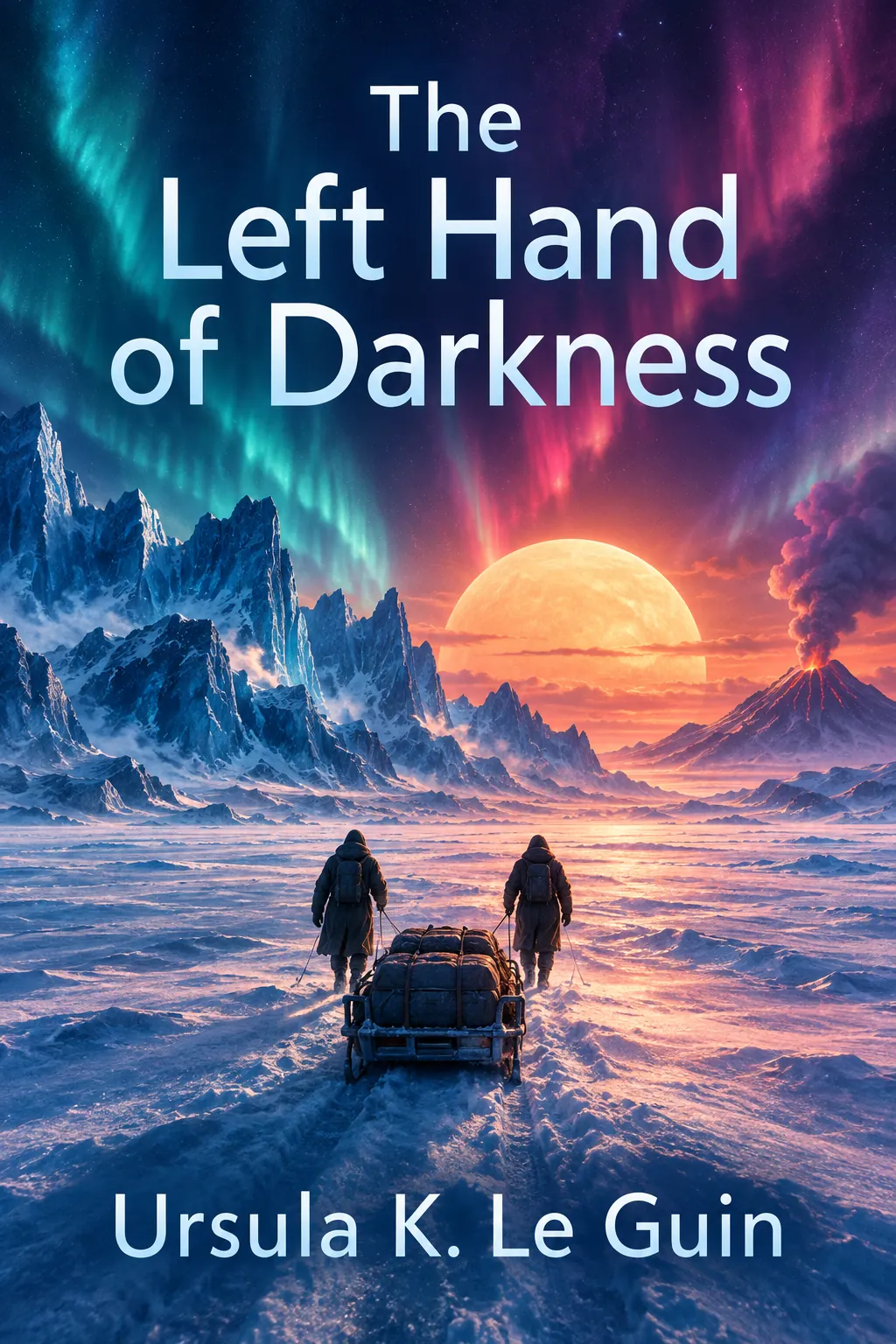
The Left Hand of Darkness
by Ursula K. Le Guin
The Left Hand of Darkness is a 1969 science-fiction novel by Ursula K. Le Guin. Genly Ai, an envoy from a league of human worlds called the Ekumen, travels to the icy planet Gethen to invite its nations to join. The Gethenians have no fixed sex, and their politics run on pride, rumour and old rivalries. Genly cannot read the people around him, least of all the royal minister Estraven. The story follows the slow, risky growth of trust between them.
The Big Idea
"What if you met people with no fixed sex or gender role? Le Guin sends one man to a frozen world, and shows that trust between two strangers can cross every difference."
Key Insights
Taking away gender to see it clearly
Gethenians become male or female only during the short kemmer phase, so there are no fixed roles of strength, work or family. Le Guin removes the familiar divisions to show how much of our thinking depends on them, and how much of it is habit rather than nature.
Genly keeps trying to sort the people he meets into men and women, and keeps stumbling. His confusion works as a mirror for the reader's own assumptions.
Trust grows through shared hardship
Genly misreads Estraven's words and silences again and again. The book suggests that trust across difference does not come from explanation alone but from time spent facing the same danger, when each person has to rely on the other.
On the Gobrin Ice the two share food and wait out storms side by side. Their ranks and nations matter less with every day, and it is on the ice that they first speak mind to mind.
Pride, patriotism and politics
Karhide runs on royal pride and face, Orgoreyn on offices and paperwork. Their forms differ, but both distrust outsiders and defend their own side. Le Guin shows patriotism as something that can unite people and cloud their judgement at once.
Estraven is exiled as a traitor for a different idea of loyalty to his country, and Genly is later betrayed by Orgoreyn's officials, who had welcomed him so warmly.
Truth told from many angles
The novel alternates between Genly's report, Estraven's journal, legends and myths. The same events look different depending on who tells them, and the narrator opens by saying truth is a matter of the imagination. The book leaves the final judgement to the reader.
Estraven's journal reveals what he was thinking in scenes Genly saw only from outside, and it changes the meaning of what the reader has already read.
Chapter Breakdown
About the book
The Left Hand of Darkness is a 1969 novel by Ursula K. Le Guin that won both the Hugo and Nebula awards for best novel. It is set on Gethen, a planet of ice and snow whose people have no fixed sex: for most of each month they are neither male nor female, and in a short phase called kemmer they take on one or the other. The narrator, Genly Ai, visits Gethen's two main nations, Karhide and Orgoreyn. The heart of the story is not a battle but two people from different worlds learning to understand each other on a long journey.
Chapter-by-chapter summary
Spoiler warning: this section covers the whole plot, including the ending.
Chapters 1–3: A Parade in Erhenrang to The Mad King
Genly Ai, the Ekumen's lone envoy, is in Karhide, a cold northern nation on Gethen, hoping its king will join the alliance. At a parade in the capital, Erhenrang, he sees that Estraven, the king's chief minister, who once backed his mission, has turned cold and gives him a vague warning. Soon Estraven is exiled as a traitor, and King Argaven, a suspicious ruler, turns Genly down. Genly is left alone with a court he cannot read. Why it matters: the opening shows his blind spot. He judges Estraven by his own assumptions, and the rest of the novel slowly corrects that.
Chapters 4–5: The Nineteenth Day and the Handdara
Between plot chapters, the book pauses for Karhidish legends. Chapter 4, The Nineteenth Day, tells of a lord who misreads a prophecy, kills his partner and dies on the day it named. In Chapter 5, Genly visits the Handdara, a quiet religious community, and asks its foretellers about the future. They answer hopefully: Gethen joining the Ekumen looks good. Why it matters: the tales show how Gethenians think about fate and knowledge, and the question of whether to trust a prophecy returns later.
Chapters 6–7: One Way into Orgoreyn and The Question of Sex
Estraven, exiled, leaves Karhide, is rescued at sea and reaches Orgoreyn, a rival nation run by committees and bureaus, where he finds work in the capital, Mishnory. Chapter 7 steps out of the plot with field notes from an earlier Ekumen investigator on Gethenian biology: most of the month a person has no sex; in a short phase called kemmer, each becomes male or female, and anyone can bear a child. Why it matters: this is the book's central thought experiment, which removes fixed gender roles and asks what is left.
Chapters 8–10: Into Orgoreyn and Conversations in Mishnory
Genly travels across Karhide, is caught in a border raid and ends up in Orgoreyn, where officials welcome him warmly and seem more modern than the Karhidish court. Chapter 9 is a legend of two feuding families whose heirs make peace, and of a lord later branded a traitor. In Mishnory, Estraven warns Genly of danger, but Genly does not trust him, and he tells Orgota leaders that an Ekumen ship waits in orbit. Why it matters: Genly relaxes among those who flatter him and brushes off the one person who warns him.
Chapters 11–14: Soliloquies in Mishnory to The Escape
Chapter 11 is Estraven's own account of the same weeks, and it gives the reader what Genly lacks: Estraven's point of view. His journal shows him seeing that Orgoreyn's officials mean to use Genly for their own ends. Chapter 12 offers an Orgota religious text about the prophet Meshe, light and darkness. Genly is then arrested, sent to a forced-labor farm in the north and falls gravely ill. Estraven, at great risk, breaks him out. Why it matters: the man Genly never fully trusted comes to save him unasked, which turns their relationship.
Chapters 15–18: To the Ice to On the Ice
The two prepare sledges and food and set out across the Gobrin Ice toward Karhide. Chapter 16 is Estraven's journal, describing volcanic ground and the climb onto the ice plateau. Chapter 17 is an Orgota creation myth that ends with a warning about shadow. On the Ice they haul the sledge through storms, talk through long nights and find they can speak mind to mind. Estraven also tells Genly what he has been working toward. Why it matters: trust, the book's main theme, becomes physical effort here, and the two start to see each other as people rather than as representatives.
Chapters 19–20: Homecoming and A Fool's Errand
They reach the southern edge of the Ice and a Karhidish village, but Estraven is shot dead by border guards. Genly, who has crossed the Ice beside him, can only watch. In Chapter 20 King Argaven agrees to welcome the Ekumen ship, Karhide signs a treaty and Genly brings Estraven's journals to his family. Why it matters: Genly succeeds as an envoy only because he learned to see Estraven as a friend, and the ending leaves loss beside victory.
Characters
Genly Ai. The Ekumen's envoy to Gethen, sent alone to ask its nations to join. He is honest and well meaning but slow to see his own assumptions. The novel is largely his report, and it follows his growing understanding of the people around him, above all Estraven.
Estraven (Therem Harth rem ir Estraven). A Karhidish noble and the king's chief minister who is exiled early on. Calm, reserved and hard for Genly to read, he works for his country's future and for Gethen's, and he pays heavily for it.
King Argaven XV. Ruler of Karhide, suspicious and anxious. Some call him the Mad King, and his court runs on rumour. He refuses Genly's offer, and his reign shows how national pride and fear can crowd out good judgement.
Tibe. The king's cousin, who takes Estraven's place as chief minister. A nationalist who stokes fear of outsiders and uses pride as a political tool, he is one of the main obstacles to Genly's mission.
Faxe. A member of the Handdara, the quiet religious community that Genly visits. He answers Genly's questions with calm and gives him a hopeful answer about the future, showing a way of living comfortably with uncertainty.
Key terms
- Ekumen: a league of human worlds that shares knowledge and trade, and sends single envoys rather than armies.
- Gethen: the cold planet at the centre of the story, also called Winter.
- Karhide and Orgoreyn: Gethen's two rival nations, one ruled by a king and a court, the other by committees and bureaus.
- Kemmer: the short phase when a Gethenian becomes male or female.
- Shifgrethor: a Karhidish code of prestige, pride and indirect manners.
Writing about this book
The novel leaves many questions open, so there is room for your own reading. Rather than retelling the plot, start from a scene that stayed with you and explain why.
Themes you could write about:
- How imagining a world without fixed sex shakes our everyday assumptions.
- How Genly misjudges Estraven and slowly learns to trust him.
- How national pride can both protect people and blind them.
- How reports, journals and myths together shape what we call truth.
Questions to think about:
- What did Genly see in Gethen, and what did he miss?
- Have you ever decided what someone was like before you knew them?
- What changes between the two travellers on the Ice?
- How did you feel about the ending, and why?
Tip: pair one moment from the book with one moment from your own life. Keep the plot summary short and put your own thinking in the longest paragraph.
Take Action
Practical steps you can implement today:
-
Before you decide what someone is like, check whether you are only measuring them with your own ruler.
-
Trust usually grows from facing a hard task together, not from long explanations of who you are.
-
Set aside a familiar assumption, such as how a man or a woman should behave, and notice what new questions appear.
-
When pride in a group or country speaks loudly, look past it to the individual person in front of you.
Notable Quotes
"“Truth is a matter of the imagination.” (Chapter 1)"
— Ursula K. Le Guin
"“The king was pregnant.” (Chapter 7)"
— Ursula K. Le Guin
"“Light is the left hand of darkness and darkness the right hand of light.” (Chapter 16)"
— Ursula K. Le Guin
Who Should Read This
Readers from about 15 years old up, including adults. It is a slow, thoughtful novel, so it suits students who are ready for a longer book. It is a good fit for people new to science fiction, for anyone curious about gender and culture, and for those who enjoy a long journey and a deep friendship.
Frequently Asked Questions
What is The Left Hand of Darkness about?
It follows Genly Ai, an envoy from the Ekumen, a league of human worlds, who is sent to the icy planet Gethen to invite its nations to join. He struggles to understand a society with no fixed sex, and slowly builds trust with the exiled minister Estraven during a harsh journey across a glacier.
Why do Gethenians have no fixed sex?
It is a feature of the novel's invented world. Gethenians are without sex for most of each month. In a short phase called kemmer they become male or female, and the role can differ from one cycle to the next, so anyone can become a parent. Le Guin used the idea to ask what a society looks like without fixed gender roles.
Did the novel win any awards?
Yes. It won the Nebula Award for best novel and the Hugo Award for best novel in 1970. It belongs to Le Guin's Hainish Cycle, a group of novels set in a shared universe, but it can be read on its own without any of the others.
Is the book hard to read?
The language is clear, but the pace is slow at first, and the book mixes the narrator's report with legends, journals and field notes. Keeping a short list of names and nations helps. Many readers find it grows faster and more gripping once the journey across the ice begins.
Is it a good choice for a school book report?
Yes, if you pick one theme, such as trust, gender or national pride. The book holds many ideas, and a report built around a single scene or question is clearer than a plot retelling. See the Writing about this book section for starting points.
Check Your Understanding
Pick an answer for each question to see if you were right.
-
What is the name of the league of worlds that Genly Ai represents?
The Ekumen — Genly is the Ekumen's envoy, sent to invite the nations of Gethen to join its network of worlds.
-
What is the short phase called in which a Gethenian becomes male or female?
Kemmer — Kemmer is the brief period when a Gethenian takes on male or female traits.
-
What is the name of the glacier that Genly and Estraven cross?
The Gobrin Ice — They haul their sledge across the Gobrin Ice to get back to Karhide.
-
What is the capital city of Karhide, where the story opens?
Erhenrang — The first chapter takes place at a parade in Erhenrang, Karhide's capital.
-
Who wrote The Left Hand of Darkness?
Ursula K. Le Guin — The novel was published in 1969 by Ursula K. Le Guin.
About Ursula K. Le Guin
Ursula K. Le Guin (1929–2018) was an American writer of science fiction and fantasy. She is known for the Earthsea books, The Dispossessed and this novel, which won both the Hugo and Nebula awards. Her work uses invented worlds to ask how societies handle power, gender and difference.
Summary Written By

Software Engineer & Writer
Software engineer with a passion for distilling complex ideas into actionable insights. Writes about finance, investment, entrepreneurship, and technology.
View all summaries →Reviews
No reviews yet. Be the first to share your thoughts!
Write a Review
Keep reading
Explore the topic: Sci-Fi Authors & AwardsSummaries

Out of My Mind
Sharon M. Draper
“Out of My Mind” by Sharon M. Draper is a poignant narrative that explores the life of Melody Brooks, a…

Ender’s Game
Orson Scott Card
“Ender’s Game” by Orson Scott Card is a riveting science fiction novel that transports readers into a future where humanity…

Pachinko
Min Jin Lee
“Pachinko”, a spellbinding multigenerational historical saga by Min Jin Lee, explores the lives of a Korean family trying to make…

The Perks of Being a Wallflower
Stephen Chbosky
The Perks of Being a Wallflower by Stephen Chbosky is a profound coming-of-age novel, told through the intimate letters of…
Articles

Nebula Award: What It Is and Notable Winners
The Nebula Award is an American science fiction and fantasy prize voted on by working writers. The Science Fiction and…

Best Science Fiction Books: 11 Novels Worth Reading
The best science fiction books to start with are Frankenstein, 1984, Dune, Neuromancer, The Three-Body Problem and Project Hail Mary.…

Hugo Award
The Hugo Award is science fiction's best-known prize, voted by fans rather than a jury. Members of the yearly World…