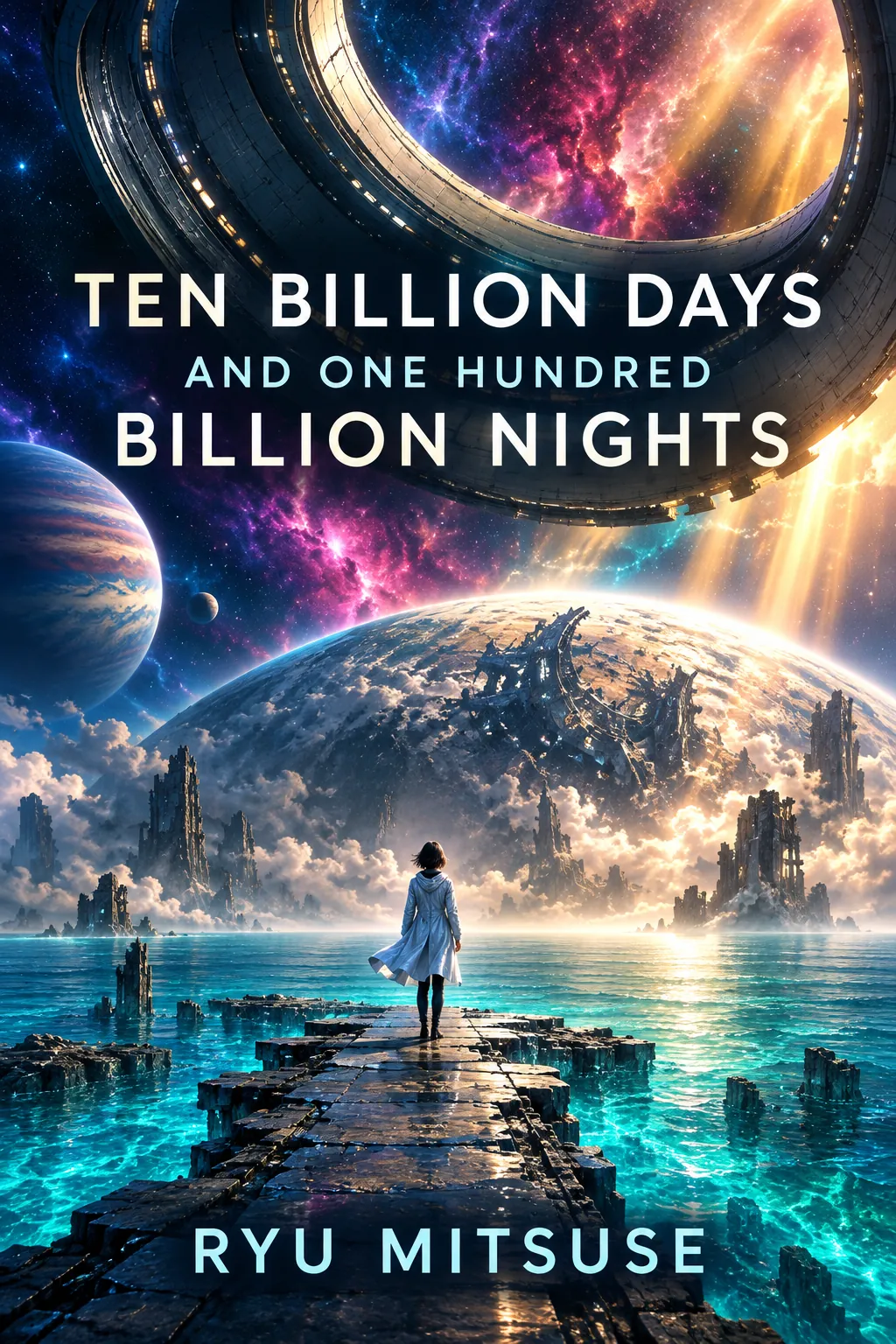
Ten Billion Days and One Hundred Billion Nights
by Ryu Mitsuse
Ten Billion Days and One Hundred Billion Nights is a Japanese science-fiction novel about why worlds end. The philosopher Plato goes looking for documents about Atlantis, and his search pulls him across time and space. Along the way he meets Siddhartha, the future Buddha, and a fierce figure named Asura who has been fighting the gods for ages, and they are opposed by Jesus. Together they uncover a hidden order behind history and ask whether anyone can resist it.
The Big Idea
"Gods, prophets and philosophers may be pieces in a vast machine that decides when worlds end, and one rebel refuses to accept it."
Key Insights
The gods as a system
The novel suggests that what people call gods might act more like administrators of a vast machine than loving rulers. Their task is to keep the universe in a fixed shape, even if that means ending worlds. This turns religion and science into one question about who controls the rules of existence.
Siddhartha is told by Brahma that ruin is coming, yet Asura's own long war casts doubt on the heavens that give the warning.
Memory carried across time
Plato turns out to be the same person as Orionae, the Atlantean administrator, which shows that one self can stretch across a chain much longer than one life. The book treats memory as a kind of survival, and as a weapon, because remembering a lost world is the first step toward asking why it was lost.
Plato, searching for Atlantis, wakes as Orionae and lives through the last night of the kingdom.
Resistance without a promise of victory
Asura keeps fighting even though the enemy is almost beyond measure. The book does not say that resistance wins; it says that choosing to resist gives the fighter a meaning that the system cannot take away. That is why the bleak ending still feels defiant.
Asura's war with Taishakuten goes on for ages, and she is the last survivor at the end, still facing a far larger power.
Religion and science in one story
Buddhist, Christian and Greek figures stand next to ideas from astronomy, such as the death of planets and enormous spans of time. The mix lets the author ask old questions about salvation and fate in a modern, scientific setting, which is one reason the novel is still read.
Siddhartha, Jesus and Plato all appear in the same story, each facing the same hidden order from a different place.
Chapter Breakdown
Chapter-by-chapter summary
Spoiler warning: this section covers the whole plot, including the ending.
Part 1: Plato searches for Atlantis
The philosopher Plato sets out to find documents about Atlantis, the land said to have vanished in a single night. He travels far to learn why the kingdom fell, and the story then shifts. This matters because it plants the question that drives the whole book: was the fall of Atlantis an accident, or was it arranged?
Part 2: Plato wakes as Orionae
Plato wakes up living as Orionae, the administrator of Atlantis in its last days. Orionae is not a stranger he meets; he is Plato's own earlier self. The Planetary Development Committee, an outside body that directs the fate of worlds, presses the kingdom to act. The plan fails, and a catastrophe destroys Atlantis in one night. Plato wakes again and begins a long journey through time. This matters because the novel turns here from ancient history into cosmic mystery.
Part 3: Siddhartha leaves the palace
The story moves to ancient India. Prince Siddhartha of the Shakya clan gives up his place in Kapila castle and takes up the religious life. In the heavenly city of Tobatsu, the ruler of the heavens, Brahma, tells him that a ruin is coming, and Siddhartha resolves to meet Asura. This matters because the author shows the future Buddha not as a finished saint but as a young man still looking for answers.
Part 4: Asura, the heavens and Jesus
Asura appears as a girl who has fought the heavenly army of the god Taishakuten, the Buddhist Indra, for ages. The heavens also hold Maitreya, the saviour expected in the far future, and the Wheel-turning King, who lives outside the world and whom no one has seen. After the miracle at Golgotha, Jesus of Nazareth emerges as an immortal and turns against Plato, Asura and Siddhartha. This matters because it flips the usual roles: the gods may be the ones who confine the world, and the so-called demon is the one who questions them.
Part 5: The ruins of Tokyo
The story jumps to the far future, around the year 3905, when the whole planet is a wasteland. In the ruins of Tokyo, Siddhartha, Plato (now calling himself Orionae) and Asura meet, and Jesus attacks them. This matters because even the best-known figures of religion are shown as parts of the same hidden system.
Part 6: The war that does not end
The group learns that the true enemy is the power behind Jesus and the Planetary Development Committee, a being known only as Shi, a name that can be read as death. Asura leads the others toward it, and a series of battles and revelations follows. In the end Asura is the last survivor, and there is no clear victory over Shi; her struggle is left unfinished. The ending is bleak. This matters because the huge spans of time in the title now feel real.
Characters
- Plato: The Athenian philosopher, who in this novel becomes a traveller through time. His search for Atlantis documents begins the story, and he is the reader's first guide.
- Orionae: The administrator of Atlantis in its last days. He is Plato's own earlier self, which ties the lost civilisation of the past to the mysteries of the far future.
- Siddhartha: A young prince of the Shakya clan and the future Buddha. He looks for a way out of suffering and ends up questioning the nature of the heavens themselves.
- Asura: A girl who has fought the gods for ages. She is the rebel at the emotional centre of the book and the one who refuses to accept the order of things.
- Taishakuten: The Buddhist Indra, who commands the heavenly army and is Asura's long-time opponent. He stands for the order that Asura fights.
- Brahma: The ruler of the heavens in Tobatsu, who warns Siddhartha that a ruin is coming.
- Shi: The hidden power behind Jesus and the true enemy of Asura and her companions. Its nature is never fully explained.
- Jesus: The central figure of Christianity, shown here as an immortal who serves the hidden order. He becomes an enemy of Asura and her companions.
Background and context
The novel first ran in S-F Magazine from December 1965 to August 1966 and came out as a book in 1967. It belongs to the early generation of Japanese science fiction, when writers were building a voice of their own instead of copying Western models. Mitsuse takes figures that readers already know from school or from religion and places them inside a story about astronomy, the death of planets and spans of time that no person can picture.
The English edition appeared from Haikasoru in 2011, in a translation by Alexander O. Smith with Elye J. Alexander. It gave English-language readers their first full look at a book that Japanese readers had known for decades. The title itself is a clue to the scale: ten billion days and one hundred billion nights are far beyond any human lifetime, and the novel keeps reminding the reader of that gap between people and the universe.
It also helps to know that the book mixes sources freely. Greek philosophy, Buddhist cosmology and Christian history all sit side by side with science-fiction ideas. The author does not ask the reader to believe any one of them. He uses them as pieces in a single puzzle about who decides the fate of worlds.
Key terms
- Atlantis: The legendary land that Plato wrote about. In this novel its fall is the first sign that a disaster may have been planned.
- Asura: A figure from Buddhist tradition, usually shown as a fighting spirit. Here she is a rebel who questions the gods.
- Taishakuten: The Japanese name for Indra as he appears in Buddhism, a ruler among the gods.
- Planetary Development Committee: The body that directs the development of worlds, and that stands behind the fate of Atlantis.
- Maitreya: The Buddhist saviour expected in the far future.
- Orionae: The Atlantean administrator whom Plato finds he once was.
Reading tips
Read the opening parts slowly, because the names and places change quickly and the story jumps across eras. Keep a short note of who is speaking in each part and where they are. It also helps to treat the story as a chain of questions rather than a plot with one hero: each part asks the same thing from a different place, namely who decides when a world ends. If a passage feels dense, move on and return to it later, since the final parts pull the earlier threads together.
Writing about this book
This is a book where the questions are more useful than the answers, so start from a question you really have. You could ask whether it is comforting or frightening to think that history has a hidden design. You could compare how the novel treats Siddhartha and Jesus with what you already know about them, and say what changes when they become characters in science fiction. Another angle is Asura: why does the author make the one who opposes the gods the most human figure, and do you agree?
Pick one scene that stayed with you, such as Plato waking as Orionae, Siddhartha hearing of the coming ruin, or the meeting in the ruins of Tokyo, and explain in your own words why it affected you. Be careful to describe the book's story rather than the manga or any film, and use short quotes with the part they come from. A strong piece takes one question and follows it all the way through, rather than listing everything that happens.
Take Action
Practical steps you can implement today:
-
Read the setup patiently; the first parts plant questions that the later parts answer.
-
Compare the familiar versions of Plato, Siddhartha and Jesus with the characters here to see what the author changed.
-
Treat Asura as a lens for asking when it is right to question authority, rather than as a simple hero.
-
Use a single question about fate or memory as the thread for any report or discussion of the book.
Who Should Read This
Readers of ambitious science fiction who like big questions about fate, religion and the end of the world. It suits upper-secondary students and adults, though the ideas and the mix of Buddhist and Christian figures can feel dense, so allow time for it.
Frequently Asked Questions
What is Ten Billion Days and One Hundred Billion Nights about?
It is about why worlds end. Plato follows the trail of Atlantis, wakes as its administrator Orionae, and later joins Siddhartha and Asura against Jesus and a hidden order that shapes history. The story asks whether that order can be questioned, and the title points to huge spans of time.
Who wrote it and when was it published?
Ryu Mitsuse wrote it. It ran in S-F Magazine from December 1965 to August 1966 and appeared as a book in 1967. The author revised it for a later edition, and the English translation by Alexander O. Smith with Elye J. Alexander came out in 2011.
Who is Asura?
Asura is a girl who has fought the heavenly army of Taishakuten for ages. She doubts the heavens' idea of salvation and stands against the hidden order. For many readers she is the emotional centre of the book.
Do I need to know Buddhism or Christianity to read it?
No, but some background helps. The book uses figures such as Siddhartha and Jesus, and ideas like the heavens. A basic idea of who they are is enough, because the novel explains what it needs through the story.
Is there a manga version?
Yes. Moto Hagio drew a manga adaptation, which is praised in its own right. It changes some details from the novel, so use the original book when you write about the plot.
Is it a difficult book to read?
It can be demanding. The story jumps between eras and places, and it mixes ideas from several religions with science fiction. Reading slowly, keeping a short list of who is who, and focusing on the central question of who decides when a world ends will make it much easier to follow.
Check Your Understanding
Pick an answer for each question to see if you were right.
-
Which ancient philosopher begins the search for Atlantis?
Plato — Plato goes looking for documents about Atlantis, and that search starts his journey.
-
Who is Orionae?
The administrator of Atlantis, who is Plato's own earlier self — Orionae is the Atlantean administrator whom Plato wakes up as; they are the same person.
-
Whom does Asura fight against for ages?
Taishakuten — Asura has been in a long war with the heavenly army of Taishakuten, the Buddhist Indra.
-
Who was the young prince looking for salvation?
Siddhartha — Prince Siddhartha, the future Buddha, turns to the religious life to seek salvation.
-
In what year was the book first published?
1967 — It appeared as a book in 1967 after running in S-F Magazine in 1965 and 1966.
About Ryu Mitsuse
Ryu Mitsuse (1928–1999) was a Japanese science-fiction writer who published widely in S-F Magazine from the 1960s. His work often looks at vast stretches of time and the place of people within them. Ten Billion Days and One Hundred Billion Nights is his best-known novel, and it has stayed in print in Japan for decades.
Summary Written By

Software Engineer & Writer
Software engineer with a passion for distilling complex ideas into actionable insights. Writes about finance, investment, entrepreneurship, and technology.
View all summaries →Reviews
No reviews yet. Be the first to share your thoughts!
Write a Review
Keep reading
Explore the topic: Science FictionSummaries

Out of My Mind
Sharon M. Draper
“Out of My Mind” by Sharon M. Draper is a poignant narrative that explores the life of Melody Brooks, a…

Ender’s Game
Orson Scott Card
“Ender’s Game” by Orson Scott Card is a riveting science fiction novel that transports readers into a future where humanity…

Pachinko
Min Jin Lee
“Pachinko”, a spellbinding multigenerational historical saga by Min Jin Lee, explores the lives of a Korean family trying to make…

The Perks of Being a Wallflower
Stephen Chbosky
The Perks of Being a Wallflower by Stephen Chbosky is a profound coming-of-age novel, told through the intimate letters of…
Articles

A Christmas Carol themes: generosity, isolation and responsibility
Dickens's novella is usually read as a story about a man who changes his mind. Its themes are sharper than…
Nebula Award: What It Is and Notable Winners
The Nebula Award is an American science fiction and fantasy prize voted on by working writers. The Science Fiction and…

Seiun Award
The Seiun Award is Japan's oldest science fiction award, first given in 1970. Fans who attend the annual Japan SF…