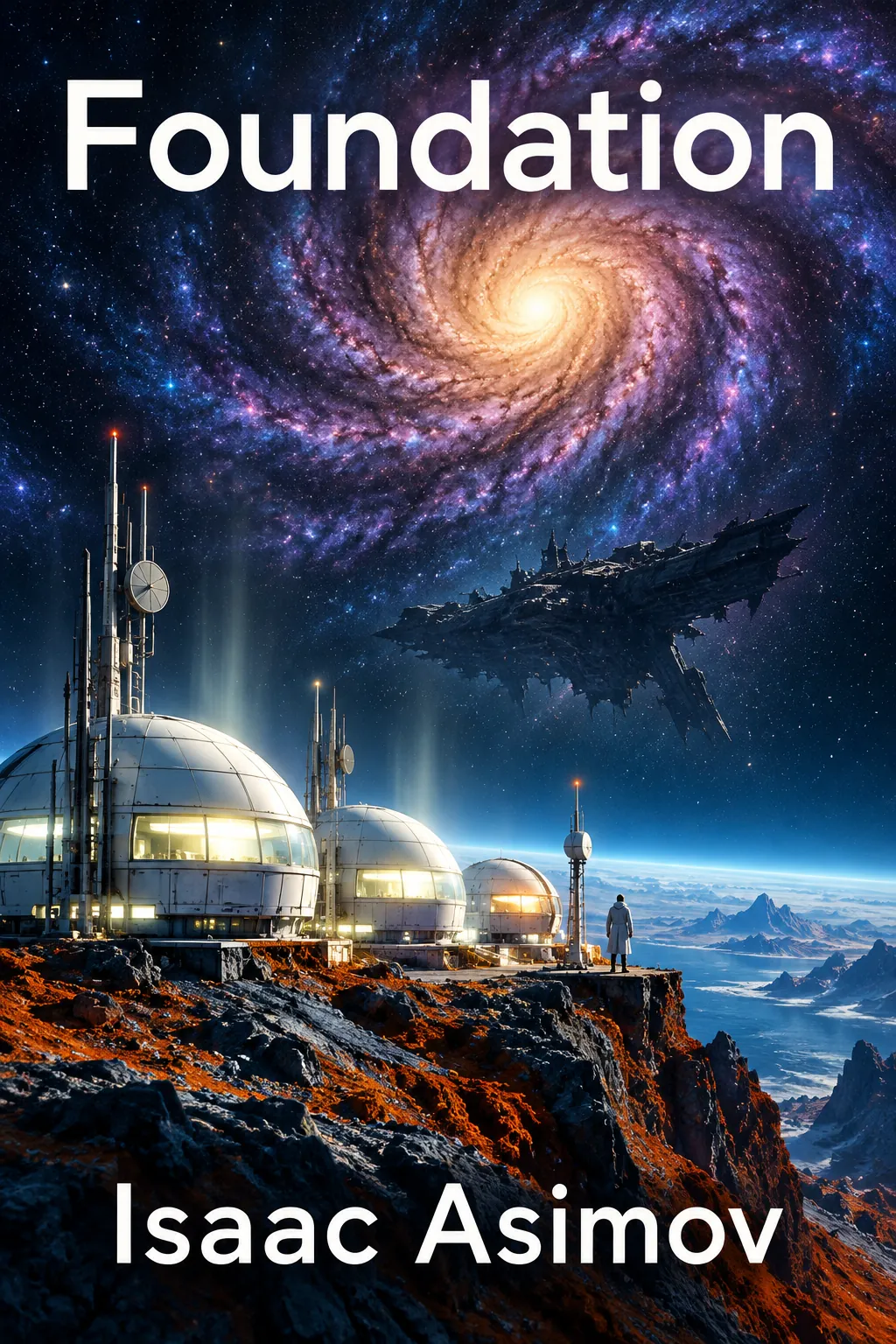
Foundation
by Isaac Asimov
Foundation is Isaac Asimov's 1951 novel about the fall of a galactic empire and the small group that tries to shorten the dark age after it. Mathematician Hari Seldon uses psychohistory, a science that predicts the behaviour of huge populations, to see that the collapse is certain. He cannot stop it, so he sends scholars to the remote planet Terminus. Over more than a century, its leaders face crisis after crisis and must survive without a fleet or an army.
The Big Idea
"A mathematician predicts that the Galactic Empire will fall, and sets up a hidden refuge at the galaxy's edge to cut the coming dark age from thirty thousand years to one thousand."
Key Insights
History can be predicted, but only in large numbers
Psychohistory is the book's central invention, and its rule is strict: it can say what a huge population will probably do, but never what one person will choose. That limit is what keeps the story open. Seldon's equations set the path, and individuals like Hardin and Mallow still have to act.
Seldon can foresee the Empire's fall, yet he cannot tell Hardin what to do on any given day.
Power does not always come from force
Each Foundation leader wins by finding a lever other than weapons. The Foundation is small and has no real military. Instead, it uses technology, belief and economic dependence to shape what stronger neighbours choose to do.
In Part 3, Anacreon's regent has warships, but the Foundation's priests turn his own people against him.
Knowledge needs a strategy to survive
The Encyclopedists believe saving knowledge is enough. Hardin shows it is not: a society that stores facts but cannot defend or apply them will be absorbed by whoever has power. Knowledge has to be turned into influence, or it stays an ornament.
Terminus has the best science nearby, yet in Part 2 it would be swallowed by Anacreon without Hardin's political moves.
Individuals still matter inside a grand plan
The book asks whether people are free if a plan is guiding them. Its answer is that the plan sets the crises, but each crisis is solved by a person making a choice. Hardin and Mallow are remembered because they acted at the right moment.
In Part 5, Mallow's decision to rely on trade rather than war is his own, even though the crisis was foreseen.
Chapter Breakdown
Chapter-by-chapter summary
Spoiler warning: this section covers the whole plot, including the ending. Foundation is built from five linked parts, each set decades after the last, so there is no single hero. Here is the book part by part.
Part 1: The Psychohistorians
Young mathematician Gaal Dornick travels to Trantor, the vast capital world of the Galactic Empire, to join Hari Seldon's project. He soon learns that Seldon has been arrested. Seldon's science, psychohistory, uses mathematics to predict the behaviour of enormous populations, and it says the Empire will collapse. At his trial before the Commission of Public Safety, Seldon argues that a dark age of thirty thousand years will follow, but a carefully placed group of scholars could cut it to one thousand. The commission, eager to have him out of sight, exiles him and his Encyclopedists to the remote planet Terminus. Why it matters: this part sets up the central bargain of the book. The future cannot be stopped, only shortened, and the reader is asked to trust a plan that no character fully sees.
Part 2: The Encyclopedists
Fifty years later, Terminus is a quiet town of scholars who believe they are compiling a giant encyclopedia. Salvor Hardin, the mayor, sees what they do not: the neighbouring kingdom of Anacreon is growing bolder, and the Foundation has no army. The Encyclopedia Committee, led by Lewis Pirenne, refuses to think about politics at all. Hardin plays the surrounding kingdoms against one another so that none can take Terminus without the others objecting, and he pushes the committee out of power. When the crisis arrives, a recording of Seldon appears and confirms that the encyclopedia was only a cover story. Why it matters: it shows that knowledge alone does not protect a society. It also introduces Hardin's habit of winning with clever positioning rather than force.
Part 3: The Mayors
About three decades later, Hardin is still mayor, and Anacreon's ruler, Regent Wienis, is preparing to attack Terminus with an old imperial warship. Sef Sermak and his young party demand that the Foundation strike first. Hardin refuses. Over the years, he has taught the neighbouring kingdoms to treat the Foundation's technology as a sacred mystery run by priests. At the key moment, those priests withdraw their blessing, and Anacreon's people turn on their own government. Wienis falls without a shot being fired. Why it matters: this part states one of the book's main arguments, that force is often the weakest tool available, and it shows how belief can work as a weapon.
Part 4: The Traders
Control of the Foundation's influence now passes from priests to traders. Limmar Ponyets travels to the planet Askone to find a missing colleague, Eskel Gorov. Askone's rulers forbid the nuclear devices the traders sell, and the religious order is hostile. Ponyets does not argue or fight. He studies what the rulers want and uses a clever commercial trick to turn their own greed against their rules. The mission succeeds, and the Foundation gains a new lever over a hostile world. Why it matters: it shows the Foundation's method changing from religion to commerce. It also hints at a new class of people, the merchants, who will soon want a say in how the Foundation is run.
Part 5: The Merchant Princes
Hober Mallow, a master trader, is sent to the kingdom of Korell, which is beginning to threaten the Foundation. He finds the Korellians already hold some of the Foundation's own technology, and he is tried at home for his methods. Mallow wins the argument and rises to power. Facing the kingdom's military threat, he refuses the old tools of priests and treaties. Instead, he builds trade so that Korell grows dependent on the Foundation's goods, and then he cuts the supply. Korell's own economy forces it to back down. Why it matters: this is the book's third big crisis, and it puts the argument in plain form. The Foundation wins by controlling what other worlds cannot live without.
Characters
Foundation has a new cast in almost every part. These are the people to know.
- Hari Seldon: the mathematician who invents psychohistory and sets the Foundation in motion. He is present in the story mostly through recordings, and his plan hangs over every later decision.
- Gaal Dornick: a young mathematician from a far planet who arrives on Trantor in Part 1. He is the reader's guide to the Empire and to Seldon's ideas.
- Salvor Hardin: the mayor of Terminus in Parts 2 and 3. He is practical, dry-humoured and calm, and he uses cleverness where others would use weapons.
- Lewis Pirenne: chairman of the Encyclopedia Committee. He cares only about the encyclopedia, and he cannot see the danger growing around him.
- Wienis: the scheming regent of Anacreon, who tries to seize Terminus. His fall shows the limits of brute force.
- Sef Sermak: a young politician who wants the Foundation to act aggressively. He stands for the impatient side of the argument against Hardin.
- Limmar Ponyets: a quick-witted trader in Part 4. He solves a hostile situation with sales skill rather than fighting.
- Hober Mallow: a master trader and later mayor. In Part 5, he turns commerce into a political weapon.
Writing about this book
Foundation is a good book for a school report because it is built around a clear question: can history be predicted, and how should people act if they think they know the future? A strong report picks one of its ideas and follows it through the five parts.
Start with the contrast between the Empire and the Foundation. The Empire has power, wealth and size, yet it is decaying. The Foundation has none of these at the start, yet it survives. Ask yourself what the book says is the real source of strength.
You could also compare the three methods the Foundation uses: knowledge in Part 2, religion in Part 3 and trade in Parts 4 and 5. Which one does the book seem to favour, and does the pattern look wise, or manipulative?
Finally, think about Seldon's plan itself. The people living inside it do not know they are being guided. Does that make their choices less real? Pick a scene, state your view and support it with a specific example. Do not rely on a plot summary alone.
Take Action
Practical steps you can implement today:
-
Look for the lever other than force: negotiation, information or timing often beat a direct fight.
-
When a big change is coming, ask how to shorten the hard period, not only how to stop it.
-
Do not mistake collecting knowledge for protecting it; decide how it will be used and defended.
-
Make decisions at the moment they are needed, even when you are working within a larger plan.
-
Check what others depend on you for, because that often decides who holds real influence.
Notable Quotes
"“Violence is the last refuge of the incompetent.” (Part 3)"
— Isaac Asimov
"“Never let your sense of morals prevent you from doing what is right!” (Part 4, epigraph)"
— Isaac Asimov
Who Should Read This
Foundation suits readers from about age 14 who enjoy big ideas more than action scenes. It works well for students writing about history, politics or the future, and for anyone curious about where modern science fiction got its sweeping view of empires and civilisations. The first part is the slowest, so patience helps.
Frequently Asked Questions
What is Foundation about?
Foundation is about the fall of a galactic empire and a plan to shorten the dark age that follows. Mathematician Hari Seldon predicts the collapse and sets up a refuge, the Foundation, on the distant planet Terminus. Each of the book's five parts shows a new crisis the Foundation must survive without a large military.
What is psychohistory?
Psychohistory is a fictional science in Foundation that combines mathematics, history and sociology. It predicts the behaviour of very large populations, but it cannot predict what one individual will do. Hari Seldon uses it to foresee the end of the Empire and design a plan for the age that follows.
Is Foundation one novel or a series?
Foundation is the first book of the Foundation series, and it is also a complete story on its own. It collects five linked parts that Asimov first wrote as magazine stories in the 1940s. Later books continue the story and connect it to his other science-fiction works, but you can read this one first without any background.
Who is the main character of Foundation?
There is no single main character. Each part follows a different person: Gaal Dornick and Hari Seldon in Part 1, Salvor Hardin in Parts 2 and 3, Limmar Ponyets in Part 4 and Hober Mallow in Part 5. Hari Seldon, who is rarely on stage after Part 1, works as the figure around whom the whole story turns.
Why does the Foundation survive without an army?
The Foundation survives by using technology, religion and trade rather than soldiers. In Part 3, priests withdraw their blessing from a hostile ruler. In Part 5, trade makes a rival kingdom dependent on Foundation goods. The book argues that influence over what others need can be stronger than weapons.
Is the Foundation TV series the same as the book?
No. The television adaptation changes many events, characters and the order of the story. This guide covers only Asimov's 1951 novel. If you are writing a school report, use the book's own five parts and scenes as your examples, and do not rely on details from the screen version.
Check Your Understanding
Pick an answer for each question to see if you were right.
-
What is psychohistory?
A mathematical science that predicts the behaviour of huge populations — Psychohistory predicts what large groups of people will probably do, not what a single person will choose.
-
Where does Hari Seldon send the Encyclopedists?
Terminus — The scholars are exiled to Terminus, a remote planet at the edge of the galaxy.
-
How long does Seldon say the dark age could be shortened to?
One thousand years — Without the Foundation, the dark age would last thirty thousand years, but Seldon says it can be cut to one thousand.
-
In Part 3, how does Salvor Hardin defeat Anacreon's regent?
His priests withdraw their blessing and the people turn on the regent — Hardin uses religion as a lever, and Wienis falls without a battle.
-
Which method does Hober Mallow use against Korell?
A trade dependence that he can cut off — Mallow makes Korell rely on Foundation goods, then withdraws them to force the kingdom to back down.
About Isaac Asimov
Isaac Asimov (1920–1992) was a Russian-born American writer and biochemistry professor who wrote or edited hundreds of books, from science fiction to popular science. Foundation grew out of stories he wrote for magazines in the 1940s. It became one of the most influential series in the genre and won a special Hugo Award in 1966.
Summary Written By

Software Engineer & Writer
Software engineer with a passion for distilling complex ideas into actionable insights. Writes about finance, investment, entrepreneurship, and technology.
View all summaries →Reviews
No reviews yet. Be the first to share your thoughts!
Write a Review
Keep reading
Explore the topic: Sci-Fi Genres & IdeasSummaries

Out of My Mind
Sharon M. Draper
“Out of My Mind” by Sharon M. Draper is a poignant narrative that explores the life of Melody Brooks, a…

Ender’s Game
Orson Scott Card
“Ender’s Game” by Orson Scott Card is a riveting science fiction novel that transports readers into a future where humanity…

Pachinko
Min Jin Lee
“Pachinko”, a spellbinding multigenerational historical saga by Min Jin Lee, explores the lives of a Korean family trying to make…

The Perks of Being a Wallflower
Stephen Chbosky
The Perks of Being a Wallflower by Stephen Chbosky is a profound coming-of-age novel, told through the intimate letters of…
Articles
Best Science Fiction Books: 11 Novels Worth Reading
The best science fiction books to start with are Frankenstein, 1984, Dune, Neuromancer, The Three-Body Problem and Project Hail Mary.…
Isaac Asimov
Isaac Asimov (1920–1992) was a Russian-born American writer and biochemist who became one of the most influential science fiction authors.…

A Christmas Carol themes: generosity, isolation and responsibility
Dickens's novella is usually read as a story about a man who changes his mind. Its themes are sharper than…