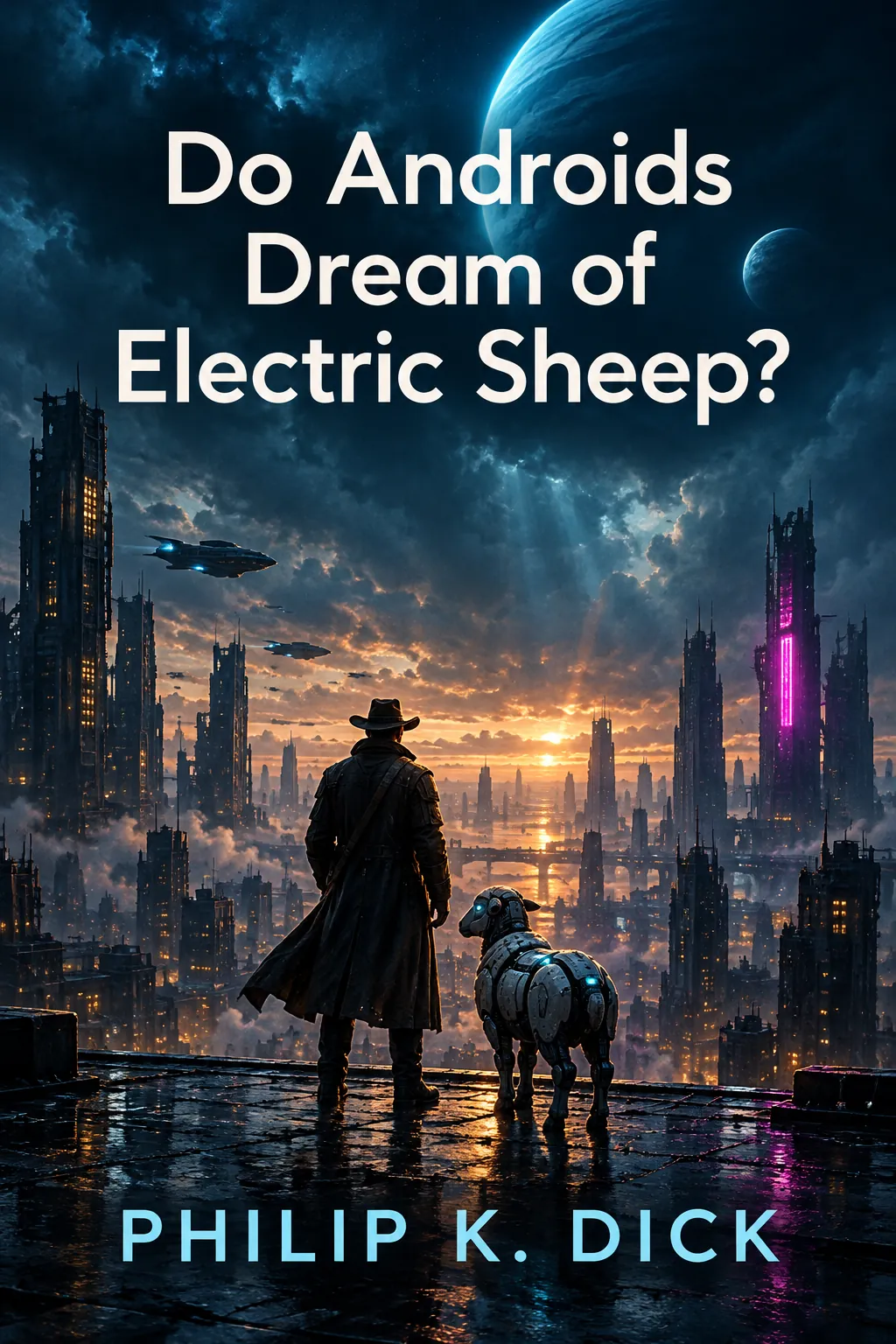
Do Androids Dream of Electric Sheep?
by Philip K. Dick
Do Androids Dream of Electric Sheep? is a 1968 novel by Philip K. Dick about Rick Deckard, a bounty hunter in a poisoned, half-empty San Francisco. Most animals have died out, so owning a real one shows status, and Rick can only afford an electric sheep. When eight androids escape from Mars, he takes the job of hunting them down. The test he relies on measures empathy, and the work slowly shakes his idea of what separates people from machines.
The Big Idea
"In a ruined future where real animals are status symbols, a bounty hunter who hunts artificial humans starts to wonder whether empathy is what makes someone human, or just a skill that can be faked."
Key Insights
Empathy is the line between human and machine
The book treats empathy as the thing that makes someone human, and the Voigt-Kampff test measures it. But the story keeps breaking that rule. Rick feels pity for an android singer, while a human bounty hunter feels nothing about killing. Empathy turns out to be less a fixed trait of one group and more something people can switch on, lose or direct at the wrong target.
After Luba Luft is shot, Rick is sorry for her, while Phil Resch, who tests as human, seems untroubled.
What is real, and does it matter?
Real animals are treasured and fake ones are hidden. Mercer, the central religious figure, turns out to be staged. Yet the feelings people get from these things are real. The novel does not decide that the fake is worthless; it asks whether a thing's origin changes what it can mean to us.
Mercer is exposed as a paid actor, but he still appears to Isidore and comforts him.
Machines that manage feelings
The mood organ lets people dial up any mood, and the empathy box lets strangers share one man's suffering. These devices promise connection but also make people lazy about real feeling. Iran can choose despair or cheer with a number, which shows how easily emotions can become products.
Iran uses the mood organ to fight her despair, yet she still resents her husband's job and the electric sheep.
Status, loneliness and care for living things
With so many animals gone, owning one is a way to show you are caring and successful. Rick wants one less for love than to be seen as a decent person. The book suggests that caring can slip into status-seeking, and then an electric sheep can feel like an insult. Real care shows up in small, costly acts instead.
Rick feels embarrassed by his electric sheep, so he is willing to take a dangerous job to afford a goat.
Chapter Breakdown
Chapter-by-chapter summary
Spoiler warning: this section covers the whole plot, including the ending. The novel's numbered chapters are grouped here into seven parts.
Part 1: A morning with an electric sheep
A world war has left radioactive dust over Earth and killed most animals. Owning a real one is now a sign of status and decency. Rick Deckard, a San Francisco bounty hunter, keeps an electric sheep on his roof because his real sheep died. His wife Iran uses a mood organ to switch her feelings on and off. After a colleague is wounded, Rick's boss assigns him six remaining Nexus-6 androids who fled Mars. Why it matters: the bounty could buy a real animal, so his longing for the genuine thing drives the whole plot.
Part 2: The Rosen Association and Rachael
Before the hunt, Rick travels to Seattle to see the company that builds the Nexus-6. He needs to know whether the Voigt-Kampff test, which watches reactions to emotional questions, still works on the newest model. He tests Rachael Rosen, introduced as the owner's niece, and concludes she is an android. Her creator first denies it, then admits it. Why it matters: the test is less certain than the police claim, and the line between human and machine is already blurring.
Part 3: John Isidore and Mercerism
John Isidore is a lonely young man whom society looks down on because radiation has dulled his mind. He lives alone in an emptied apartment block and drives a van for a shop that repairs artificial animals. A new neighbour, Pris Stratton, moves in; she is one of the escaped androids. People in this world also grip an empathy box and share the suffering of Wilbur Mercer, an old man climbing a hill under a rain of stones. Why it matters: the kindest person in the book is the one the androids use.
Part 4: Polokov, Luba Luft and a false police station
Rick's first target, Polokov, claims to be a Soviet police official, and Rick kills him. Next he finds Luba Luft, an android living as an opera singer. Her voice moves him. Before he can test her, she has him arrested and taken to a police station he has never heard of, run by androids. Phil Resch, a fellow bounty hunter who is also held there, helps him escape. Why it matters: the androids copy human institutions to protect themselves.
Part 5: Doubts, a goat and Rachael
Resch later shoots Luft in a museum, and Rick feels a grief he did not expect. Because Resch seems to enjoy killing, Rick tests him and finds he is human. Rick starts to see that some androids seem kinder than some people. With his bounty he buys a real goat. Shaken, he calls Rachael, and they spend a night together. She says she has done the same with other bounty hunters to make them unable to do their job. Why it matters: Rick's certainty about who deserves pity begins to crack.
Part 6: The apartment and the fall of Mercer
The last three androids, Roy Baty, his wife Irmgard and Pris, hide in Isidore's apartment. Isidore welcomes them as friends. Pris cuts the legs off a spider he has found, treating it as a game. Meanwhile the TV host Buster Friendly announces that Mercer is a fraud, an actor on a cheap set. Isidore is shaken, yet Mercer appears to him and says the shared suffering is real anyway. Why it matters: it asks whether a feeling counts if its source is faked.
Part 7: The last hunt and the toad
Rick reaches the building and kills Roy, Irmgard and Pris. Afterwards he feels no triumph. At home he finds his goat dead, killed by Rachael. He flies into the northern desert, sees himself climbing Mercer's hill and finds a toad, a creature thought extinct. Iran then finds the control panel on its belly, and it is electric. Rick accepts this calmly and goes to sleep. Why it matters: the novel ends by asking whether made things have a kind of life too.
Characters
Rick Deckard
A San Francisco bounty hunter and the main character. He can only afford an electric sheep and dreams of a real animal. As he retires androids, he starts to feel pity for some of them, and that unsettles him.
Iran Deckard
Rick's wife. She depends on the mood organ and often sinks into despair. She resents the fake sheep and Rick's job, and in the last scene she is the one who finds the toad's control panel.
Rachael Rosen
A Nexus-6 android linked to the company that builds them. She first appears as the owner's niece. She draws Rick close, then makes sure his work cannot stay the same for him afterwards.
John Isidore
A lonely worker at a shop that repairs artificial animals. He treats the escaped androids as friends and tries to protect them. He may be the most gentle character in the book.
Pris Stratton
An escaped android who looks just like Rachael. She moves in next to Isidore and uses his kindness. Her cold curiosity shows when she cuts the legs off a spider.
Roy and Irmgard Baty
Roy leads the escaped androids and wants them to survive on Earth. His wife Irmgard is one of the group. Along with Pris, they are the last of Rick's targets.
Phil Resch
Another bounty hunter, who seems to enjoy killing. Rick suspects he is an android, but the test shows he is human. That leaves Rick questioning what empathy really is.
Luba Luft
An android who lives as an opera singer. Her talent moves Rick, and her death at Resch's hands makes him sorry in a way he cannot explain.
Wilbur Mercer and Buster Friendly
Mercer is the old man at the centre of the religion Mercerism, who climbs a hill while stones are thrown at him. Buster Friendly is a TV host who says Mercer is staged. Together they ask whether a shared feeling counts if its source is fake.
Writing about this book
Pick one question and follow it through the plot. Do not retell everything; use two or three scenes as evidence. Here are some starting points:
- Rick uses a test to decide who deserves pity. What happens to his certainty after he meets Luba Luft and Phil Resch?
- The mood organ and the empathy box let people manage their feelings with machines. Are they helping or harming?
- Why does the author make the cruellest scene a spider losing its legs, not a murder?
- The book ends with an electric toad. Does Rick treat it differently because it is artificial?
Pair each point with a scene and your own reaction. A good paper also links the story to something you have seen, such as how people treat pets, social media or voice assistants. Use short quotes only, and name the part of the book they come from.
Take Action
Practical steps you can implement today:
-
Ask what a test really measures before trusting its result, whether it is an exam score or an algorithm.
-
Notice when you treat someone as a category instead of a person, and check whether your sympathy is reaching the right place.
-
Pay attention to feelings you outsource to screens or gadgets, and keep some contact that is not managed.
-
Care for living things in small, regular ways, not to show off, but because someone depends on you.
Notable Quotes
"“The electric things have their lives too. Paltry as those lives are.” (Part 7)"
— Philip K. Dick
"“Kipple drives out non-kipple.” (Part 3)"
— Philip K. Dick
"“You will be required to do wrong no matter where you go.” (Part 6)"
— Philip K. Dick
Who Should Read This
Readers aged about 14 and up who like thoughtful science fiction, and students who need a book for a class on technology, ethics or identity. It also suits anyone who has seen Blade Runner and wants to know the novel it grew from.
Frequently Asked Questions
What is Do Androids Dream of Electric Sheep? about?
It follows Rick Deckard, a bounty hunter in a polluted future San Francisco, as he hunts escaped androids. On the way he questions whether empathy truly separates humans from machines. It is also about loneliness, status and the need to care for something living.
Is the book the same as the film Blade Runner?
No. The 1982 film Blade Runner is based on the novel, but it changes much of the story. The book has Mercerism, the empathy box and the importance of owning real animals, which the film leaves out or plays down, and its themes are different in places.
What is the Voigt-Kampff test?
It is the test Rick uses to tell androids from humans. The tester asks emotional questions and watches the subject's body for tiny reactions, such as the eyes and blushing. The idea is that androids lack real empathy, but the book shows that the test can be unsure.
When is the story set?
The novel was written in 1968 and set in a near future, originally 1992. Later editions moved the date to 2021. The setting is San Francisco after a world war has left radioactive dust over the planet.
What does the title mean?
The title asks whether artificial beings have an inner life, like a dream, and also hints at Rick's electric sheep. It points to a central question of the book: if made things can feel, how should people treat them?
Check Your Understanding
Pick an answer for each question to see if you were right.
-
What does Rick Deckard keep on his roof at the start of the novel?
An electric sheep — His real sheep died, so he replaced it with an electric copy.
-
What is the name of the test used to tell androids from humans?
The Voigt-Kampff test — The Voigt-Kampff test reads emotional reactions to spot androids.
-
Who is John Isidore?
A lonely worker who befriends the fugitive androids — Isidore works at an artificial-animal repair shop and shelters the androids.
-
What does the TV host Buster Friendly claim about Wilbur Mercer?
That he is a fraud played by an actor — Buster says Mercer is staged on a cheap set.
-
What does Rick find in the desert at the end?
An electric toad — Iran later finds the control panel that shows the toad is electric.
About Philip K. Dick
Philip K. Dick (1928–1982) was an American science fiction writer who published dozens of novels and well over a hundred short stories. He wrote about false realities, artificial people and fragile identity. His books include The Man in the High Castle and Ubik, and this novel became the basis of the film Blade Runner.
Summary Written By

Software Engineer & Writer
Software engineer with a passion for distilling complex ideas into actionable insights. Writes about finance, investment, entrepreneurship, and technology.
View all summaries →Reviews
No reviews yet. Be the first to share your thoughts!
Write a Review
Keep reading
Explore the topic: Sci-Fi Authors & AwardsSummaries

Out of My Mind
Sharon M. Draper
“Out of My Mind” by Sharon M. Draper is a poignant narrative that explores the life of Melody Brooks, a…

Ender’s Game
Orson Scott Card
“Ender’s Game” by Orson Scott Card is a riveting science fiction novel that transports readers into a future where humanity…

Pachinko
Min Jin Lee
“Pachinko”, a spellbinding multigenerational historical saga by Min Jin Lee, explores the lives of a Korean family trying to make…

The Perks of Being a Wallflower
Stephen Chbosky
The Perks of Being a Wallflower by Stephen Chbosky is a profound coming-of-age novel, told through the intimate letters of…
Articles

Philip K. Dick
Philip K. Dick (1928–1982) was an American science fiction writer who kept asking one question: what is real, and what…
Cyberpunk
Cyberpunk is a science fiction genre about advanced technology and hard lives: hackers, outsiders and giant corporations in neon-lit near-future…
Turing Test
The Turing test asks whether a machine can pass as a human in conversation. Alan Turing proposed it in 1950…