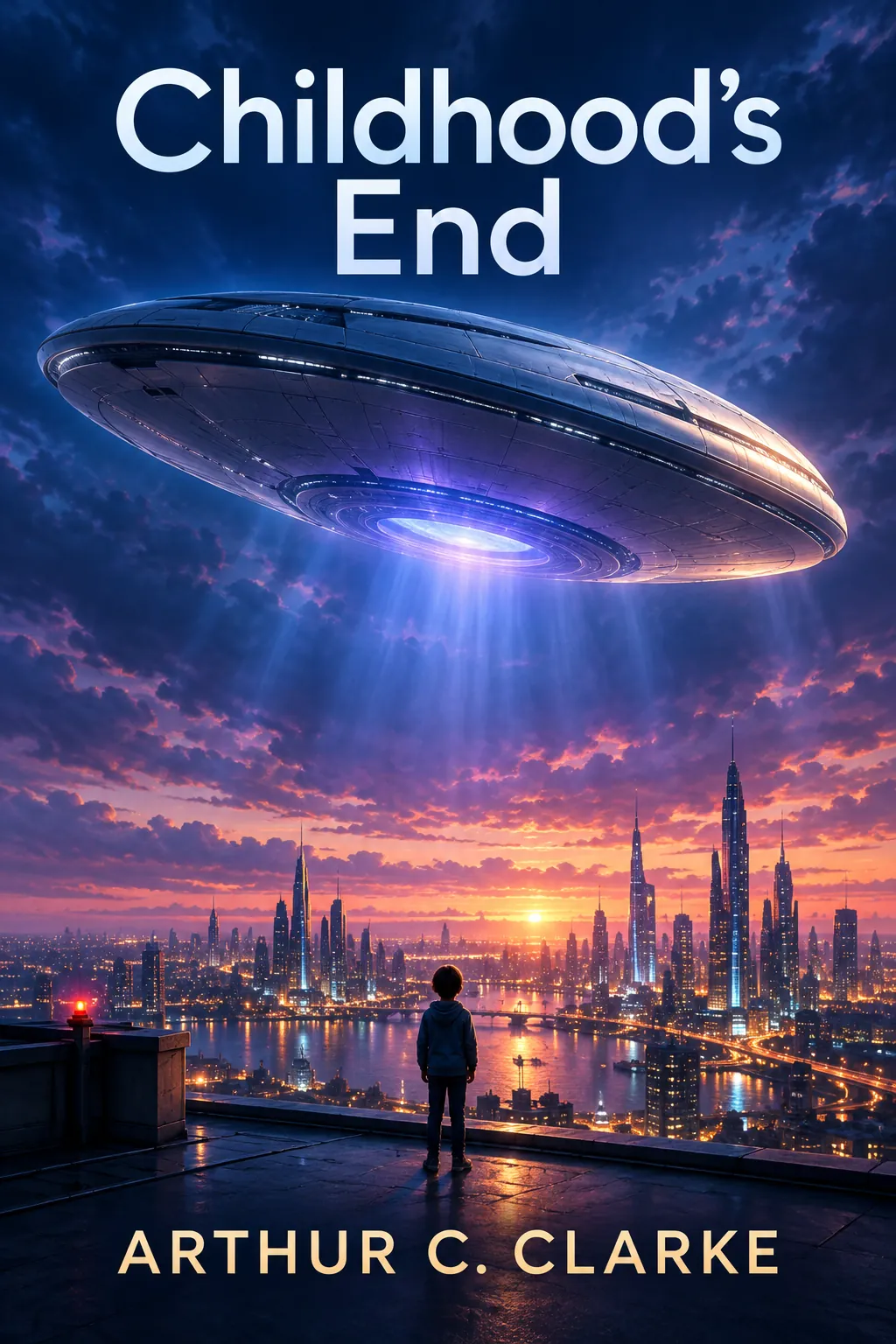
Childhood's End
by Arthur C. Clarke
Childhood's End is a 1953 novel by Arthur C. Clarke about the day huge alien ships appear above Earth's cities and a calm alien called Karellen takes charge. These “Overlords” end war, hunger and poverty, but they will not explain their purpose or show their faces. Humanity enjoys a golden age, yet some people begin to wonder what has been taken in return, and what the Overlords are really waiting for.
The Big Idea
"When benevolent aliens hand humanity a peaceful, comfortable world, is that the goal of progress or only a waiting room? Clarke uses the Overlords to ask what growing up could cost a whole species."
Key Insights
Comfort has a cost
A world without war, hunger or crime sounds like the finish line of history. In the novel, though, art and science slow down once nobody needs to struggle. Clarke does not claim comfort is bad. He suggests that effort and risk are part of what makes people want to create.
In the Golden Age, new work becomes rare, and small communities like New Athens try to keep human culture alive.
A kind ruler is still a ruler
The Overlords never use force against humans, and still the question of their authority will not go away. Because they hide their plans, people have to trust them blindly. The book shows that good results do not remove the human need to understand who is in charge, and why.
Wainwright's Freedom League protests, and Stormgren keeps wondering what he is not being told.
The next generation may not be ours to understand
Parents expect their children to carry on something familiar. In the novel, the children become something their parents cannot follow. It is an extreme version of the gap every generation feels, which makes the final section moving as well as strange.
George and Jean can only watch as Jeffrey and Jennifer Anne drift beyond their reach.
Power is not the same as progress
The Overlords are far more advanced than humans, yet they are stuck. They can guide and protect, but they cannot take the next step themselves. Clarke uses them to show that technology and wisdom do not guarantee growth, and that a species can serve greatness without sharing it.
Karellen's last words to Rodricks reveal that the Overlords can serve the Overmind but never join it.
Chapter Breakdown
Chapter-by-chapter summary
Spoiler warning: this section covers the whole plot, including the ending.
Part 1: The ships arrive
Huge silent ships take position above every major city on Earth. Their commander, an Overlord named Karellen, speaks to humanity through one man, United Nations Secretary-General Rikki Stormgren, and never leaves his ship. Over the following years the Overlords stop wars and end famine, and they do it without a visible fight. They refuse to share their plans or their appearance, promising only that humans will see Karellen in fifty years. Why it matters: the book begins as a rescue story, and the hidden face is the first sign that the rescue has a price.
Part 1: The Freedom League and the long wait
Not everyone is grateful. Alexander Wainwright's Freedom League argues that humanity has swapped independence for comfort. Stormgren trusts Karellen but badly wants to understand him, so he is pulled between the two sides. He keeps his promise to wait, and he does not live to see the answer. Why it matters: this is where the novel asks whether a kind ruler is still a ruler, and whether “trust me” can ever be enough.
Part 2: Karellen's face
Fifty years later, as promised, Karellen steps into view. The Overlords look like the devils of old stories, with horns, leathery wings and a barbed tail. People are more startled by the resemblance than by the aliens themselves, and it hints that the Overlords visited Earth long ago. Because a whole generation has now grown up under their care, the shock fades quickly. That is also why Karellen made humans wait. Why it matters: Clarke turns an ancient fear into a quiet puzzle about where our oldest images come from.
Part 2: The Golden Age
With want and war gone, Earth enjoys a golden age. Work shrinks, crime fades and schooling spreads, yet art and science seem to stall, because there is little reason to invent when everything is provided. Small communities such as New Athens try to keep human culture alive. At a party hosted by the wealthy Rupert Boyce, a Ouija board game produces a number that turns out to name the Overlords' home star. Jan Rodricks, a young scientist who is obsessed with their world, hides aboard a supply ship and leaves Earth. Why it matters: the comfort is real, but the story asks what happens to ambition when there is nothing left to fight for.
Part 3: The children change
On Earth, George Greggson and Jean Morrow raise their two children, Jeffrey and Jennifer Anne. The children begin to dream of a vivid, strange world, and soon children everywhere do the same. They start to move objects with their minds and to act like one group. Their parents watch helplessly as the children drift out of reach. Karellen finally explains: the Overlords were never Earth's masters, only caretakers working for a vast mind called the Overmind. Why it matters: the answer turns the rescue story inside out, because the goal was never to keep humans happy but to prepare them for something else.
Part 3: The last man
The children's minds merge, and they lose their individual selves. Adults, with no new generation coming, spend their last years quietly. The children join the Overmind, and the planet itself is consumed. Jan Rodricks has returned to Earth after his long journey, and as the last human he watches it happen. Karellen tells him that the Overlords can serve the Overmind but can never join it, and then he leaves. Why it matters: the ending is both a triumph and a loss, and Clarke deliberately gives no single verdict.
Characters
Karellen
The Overlord Supervisor for Earth. Calm, patient and dryly funny, he speaks to humans through a screen for fifty years. He is the book's central mystery: plainly kind, plainly hiding something, and in the end more tragic than he first seems.
Rikki Stormgren
The UN Secretary-General and Karellen's link to humanity. Fair-minded and loyal, he is torn between trusting the Overlords and needing to know the truth. He stands for the human urge to ask why.
Alexander Wainwright
Leader of the Freedom League, which says humanity has lost its independence. He is sincere but outmatched, and he voices the reasonable objection to being ruled kindly.
Jan Rodricks
A young scientist whose curiosity about the Overlords' world drives him to stow away on a supply ship. He later takes on the heaviest role in the book: the last human to watch Earth's end.
Rupert Boyce
A wealthy, sociable host. The party at his home brings several key characters together and sets the second part of the story in motion.
George Greggson and Jean Morrow
A young couple who want an ordinary family life. When their children begin to change, they are pulled into the centre of the story and have to face how little control parents have.
Jeffrey and Jennifer Anne
The Greggsons' children, among the first to show the change. They stand for humanity's next form, which is both wonderful and frightening to the adults around them.
The Overmind
A vast combined mind that the Overlords serve. It is hardly described and never speaks in human terms, which keeps it beyond anything people can fully understand.
Writing about this book
A good report starts with the title. Ask whose childhood is ending, and in what sense. It could be humanity's, the individual's or the Overlords' own. Then choose one theme from this guide and follow it through the three parts, noting how the book's mood shifts from relief to unease to awe.
Some questions to work from: Is Karellen a hero, a jailer or a servant? Would you want to live in the Golden Age, and what exactly would you miss? Does the ending read to you as growth, as loss, or as both at once? Why might Clarke have given the aliens the look of old devils?
Back up every point with a scene: the fifty-year wait, the Ouija board, the children's dreams. Say clearly where you are describing the book and where you are giving your own opinion. Try to end on a question you could not fully answer, because the book itself does.
Take Action
Practical steps you can implement today:
-
When life gets easier, ask what you might stop doing, and decide what challenges are worth keeping.
-
Notice who benefits from a rule, and don't accept “trust me” as a full explanation.
-
Read the same ending twice: once as a gain and once as a loss, then compare.
-
Pick one scene from the book and explain why it supports your theme, not just what happens.
Notable Quotes
"“But the stars are not for man.” (Chapter 14)"
— Arthur C. Clarke
"“Can you deny that the Overlords have brought security, peace, and prosperity to the world?” (Chapter 2)"
— Arthur C. Clarke
"“When the Overlords had abolished war and hunger and disease, they had also abolished adventure.” (Chapter 8)"
— Arthur C. Clarke
Who Should Read This
Readers who like big ideas in a short novel, and students writing about utopias, power or science fiction. It suits upper-secondary students and adults. The language is plain, but the final section asks for slow, careful reading.
Frequently Asked Questions
What is Childhood's End about?
It is about alien Overlords who arrive over Earth's cities and bring peace without explaining why. The story follows several people over many decades and asks what humanity might lose, or become, in a world where all its problems are solved for it.
Who are the Overlords and what do they want?
The Overlords are advanced aliens led on Earth by Karellen. At first they say little about their goals. Later in the book it becomes clear that they work for a larger power, and that their real task is to prepare humanity for something beyond ordinary life.
Why do the Overlords look like devils?
Their horns, wings and tail match traditional pictures of the devil. Clarke uses this as a hint that the Overlords visited Earth long ago and left a lasting mark on human imagination, which turns an old fear into a puzzle about memory.
Is the ending happy or sad?
Neither completely. The ending can feel hopeful and heartbreaking at the same time, and the book leaves it to the reader to decide. The chapter-by-chapter section above explains what happens, so read it only if you are happy to be spoiled.
Is Childhood's End hard to read?
The language is simple and the book is short. The difficulty is in the ideas, especially in the last part, where the story moves from human characters to something much larger. Reading slowly and stopping after each part helps.
Has the book been adapted?
Yes. A television miniseries of the novel was shown on Syfy in 2015. This guide covers the book only, and details in the screen version differ.
Check Your Understanding
Pick an answer for each question to see if you were right.
-
Which Overlord speaks for his people on Earth?
Karellen — Karellen is the Overlord Supervisor for Earth; Stormgren and Wainwright are humans.
-
How long does Karellen make humanity wait before showing himself?
Fifty years — He promises that humans will see him in fifty years, and the promise is kept.
-
What do the Overlords look like when they are finally seen?
Like traditional devils, with horns, wings and a tail — Their appearance matches old pictures of the devil, which hints at an ancient visit to Earth.
-
Who hides aboard a ship to reach the Overlords' world?
Jan Rodricks — Jan Rodricks, a young scientist, stows away on a supply ship because he is curious about the Overlords.
-
What is the Overmind?
A vast combined mind the Overlords serve — The Overlords are its caretakers, and the human children are the ones it eventually gathers in.
About Arthur C. Clarke
Arthur C. Clarke (1917–2008) was a British science-fiction writer and science popularizer who spent his later life in Sri Lanka. In 1945 he described how satellites in a fixed orbit could relay communications. He wrote Childhood's End and Rendezvous with Rama, and with director Stanley Kubrick he created the story behind 2001: A Space Odyssey.
Summary Written By

Software Engineer & Writer
Software engineer with a passion for distilling complex ideas into actionable insights. Writes about finance, investment, entrepreneurship, and technology.
View all summaries →Reviews
No reviews yet. Be the first to share your thoughts!
Write a Review
Keep reading
Explore the topic: Sci-Fi Authors & AwardsSummaries

Out of My Mind
Sharon M. Draper
“Out of My Mind” by Sharon M. Draper is a poignant narrative that explores the life of Melody Brooks, a…

Ender’s Game
Orson Scott Card
“Ender’s Game” by Orson Scott Card is a riveting science fiction novel that transports readers into a future where humanity…

Pachinko
Min Jin Lee
“Pachinko”, a spellbinding multigenerational historical saga by Min Jin Lee, explores the lives of a Korean family trying to make…

The Perks of Being a Wallflower
Stephen Chbosky
The Perks of Being a Wallflower by Stephen Chbosky is a profound coming-of-age novel, told through the intimate letters of…
Articles
Arthur C. Clarke
Arthur C. Clarke (1917–2008) was a British science-fiction writer and science populariser who co-created 2001: A Space Odyssey and wrote…
First Contact in Fiction and Science
First contact is the moment humans and another intelligent species first learn of each other. It has never happened: no…
History of Science Fiction
The history of science fiction runs about 200 years, from Mary Shelley's Frankenstein in 1818. Jules Verne and H. G.…