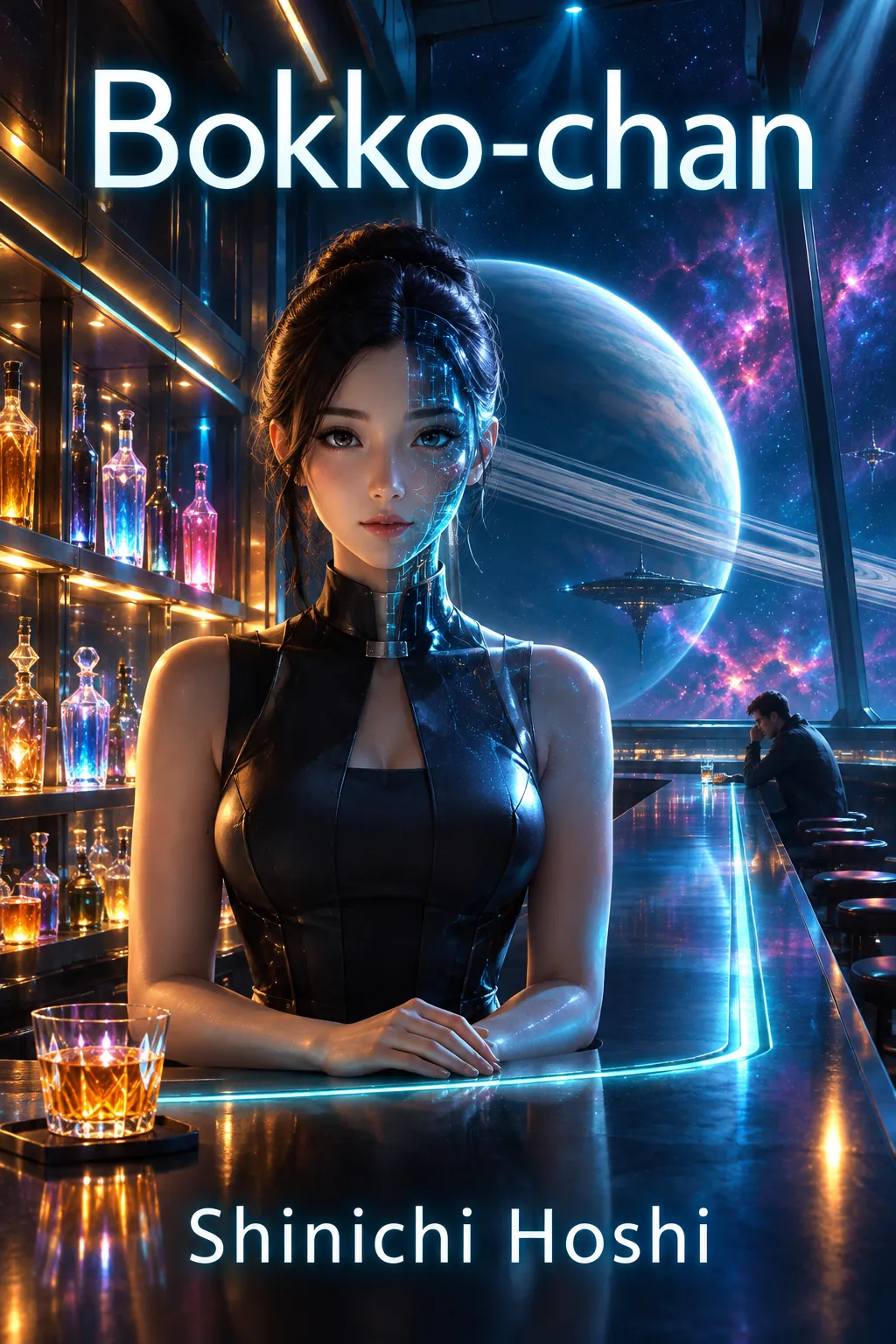
Bokko-chan
by Shinichi Hoshi
Bokko-chan is a collection of 50 very short stories chosen by Shinichi Hoshi himself, the Japanese master of the short-short. It came out as a Shinchosha paperback in 1971. Each story takes a single odd idea, such as a female robot serving in a bar or a bottomless hole, and follows it to a neat, often ironic last line. The science fiction is light. The real subject is people and their habits. The title story is the best place to start.
The Big Idea
"Hoshi's stories use one odd idea and a few pages to show how people really behave: lonely, greedy, hopeful and careless. A robot hostess and a hole in the ground become mirrors for human nature."
Key Insights
One idea can carry a whole story
Hoshi's stories each rest on a single strange premise. He does not build big plots or large casts. He sets one condition, follows it honestly and stops. The short length forces every sentence to work, and the reader's imagination fills the space. The idea stays sharp because nothing else competes with it, and that is why a story of a few pages can be remembered for years.
In the title story, a robot who mostly gives back what customers say is enough. No long backstory is needed to understand why men fall for her.
A convenient partner becomes a mirror
Bokko-chan gives the customers what they most want: attention without argument. That makes her popular, and it also makes her empty. The story suggests that a perfectly agreeable listener shows us ourselves rather than another person. We often prefer people who agree with us, and the story lets us see what that preference costs when the other side has nothing of its own to give.
The men pour out their feelings to her and hear their own words come back, so their hope has nowhere to go. Even a poisoned glass changes nothing for her.
What we throw away does not vanish
“Ōi Dete Koi” is about the hidden cost of easy disposal. People treat the hole as if it has no end, so they stop thinking about what goes in. The ending says the world is not that forgiving, without a single line of explanation. The story is read today as a quiet parable about waste and responsibility, though Hoshi himself never uses those words.
The pebble that falls past the construction worker answers the stone thrown in at the start, and it arrives long after everyone has stopped asking where things go.
The reader finishes the thought
Hoshi rarely explains his own twists. He ends on an image or an action, and the meaning is left for you to work out. This trust in the reader is part of why the stories stay in the mind after only a few pages. Two readers can take different lessons from the same story, which makes the book good for discussion.
“Ōi Dete Koi” closes with a falling pebble and no moral. You decide whether the lesson concerns carelessness, greed or looking away.
Technology changes, appetites do not
The robots and gadgets in these stories are simple tools. What stays constant is human desire: for company, for an easy way out, for a place to hide what we do not want to see. That is a main reason stories written decades ago still read as fresh. New tools keep arriving, and the wishes behind them stay much the same.
A robot built to serve drinks and a hole used as a dump both end up showing what the people around them want, not what the objects can do.
Chapter Breakdown
Chapter-by-chapter summary
Spoiler warning: this section covers the plots of “Bokko-chan” and “Ōi Dete Koi”, including their endings. The book has 50 stand-alone stories rather than chapters, so they are grouped into parts here.
Part 1: Fifty stories, no chapters
Bokko-chan has no chapters and no shared plot. It holds 50 stand-alone stories, each only a few pages long, which Hoshi picked himself. The contents begin with “Akuma”, then the title story, then “Ōi Dete Koi” and “Koroshiya Desu no yo”. They end with “Saigo no Chikyūjin”. Titles in between include “Raihōsha”, “Nerawareta Hoshi”, “Manē Eiji”, “Jinruiai” and “Yokubō no Shiro”. Why it matters: you can open the book anywhere, and each piece is a complete small experience.
Part 2: “Bokko-chan”, the title story
The owner of a bar builds a beautiful female robot, Bokko-chan, to serve the customers and bring in more drink sales. She says little and mostly gives back the words the customers say to her, and she never gets drunk. The men fall for her anyway, and their feelings go nowhere. One young man, hopelessly in love, secretly puts poison in her glass and leaves. Poison cannot harm a robot, and in the end it is the people in the bar who suffer, while Bokko-chan alone is left standing at the counter, calm and unchanged. The story first appeared in February 1958 in the fan magazine Uchūjin under the title “Jinzō Bijin” (Artificial Beauty). It was reprinted in the magazine Hōseki that May and became Hoshi's breakthrough. Why it matters: the story shows in a few pages how strongly people are drawn to someone who only reflects them back.
Part 3: “Ōi Dete Koi”
After a typhoon, a deep hole opens where a village shrine once stood. A young villager shouts “Hey, come out!” into it and throws in a stone, but no answer comes back. A reporter lowers a weighted string and it snaps. A scientist tries to measure the depth by sound and hears no echo. People then start using the hole to get rid of things: secret documents, radioactive waste, sewage, and evidence of crimes. At the end, a construction worker on a steel frame hears the same call from the sky and ignores it. A small pebble falls past him, and he does not notice. Why it matters: Hoshi never lectures about waste or hidden costs; one small stone makes the point.
Part 4: Four more set-ups
Here are the openings of a few other stories, with their endings left out. In “Koroshiya desu no yo”, a woman who says she is a hired killer visits N, the head of a company, and asks whom he would like to have killed. In “Raihōsha”, aliens arrive on Earth, but they stay cool when humans show off their gold and technology. In “Seikatsu Ijishō”, an official spends a day taking cards to different places in a peaceful world with no war or struggle for survival, where his ministry keeps everything running. In “Atsusa”, a man walks into a police box on a summer afternoon and asks to be arrested, because he feels he is about to do something. Why it matters: each story begins with one odd situation and builds from it, which shows how much Hoshi can do with a few lines.
Part 5: Reading the book as a whole
The Shinchosha paperback runs to 352 pages. It includes an afterword by Hoshi, a commentary by the writer Yasutaka Tsutsui, and small drawings by Hiroshi Manabe. The stories work best in small doses: read three or four, then stop, so each twist has room around it. Afterwards, pick a favourite and split it into set-up, development and last line. Why it matters: the book's strength is its brevity, and the pace you choose changes how well the endings land.
Characters
These are the key people and terms in the book.
- Bokko-chan: the female robot who serves customers in the bar of the title story. She says little and mostly repeats what customers say, so each man hears what he wants to hear.
- The bar owner: the man who builds Bokko-chan to attract customers and sell more drinks. He is the one who sets the story in motion.
- The customers: the men in the bar who become hopelessly infatuated with Bokko-chan. They stand for anyone who longs to be listened to.
- The young villager: the person in “Ōi Dete Koi” who first shouts into the hole after the typhoon and throws in a stone. He gets no reply.
- The hole: the bottomless pit that appears at the old shrine site. It swallows whatever people want to forget, and it works almost like a character.
- The people who use the hole: the villagers, officials and others who send documents, waste and evidence into it. They stand for anyone who prefers a cheap solution to a lasting one.
- Shinichi Hoshi: the author, who chose and arranged these 50 stories himself and wrote the afterword.
- Short-short: a very short story form, usually a few pages, built around one idea. Hoshi is Japan's best-known master of it.
- Ochi (the twist): the Japanese word for a story's closing turn. Many pieces in the book are built to deliver one.
Writing about this book
This book suits a short school report because you can focus on one story and still say something about the whole. Here are themes and questions to start from, not an essay to copy.
- Why does a robot who mostly repeats the customers' own words become so popular? What does that say about how people like to be listened to?
- In “Ōi Dete Koi”, who is responsible for the pebble at the end: the people who dumped things, or the people who looked away?
- Hoshi says very little about feelings. How does he still make you feel something at the end?
- Pick two stories and compare their twists. Which one did you see coming, and why?
Use concrete moments, such as the snapped string in the hole or a customer talking to a robot. Then explain what each moment shows about people, in your own words and with your own example from daily life.
Take Action
Practical steps you can implement today:
-
Start with the title story, then read “Ōi Dete Koi”, which comes right after it. Together they show both Hoshi's humour and his edge.
-
Read three or four stories at a time and pause, so each twist has room to land.
-
After each story, name the one idea it rests on. This is a good way to learn how short fiction is built.
-
When you see a convenient solution, ask who or what carries the hidden cost, as the hole story does.
-
Try writing your own one-page story built on a single odd premise.
Who Should Read This
Readers aged about 13 and up who want a fast, witty way into Japanese science fiction. It suits middle and high school students looking for a short book for a report, and adults who like clever twist endings and have only a few minutes at a time.
Frequently Asked Questions
What is Bokko-chan about?
Bokko-chan is a collection of 50 very short stories by Shinichi Hoshi. The title story is set in a bar where a female robot serves customers who fall for her. Other stories use odd premises such as a bottomless hole. What they share is one strange idea and a twist at the end.
Who chose the 50 stories in the book?
Hoshi chose them himself. The collection, published by Shinchosha as a paperback in 1971, is presented as his own selection of his best short-shorts. That is why it is often recommended as the first book to read by him.
What is a short-short?
A short-short is a very short story, usually only a few pages, built around a single idea and finished with a twist. Hoshi did not invent the form, but he became Japan's best-known writer of it, with more than a thousand stories to his name.
Has Hoshi been published in English?
Yes. Hoshi's official English site offers e-books such as The Whimsical Robot, a collection of short-shorts for young readers, and his stories have appeared in English anthologies. Check a library or bookshop for the story you want, since English titles of single stories often differ.
Where should a new reader start?
Start with the title story, which is second in the book, then read “Ōi Dete Koi”, which comes directly after it. Both are short, memorable and typical of Hoshi's style. After that you can open the book at any page.
Is it suitable for a school report?
Yes. The stories are short enough to read in one sitting, and each has a clear idea to discuss. You can write about a single story and connect it to larger themes like loneliness, greed or the hidden cost of convenience.
Check Your Understanding
Pick an answer for each question to see if you were right.
-
Who selected the 50 stories in Bokko-chan?
Shinichi Hoshi himself — The collection is Hoshi's own selection of 50 of his best stories.
-
What is Bokko-chan in the title story?
A female robot serving in a bar — She is a robot in a bar who mostly gives back what customers say to her.
-
What do people do with the hole in “Ōi Dete Koi”?
Throw unwanted things into it — They treat the bottomless hole as a convenient place to dump secrets, waste and evidence.
-
What is a short-short?
A very short story with a twist — It is a story of a few pages built around a single idea and an ironic ending.
-
In what year did the Shinchosha paperback of Bokko-chan first appear?
1971 — Shinchosha released the paperback on 27 May 1971.
About Shinichi Hoshi
Shinichi Hoshi (1926–1997) was born in Tokyo and became one of Japan's best-loved writers of the very short story. He began publishing in 1957 and wrote more than a thousand short-shorts in his career. He grew up as the son of a pharmaceutical company founder before turning to writing full time.
Summary Written By

Software Engineer & Writer
Software engineer with a passion for distilling complex ideas into actionable insights. Writes about finance, investment, entrepreneurship, and technology.
View all summaries →Reviews
No reviews yet. Be the first to share your thoughts!
Write a Review
Keep reading
Explore the topic: Science FictionSummaries

Out of My Mind
Sharon M. Draper
“Out of My Mind” by Sharon M. Draper is a poignant narrative that explores the life of Melody Brooks, a…

Ender’s Game
Orson Scott Card
“Ender’s Game” by Orson Scott Card is a riveting science fiction novel that transports readers into a future where humanity…

Pachinko
Min Jin Lee
“Pachinko”, a spellbinding multigenerational historical saga by Min Jin Lee, explores the lives of a Korean family trying to make…

The Perks of Being a Wallflower
Stephen Chbosky
The Perks of Being a Wallflower by Stephen Chbosky is a profound coming-of-age novel, told through the intimate letters of…
Articles

A Christmas Carol themes: generosity, isolation and responsibility
Dickens's novella is usually read as a story about a man who changes his mind. Its themes are sharper than…

Nebula Award: What It Is and Notable Winners
The Nebula Award is an American science fiction and fantasy prize voted on by working writers. The Science Fiction and…

Seiun Award
The Seiun Award is Japan's oldest science fiction award, first given in 1970. Fans who attend the annual Japan SF…