In five minutes: how to study modern world history
If you are wondering how to study AP World History, AP Euro or Japan's Kyotsu Test, start with one idea: modern world history is a set of chains, not a pile of facts. An event happens because of earlier events, and it pushes later ones along. Once you know the chain, dates and names hang on it and become much easier to remember. This guide gives you a five-step method, a four-week plan and a list of common mistakes. It is part of our Modern World History Study Guide, which collects the key topics from 1700 to 1918.
- Build a skeleton timeline of 15 to 25 events.
- Write causes and effects as short "because… so…" sentences.
- Group events by theme and by region.
- Practise with real exam questions, then study your mistakes.
- Review on a schedule, not just before the test.
Why memorising dates alone fails
Many students begin by copying dates onto flashcards. It feels productive, but exams are built to test understanding. AP questions ask you to explain change over time, compare two societies or judge a source. Kyotsu questions often give you a short text, a map, a table or a graph and ask which event it belongs to, or put several events in order. In both cases a date only helps if you know what came before it and what followed.
There is also a memory reason. Facts that are linked to other facts stay in your head longer than facts that stand alone. A cause-and-effect story is easier to recall than a number, and the number can then be recovered from the story.
Step 1: Build a skeleton timeline
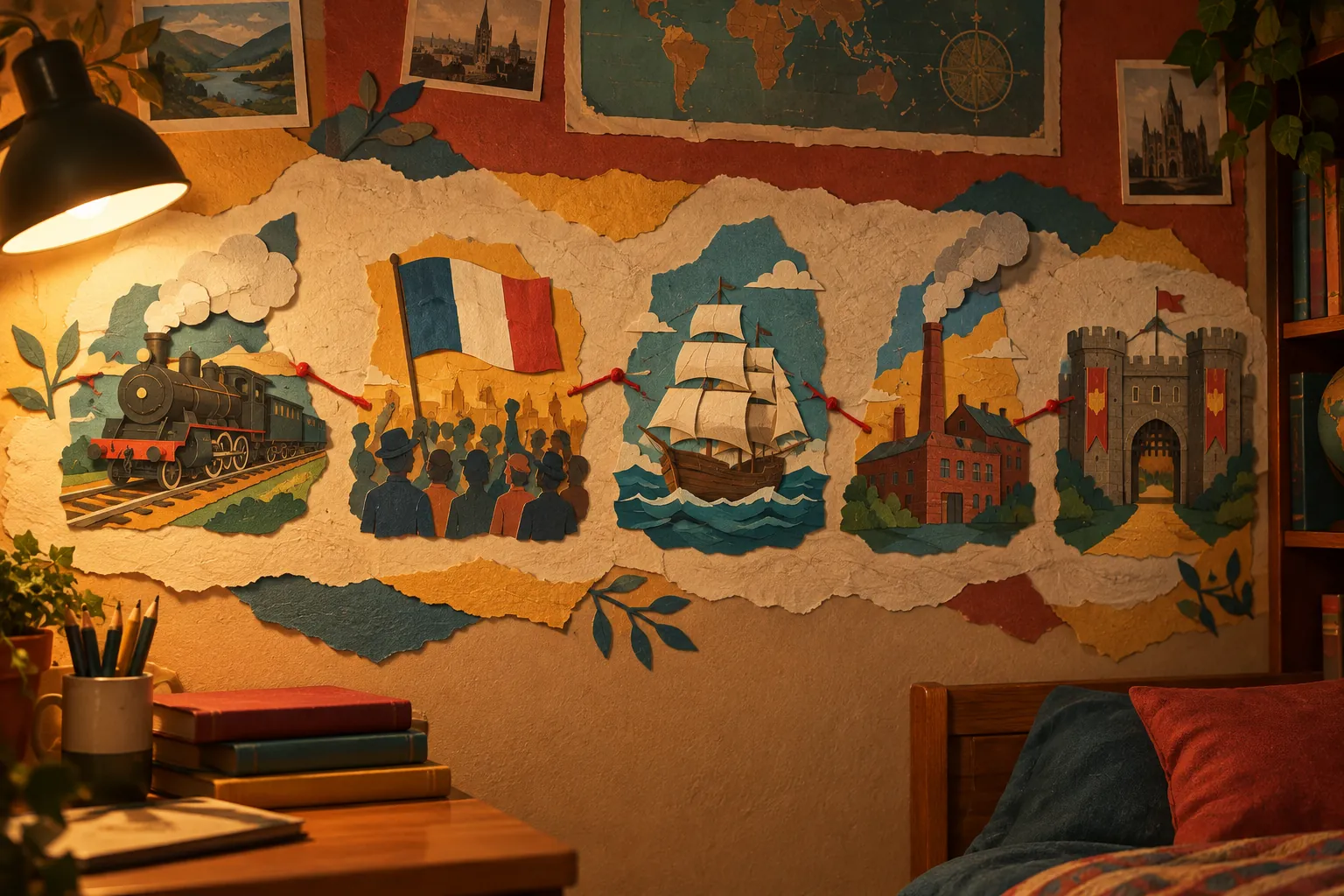
Take one sheet of paper and write down the 15 to 25 events that hold the period together. For 1700 to 1918, a good skeleton looks like this: the Seven Years' War (1756–1763), the American Revolution (1775–1783), the French Revolution (1789), the Napoleonic Wars, the Congress of Vienna (1814–1815), the Opium War (1839–1842), the revolutions of 1848, the Meiji Restoration (1868), German unification (1871), the Berlin Conference (1884–1885) and the First World War (1914–1918). Add the Industrial Revolution as a long bar rather than a single date.
Do not add details yet. The skeleton's only job is to give every later fact a place to land. Our 19th-century timeline is a good model to check your sheet against. If you are unsure what "modern" means in your course, read how historians divide time first.
Step 2: Write causes and effects
For each event on the skeleton, write two or three sentences in the form "because X, Y happened, so Z". For example: Britain finished the Seven Years' War with heavy debts, so it raised taxes on its American colonies, and the colonists' protests grew into the American Revolution. France spent heavily on supporting that revolution, and its own financial crisis helped bring on the French Revolution of 1789.
Keep each chain short. If a chain needs more than four links, split it into two. Say it aloud as if you were explaining it to a friend; if you get stuck, that is the exact spot you need to review.
Step 3: Group events by theme and region
Exams rarely follow the order of your textbook, so you need a second way to sort what you know. The AP World course uses six themes, including governance, economic systems and technology. Pick one theme and follow it across the whole period: how did states gain power, how did trade change, how did new machines change work?
A simple grid also helps. Put time periods (say, 1750–1800, 1800–1850, 1850–1914) in the rows and regions (Europe, Asia, the Americas, Africa) in the columns. Fill each box with one or two events. You will quickly see what was happening at the same time in different places, which is exactly what comparison questions test, and which also helps with Kyotsu questions that mix Asia and Europe.
Step 4: Practise with real exam questions
Reading your notes again feels easy, but answering questions is what builds recall. Start practice early, even when you do not know everything.
AP World History: Modern. The exam has multiple-choice questions, short-answer questions, a document-based question (DBQ) and a long essay question (LEQ). They count for roughly 40, 20, 25 and 15 percent of the score. For the essays, practise a simple routine: write a thesis that makes a claim, support it with specific evidence, and explain the context. Time yourself, then compare your answer with the official scoring guidelines that College Board publishes.
Kyotsu Test. From the 2025 exam, world history is part of a combined subject, Historical Overview and World History Inquiry. Work through past papers under time limits, and for every wrong answer write one line: what did I confuse, and what is the cause-and-effect link I missed?
Keep an error log. Three columns are enough: the question, why you got it wrong, and the fix. Review the log before each new practice set.
Step 5: Review on a schedule
Spaced review beats cramming. A common pattern is to review new material after one day, then after about three days, one week and a month. Each review should be short: cover your notes, redraw the skeleton timeline from memory, and say the causal chains aloud. Check only afterwards. Ten minutes of recall is worth more than thirty minutes of rereading.
What exams ask
Across AP World, AP Euro and the Kyotsu Test, the same kinds of task keep returning. Learning to spot them tells you what to study.
- Cause and effect: why did an event happen, and what did it change?
- Continuity and change: what stayed the same across a revolution or a reform?
- Comparison: how were two empires, revolutions or reforms alike and different?
- Sources: who wrote this, when, for whom, and why does that matter?
- Order and place: which came first, and where on the map did it happen?
If you can answer these five kinds of question about each item on your skeleton timeline, you are well prepared.
A four-week plan
This plan assumes 30 to 60 minutes a day. Adjust it to the time you have.
- Day 1: draw the skeleton timeline from your textbook's table of contents.
- Week 1: read one period at a time and write the cause-and-effect sentences.
- Week 2: build the theme grid and add the missing events.
- Week 3: do timed practice questions every other day and keep the error log.
- Week 4: redraw the timeline from memory, retry the questions you missed and do one full practice test.
Common mistakes
- Starting with details. Without a skeleton, details have nowhere to go.
- Only rereading. Recognising a page is not the same as recalling it.
- Skipping geography. Many questions show a map; look at one every study session.
- Memorising a list of causes. Exams reward explaining how one cause led to the result.
- Practising only at the end. Start questions in week one, even if you get many wrong.
Read next
- Everything You Need for the Kyotsu Test: Modern World History is a checklist of what the Japanese test expects.
- The 19th Century: World Events Timeline (1801–1900) gives you a ready-made timeline to practise your skeleton against.
- Ancient, Medieval, Early Modern, Modern: How Historians Divide Time explains why courses cut history in different places.
- Modern World History Study Guide is the hub for all our 1700–1918 topics.