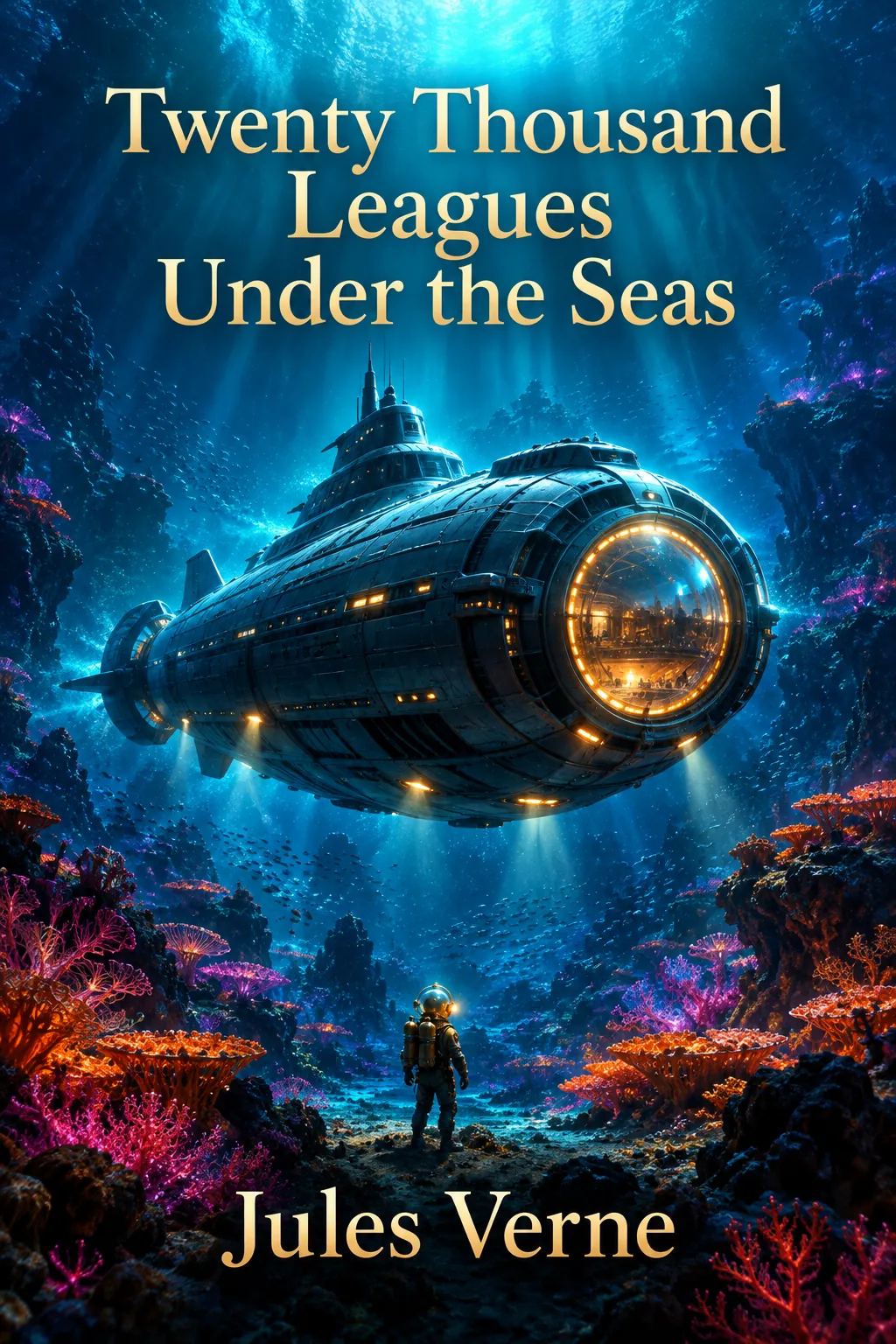
Twenty Thousand Leagues Under the Seas
by Jules Verne
Twenty Thousand Leagues Under the Seas is Jules Verne's 1870 adventure about a marine biologist, Pierre Aronnax, who hunts a supposed sea monster and finds a submarine, the Nautilus, ruled by the mysterious Captain Nemo. Aronnax, his servant Conseil and the harpooner Ned Land are kept aboard and travel across the world's oceans, seeing coral forests, sunken ruins and the South Pole. The book mixes real science with one question: who is Nemo, and what is he running from?
The Big Idea
"A French scientist is taken prisoner aboard a secret electric submarine, and the voyage shows both the beauty of the deep sea and the cost of a captain who wants no part of the land."
Key Insights
The ocean as a place of wonder
Verne treats the deep sea as a world worth studying, full of coral forests, strange fish and sunken cities. Aronnax's lists of species and Conseil's classifications show the pleasure of knowing the names of things.
In the diving-suit walk near Crespo Island, the men cross a forest on the seabed and Aronnax simply stares, forgetting for a moment that he is a prisoner.
Technology gives freedom and power
The Nautilus lets Nemo live apart from every nation, powered by electricity and fed by the sea. The same machine can rescue a diver or sink a ship, so the book asks who should hold such power.
Nemo uses electricity to light the ship, to cross the world, and to drive attackers off the deck.
Captivity and freedom
The three men have comfort, good food and amazing sights, but they cannot go home. Ned feels this most strongly, while Aronnax is torn between curiosity and his wish to be free.
Ned counts every chance of escape, from the Pacific islands to the Mediterranean, while Aronnax admits he does not want the voyage to end.
A man who turned away from the world
Nemo's name means 'nobody' in Latin, and his past stays hidden. Signs of grief and anger, from the coral graveyard to the sunken warship, hint at a history that the book never spells out.
After the giant squid attack, the captain weeps for a lost sailor, showing that the cold commander has deep feelings.
Chapter Breakdown
Chapter-by-chapter summary
Spoiler warning: this section covers the whole plot, including the ending. The novel has two parts and 47 short chapters, so the summary below groups them into eight stages.
1. The monster hunt
In 1866 ships around the world report a huge creature in the sea, and some are damaged by it. Professor Pierre Aronnax, a French marine biologist visiting New York, is invited to join the American frigate Abraham Lincoln to hunt it. He accepts and brings his loyal servant Conseil. On board they meet Ned Land, a Canadian harpooner famous for his skill. The ship searches for months, round South America and into the Pacific. Off Japan it finds the creature and attacks, and the creature strikes back, throwing Aronnax, Conseil and Ned into the water. Why it matters: the story starts as a monster hunt, so the discovery that the monster is made of metal turns the whole book in a new direction.
2. Aboard the Nautilus
The three survivors climb onto a hard, steel back and learn that the monster is a submarine. Inside, they are locked up and left alone until Captain Nemo appears and speaks to them in French. He treats them as guests but gives one rule: they will never be allowed to leave, because they now know his secret. The Nautilus runs on electricity, has a large library and a museum of sea treasures, and gets all its food from the ocean. Why it matters: this sets up the tension that drives the book, the wonder of the machine against the fact that the three men are prisoners.
3. Walking on the seabed
The Nautilus rides the Kuro Siwo, the warm current off Japan, and crosses the Pacific. Nemo invites his guests on a hunt near Crespo Island, where they wear diving suits and walk through an underwater forest. Later the submarine reaches Vanikoro, where the French explorer La Pérouse was shipwrecked in the 1780s, and then struggles through the Torres Strait. Ned keeps looking for a way to escape. Why it matters: these scenes let Verne show real ocean science and history while the reader slowly learns how Nemo thinks.
4. Pearls, sharks and a funeral
In the Indian Ocean the group visits the pearl fisheries near Ceylon. Nemo saves a poor diver from a shark, and Ned later harpoons a shark that attacks Nemo himself. Near a Pacific island, local men attack the Nautilus, and Nemo drives them off with an electric current. When a crew member dies, he is buried in a cemetery of coral. Then the submarine passes through the Red Sea and a secret tunnel under the Suez isthmus, which Verne invents. Why it matters: Nemo is shown as both generous and ruthless, and Aronnax cannot decide how to judge him.
5. The Mediterranean and Atlantis
Ned plans to escape in the Mediterranean, but the Nautilus moves too fast for any chance. Aronnax sees the volcanic island of Santorini erupt from below and walks through ruins that he is told are Atlantis. In Vigo Bay the crew collects gold from sunken Spanish ships. Why it matters: Nemo treats the ocean floor as a place of history and wealth that no government controls.
6. The South Pole
The Nautilus heads south and meets the ice barrier of Antarctica. Nemo reaches the South Pole on 21 March and plants a flag there, claiming it for himself. On the way back the ice closes around the ship, the air runs low and everyone must dig and breathe carefully until the crew finds a way out. Why it matters: this is the book's clearest picture of human endurance against nature, and Nemo is at his most heroic.
7. The giant squids
After the Atlantic and the Sargasso Sea, the Nautilus meets a group of giant squids. The crew fights them with axes on the deck, and one sailor is dragged away. Nemo weeps for him. Why it matters: it is the first time Aronnax sees the captain's grief openly, which makes him more than a mystery.
8. The warship and the escape
In the North Atlantic a warship approaches, and Nemo, full of rage, sinks it. Aronnax is horrified and decides he must leave. Ned, Conseil and Aronnax take the small boat just as the Nautilus is pulled toward the Maelstrom off Norway. They wake in a fisherman's hut in the Lofoten Islands. Aronnax does not know whether the Nautilus survived. Why it matters: the ending leaves Nemo unexplained, so the reader is left to decide how much to admire him.
Characters
Pierre Aronnax. A French marine biologist and the narrator. He loves science and cannot resist the ocean, which makes him both Nemo's prisoner and his willing student.
Conseil. Aronnax's calm, devoted servant, who loves to classify every animal by its scientific name and stays cheerful in any danger.
Ned Land. A Canadian harpooner, strong, direct and hungry for land. He is the one character who keeps pushing to escape.
Captain Nemo. The captain and builder of the Nautilus. Learned, calm and very private, he has left human society for reasons he never fully explains.
Commander Farragut. The captain of the Abraham Lincoln, who leads the hunt for the monster in the opening chapters.
The Nautilus. The electric submarine itself, almost a character: a floating home, a library, a tool of discovery and a weapon.
Nemo's crew. Silent men who speak a language Aronnax cannot identify and seem to share their captain's purpose.
Writing about this book
For a school report or book review, start with a question rather than a plot list. Is Captain Nemo a hero, a villain, or both? Pick two scenes that support your view, such as the rescue of the pearl diver and the attack on the warship, and explain what each shows about him. Another angle is technology: Verne wrote in 1870 about a submarine powered by electricity. Ask which of his ideas were close to later reality and where he invented things freely, like the tunnel under Suez. You could also write about freedom: the three men are well treated but cannot leave, and Ned, Conseil and Aronnax each respond differently. Whatever angle you take, use your own words, name the scene you are discussing, and say how you felt as a reader. Notes from this page can help you plan, but the argument has to be yours.
Take Action
Practical steps you can implement today:
-
Treat curiosity as a skill: Aronnax learns most when he looks closely and names what he sees.
-
When a new technology appears, ask both what it makes possible and who controls it.
-
Read a puzzling character by his actions, not just his words, as you do with Nemo.
-
Stay steady in a crisis like Conseil: calm routine can help a group survive.
-
Use adventure stories to spark curiosity about real science, such as ocean currents and marine life.
Notable Quotes
"“The sea is everything. It covers seven tenths of the terrestrial globe.” (Part 1)"
— Jules Verne
"“Mobilis in mobili.” The Nautilus's motto: moving within the moving element. (Part 1)"
— Jules Verne
"“The sea does not belong to despots.” (Part 1)"
— Jules Verne
Who Should Read This
Twenty Thousand Leagues Under the Seas suits readers from about 12 up who enjoy adventure, early science fiction or ocean science. Older students will find a rich character to analyse in Captain Nemo. It is long and full of species lists, so younger readers may prefer an abridged edition.
Frequently Asked Questions
What is Twenty Thousand Leagues Under the Seas about?
It follows Professor Aronnax, who sets out to hunt a sea monster and is captured by Captain Nemo aboard the submarine Nautilus. He travels the world's oceans as Nemo's guest and prisoner, seeing wonders and learning how strange his host is.
Who is Captain Nemo?
Nemo is the commander and builder of the Nautilus. He is highly educated and has left human society, but the novel only hints at why. His name is Latin for 'nobody', which fits how little the reader learns about his past.
Does the title mean the ship went 20,000 leagues deep?
No. The number is the distance travelled, not the depth. A league is an old unit of distance, so the title describes a very long journey across and under the oceans.
Was the Nautilus a real submarine?
No. Verne invented it. Real submarines already existed in simple forms in the 1800s, but a ship with electric power that could travel for months underwater was far ahead of its time.
How does the book end?
Aronnax, Conseil and Ned escape in a small boat as the Nautilus is drawn toward the Maelstrom off Norway. They reach land, but Aronnax never learns what became of Nemo.
Check Your Understanding
Pick an answer for each question to see if you were right.
-
What do the characters think the 'monster' is at the start?
A giant whale or sea creature — Ships report a huge creature, and the Abraham Lincoln sets out to hunt what people believe is a giant sea animal.
-
What is Ned Land's job?
Harpooner — Ned is a Canadian harpooner, known for his great skill with the harpoon.
-
What powers the Nautilus?
Electricity — Nemo's ship runs entirely on electricity drawn from the sea.
-
Where does Nemo plant a flag in the story?
The South Pole — The Nautilus reaches the South Pole, where Nemo claims the land for himself.
-
Where do the three men wake up after they escape?
In the Lofoten Islands in Norway — They wake in a fisherman's hut in the Lofoten Islands after escaping near the Maelstrom.
About Jules Verne
Jules Verne (1828–1905) was a French novelist who helped create modern science fiction. His Extraordinary Voyages series, including Journey to the Center of the Earth and Around the World in Eighty Days, mixed real geography and science with adventure and made him one of the most translated authors in the world.
Summary Written By

Software Engineer & Writer
Software engineer with a passion for distilling complex ideas into actionable insights. Writes about finance, investment, entrepreneurship, and technology.
View all summaries →Reviews
No reviews yet. Be the first to share your thoughts!
Write a Review
Keep reading
Explore the topic: Sci-Fi Authors & AwardsSummaries

Out of My Mind
Sharon M. Draper
“Out of My Mind” by Sharon M. Draper is a poignant narrative that explores the life of Melody Brooks, a…

Ender’s Game
Orson Scott Card
“Ender’s Game” by Orson Scott Card is a riveting science fiction novel that transports readers into a future where humanity…

Pachinko
Min Jin Lee
“Pachinko”, a spellbinding multigenerational historical saga by Min Jin Lee, explores the lives of a Korean family trying to make…

The Perks of Being a Wallflower
Stephen Chbosky
The Perks of Being a Wallflower by Stephen Chbosky is a profound coming-of-age novel, told through the intimate letters of…
Articles

Jules Verne
Jules Verne (1828–1905) was a French novelist who turned science and travel into adventure stories. His Extraordinary Voyages series, including…

History of Science Fiction
The history of science fiction runs about 200 years, from Mary Shelley's Frankenstein in 1818. Jules Verne and H. G.…

A Christmas Carol themes: generosity, isolation and responsibility
Dickens's novella is usually read as a story about a man who changes his mind. Its themes are sharper than…