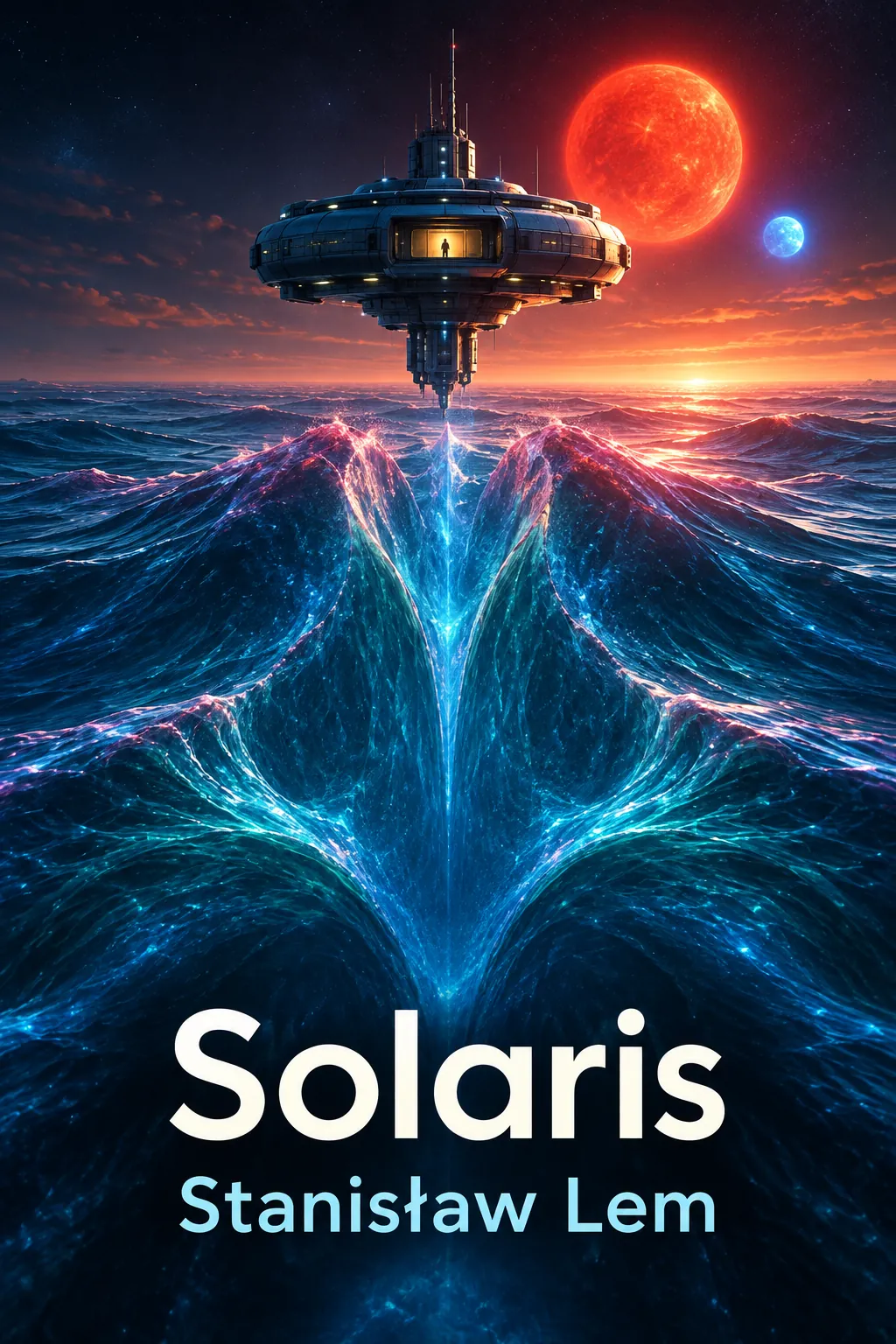
Solaris
by Stanisław Lem
Solaris is a 1961 novel by Stanisław Lem about the failure of human science to understand an alien mind. Psychologist Kris Kelvin travels to a research station hovering above the planet Solaris, whose single ocean may be alive and thinking. He finds the crew frightened and secretive, and soon learns why: the ocean has begun sending each of them a living, impossible reminder of their past. Kelvin must decide what is real and what he owes it.
The Big Idea
"Solaris asks what happens when humans meet something truly alien. The planet's ocean does not talk back in any way we recognise, so the people studying it end up learning mostly about themselves, and about the limits of understanding."
Key Insights
Alien means truly alien
Many stories give aliens human-like goals and speech. Solaris refuses. The ocean shares no language, purpose or body plan with us, and the people studying it cannot even be sure that words like “mind” or “intention” apply. Lem suggests that real contact starts with admitting how little we share.
The ocean builds enormous, shifting structures that scientists name and sort for decades. Nobody ever learns what they are for, and every new observation makes the puzzle larger.
Contact becomes a mirror
The visitors are drawn from memories the crew would rather forget. The people who came to study the ocean find that it is studying them, or at least reflecting them back. The novel argues that when we meet the unknown, we often see our own fears and hopes first.
Kelvin does not meet a monster. He meets Rheya, whose death he blames himself for, and her presence forces him to look at what he has avoided for ten years.
Grief and guilt with a body
Rheya is a copy built from Kelvin's memory, yet she begins to think, suffer and choose on her own. Lem asks what makes someone a real person: the material they are made of, or how they act and what they care about. He leaves the verdict to the reader.
Once she learns what she is, Rheya acts for Kelvin's sake rather than her own. She is not simply a puppet of his memory, and that is what makes her loss hurt.
Theories are not understanding
In the library chapters Lem piles up the theories of Solaristics. Each makes some sense, yet none reaches the ocean itself. Science is a powerful tool, but faced with something truly unknown, people tend to press their own assumptions onto it. The book is a warning against mistaking description for knowledge.
One school treats the ocean as a giant brain, another sorts its structures into neat classes. Both talk about it in human terms without ever knowing what it is like from the inside.
Hope without proof
Kelvin ends by staying on Solaris with no promise of an answer. The ending is neither happy nor tragic. It shows a quiet resolve to keep the possibility of contact open, even when nothing guarantees that the ocean cares or that anyone will ever know.
A wave touches Kelvin's gloved hand and withdraws without harming him. Neither he nor the reader can say what it meant, and that small moment is all the hope the book offers.
Chapter Breakdown
Chapter-by-chapter summary
Spoiler warning: this section covers the whole plot, including the ending.
Part 1: Arrival at Solaris Station
Kelvin, a psychologist, is lowered in a capsule to Solaris Station, a research outpost hovering above the planet's ocean under a red sun and a blue one. Nobody greets him. The cybernetician Snaut, the first person he finds, is jumpy and evasive. Kelvin learns that his old teacher Gibarian has just killed himself, and that the physicist Sartorius will not open his laboratory door. Kelvin glimpses strange figures in the corridor. Why it matters: Lem holds back every explanation, so the reader feels the dread at the same pace Kelvin does and understands that the station's problem is not broken equipment.
Part 2: The first visitor
Exhausted, Kelvin sleeps, and wakes to find Rheya beside him. She is his wife, who died by suicide ten years earlier after a bitter quarrel. She is warm, she speaks, and she behaves as if nothing happened. Panicked, Kelvin tricks her into a small rocket capsule and launches it into space. Snaut then tells him that every crew member receives such a visitor, shaped from private memories, and that this will not be the last. Why it matters: the premise lands as a personal horror, guilt that cannot stay buried.
Part 3: The second Rheya
The next day another Rheya appears. This time Kelvin does not send her away. She cannot bear to be out of his sight, remembers only what Kelvin remembers, and does not know she is not the woman who died. Kelvin notices that her body heals from any wound. When she overhears a recording left by Gibarian, she learns what she is and tries to end her life with liquid oxygen, then revives. Why it matters: the book asks whether a copy made from memory can have feelings of its own, and Kelvin has to treat her as a person while knowing what she is.
Part 4: The library of failed theories
Looking for answers, Kelvin reads the station's library on Solaristics, the long-running science of studying the ocean. He finds competing theories, including the idea that the ocean is a giant brain, and detailed catalogues of the towering structures it builds, which researchers named mimoids, symmetriads and asymmetriads. He also finds the report of the pilot Berton, who said he saw a giant child rise from the surface and was dismissed as hallucinating. Why it matters: this long, almost comic account shows scientists describing in great detail something they cannot understand, each school finding its own beliefs reflected in the ocean.
Part 5: What the visitors are
Sartorius finally explains what he has found. The visitors are made of unstable neutrino matter, and the ocean seems to read the sleeping minds of the crew to shape them. Sartorius wants to destroy the visitors with a device he is building. Kelvin and Snaut doubt that the ocean means harm, and Snaut suspects that humans go looking for other worlds when what they really want is a mirror. Kelvin proposes sending the ocean a beam shaped by his own brain activity, a message made of himself. Why it matters: research turns into something closer to a confession.
Part 6: Rheya's choice
After the beam is sent, new visitors stop appearing. Rheya understands that the device could free Kelvin, and that her presence is hurting him. When Kelvin wakes one morning she is gone: she has asked Snaut to destroy her. Kelvin is left with grief that no longer has a body to attach to. Why it matters: Rheya began as a symptom of Kelvin's guilt and ends as someone who makes her own moral decision.
Part 7: The island in the ocean
With the crisis over, Kelvin thinks about returning to Earth but does not go. He flies down to the surface, lands on an island the ocean has formed, and holds out his gloved hand. A wave rises, closes around it without harm, and withdraws, as if testing something. Kelvin decides to stay, not because he understands the ocean but because he cannot rule out that it understands him. Why it matters: Lem refuses a neat answer. Contact stays possible, and its meaning stays unknown.
Characters
Kris Kelvin
The narrator, a psychologist sent to the station. He arrives to analyse other people's minds and finds that his own is what the ocean is studying. His path runs from denial to a quiet, stubborn hope.
Rheya
A visitor shaped like Kelvin's wife, who died ten years before. She is built from his memories, so she does not know what she is. What she chooses once she learns the truth is the most moving thread in the book.
Snaut
The station's cybernetician. Worn out and sarcastic, he has been there long enough to understand the visitors. He is Kelvin's reluctant guide, and his honesty about human limits shapes the book's ideas.
Sartorius
The station's physicist. Cold and guarded, he treats the visitors as a phenomenon to measure and remove. He stands for science without comfort, but his findings explain what the visitors are made of.
Gibarian
Kelvin's former teacher and the first crew member to break down. He dies before Kelvin arrives, and his death starts the mystery. The recording he leaves helps explain what is happening.
Berton
A pilot who flew over the ocean years earlier and reported a giant child. The scientists dismissed him as hallucinating, but his story looks very different in light of what the crew now faces.
The ocean
The single liquid mass covering Solaris. It may be alive and thinking, but nobody can prove it. It never speaks in a way humans can read, yet it drives the whole plot of the novel.
Writing about this book
Solaris works well for essays because it has no single answer. These are questions to start from, not conclusions to copy.
- Why does the ocean send each person someone from their past, and what does that say about how the ocean sees humans? Compare at least two explanations the characters offer.
- Is Rheya a person? Look at the moments where she acts on her own: the night she tries to end her life and the choice she makes at the end.
- Why does Lem spend so many pages on invented scientific theories? What does the library section say about how people treat what they cannot understand?
- Kelvin stays on Solaris. Is that hope, stubbornness or escape? Use the final scene on the island to support your view.
- Pick one idea from the book, such as mirrors versus other worlds, and connect it to something from your own life or the news.
A strong essay names a scene, explains it in your own words and says how it changed your reading. Keep quotes short and note where they come from.
Take Action
Practical steps you can implement today:
-
Notice when you explain something unfamiliar only in terms you already know; that may be projection, not understanding.
-
When you study something new, expect to learn about your own memories, fears and assumptions too.
-
Treat detailed theories and labels as tools, not proof that you understand the thing itself.
-
Allow a question to stay open instead of forcing a quick answer; waiting can be a reasonable choice.
Notable Quotes
"“At 19.00 hours, ship's time, I made my way to the launching bay.” (Chapter 1)"
— Stanisław Lem
"“We have no need of other worlds. We need mirrors.” (Snaut's talk with Kelvin)"
— Stanisław Lem
"“Man has gone out to explore other worlds and other civilizations without having explored his own labyrinth of dark passages and secret chambers.” (Snaut's talk with Kelvin)"
— Stanisław Lem
Who Should Read This
Readers aged about 15 and up who like slow, thoughtful science fiction. It suits fans of first-contact stories, philosophy of mind and psychological drama. If you want battles and fast plots, it will feel quiet. The library chapters are dense and can be skimmed on a first read without losing the story.
Frequently Asked Questions
What is Solaris about?
Solaris is a 1961 novel about the attempt to understand an alien intelligence. Psychologist Kris Kelvin joins a research station above a planet covered by a possibly living ocean. The ocean sends the crew people from their pasts, and the book explores memory, guilt and the limits of human knowledge rather than space battles.
Is the ocean in Solaris alive?
The book never says for certain. Researchers have spent decades building theories about the ocean, including that it is a giant brain, but none is proven. Its responses to the crew are real yet unreadable, and that uncertainty is the main point of the story.
Who is Rheya in Solaris?
Rheya takes the form of Kelvin's wife, who died ten years before the story begins. The ocean builds her from his memories, so she starts without knowing what she is. As the story goes on, she becomes a character who makes her own choices.
How is the Solaris novel different from the films?
Andrei Tarkovsky made a film of Solaris in 1972 and Steven Soderbergh in 2002. Both centre on Kelvin and Rheya. The novel gives much more room to Solaristics, the history of failed theories about the ocean, and a dry, sceptical view of science. It is worth reading even if you know the films.
Is Solaris hard to read?
The story is clear, but the library chapters on Solaristics are dense, full of invented terms and long lists of theories. Many readers skim them on a first pass. Lem's prose is calm and precise, and the book is fairly short, so most adult readers can finish it in a few evenings.
Check Your Understanding
Pick an answer for each question to see if you were right.
-
What is Kris Kelvin's profession?
Psychologist — Kelvin is a psychologist sent to Solaris Station, and his own mind soon becomes the thing under study.
-
What does the ocean send to the crew of the station?
Visitors built from their memories — Each crew member receives a living visitor shaped from a painful memory.
-
What are the visitors made of, according to Sartorius?
Neutrino matter — Sartorius finds that they are formed of an unstable neutrino structure.
-
What did the pilot Berton report seeing over the ocean?
A giant child — Berton described a giant child rising from the surface, and the scientists dismissed it as a hallucination.
-
What does Kelvin do at the end of the novel?
Stays on Solaris and waits — He chooses to stay, keeping open the possibility of contact with the ocean.
About Stanisław Lem
Stanisław Lem (1921–2006) was a Polish writer who trained in medicine in Lwów before turning to fiction. He wrote novels, short stories and essays that mix science, philosophy and satire. Solaris, published in 1961, is his best-known novel and a standard example of science fiction that treats first contact as a problem of understanding.
Summary Written By

Software Engineer & Writer
Software engineer with a passion for distilling complex ideas into actionable insights. Writes about finance, investment, entrepreneurship, and technology.
View all summaries →Reviews
No reviews yet. Be the first to share your thoughts!
Write a Review
Keep reading
Explore the topic: Space & Alien LifeSummaries

Out of My Mind
Sharon M. Draper
“Out of My Mind” by Sharon M. Draper is a poignant narrative that explores the life of Melody Brooks, a…

Ender’s Game
Orson Scott Card
“Ender’s Game” by Orson Scott Card is a riveting science fiction novel that transports readers into a future where humanity…

Pachinko
Min Jin Lee
“Pachinko”, a spellbinding multigenerational historical saga by Min Jin Lee, explores the lives of a Korean family trying to make…

The Perks of Being a Wallflower
Stephen Chbosky
The Perks of Being a Wallflower by Stephen Chbosky is a profound coming-of-age novel, told through the intimate letters of…
Articles

First Contact in Fiction and Science
First contact is the moment humans and another intelligent species first learn of each other. It has never happened: no…

A Christmas Carol themes: generosity, isolation and responsibility
Dickens's novella is usually read as a story about a man who changes his mind. Its themes are sharper than…
Nebula Award: What It Is and Notable Winners
The Nebula Award is an American science fiction and fantasy prize voted on by working writers. The Science Fiction and…