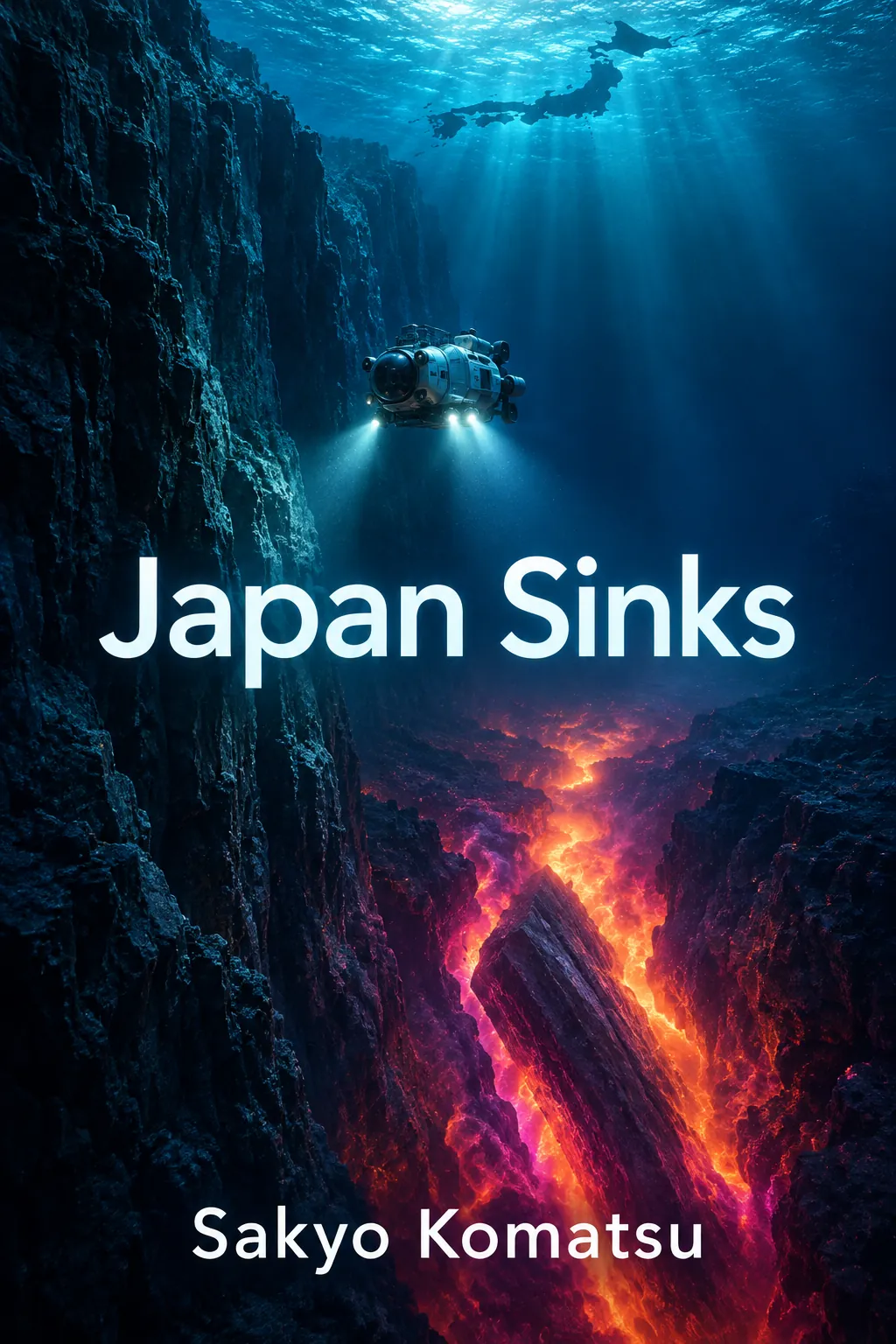
Japan Sinks
by Sakyo Komatsu
Japan Sinks is Sakyo Komatsu's 1973 disaster novel about a geophysicist who finds that the Japanese archipelago is being pulled down into the earth and will vanish far sooner than anyone expects. A deep-sea pilot, a stubborn scientist and a secret government team race to plan the escape of some hundred million people. It is part science thriller, part political drama, and a long question about what holds a people together.
The Big Idea
"When scientists discover that the Japanese islands are about to sink into the sea, the novel asks what a nation still is when it has no land left to stand on."
Key Insights
A nation is more than its land
The central question of the novel is what remains of a people when its territory is gone. Komatsu pushes the reader to separate language, memory and community from soil and borders, and he does not offer an easy answer.
By the end the islands are gone, yet some characters choose to stay and go down with their country, which shows how deeply people tie themselves to a place.
Science needs politics to matter
Tadokoro's discovery is worthless until someone with power believes it. The book shows that knowing the truth and acting on it are two different problems, and the second is often harder.
Scholars laugh at Tadokoro, and only when Watari takes him seriously and the prime minister starts Project D does the research turn into action.
Preparation is a form of care
Much of the story is about planning: running simulations, setting timetables, designing an evacuation abroad. Komatsu treats this unglamorous work as heroic, because every plan decides who gets saved and how.
The D-2 plan to move people and their assets out of Japan depends on quiet work by a small team of officials and experts.
Disaster reveals ordinary people
The novel keeps returning to individuals, not just statistics. A huge event is made understandable by following a pilot, a scientist and a young woman through it, and by showing how love, fear and duty collide.
Onodera meets Reiko Abe through an arranged marriage meeting, and their private story is then caught up in the same forces that are breaking the country apart.
Chapter Breakdown
Chapter-by-chapter summary
Spoiler warning: this section covers the whole plot, including the ending. It is split here into six parts.
Part 1: The island that vanished overnight
One summer, a small uninhabited island near the Ogasawara Islands sinks into the sea in a single night. Geophysicist Yusuke Tadokoro goes to investigate. He dives into the Japan Trench with the submersible pilot Toshio Onodera and his assistant, Associate Professor Yukinaga, and the three find cracks in the seafloor and muddy turbidity currents that should not be there. Why it matters: the book begins with a small, measurable oddity, so the later catastrophe feels earned rather than sudden.
Part 2: Amagi erupts and Project D begins
Earthquakes shake the Izu Peninsula and Mount Amagi erupts. At a government advisory meeting, Tadokoro says Japan itself may disappear, and the other scholars laugh at him. Watari, an old power broker behind both politics and business, takes the idea seriously and has the prime minister start a secret study called Project D. Why it matters: it shows that in this world, real decisions move through private trust long before any official process.
Part 3: What the mantle is doing
Tadokoro, Yukinaga, Onodera and the information scientist Kazunari Nakada work through the data. They conclude that the mantle flow beneath the archipelago has gone wrong, and that in the worst case most of Japan's land could sink within two years. Watari asks Professor Fukuhara to plan a way for the population to leave the country. Why it matters: the story turns from a science puzzle into a question of what a state can do about it.
Part 4: Kyoto, Tokyo and the leak
A huge earthquake strikes Kyoto first, and Tokyo is hit by another giant quake soon after, while volcanoes along the Fuji belt erupt one after another. Tadokoro believes the public must be told. He leaks the danger through a weekly magazine and television, then leaves Project D. Why it matters: it sets the cost of silence against the risk of panic, a tension that runs through the rest of the book.
Part 5: Ten months and the D-2 plan
After the leak, computer simulations show that the sinking could be finished within about ten months. The prime minister announces the crisis to the Diet, and the project staff push ahead with D-2, the plan to evacuate the people and their assets abroad. Not everyone wants to leave, and some choose to stay and share the fate of their country. Why it matters: it turns a rescue plan into a personal question about loyalty and home.
Part 6: The last land goes
The islands go under one region after another. Shikoku is among the first, and northern Kanto, the last land left, ends in a huge explosion, so the archipelago vanishes completely. Watari dies in his house in Fuchu while it happens, with Tadokoro beside him. Tadokoro, who had staged a drunken scene on television as a final warning, stays with Japan to the end. The epilogue also follows members of the project who escaped abroad, and the second volume closes with the words "End of Part One", since Komatsu planned a sequel about the scattered survivors. Why it matters: the ending turns the disaster into a question about what a people keeps once the place itself is gone.
Characters
Toshio Onodera
A deep-sea submersible pilot and the reader's main eyewitness. He sees the first physical signs of the crisis from the seafloor, and he is practical and brave, with more feeling on show than the scientists around him.
Yusuke Tadokoro
A geophysicist with a prickly, obsessive manner. Colleagues treat him as a crank, yet he is the first to understand what is happening, and he stays with Japan to the end.
Yukinaga
A marine geology associate professor who joins Tadokoro and Onodera on the dive into the Japan Trench and later works with them on the Project D research. He is one of the small circle of scientists who see the first evidence.
Kazunari Nakada
An information scientist on the Project D team. His computer work helps turn a vague fear into a timetable the government can act on.
Reiko Abe
A young woman from a powerful business family in Shimoda, who is introduced to Onodera for an arranged marriage meeting. She later decides to marry him. Through her, the book shows how private hopes bend under a national disaster.
Watari
A well-connected old power broker who backs Tadokoro and sets Project D in motion. He shows how real power often runs on personal trust rather than official channels.
Project D
Not a person but a key term: the secret government effort to study and respond to the sinking. D-1 studies whether huge upheaval is coming, and D-2 plans the evacuation.
Background: why the book mattered in 1973
Japan Sinks first appeared in March 1973 from the publisher Kobunsha, in two volumes released together. Komatsu spent about nine years writing it. Japan was in a period of rapid economic growth, and the novel asked a question that was unusual for its time: what if the success story ended not through war or recession, but through the ground itself?
The book also draws on a fact every Japanese reader already knows. The islands sit where several tectonic plates meet, so earthquakes and volcanoes are part of daily life. Komatsu took this real background and pushed it to an extreme. That is why the novel works both as a thriller and as a thought experiment: the cause is believable, even if the result is invented.
It won the Seiun Award and the Mystery Writers of Japan Award. Michael Gallagher's English translation appeared in 1976 and was reissued in 1995. In 2006 Komatsu and the writer Koshu Tani published a sequel, Japan Sinks: Part Two.
How to read the book
Read the first parts for the clues. The deep-sea dive and the vanished island are short, but they set the method of the whole book: notice a small fact, ask what it means, and follow it until it becomes a national problem. If you keep a note of each clue, the later decisions in Project D will make more sense.
Then watch how the point of view moves. The book shifts between the seafloor, the professor's study, the government's offices and ordinary streets. Each shift shows the same event from a different distance, and that contrast is much of the story's power.
Writing about this book
This novel gives you plenty to write about without needing a plot retelling. Start from one question you really have, for example: what does it mean to belong to a country when the land itself is gone? Then look for scenes that help you think it through, such as the Tokyo quake, Tadokoro's leak to the public, or the choice of some people to stay.
Useful angles for an essay or class discussion: the way the book mixes real earth science with invented events; how leaders in the story weigh honesty against panic; and why a 1973 novel about Japan still feels relevant to readers who live with earthquakes today. Try to compare one scene with something from real life, such as how communities prepare for disasters, and say what the book makes you notice that you had not before.
The story has also been retold in films, a manga, TV dramas and an anime. Base your points on the novel and say clearly which version you mean. Finally, be clear about what is fiction: the sinking is invented, while the idea of plates moving and trenches swallowing rock is real science.
Take Action
Practical steps you can implement today:
-
Read slowly on the first scenes: the small deep-sea clues set up everything that happens later.
-
Note how each character reacts to bad news differently, and compare it with how you would react.
-
Separate the real earth science in the book from the invented events when you write about it.
-
Ask yourself what a country is made of besides land, and use one scene to support your answer.
Who Should Read This
Readers aged about 14 and up who like disaster stories, science thrillers or big ideas about society. It suits high school and university students who want a classic of Japanese science fiction, and anyone curious about how a country might face a crisis that threatens its existence.
Frequently Asked Questions
What is Japan Sinks about?
Japan Sinks is a 1973 novel by Sakyo Komatsu. A geophysicist discovers that movement deep inside the earth is pulling the Japanese islands under the sea. The story follows the scientists, officials and ordinary people who try to understand the danger and plan an evacuation of the whole population.
Who wrote Japan Sinks and when?
Sakyo Komatsu, a Japanese science fiction writer, published it in 1973 through Kobunsha. It became a landmark of Japanese science fiction and made him famous well beyond SF readers. An English translation by Michael Gallagher appeared in 1976.
Who are the main characters?
The main characters are Toshio Onodera, a deep-sea submersible pilot, and Yusuke Tadokoro, a geophysicist who first sees the danger. Reiko Abe, the old power broker Watari and the researchers Yukinaga and Nakada also matter. The secret government effort is called Project D.
Is the science in Japan Sinks real?
Part of it is. Japan sits where several tectonic plates meet, and earthquakes and volcanoes are real, constant risks there. The complete sinking of the islands is invented. Komatsu used real ideas about plates and the earth's interior to make an extreme story feel believable.
Is Japan Sinks a good book for a school report?
Yes, it offers many topics: the idea of a nation, how governments handle disaster, the role of scientists, and how fiction uses science. For a report, base your points on the novel itself and say clearly if you also discuss a film or anime version.
How does the novel relate to the films and anime?
The story has been adapted several times, including a 1973 film, a 2006 film remake and the 2020 anime Japan Sinks: 2020. Each is a separate work. If you write a report, say which one you mean, and take your plot points from the novel.
Check Your Understanding
Pick an answer for each question to see if you were right.
-
Who wrote Japan Sinks?
Sakyo Komatsu — Sakyo Komatsu, a leading Japanese science fiction author, published the novel in 1973.
-
What is Toshio Onodera's job?
Deep-sea submersible pilot — Onodera pilots a deep-sea submersible and sees early signs of the crisis from the seafloor.
-
What kind of expert is Yusuke Tadokoro?
Geophysicist — Tadokoro is a geophysicist who first understands that the islands are in danger.
-
What is the name of the secret government effort in the novel?
Project D — Project D is the secret team that studies and responds to the sinking.
-
Which big question does the novel leave the reader with?
What remains of a nation without its land? — The ending turns the disaster into a question about people and identity once the homeland is gone.
About Sakyo Komatsu
Sakyo Komatsu (1931–2011) was a Japanese science fiction writer born in Osaka. He was one of the leading voices of postwar Japanese SF, known for large-scale ideas and for mixing hard science with politics and history. Japan Sinks, published in 1973, is his best-known novel and won the Seiun Award.
Summary Written By

Software Engineer & Writer
Software engineer with a passion for distilling complex ideas into actionable insights. Writes about finance, investment, entrepreneurship, and technology.
View all summaries →Reviews
No reviews yet. Be the first to share your thoughts!
Write a Review
Keep reading
Explore the topic: Sci-Fi Authors & AwardsSummaries

Out of My Mind
Sharon M. Draper
“Out of My Mind” by Sharon M. Draper is a poignant narrative that explores the life of Melody Brooks, a…

Ender’s Game
Orson Scott Card
“Ender’s Game” by Orson Scott Card is a riveting science fiction novel that transports readers into a future where humanity…

Pachinko
Min Jin Lee
“Pachinko”, a spellbinding multigenerational historical saga by Min Jin Lee, explores the lives of a Korean family trying to make…

The Perks of Being a Wallflower
Stephen Chbosky
The Perks of Being a Wallflower by Stephen Chbosky is a profound coming-of-age novel, told through the intimate letters of…
Articles

Seiun Award
The Seiun Award is Japan's oldest science fiction award, first given in 1970. Fans who attend the annual Japan SF…

Hard Science Fiction: What It Is and Where to Start
Hard science fiction is science fiction that sticks closely to known science. Its inventions, from alien worlds to spaceships, must…

Sakyo Komatsu
Sakyo Komatsu (1931–2011) was a Japanese science fiction writer, best known for the disaster novel Japan Sinks. He wrote about…