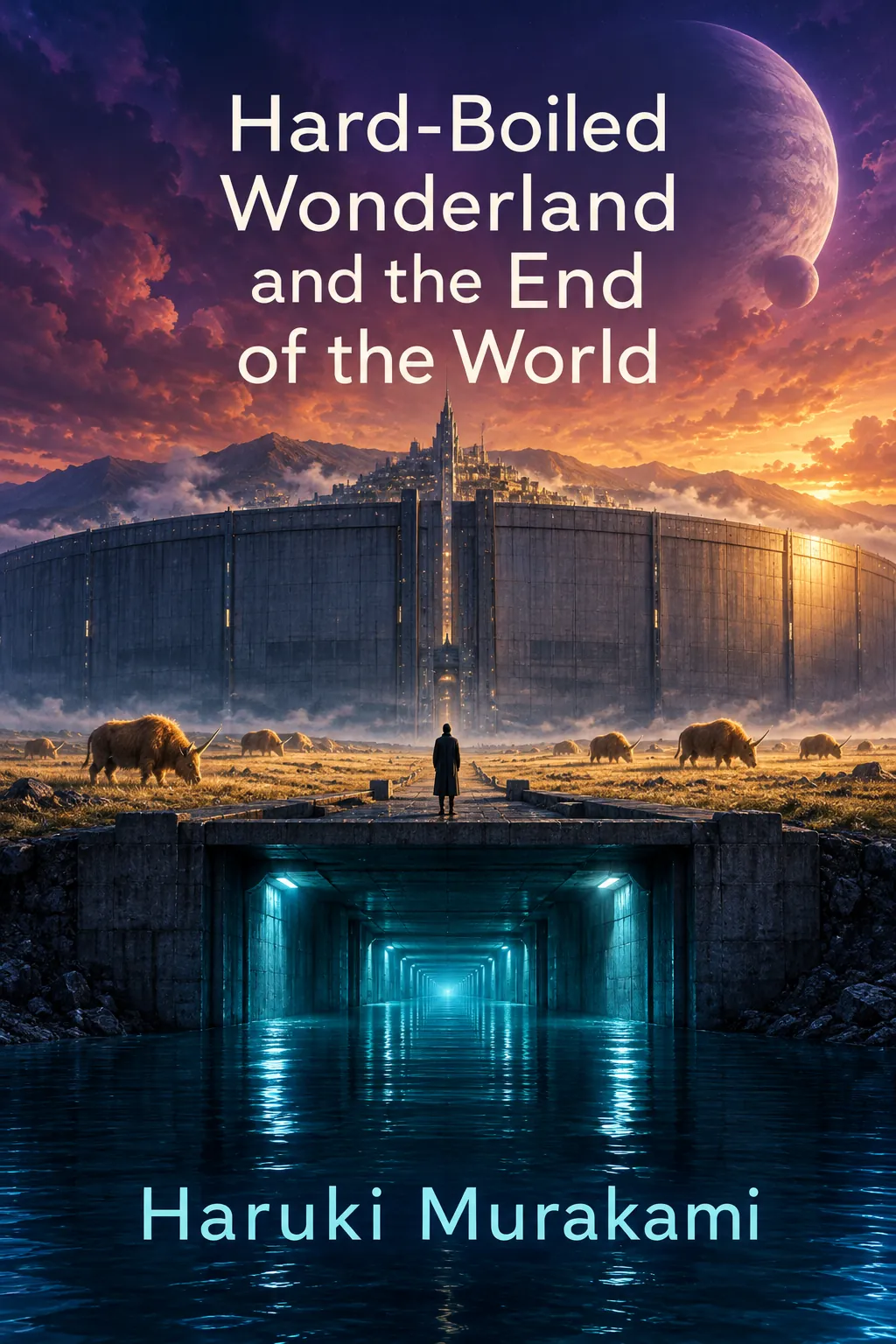
Hard-Boiled Wonderland and the End of the World
by Haruki Murakami
Hard-Boiled Wonderland and the End of the World is a 1985 novel by Haruki Murakami with two storylines that alternate chapter by chapter. In one, a Tokyo data scrambler called a Calcutec takes a job from an odd scientist and is pulled into a war between rival information agencies. In the other, a man arrives in a walled town where he loses his shadow and must read old dreams from unicorn skulls. How the two worlds connect is the book's central puzzle.
The Big Idea
"A man's mind is split into two worlds: a noisy Tokyo of data thieves and a silent walled town where feelings are taken away. The book asks what a self is worth without its heart."
Key Insights
Peace without a heart
The walled town has no conflict, hatred or grief. Its people live calmly because they have no minds. The novel sets a life without pain beside a life in which a person stays fully themselves, and it never says one is simply right. It does suggest that a quiet, safe place may rest on a hidden price. In daily life we also dull our feelings to avoid being hurt, or choose the safe option every time.
The Dreamreader gives up the outside world in exchange for calm, and that trade is what makes the final scenes ache.
Memory makes the self
Reading old dreams from unicorn skulls is the book's picture of how memory and feeling are handled. The dreams are what remains of minds that were set aside, so reading them is a slow act of recovery. In Tokyo, too, the narrator's job is to handle what is stored in people's heads. The two worlds share an idea: what we remember and imagine is what makes us who we are, and losing it thins us out.
Dreams survive in skulls even after the beasts die, as if a trace of the person always stays behind.
Information makes people into tools
Calcutecs encode information, and the System and the Factory fight over it. Both are large powers that care little about the individuals who work for them. The Professor's experiment treats one person's head as a device with a use. In a world where information is valuable, people can become parts of someone else's plan without noticing. The novel can be read as a 1980s worry about the information age told as an adventure.
The narrator does not learn what was installed in his own mind until the Professor tells him, even though he is proud of his skill.
Structure as the message
Odd and even chapters tell stories of different moods: a hard-boiled urban adventure and a quiet fable. As you read, the two begin to echo each other. The form itself makes the reader feel the book's subject, which is the outside and inside of one mind. It can be confusing at first, but spotting the small links between the two worlds is a pleasure of its own, and the answer arrives gradually.
Both worlds feature unicorns, a library and dark water, and these details are clues that tie the separate scenes together.
Chapter Breakdown
Chapter-by-chapter summary
Spoiler warning: this section covers the whole plot, including the ending.
The novel is built from short numbered chapters that alternate between two storylines. They are grouped into six parts here to keep the plot easy to follow.
Part 1: A Calcutec takes a strange job
In the "Hard-Boiled Wonderland" chapters, the narrator is a Calcutec in his mid-thirties. He encodes data using a private shuffling process that only his subconscious knows. He works for the System, which is at war with the Factory, a rival group of Semiotecs who steal information. An old scientist summons him to a hidden lab beneath Tokyo, where he meets the scientist's granddaughter, a young woman in a pink suit. The job sounds simple, but the Professor's real interest is the narrator himself. Why it matters: we meet a careful, lonely technician who has no idea his own mind is the target.
Part 2: Arrival at the walled town
In the "End of the World" chapters, a man arrives at a town enclosed by a high wall and watched by a Gatekeeper. The Gatekeeper cuts the man's shadow away from him and keeps it apart. The man is given the post of Dreamreader and works at the Library at dusk, helped by a quiet young Librarian. His task is to read the old dreams left in unicorn skulls. Golden-furred beasts graze outside, and the townspeople are calm to an eerie degree. Why it matters: the peace of the town is the first hint that something has been taken from everyone in it.
Part 3: The Professor's secret
The Professor finally admits what he did. His experiment fused the narrator's shuffling process with another circuit, which now runs a separate inner world. Because of this, the narrator's ordinary consciousness will shut down within about a day and will not return. Both the System and the Factory want what is in his head. At this point the reader sees that the walled town is the world inside his mind. Why it matters: a spy story becomes a countdown, and the two storylines turn out to be one.
Part 4: Down among the INKlings
The narrator and the granddaughter go underground to find the Professor. They move through dark, flooded tunnels beneath Tokyo, where the light-hating INKlings live. Meanwhile the Semiotecs have wrecked his apartment, so his everyday life is being taken apart as well. Why it matters: the dark water and hidden passages echo the walled town, so the two worlds seem to call to each other.
Part 5: How the town works, and what the shadow wants
Over time the Dreamreader learns the town's rules from the Colonel and the Librarian. The people live without conflict because they have given up their minds, and the dreams in the skulls are traces of those lost minds. Many of the beasts die when winter comes. The weakening shadow asks him to map the town and argues that it is a trap, urging escape. Why it matters: the town's promise of calm collides with the shadow's wish to stay whole, even if that hurts.
Part 6: The last day and the choice
In Tokyo the narrator spends his final hours on ordinary pleasures: a meal, some music, time with the librarian. In the town, the shadow prepares to flee through the Pool to the south. The Dreamreader helps the shadow leave and then chooses to stay behind in the town. Why it matters: the ending is quiet and bittersweet, and it can be read as either loss or a kind of peace.
Characters
The narrator
The unnamed narrator. In Tokyo he is a Calcutec in his mid-thirties, an orderly, lonely man who likes good food and a quiet routine. In the town he is the Dreamreader. The two are one mind seen from different sides, and the book follows what happens to that mind.
The Professor
An elderly scientist who works in a hidden underground lab. He studies how to alter the mind, and his experiment on the narrator drives the whole plot. He is more absorbed than wicked, which makes the harm he causes harder to forgive.
The Professor's granddaughter
A young woman in a pink suit who guides the narrator and travels with him into the tunnels. She is direct and lively, and she gives the Tokyo chapters a warmth that the System and the Factory lack.
The Tokyo librarian
A reference librarian who loves food and helps the narrator research unicorns. Their meals together are some of the gentlest scenes in the book, and they show what the narrator stands to lose.
The Shadow
In the walled town, the Dreamreader's shadow is cut away and kept apart from him. Weak but sharp, it sees that the town is a trap and argues for escape. It speaks for the part of the self that refuses to give up its feelings.
The Librarian in the town
A quiet young woman who helps the Dreamreader at the Library. Like the other residents she seems to have no mind, and his wish to reach her becomes one of the strongest reasons he has for staying in the town.
The Colonel
An old man in the town who befriends the Dreamreader and explains its customs. He is gentle, and his calm shows how comfortable people can become with a life that has no conflict in it.
The Gatekeeper
A powerful man who guards the town's gate and separates newcomers from their shadows. He stands for the town's rules and its quiet, unarguable authority. He is the first person the Dreamreader meets, and he is anything but welcoming.
The INKlings
Light-hating creatures that live in the dark tunnels and waterways under Tokyo. They threaten the narrator and the granddaughter on their descent, and they stand for what lies beneath a modern city.
The Semiotecs
Agents of the Factory who trade in stolen information. They are the narrator's professional enemies, and their raid on his apartment turns his quiet life into a chase.
Writing about this book
A school report on this novel works best when it follows one question about the mind rather than the whole plot. Here are some starting points, with no ready-made answers:
- The townspeople have no fights and no grief. Is that happiness? What would you give up for a life without pain?
- The shadow wants to leave and the Dreamreader chooses to stay. How would you explain each choice?
- Two storylines alternate. Which did you look forward to, and why?
- Is it better to forget painful things or to keep them?
Pick one scene that stayed with you and explain why it did, using your own words and experience. Do not retell the story from start to finish. If you mention the ending, warn readers first. This is a puzzling book, and saying honestly which parts confused you is a good way to show real thinking.
Take Action
Practical steps you can implement today:
-
Read the chapters in pairs, asking whether each is the outer or the inner world. It makes the alternating structure far less confusing.
-
Think about when you have chosen to feel less to stay comfortable, and what that choice cost you.
-
Check now and then which of your memories and opinions are really yours, and which came from the information around you.
-
For a school report, choose one scene that bothers you and write down why. That question is a better spine than a plot summary.
Notable Quotes
"“Deep rivers run quiet.”"
— Haruki Murakami
"“I never trust people with no appetite. It's like they're always holding something back on you.”"
— Haruki Murakami
"“Unclose your mind. You are not a prisoner.”"
— Haruki Murakami
Who Should Read This
Good for readers aged about 16 and up who enjoy philosophical science fiction, strange settings or Murakami's work. It is a long, odd novel with some violence and sexual content, so it may be too much for younger teens. Reading this summary first makes the two storylines easier to follow.
Frequently Asked Questions
What is Hard-Boiled Wonderland and the End of the World about?
It is a 1985 novel with two storylines that alternate. In one, a Tokyo Calcutec who encodes information is drawn into a war between rival agencies by an odd scientist's request. In the other, a man in a walled town loses his shadow and reads old dreams from unicorn skulls. Together they ask what a person is without their mind.
How do the two storylines connect? (spoiler)
The Professor's experiment has built a separate world inside the narrator's mind. The walled town is that world. As his ordinary consciousness runs out of time in Tokyo, the town storyline approaches its end. Both stories show one mind from different sides.
Is this a good first Murakami novel?
It can be, if you like ideas and strange settings. It is more openly science-fictional and more puzzle-like than Norwegian Wood, which is a quiet realist love story. If you prefer realism, start with that one. If you like an inventive, layered book, this one is a strong choice.
Who translated it into English?
Alfred Birnbaum translated it. It was first published in English by Kodansha International in 1991, and a Vintage edition followed. The Japanese title puts the End of the World first, while the English title opens with Hard-Boiled Wonderland.
Is it science fiction?
Yes, in a broad sense. It has brain-altering technology, rival information agencies and underground creatures. But it is also a fable about the self and memory, and Murakami treats the sci-fi elements as ways to ask personal questions rather than as the point of the book.
Check Your Understanding
Pick an answer for each question to see if you were right.
-
What does the narrator do for a living in the Tokyo storyline?
He is a Calcutec who encodes data — He is a Calcutec, scrambling information with a shuffling process only his subconscious knows.
-
What happens to the man's shadow when he enters the walled town?
It is cut away from him — The Gatekeeper separates the shadow from him when he arrives.
-
What does the Dreamreader read at the Library?
Old dreams held in unicorn skulls — His job is to read the old dreams that remain in the skulls of the beasts.
-
Which creatures live in the tunnels under Tokyo?
The INKlings — The INKlings are the light-hating creatures of the dark waterways below the city.
-
Which Japanese literary prize did the novel win in 1985?
The Tanizaki Prize — It received the Tanizaki Prize in 1985.
About Haruki Murakami
Haruki Murakami (born 1949 in Kyoto) is a Japanese novelist and translator whose books, including Norwegian Wood, Kafka on the Shore and 1Q84, have been translated into dozens of languages. He began writing after running a jazz bar in Tokyo. Hard-Boiled Wonderland won the Tanizaki Prize in 1985 and is among his most openly science-fictional novels.
Summary Written By

Software Engineer & Writer
Software engineer with a passion for distilling complex ideas into actionable insights. Writes about finance, investment, entrepreneurship, and technology.
View all summaries →Reviews
No reviews yet. Be the first to share your thoughts!
Write a Review
Keep reading
Explore the topic: Science FictionSummaries

Out of My Mind
Sharon M. Draper
“Out of My Mind” by Sharon M. Draper is a poignant narrative that explores the life of Melody Brooks, a…

Ender’s Game
Orson Scott Card
“Ender’s Game” by Orson Scott Card is a riveting science fiction novel that transports readers into a future where humanity…

Pachinko
Min Jin Lee
“Pachinko”, a spellbinding multigenerational historical saga by Min Jin Lee, explores the lives of a Korean family trying to make…

The Perks of Being a Wallflower
Stephen Chbosky
The Perks of Being a Wallflower by Stephen Chbosky is a profound coming-of-age novel, told through the intimate letters of…
Articles

A Christmas Carol themes: generosity, isolation and responsibility
Dickens's novella is usually read as a story about a man who changes his mind. Its themes are sharper than…
Nebula Award: What It Is and Notable Winners
The Nebula Award is an American science fiction and fantasy prize voted on by working writers. The Science Fiction and…
Seiun Award
The Seiun Award is Japan's oldest science fiction award, first given in 1970. Fans who attend the annual Japan SF…