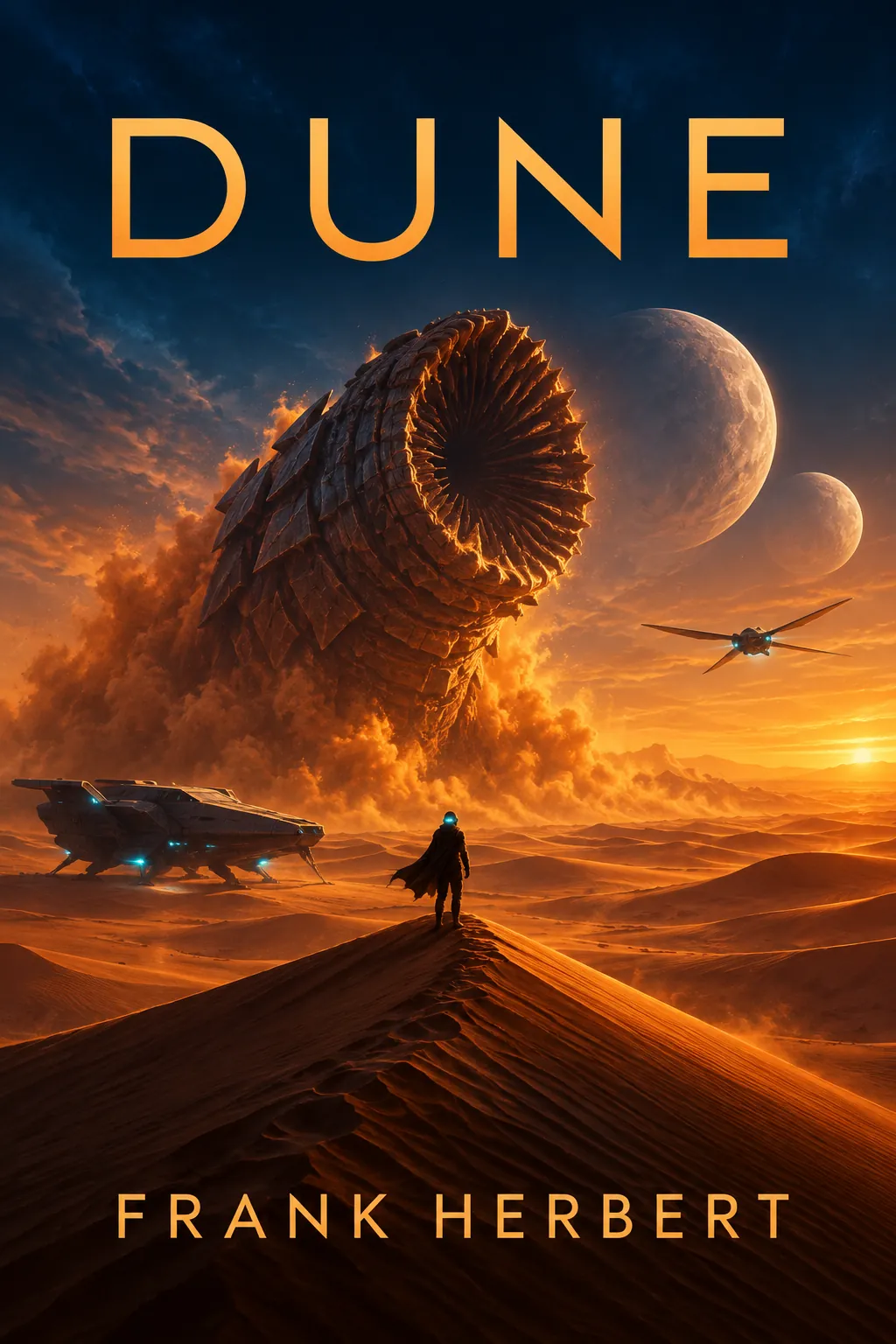
Dune
by Frank Herbert
Dune is a science-fiction novel by Frank Herbert, published in 1965, set on Arrakis, a desert planet that is the only source of the spice melange. Fifteen-year-old Paul Atreides moves there with his noble family, just as a plot against them begins. Exiled into the desert, he must learn to live with the native Fremen, who watch for a promised leader. The book mixes politics, religion and ecology into one story about power and its price.
The Big Idea
"Dune asks what happens when a people hungry for a saviour meets a young man who can see the future: power, religion and ecology collide, and the hero's rise has a terrible cost."
Key Insights
A saviour can be both hope and danger
Paul is welcomed as the leader people have been waiting for, but the story shows how that hope can swell into war. Herbert suggested that when people hand everything to a strong leader, their own belief can become a force nobody controls. It reads like a hero's tale, yet it is also a warning about heroes.
Paul sees that a holy war in his name is almost certain. The Fremen's faith keeps growing, and even he cannot hold it back.
Environment shapes culture
Arrakis has almost no water, and nearly every Fremen custom comes from protecting it. Herbert used ideas from ecology to show that the land helps decide how a society lives. The planet is not a backdrop; it is as important to the story as any character.
The Fremen recover moisture with stillsuits and even return the water of the dead to the tribe, while Kynes plans to turn the desert green over generations.
Religion can be turned into a tool
The Bene Gesserit have long planted legends and prophecies on many worlds as a form of insurance. Belief can comfort people, but it can also be used by those with their own plans. Herbert describes this coolly, and it invites readers to ask who spread a story and why.
The Fremen already expect an outside saviour, and Paul and Jessica use that expectation to be accepted.
Scarce resources drive empires
The spice extends life and makes space travel possible, so the Emperor, the great Houses and the Guild all scheme to control it. The setup echoes real struggles over oil and water. It also shows how the people who live on a resource-rich land are often the last to be asked.
The Emperor hands Arrakis to the Atreides as part of a trap, and the Fremen who have lived there for generations barely figure in his plans.
Chapter Breakdown
Chapter-by-chapter summary
Spoiler warning: this section covers the whole plot, including the ending.
Dune has no numbered chapters. It is split into three books, Dune, Muad'Dib and The Prophet, so this guide follows the story in six natural parts.
Part 1: The Test and the Move to Arrakis (Book One)
The story opens on Caladan, home of House Atreides. Paul, the fifteen-year-old heir of Duke Leto, is visited by a Bene Gesserit Reverend Mother. She holds a poisoned needle to his neck and makes him keep a hand inside a box that causes terrible pain. If he pulls away, he dies. He endures it, which shows unusual self-control. Soon after, the Emperor orders the Atreides to take over Arrakis, the only source of the spice, from their old enemies, House Harkonnen. Leto suspects a trap but cannot refuse. Why it matters: Paul is being shaped by forces larger than he understands, and the move is a political gamble with his family's lives at stake.
Part 2: Betrayal on Arrakis (Book One)
The Atreides settle in the city of Arrakeen and learn that the Fremen, the desert people, hold the key to the planet. Leto hopes to win them as allies. Paul begins to see fragments of the future in his dreams. Then the Harkonnens attack, helped by the Emperor's elite Sardaukar troops. Dr. Yueh, the family's own physician, has been forced to betray them and switches off the defensive shields. Leto is captured and dies. Duncan Idaho holds off the attackers so that Paul and his mother, Jessica, can escape. They crash their aircraft in a desert storm. Why it matters: the family's fall ends Paul's old life and starts his long road back.
Part 3: Among the Fremen (Book Two)
Book Two, Muad'Dib, begins some time after the escape. Paul and Jessica are taken in by a band of Fremen led by Stilgar. Paul wins a ritual duel against the warrior Jamis, which earns him a place among them. He receives two names: Usul, used within the tribe, and Muad'Dib, taken from a desert mouse, which becomes his public name. He learns to wear a stillsuit, to save every drop of water, and he grows close to Chani. Liet-Kynes, the Empire's planetologist and a secret ally of the Fremen, dies in the desert. Why it matters: a noble boy becomes a desert dweller, and the planet's ecology steps forward as the story's other main character.
Part 4: The Water of Life (Book Two)
Paul leads raids against Harkonnen spice operations and wins the respect of the Fremen. He also learns to ride a giant sandworm. Jessica drinks the Water of Life, a poison that a Reverend Mother can transform, and becomes a Reverend Mother herself. The change reaches her unborn daughter, Alia, who will be born with an adult's awareness. Later Paul drinks it too. He lies unconscious for days and wakes able to see across space and time. He is the figure the Bene Gesserit had spent generations trying to breed, the Kwisatz Haderach. Why it matters: Paul sees that nearly every future ends in a holy war carried out in his name, so his choices are no longer simple.
Part 5: The Prophet (Book Three, first half)
In Book Three, Fremen attacks have cut spice production sharply, and the Emperor travels to Arrakis with a great army and Baron Harkonnen. Gurney Halleck, who thought Paul was dead, meets him again among smugglers and joins his forces. The Fremen now see Paul as the promised saviour, and their faith grows stronger by the day. Paul knows this faith is both his greatest strength and a force he cannot stop. He also holds a weapon: he can destroy the spice, and the Spacing Guild, which needs it to navigate between stars, dare not move against him. Why it matters: it shows belief turning into military power, and what that costs Paul.
Part 6: The Battle of Arrakeen (Book Three, second half)
When the Emperor's fleet lands, the Fremen use atomic weapons to blast a gap in the rock wall protecting Arrakeen and attack under cover of a sandstorm. Fremen warriors riding sandworms charge into the city. The Sardaukar are overwhelmed, and Alia kills the Baron with a poisoned needle. Paul faces Feyd-Rautha, the Baron's heir, in a knife duel and wins. The Emperor admits defeat, and Paul demands the throne and a marriage to the Emperor's daughter, Princess Irulan. Chani remains the woman he loves. Paul knows he cannot stop the holy war that will carry his name. Why it matters: the book ends in victory, but Herbert presents it as the start of something larger and darker.
Characters
- Paul Atreides: The fifteen-year-old heir of House Atreides and the book's hero. He carries his father's training in leadership and his mother's Bene Gesserit discipline. Among the Fremen he becomes Muad'Dib. His gift of seeing possible futures helps him survive and also traps him.
- Lady Jessica: Paul's mother and a Bene Gesserit. She disobeyed her order by giving Leto a son instead of a daughter. She trains Paul in the sisterhood's skills, and in the desert becomes a Reverend Mother whom the Fremen respect.
- Duke Leto Atreides: Paul's father and head of the House. He is a decent, well-loved leader who walks into Arrakis knowing it is a trap. He tries to protect his family and his people to the end.
- Baron Vladimir Harkonnen: The head of House Harkonnen and the Atreides' bitter enemy. He is cruel, greedy and cunning, and he uses plots, bribes and fear to win back control of Arrakis and its spice.
- Stilgar: The leader of a Fremen sietch, or desert community. He is stern, proud and fair. He accepts Paul after the duel and becomes one of his closest and most loyal supporters.
- Chani: A young Fremen woman, the daughter of Liet-Kynes, and Paul's partner. She teaches him how to live in the desert and stays close to him even when his path frightens her.
- Dr. Wellington Yueh: The Atreides family physician. The Harkonnens hold his wife, and he betrays the Duke to save her. He carries deep guilt and quietly plans a form of revenge on the Baron.
- Liet-Kynes: The Emperor's planetologist on Arrakis, who lives close to the Fremen. He dreams of turning the desert green over generations, and that dream outlives him.
- Gurney Halleck: A warrior and musician in the Atreides household, and Paul's teacher in fighting. After the attack he survives among smugglers and later returns to Paul's side.
- Alia: Paul's younger sister. Because Jessica drank the Water of Life while pregnant, she is born with an adult's knowledge and memories, which unsettles everyone who meets her.
Terms worth knowing
- Spice (melange): a rare substance found only on Arrakis. It extends life, expands awareness and makes space travel possible.
- Sandworm: a giant creature living under the desert sand, which the Fremen treat with deep respect.
- Bene Gesserit: a sisterhood that trains its members and plans bloodlines over generations.
- Stillsuit: a desert suit that collects the body's moisture and turns it back into drinking water.
- Spacing Guild: the organisation that moves ships between stars, and depends on the spice to do so.
Writing about this book
Dune is long and full of invented terms, so a book report is easier to write when you choose one angle. These questions are a starting point for your own ideas.
- Is Paul a hero or a danger? He sees that a holy war may follow his rise and still moves forward. What would you have done?
- The Fremen live by saving water. How do climate and landscape shape the way people live where you are?
- The fight over spice resembles real fights over oil or water. Who benefits from a scarce resource, and who pays?
- Why do people long for a saviour? What is the difference between trusting a leader and handing over all responsibility?
Rather than retelling the plot, pick one scene that stayed with you and explain why. Link it to something in your own life. A short phrase from the book, followed by your own reasons, works better than a long quotation. If you write for readers who have not finished the book, be careful with how much of the ending you give away.
Take Action
Practical steps you can implement today:
-
List the main houses and what each one wants before you read; it makes the politics much easier to follow.
-
Do not try to memorise every term. Hold on to three: spice, water and sandworms.
-
When a character looks like a hero, ask which paths he did not choose and what they might have cost.
-
Connect the Fremen's water habits to your own region's climate to find a personal angle for a report.
Notable Quotes
"“Fear is the mind-killer.” (Book One)"
— Frank Herbert
"“A beginning is the time for taking the most delicate care that the balances are correct.” (Book One)"
— Frank Herbert
"“I will permit it to pass over me and through me.” (Book One)"
— Frank Herbert
Who Should Read This
Readers from about 14 up, including high-school students, who enjoy big ideas, politics and world-building. The novel is long and full of invented terms, so a five-minute summary helps before you start. It suits students looking for a book-report topic and anyone who wants to know the book behind a famous name.
Frequently Asked Questions
What is Dune about?
Dune follows Paul Atreides, a young nobleman whose family is given the desert planet Arrakis, the only source of the valuable spice. A plot destroys his House, and Paul rises among the native Fremen. The novel explores power, religion, ecology and the danger of following a saviour. A fuller outline is in the part-by-part summary above.
Is Dune hard to read?
It can be at first. The book is long, and it introduces many names, Houses and invented words. The story itself is clear: a boy loses his family and must choose how to use his gifts. Reading the character list and the term list here first helps. The glossary at the end of the novel is also useful.
What is the spice melange?
The spice is a rare substance found only on Arrakis. It extends life, expands awareness and lets Guild navigators guide ships between stars. Because the whole Empire depends on it, whoever controls Arrakis holds great power. Heavy use also creates dependence and turns the eyes of users deep blue.
What does Muad'Dib mean?
In the Fremen language Muad'Dib is the name of a small desert mouse that survives where little else can. Paul chooses it as his public name after joining the Fremen. As his fame grows, the name comes to mean the promised leader the Fremen have been expecting.
How many Dune books did Frank Herbert write?
Herbert wrote six novels in the series. Dune is the first, followed by Dune Messiah, Children of Dune, God Emperor of Dune, Heretics of Dune and Chapterhouse: Dune. The first book works as a complete story on its own. Later volumes follow the results of Paul's choices.
Check Your Understanding
Pick an answer for each question to see if you were right.
-
Which planet is the main setting of Dune?
Arrakis — The Atreides are sent to Arrakis, the desert planet where the spice is found.
-
What makes Arrakis so valuable?
The spice melange — Arrakis is the only source of the spice, which extends life and makes space travel possible.
-
Who is Paul's mother?
Lady Jessica — Jessica is a Bene Gesserit and Duke Leto's partner, and she raises Paul in her order's skills.
-
What do the Fremen wear to recover their body's moisture?
A stillsuit — A stillsuit captures sweat and breath and turns them back into drinking water.
-
Who kills Baron Harkonnen?
Alia — Alia, Paul's young sister, kills the Baron with a poisoned needle during the battle for Arrakeen.
About Frank Herbert
Frank Herbert (1920–1986) was an American writer who worked as a journalist before turning to fiction. Dune ran as a serial in Analog magazine in 1963–65 and appeared as a book in 1965. It won the first Nebula Award for best novel and shared the Hugo Award. Herbert went on to write five sequels.
Summary Written By

Software Engineer & Writer
Software engineer with a passion for distilling complex ideas into actionable insights. Writes about finance, investment, entrepreneurship, and technology.
View all summaries →Reviews
No reviews yet. Be the first to share your thoughts!
Write a Review
Keep reading
Explore the topic: Sci-Fi Genres & IdeasSummaries

Out of My Mind
Sharon M. Draper
“Out of My Mind” by Sharon M. Draper is a poignant narrative that explores the life of Melody Brooks, a…

Ender’s Game
Orson Scott Card
“Ender’s Game” by Orson Scott Card is a riveting science fiction novel that transports readers into a future where humanity…

Pachinko
Min Jin Lee
“Pachinko”, a spellbinding multigenerational historical saga by Min Jin Lee, explores the lives of a Korean family trying to make…

The Perks of Being a Wallflower
Stephen Chbosky
The Perks of Being a Wallflower by Stephen Chbosky is a profound coming-of-age novel, told through the intimate letters of…
Articles

Best Science Fiction Books: 11 Novels Worth Reading
The best science fiction books to start with are Frankenstein, 1984, Dune, Neuromancer, The Three-Body Problem and Project Hail Mary.…

Terraforming Mars: What It Is and Could It Work?
Terraforming means changing a planet’s air, temperature and water until people can live outdoors without a spacesuit. The word was…

History of Science Fiction
The history of science fiction runs about 200 years, from Mary Shelley's Frankenstein in 1818. Jules Verne and H. G.…