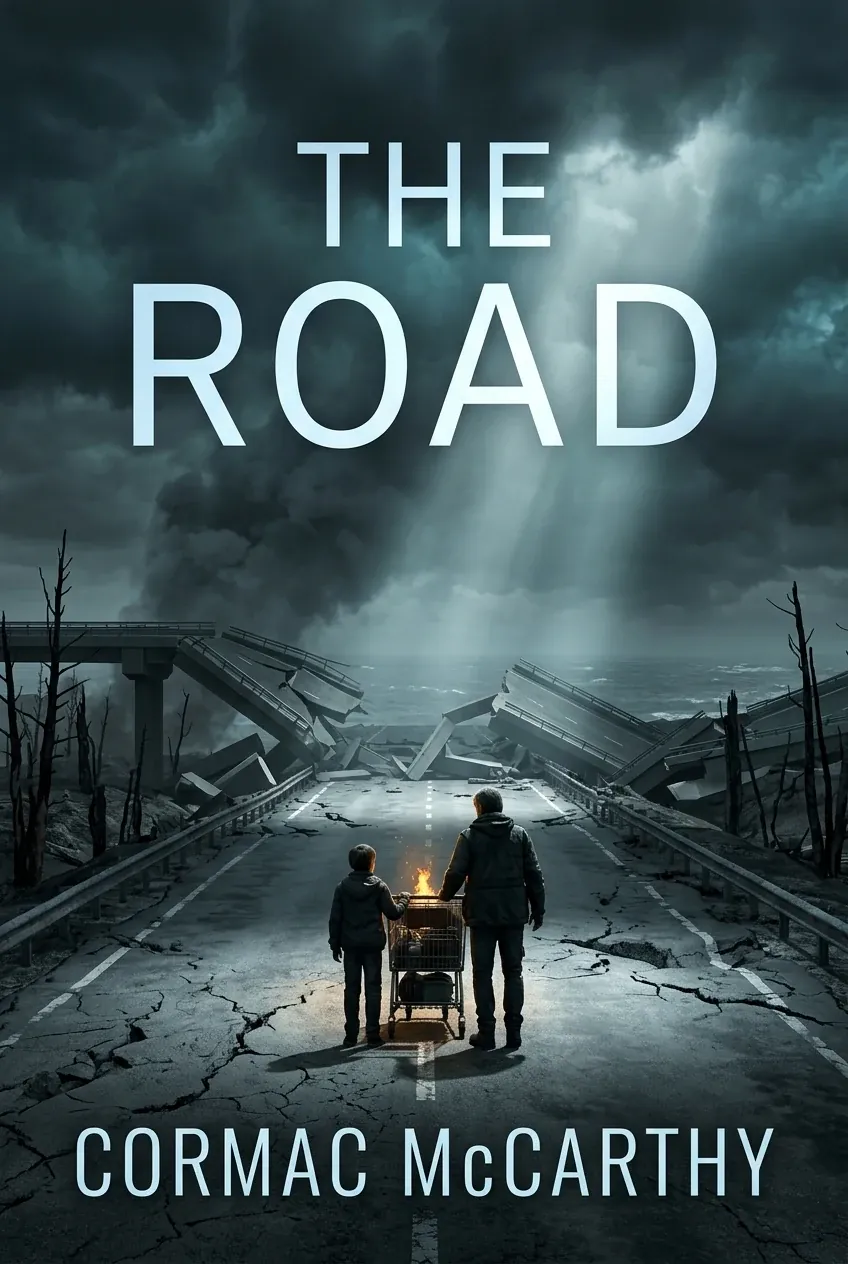
The Road
by Cormac McCarthy
The Road is Cormac McCarthy's 2006 novel about a father and his young son walking south along a road through an America ruined by an unnamed disaster. Ash covers everything, food is nearly gone, and desperate people hunt others. The man has a pistol with two bullets and one aim: get the boy to the coast alive. Their journey is a quiet test of whether kindness can survive when survival is all that matters.
The Big Idea
"In a dead, ash-covered world, a father's only purpose is to keep his young son alive and decent. The Road asks what is left of goodness when nothing else is."
Key Insights
Love as the last compass
With no law, no school and no future, the father's love becomes the one rule that still works. Everything he does, from rationing food to sleeping beside a gun, comes from it. McCarthy does not make this love soft: it makes the man cold toward strangers as well as tender toward his son. Readers are left to decide whether that love saves him or narrows him.
When the man shoots the stranger who grabs the boy, his love protects the child and also costs the boy another piece of innocence.
Carrying the fire
The fire is the book's private name for hope and goodness, the quality that sets the pair apart from the gangs. It is never fully explained, and that is the point. It works as a promise the two keep making to each other rather than as a fact about the world. By the end, the father hands the job of keeping it alive to his son.
In their quiet talks, the man tells the boy that the fire is inside him, and the boy chooses to keep walking.
What makes someone one of the good guys
The boy keeps asking whether they are the good guys, and the answers get harder to give. The father kills and steals in order to live, while the boy insists on sharing food and worrying about strangers. The novel does not declare a winner. It lets the father's hard realism and the son's open kindness stand side by side.
When the thief takes their cart, the father strips him and leaves him on the road, while the boy begs him to give the clothes back.
A world described by what is missing
McCarthy writes in short, plain sentences and skips quotation marks. His grey landscape is built from absences: no birds, no colour, few names. The father's dreams of the old world, full of colour and warmth, make the loss felt more strongly than any explanation of the disaster could.
The book never says what caused the catastrophe. Readers learn only what is left behind.
Chapter Breakdown
Chapter-by-chapter summary
Spoiler warning: this section covers the whole plot, including the ending. The novel has no numbered chapters, so it is split here into six natural parts.
Part 1: Ash and a Shopping Cart
A father and his young son wake in the cold woods, years after a catastrophe that darkened the sky and killed nearly everything alive. They push a shopping cart of blankets and scraps south along an old road, hoping the coast will be warmer. The man carries a revolver with two bullets, and he knows what he may have to do with them if the worst comes. He teaches the boy the rules of their world: stay quiet, stay hidden, keep moving. Why it matters: the opening makes the boy's survival the only goal the story recognises, and it shows a love that speaks mostly through small acts like sharing food.
Part 2: The Gangs on the Road
The real danger is other people. Some survivors have formed gangs that capture and eat their victims, and the man and boy hide in roadside brush whenever armed groups pass. When a stranger grabs the boy, the father shoots him without hesitation, leaving himself with one bullet. Later, searching a large old house for food, they discover people locked in the cellar, kept alive to be eaten. They flee, but the boy cannot stop trembling. Why it matters: these scenes show what the father's protectiveness costs, and they bring the book's central question into the open: what separates the good guys from everyone else?
Part 3: The Underground Shelter
Hidden under the ground behind a house, the pair find a stocked shelter built by someone who prepared for the end. It holds canned food, blankets and clean water. For a few days they wash, eat until they are full and sleep warm, the first real rest of the journey. Even so, the father cannot relax and insists they leave before anyone finds the place, while the boy is reluctant to go. Why it matters: this is nearly the only moment of comfort in the book, and it shows how fear has changed the father, so that even safety feels like a trap.
Part 4: Ely and the Boy's Questions
Along the road they meet an old man who says his name is Ely. The boy asks his father to give Ely some food, and the father agrees unwillingly, keeping a close eye on him. Ely says he does not believe in God or hope, and that nothing will matter once the last person is gone. Elsewhere the boy repeatedly begs to help other survivors, including another child he glimpses, but his father refuses because it is too dangerous. Why it matters: the contrast between the father's hard caution and the boy's open compassion becomes the book's moral centre.
Part 5: The Grey Sea
The man's cough grows worse and starts to bring up blood. At last they reach the sea, but it is cold and grey, not the blue the father remembered, and his quiet disappointment is plain. While he sleeps, a thief takes their cart and supplies. The father tracks him down, points the pistol at him and makes him take off his clothes and shoes, leaving him on the road. The boy is in tears and says it is too cruel. Why it matters: this is where father and son clash most sharply over right and wrong, and it signals that the journey is nearing its end.
Part 6: Carrying the Fire
On the beach the man is hit in the leg by an arrow. He kills the attacker with a flare gun, and the two escape, but the wound and his sickness drain him. Knowing he cannot go on, he asks the boy to keep going and to carry the fire. He dies with the boy beside him, and the boy stays by his body for three days. Then a stranger, a man travelling with his wife and two children, finds him, and the boy goes with them. The novel closes with a memory of brook trout in mountain streams. Why it matters: the ending offers a thin, hard-won hope, passed from father to son.
Characters
- The Man (the father): He is never named. Before the disaster he was an ordinary family man; now his whole purpose is his son. He is careful, resourceful and sometimes ruthless with strangers, yet endlessly gentle with the boy. His worsening cough hints that his time is short.
- The Boy: The man's young son, born after the disaster and knowing no other world. He keeps his compassion and keeps asking whether they are still the good guys. He is the book's conscience.
- The Woman (the boy's mother): She appears only in the man's memories and dreams. She chose to end her life rather than face the new world, and her absence shapes the man's grief and his will to continue.
- Ely: An old man the pair meet on the road who gives that name. He believes in neither God nor hope and calmly accepts that humanity is ending. He is a dark mirror to the boy's kindness.
- The Thief: A man who steals the cart and supplies near the sea. The father's harsh punishment of him sets off the sharpest disagreement between father and son.
- The gangs on the road: Survivors who capture and eat other people. They are the pair's greatest threat and a picture of what happens when people give up their humanity.
- The family at the end: A man travelling with his wife and two children, who take in the orphaned boy. They give the story its final, cautious note of hope.
Writing about this book
Teachers often ask for a theme, a symbol and a personal response. These questions are for thinking with, not for copying.
- Why might McCarthy leave the characters and the cause of the disaster unnamed? What does that do to you as a reader?
- What does the fire stand for, and who finally carries it? Find two scenes where it comes up and compare them.
- Father and son disagree about strangers. Whose view do you find more convincing, and why?
- The sentences are short and plain, with very little punctuation. Choose one paragraph and explain how its style matches its mood.
A good report picks one scene and looks at it closely instead of retelling the plot. Use one short quotation at most, and connect it to your own experience of care, fear or hope. The book contains harsh violence, so if it troubled you, say so honestly. That reaction can be part of a thoughtful response.
Take Action
Practical steps you can implement today:
-
Pick one small, steady rule to keep, such as being kind, and hold to it even when conditions make it hard.
-
Say the important things out loud. The man and boy keep hope alive by repeating it to each other.
-
Notice what you would protect first when everything is uncertain, and ask whether fear is shrinking your compassion.
-
Hope can be handed on. Look for people you can teach, support or encourage so that good habits outlast you.
Notable Quotes
"“You have to carry the fire.” (the father's words to the boy)"
— Cormac McCarthy
"“And we’re carrying the fire.” (father and son's repeated exchange)"
— Cormac McCarthy
"“It’s inside you.” (the father reassuring the boy)"
— Cormac McCarthy
Who Should Read This
Best for readers aged about 15 and up, including upper high school and college literature students. It suits anyone who likes quiet, character-driven stories about family and survival. Be aware that the book contains violence, cannibalism and grief, and its tone stays bleak. The prose is short and plain, so it reads quickly.
Frequently Asked Questions
What is The Road about?
The Road is a 2006 novel by Cormac McCarthy about a father and his young son walking south across a ruined America, years after an unnamed catastrophe. They scavenge for food, avoid violent gangs and try to reach the coast. It is a story about survival, but even more about love, fear and whether goodness can last.
What caused the disaster in The Road?
The book never says. It describes ash, burned forests, a dark sky and a dead landscape, but it gives no cause. Readers have suggested a nuclear war or a comet strike, yet McCarthy leaves the cause out on purpose, so attention stays on the father and son rather than on how the world ended.
Why don't the main characters have names?
The man and the boy are only ever called that, which makes them feel like any father and any child. The missing names also match a world where the old structures, including names and records, have lost their meaning. Only a few minor characters, such as the old man Ely, give a name.
What does carrying the fire mean in The Road?
Carrying the fire is the father and son's shared way of speaking about hope and decency. It sets them apart from those who have given up their humanity. The book never defines it exactly, so readers can interpret it themselves, and at the end the boy is the one who must keep it alive.
Did The Road win any awards, and is it suitable for school?
It won the 2007 Pulitzer Prize for Fiction and is widely taught. Because of its violence, cannibalism and grief, teachers usually assign it to older students, around grade 10 and up. Parents or teachers may want to read ahead and talk about the harder scenes with younger readers.
Check Your Understanding
Pick an answer for each question to see if you were right.
-
In which direction do the man and the boy travel?
South — They head south along the road, hoping the coast will be warmer.
-
How many bullets are in the father's revolver at the start?
Two — He has a revolver with only two bullets and knows what he might have to use them for.
-
What do the father and son call the hope they keep alive?
The fire — They repeat that they are carrying the fire, their way of naming hope and decency.
-
Who is the old man the pair meet who gives his name as Ely?
A lone traveller who has lost faith in everything — Ely is a solitary old man who does not believe in God or hope.
-
Which major prize did The Road win?
The Pulitzer Prize for Fiction — The novel won the Pulitzer Prize for Fiction in 2007.
About Cormac McCarthy
Cormac McCarthy (1933–2023) was an American novelist born in Rhode Island and raised in Tennessee. His books include Blood Meridian, All the Pretty Horses and No Country for Old Men. The Road, published in 2006, won the Pulitzer Prize for Fiction in 2007.
Summary Written By

Software Engineer & Writer
Software engineer with a passion for distilling complex ideas into actionable insights. Writes about finance, investment, entrepreneurship, and technology.
View all summaries →Reviews
No reviews yet. Be the first to share your thoughts!
Write a Review
Keep reading
Explore the topic: Science FictionSummaries

Out of My Mind
Sharon M. Draper
“Out of My Mind” by Sharon M. Draper is a poignant narrative that explores the life of Melody Brooks, a…

Ender’s Game
Orson Scott Card
“Ender’s Game” by Orson Scott Card is a riveting science fiction novel that transports readers into a future where humanity…

Pachinko
Min Jin Lee
“Pachinko”, a spellbinding multigenerational historical saga by Min Jin Lee, explores the lives of a Korean family trying to make…

The Perks of Being a Wallflower
Stephen Chbosky
The Perks of Being a Wallflower by Stephen Chbosky is a profound coming-of-age novel, told through the intimate letters of…
Articles

A Christmas Carol themes: generosity, isolation and responsibility
Dickens's novella is usually read as a story about a man who changes his mind. Its themes are sharper than…

Nebula Award: What It Is and Notable Winners
The Nebula Award is an American science fiction and fantasy prize voted on by working writers. The Science Fiction and…

Seiun Award
The Seiun Award is Japan's oldest science fiction award, first given in 1970. Fans who attend the annual Japan SF…