The Republic
by Plato
Plato's Republic is a dialogue in which Socrates asks what justice is and whether a just life is better than an unjust one. To answer, he imagines an ideal city with three classes and a ruling group of philosophers, then shows that the human soul has the same three parts. Along the way he gives the cave allegory, attacks poetry, traces how cities decline into tyranny, and ends with a story of life after death.
The Big Idea
"In the Republic, Socrates asks what justice is and builds an ideal city to find out. His answer: a just person, like a just city, has every part doing its own job under the guidance of reason."
Key Insights
Justice is order inside the soul
Plato does not treat justice as a rule handed down from outside. He describes it as a state of the soul in which reason, spirit and appetite each do their own job, with reason in charge. On this view, a just person is also a healthy and happy one.
Think of a student who wants to play games before an exam. If appetite wins, reason and spirit are left unhappy. If reason plans, spirit supplies effort and appetite gets a break afterwards, the whole person works together.
What we see may only be shadows
The cave allegory asks us to treat everyday appearances as one step short of the real thing. For Plato, knowing is not collecting facts but turning away from comfortable opinions and looking at what is true. That turn can feel uncomfortable at first.
Many people have repeated a claim from social media without checking it. Treat that post as a shadow, then look for the original source and a different view. That is a small step out of the cave.
Should the people who know do the ruling?
Plato argues that, as with steering a ship or treating illness, running a city should be left to those who understand the good. He also says such people must not crave power, and should rule as a duty, because the best rulers are those who would rather be doing something else.
A team that picks its captain only for popularity may do worse than one that picks the person who sees its weak points. The idea is strong, but it leaves a hard question: who decides who truly knows?
Political decay starts in what people value
In Book 8, cities change as the values of their citizens change: first honour, then wealth, then freedom, then unchecked desire. Plato claims the shape of a state follows what its people love most, so reform has to begin with character and education, not only with laws.
A class where only loud people are praised slowly stops rewarding quiet helpers, and its overall quality drops. What a group prizes shapes the group, and this gives a way to look at any community.
Chapter Breakdown
Chapter-by-chapter summary
Spoiler warning: this section covers the whole plot, including the ending. The Republic has ten books, and the guide below follows them in order.
Book 1: What Is Justice?
The dialogue opens in the Piraeus, the harbour of Athens, at the house of a wealthy old man named Cephalus. Socrates asks him what justice is. Cephalus says it means telling the truth and paying your debts, but Socrates points out that returning a borrowed weapon to a man who has gone mad would not be right. Polemarchus then suggests that justice is helping friends and harming enemies, and Socrates argues that harming anyone only makes them worse. Thrasymachus bursts in and claims that justice is just whatever benefits the stronger, and that injustice pays. Socrates answers that a true ruler, like a doctor, works for the good of those he serves. The book ends with no settled answer. That open question drives the other nine books.
Book 2: Glaucon's Challenge and the First City
Glaucon is not satisfied. He tells the story of the ring of Gyges, which makes its wearer invisible, and asks whether anyone would stay honest if they could never be caught. His brother Adeimantus adds that parents and poets praise justice only for what it brings. Both ask Socrates to show that justice is good in itself. Socrates suggests looking for it in a city first, because a city is larger and easier to read than a single soul. He sketches a simple city that grows into a luxurious one, which then needs an army of guardians. The book closes by asking what stories young guardians should hear. This is the challenge the whole work answers.
Book 3: Educating the Guardians and the Noble Lie
Socrates goes on to shape the guardians’ education. Stories must not show the gods as liars or heroes as cowards, and music and poetry should teach order and courage. Gymnastics trains the character as well as the body. The best guardians will rule, and the rest will act as their helpers. To keep the city united, Socrates proposes a “noble lie”: citizens are told they were born from the earth with gold, silver or bronze in their souls, which sets their roles. Guardians will own no private property. Plato treats education as the base of politics, and the noble lie remains one of the most debated ideas in the book.
Book 4: Four Virtues and Three Parts of the Soul
Adeimantus objects that the guardians, with no property, will not be happy. Socrates replies that the aim is the happiness of the whole city, not of one class. A rightly founded city, he says, has four virtues: wisdom in its rulers, courage in its soldiers, moderation as agreement about who should rule, and justice, which is each class doing its own work. He then argues that the soul has three parts: reason, spirit and appetite. A person is just when reason leads, spirit supports it and appetite obeys. This is Plato’s central answer: justice is order within, and injustice is a kind of civil war inside a person.
Book 5: The Three Waves and the Philosopher-King
Pressed to explain how guardians will share wives and children, Socrates makes three bold proposals he calls waves. First, women guardians receive the same education and work as men, since the real difference is ability, not sex. Second, guardians live in common and the city raises the children. Third, and hardest: cities will have no rest from trouble until philosophers rule or rulers become philosophers. To defend this, he separates philosophers, who love seeing the truth itself, from lovers of sights and sounds, who hold only opinions. The idea of the philosopher-king appears here, and it explains why the ideal city is led by knowledge rather than popularity.
Book 6: The Good, the Sun and the Divided Line
Socrates explains why real philosophers look useless or corrupt in actual cities: crowds reward flatterers, and gifted young people are spoiled by bad company. He compares a state to a ship whose crew fight over the steering and ignore the one true navigator. Rulers must learn the highest subject, the Form of the Good, which he describes only through images. The Good is like the sun: it lets us see things and gives them life. He then draws the divided line, which ranks four levels of understanding, from imagination and belief up to reasoning and pure knowledge. These images set out Plato’s view that knowledge aims at unchanging Forms, not at the changing things we see.
Book 7: The Cave and the Education of Philosophers
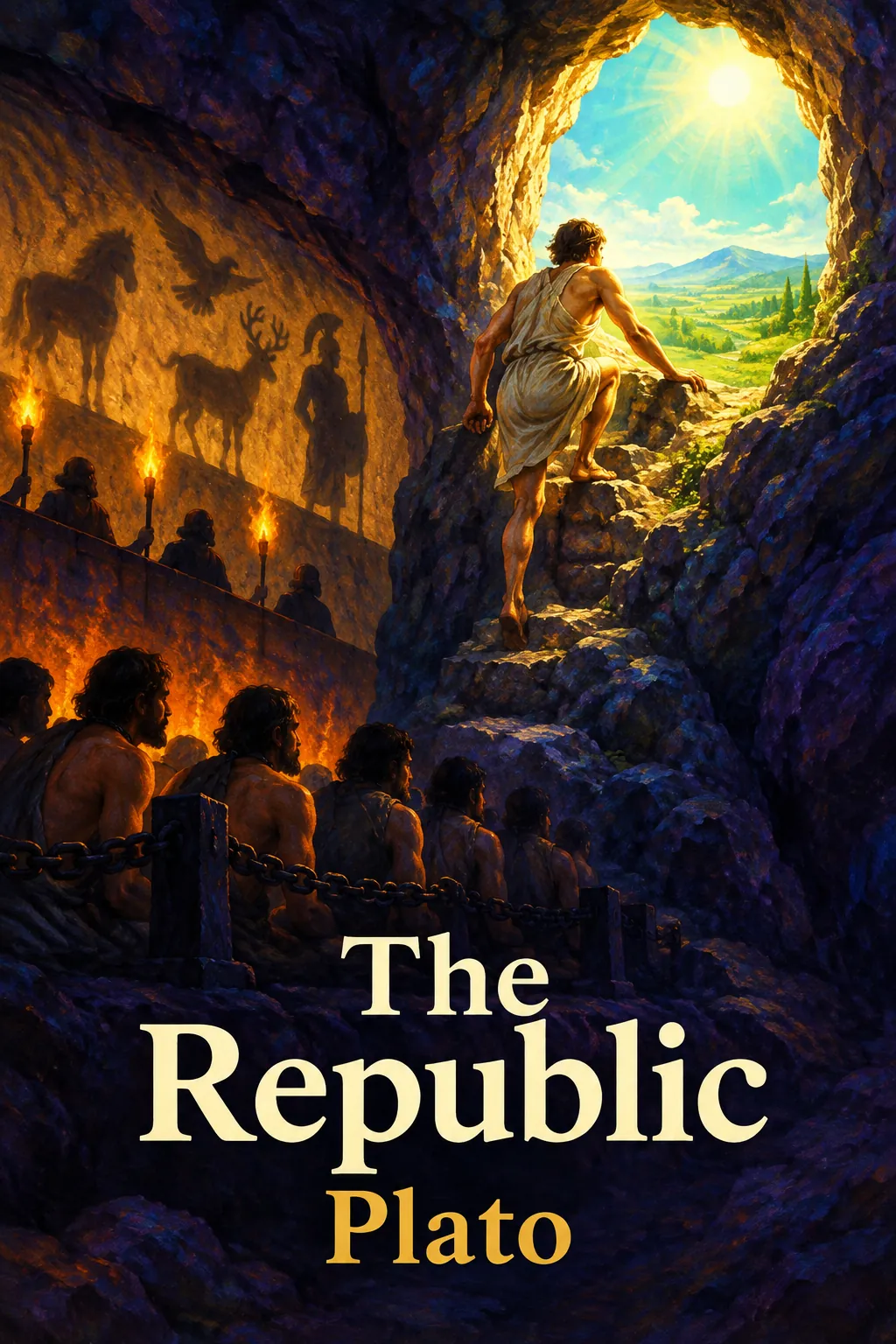
Book 7 opens with the allegory of the cave. Prisoners chained since childhood see only shadows on a wall and take them for reality. One is freed, climbs into the sunlight and slowly learns to look at real things, and finally at the sun. If he goes back, his old companions will laugh at him and might even kill him. Socrates then lays out the future rulers’ education: arithmetic, geometry, astronomy and harmony, leading to dialectic, the method of reasoning toward the Good. Those who have seen the truth must go back and rule the cave, even if reluctantly. Education here means turning the whole soul toward the truth, not filling it with facts.
Book 8: How Cities and People Decline
Socrates describes how the best city would decline through four worse regimes. Timocracy is rule by honour and soldiers; oligarchy is rule by the rich; democracy is rule by the free and the many; tyranny is rule by one master. Each regime has a matching type of person whose character mirrors the city. Oligarchy undoes itself through love of money and a widening gap between rich and poor. In democracy, the love of freedom turns into disorder, the people look for a champion, and the champion becomes a tyrant. For Plato, political decay begins in the values of the citizens.
Book 9: The Tyrant's Misery and the Reward of Justice
The tyrannical person is ruled by wild appetite, lives in fear, and is never free or satisfied. Socrates gives three arguments that the just life is the happiest. First, the person fit to rule is the happiest and the tyrant the most wretched. Second, each part of the soul has its own pleasures, but only the lover of wisdom has tasted all of them and can judge. Third, pleasures of the mind are more real and lasting than those of the body. He ends with an image of the soul as a many-headed beast, a lion and a human, and says the human part must be made strongest. Glaucon’s challenge from Book 2 is finally answered.
Book 10: Poetry, the Soul and the Myth of Er
Socrates returns to poetry and says imitative art stands three steps from truth: a painter’s bed copies a carpenter’s bed, which copies the Form of the bed. Poetry also feeds emotion at the expense of reason, so most of it is kept out of the ideal city, though its defenders are invited to make their case. He argues that the soul is immortal and that justice is rewarded both in life and after it. The work ends with the Myth of Er, a soldier who returned from death and reports how souls choose their next lives. The myth leaves the reader with a last point: our choices shape who we become, so it matters to know what a good life is.
The allegory of the cave in plain words
Picture people chained in a cave, facing a wall. Behind them, a fire throws the shadows of carried objects onto the wall. The prisoners have never seen anything else, so for them the shadows are the world. When one is freed, the light hurts his eyes and the shadows still seem more real. Slowly he adjusts and looks at the sun. In the story, the shadows stand for everyday appearances and opinions, the outside world for the unchanging Forms, and the sun for the Form of the Good. The prisoner who goes back down stands for the philosopher’s duty to share what he has learned.
Key people and terms
- Socrates. The main speaker and narrator. A real Athenian philosopher and Plato’s teacher, he tests ideas by asking questions. In this book he argues that justice is a kind of order, first in a city and then in the soul.
- Glaucon. Plato’s brother and an eager debater. His ring of Gyges story forces Socrates to show that justice is worth having for its own sake, not only for its rewards.
- Adeimantus. Glaucon’s brother, and so also a brother of Plato. He points out that parents and poets praise justice for its rewards, and in Book 4 he asks whether the guardians can really be happy without property.
- Thrasymachus. A teacher of public speaking, known as a sophist, who argues in Book 1 that justice is the interest of the stronger. He speaks for the view that power, not goodness, decides what is right.
- Cephalus and Polemarchus. Cephalus is the wealthy old host who links justice to honesty and paying debts. His son Polemarchus, borrowing a poet’s words, defines justice as helping friends and harming enemies.
- Guardians and philosopher-kings. Guardians are the class that defends and runs the ideal city after strict training. The wisest of them, who know the Good, become philosopher-kings. They own no property and have no private families.
- The Form of the Good. The highest principle in Plato’s thought. Like the sun, it makes other things knowable and gives them their worth. Rulers must understand it before they can govern well.
- Er. The soldier who tells the final myth. He is killed in battle, revives on the twelfth day and reports what he saw: souls judged after death and then choosing new lives.
Writing about this book
The Republic is long, so choose one question instead of trying to cover everything. Four good starting points:
- The ring of Gyges: would you act the same way if nobody could see you? What does your answer say about why people are honest?
- The cave: where have you taken a shadow for the real thing, such as an online rumour or a first impression?
- Philosopher-kings: is it wise to hand power to those who know the most? Who decides who knows?
- The noble lie: can a lie ever be good for a community?
Strong essays follow three steps. State Plato’s claim in your own words. Test it against an example from your life, school or the news. Then say where you agree and where you doubt. Plato himself leaves room for disagreement: he lets poetry’s defenders speak, and Glaucon and Adeimantus push back throughout. If you quote, keep it short, name the book number, and explain it rather than letting it stand alone.
Take Action
Practical steps you can implement today:
-
Test your sense of right and wrong with the ring of Gyges: would you still choose it if no one could ever find out?
-
Treat strong first impressions and viral claims as possible shadows, and look for the original source before you believe them.
-
When your feelings, willpower and desires pull in different directions, let reason set the plan, as in Plato’s three-part soul.
-
When choosing a leader, ask what the person knows and values, not only how popular or confident they are.
Notable Quotes
"“Until philosophers are kings... cities will never have rest from their evils.” (Book 5)"
— Plato
"“The beginning is the most important part of any work.” (Book 2)"
— Plato
"“Justice is nothing else than the interest of the stronger.” (Thrasymachus, Book 1)"
— Plato
Who Should Read This
Best for high school and university students of philosophy, ethics, politics or classics, and for adults who want to see where debates about justice, education and leadership began. Readers from about sixteen can follow this guide, and it gives you a map before you take on the long original.
Frequently Asked Questions
What is Plato's Republic about?
The Republic is a dialogue in ten books in which Socrates asks what justice is and whether being just makes a person happy. To find out, he designs an ideal city and compares it with the human soul. Famous parts include the philosopher-kings, the allegory of the cave and the Myth of Er.
What is the allegory of the cave?
It is a story from Book 7 about prisoners chained in a cave who take shadows on a wall for reality. One prisoner escapes, sees the real world and the sun, and must decide whether to return. The shadows stand for opinion and appearances, the sunlit world for true knowledge, and the sun for the Form of the Good.
Who are the philosopher-kings?
Philosopher-kings are rulers who love wisdom and understand the Form of the Good. In Book 5, Socrates argues that cities will not escape their troubles until philosophers rule or rulers become philosophers. Importantly, they are meant to govern as a duty, not because they want power or wealth.
Is the ideal city a real plan?
Socrates calls the city a pattern built in words, made to help us see justice more clearly by comparing a city with a soul. Whether Plato wanted it built is debated. What the book spends most effort on is not the plan itself but understanding what justice is and why it matters.
Why does Plato criticise poetry?
Plato thinks poetry copies appearances, so it stands far from the truth, and that it stirs up emotion and weakens reason. He is especially worried about its effect on young people. Still, he leaves a door open at the end of Book 10, inviting defenders of poetry to argue their case.
Why is the book called The Republic?
The Greek title is Politeia, a word closer to “constitution” or “the way a city is organised”. The English title comes from the Latin translation, res publica, which means “the public thing”. The book is about much more than government, since it also deals with the soul, education and knowledge.
Check Your Understanding
Pick an answer for each question to see if you were right.
-
What does Glaucon's ring of Gyges story test?
Whether people would stay honest if they could never be caught — The ring makes its wearer invisible, so it asks whether anyone is just for its own sake rather than from fear of punishment.
-
What are the three parts of the soul in the Republic?
Reason, spirit and appetite — Book 4 divides the soul into reason, spirit and appetite, and calls a person just when reason leads the other two.
-
In the allegory of the cave, what does the sun stand for?
The Form of the Good — The sun lets us see things and gives them life, just as the Good lets us understand things and gives them their worth.
-
Which regime does Book 8 name as the last and worst in the decline?
Tyranny — Book 8 ends the chain of decline with tyranny, which grows out of democracy's disorder.
-
Who tells the final myth in Book 10?
Er — Er, a soldier who revived after being counted dead, describes what happens to souls after death.
About Plato
Plato (about 427–347 BCE) was an Athenian philosopher and a student of Socrates. He founded the Academy in Athens, one of the earliest schools of higher learning in the Western world, and taught Aristotle there. His dialogues, including the Republic, Symposium and Phaedo, shaped Western thought on ethics, politics and knowledge.
Summary Written By

Software Engineer & Writer
Software engineer with a passion for distilling complex ideas into actionable insights. Writes about finance, investment, entrepreneurship, and technology.
View all summaries →Reviews
No reviews yet. Be the first to share your thoughts!
Write a Review
Keep reading
Explore the topic: Saigon & Southern VietnamSummaries

Educated by Tara Westover
Tara Westover
A memoir about a young woman born to survivalists in Idaho who, despite having no formal schooling, teaches herself to…

Atomic Habits: An Easy & Proven Way to Build Good Habits & Break Bad Ones
James Clear
No matter your goals, Atomic Habits offers a proven framework for improving–every day. James Clear, one of the world’s leading…
Think and Grow Rich
Napoleon Hill
What if the secrets to wealth and success weren’t hidden in complex financial strategies, but within the power of your…
Melbourne
Alex Ng
Sophie Cunningham's Melbourne is a deeply personal exploration of Australia's cultural capital, weaving together history, architecture, weather patterns, and personal…
Articles

South Vietnam: The Republic of Vietnam (1955–1975) Explained
South Vietnam usually means the Republic of Vietnam, the state based in Saigon from 1955 until 1975. It grew out…
The Fall of Saigon (30 April 1975)
The Fall of Saigon on 30 April 1975 ended South Vietnam’s government and the Vietnam War. It followed the rapid…
The 1911 Revolution (Xinhai Revolution)
The Xinhai Revolution began with an uprising in Wuchang on 10 October 1911. It toppled the Qing dynasty and ended…