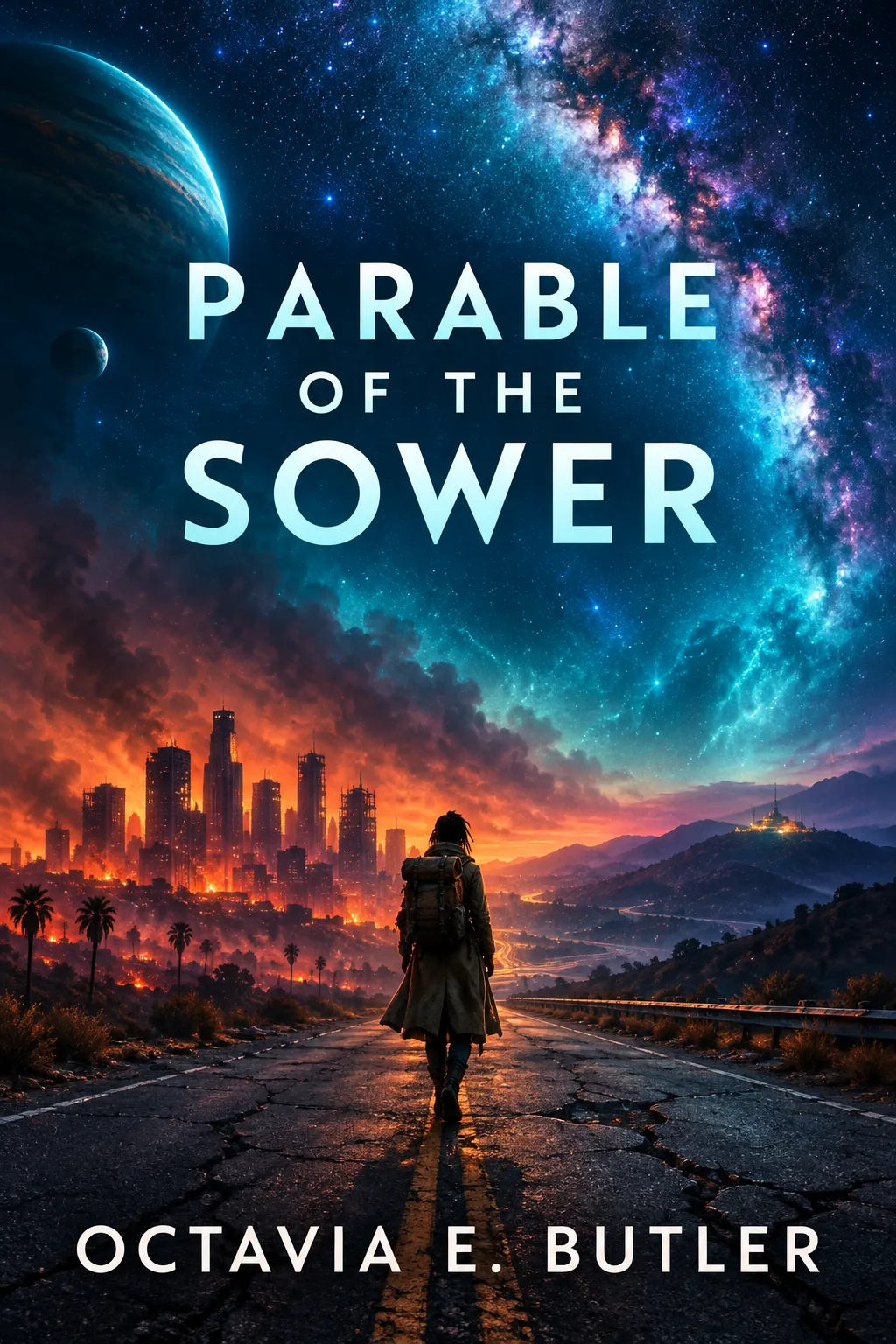
Parable of the Sower
by Octavia E. Butler
Parable of the Sower is a 1993 novel about Lauren Olamina, a teenager growing up in a walled neighbourhood near Los Angeles in 2024, when water is expensive, jobs are gone and violence is everywhere. Lauren has hyperempathy: she physically feels the pain of others. While preparing for the day the walls fail, she writes the verses of a new belief, Earthseed, whose central idea is that God is change.
The Big Idea
"In a collapsing California, a teenager who feels other people's pain decides that the only lasting truth is change, and builds a faith around shaping it."
Key Insights
Change is the only certainty
Earthseed starts from a simple claim: everything changes, so the useful question is how to shape change rather than how to stop it. Lauren's neighbours cling to the old rules of a safe suburb, while she studies what is actually happening. The book suggests that denial is a form of risk, and that a clear view of the future is a kind of kindness to yourself and others.
Lauren's emergency bag looks silly to the adults around her until the night the wall fails.
Empathy is both gift and weakness
Hyperempathy makes Lauren feel others' pain as her own. That makes her vulnerable in a fight, yet it also makes violence impossible to ignore and cooperation natural. Butler uses the condition to ask what a society would look like if people simply could not bear to hurt one another.
When Lauren shoots an attacker, she feels the wound herself. When a friend is hurt, she cannot look away from it.
People last longer than walls
The wall around Robledo protects people only as long as everyone believes in it. What lasts is a group of people who know one another's skills, share supplies and trust each other. On the road, Lauren builds this slowly, asking each new member what they can do and what they need.
The party that leaves Robledo with only a few people becomes a true community by the time it reaches the north, and it is a stronger shelter than the wall ever was.
Faith that leads to action
Earthseed is not a comforting faith about being rescued. It says God is change and asks people to act. Butler sets it beside the Baptist faith of Lauren's father, which gave comfort but did not turn into a plan for survival. The novel shows that belief matters most when it organises what people do, not only how they feel.
Lauren speaks about Earthseed in the same moments that the group arranges night watches and shares food, so the verses become a tool for daily life.
Chapter Breakdown
Chapter-by-chapter summary
Spoiler warning: this section covers the whole plot, including the ending.
Part 1: Life behind the wall
In July 2024, Lauren Olamina turns fifteen in Robledo, a small walled community outside Los Angeles. Inside, a few families share gardens, guard duty and a church led by her father, a Baptist minister. Outside, people sleep in the open, water costs more than many can pay, and addicts of a fire-starting drug called pyro burn whatever they can reach. Lauren has hyperempathy: she feels the pain she sees in others. She hides it and secretly writes verses for a belief of her own, Earthseed. Why it matters: the opening shows how thin the line is between a safe home and a ruin.
Part 2: Warnings and losses
Lauren does not trust the wall. She packs an emergency bag, practises shooting with friends and urges neighbours to learn survival skills, but most adults would rather believe that life will improve. Her father listens, yet hopes the wall will hold. Then the losses begin: her brother Keith leaves home, gets into trouble and is killed, and soon after her father goes out one day and never comes back. Why it matters: Lauren's planning looks like paranoia until events prove it was good sense.
Part 3: The fall of Robledo
One night a crowd of looters and pyro addicts breaks through the wall and sets the neighbourhood on fire. Lauren escapes with her emergency bag. When she returns she finds her home destroyed and her stepmother Cory killed in the attack. With Keith already dead and her father still missing, no one from her family is there to meet her, and the neighbours who survive scatter into the dark. She is suddenly alone, with the supplies she packed and almost nothing else. Why it matters: the bag she was laughed at for is now the only thing between her and the street.
Part 4: North on the highway
Lauren decides to go north, where she hopes work and water are easier to find. She dresses to pass as a man and joins two neighbours who also escaped, Zahra Moss and Harry Balter. They walk the highway among crowds of other migrants, sleeping in shifts and hiding their money. Along the way they meet Travis Douglas, his wife Natividad and their baby, and later Taylor Bankole, an older doctor. Why it matters: the journey shows that a small group with a shared plan lasts longer than any one person.
Part 5: A group grows on the road
On the road the group is robbed, attacked and tested. Lauren's hyperempathy is a real danger, because when she wounds someone she feels the wound too. Even so, she talks with people around campfires and explains Earthseed: God is change, and people can shape where change leads by planning for it. Some listen. The group grows, with Allie Gray, Emery Solis and Tori Solis among the newcomers, and Lauren and Bankole grow close. Why it matters: ideas spread through small acts of trust.
Part 6: The start of Acorn
Bankole leads the travellers to land he owns in northern California. It has been burned, and the people who lived there have been killed. The group buries them, finds water and decides to stay. Together they begin the first Earthseed community, which they call Acorn, and Lauren gives shape to the teachings she has been writing since she was a girl. Why it matters: after so much loss, the ending is a beginning, a seed rather than a rescue.
Characters
Lauren Olamina
The narrator, whose journal entries make up the novel. Practical, stubborn and unusually calm under pressure, she feels the pain and pleasure of those around her through hyperempathy. She founds Earthseed and leads the travellers north.
Reverend Olamina
Lauren's father, a Baptist minister and college teacher. He keeps the neighbourhood together with faith and routine, believes the wall will protect them, and disappears before the worst comes. Lauren loves him, though she disagrees with him.
Cory
Lauren's stepmother, who raised her after her mother died. She teaches the neighbourhood children and keeps the household going, and she believes in holding on to a stable, ordinary life for as long as possible. She is killed in the attack on Robledo.
Keith
Lauren's brother. Restless and proud, he resents the limits of life behind the wall and chases money outside it. His fate shows Lauren what the world beyond the wall can do to a family.
Harry Balter
A young man from Robledo who flees north with Lauren. Steady and capable, he becomes one of her closest partners on the road and is willing to listen to her ideas about Earthseed.
Zahra Moss
A young woman from Robledo who survives the fire and travels with Lauren and Harry. Strong-minded and quick, she carries her own anger and grief and becomes a dependable member of the group.
Taylor Bankole
A widower in his fifties and a retired doctor with land in northern California. He is cautious about Lauren's beliefs but values her honesty, and their friendship becomes the heart of the new community.
Travis Douglas
A young man travelling with his wife Natividad and baby son. He is a skilled worker and a loyal ally, and his family shows what the group is trying to protect.
Earthseed (the belief)
Lauren's faith, written as short verses she calls the Books of the Living. Its core ideas are that God is change and that humanity's destiny lies among the stars.
Writing about this book
Pick one question and let it lead your report. Is Earthseed a religion, a survival plan or both? Look at how Lauren uses its verses when she is afraid and when she is leading others. How does hyperempathy change the way she treats people, and what does the book suggest about empathy as a strength and a weakness? Compare Lauren's habit of preparing with the neighbours' habit of hoping. Which attitude does the novel reward, and does it ever show a cost to preparing?
You can also connect the story to today. Butler wrote it in 1993 about 2024, so you can ask which of her warnings about water, inequality, private security and political promises feel close to our time, and which do not. Use short scenes as examples, such as the packing of the emergency bag or the walk north, instead of retelling the whole plot. Say what you think and give a reason from the book. Keep any quotation short and name the chapter. Finally, this is a hard book with violence, death and cruelty, so say honestly how it affected you as a reader.
Take Action
Practical steps you can implement today:
-
Look at what is changing around you now, then plan for it instead of hoping it will pass.
-
Learn useful skills and keep simple supplies ready. Preparing early costs little, and it can matter a great deal in an emergency.
-
Build trust in a small group before you need it, because shared skills last longer than any wall.
-
When you read a story about collapse, ask what people choose to build afterwards, not only what they lose.
Notable Quotes
"“God is Change.” (Chapter 1, Earthseed verse)"
— Octavia E. Butler
"“The Destiny of Earthseed is to take root among the stars.” (Chapter 7, Earthseed verse)"
— Octavia E. Butler
"“The only lasting truth is Change.” (Chapter 1, Earthseed verse)"
— Octavia E. Butler
Who Should Read This
Readers from about age 15 who like thoughtful science fiction, dystopias or stories about climate and community, and anyone who has read other dystopian novels and wants another view. It contains violence and loss, including the deaths of family members, so it suits mature teens and adults rather than younger readers.
Frequently Asked Questions
When and where is Parable of the Sower set?
The novel runs from July 2024 to 2027, mostly in southern and northern California. It begins in Robledo, a walled neighbourhood near Los Angeles, then follows a journey north along the highways. Butler wrote it in 1993, so the dates were then the near future.
What is hyperempathy?
It is a condition that makes Lauren feel the pain and pleasure she sees in others as if it were her own. In the novel it comes from her mother's drug use during pregnancy. Lauren calls it sharing, and in violent moments it is a serious weakness.
What is Earthseed?
Earthseed is the belief Lauren writes down in short verses called the Books of the Living. Its central idea is that God is change, and its goal is for people to take root among the stars. It encourages people to act and adapt rather than wait to be saved.
Is there a sequel?
Yes. It is the first of two Parable novels. The sequel, Parable of the Talents, was published in 1998 and follows Lauren's story further. The first book is complete in itself, so you can read it without the sequel and decide later whether to continue.
Why is it called Parable of the Sower?
The title points to the parable of the sower in the Gospels, where seeds fall on different kinds of ground. Butler uses the image for Earthseed's ideas, which are scattered among people and only grow where conditions allow. Lauren's Baptist upbringing makes the biblical reference natural.
Check Your Understanding
Pick an answer for each question to see if you were right.
-
Where does the story begin?
Robledo, a walled neighbourhood near Los Angeles — The first part is set in Robledo, outside Los Angeles, in 2024.
-
What is hyperempathy?
A condition that makes Lauren feel others' pain and pleasure — Lauren physically feels what she sees others feel, which is both a danger and a link to people.
-
What is the central idea of Earthseed?
God is change — Earthseed teaches that God is change and that people should learn to shape it.
-
Which drug do the fire-setting addicts in the novel use?
Pyro — Pyro addicts set fires, and they help bring about the fall of Robledo.
-
Who is Taylor Bankole?
An older doctor who owns land in northern California — Bankole joins the travellers and leads them to his land, where they found the first community.
About Octavia E. Butler
Octavia E. Butler (1947–2006) was an American science fiction writer from Pasadena, California. She was among the first widely recognised Black women in the genre, won both Hugo and Nebula awards, and in 1995 became the first science fiction writer to receive a MacArthur Fellowship. Parable of the Sower is one of her best-known novels.
Summary Written By

Software Engineer & Writer
Software engineer with a passion for distilling complex ideas into actionable insights. Writes about finance, investment, entrepreneurship, and technology.
View all summaries →Reviews
No reviews yet. Be the first to share your thoughts!
Write a Review
Keep reading
Explore the topic: Sci-Fi Genres & IdeasSummaries

Out of My Mind
Sharon M. Draper
“Out of My Mind” by Sharon M. Draper is a poignant narrative that explores the life of Melody Brooks, a…

Ender’s Game
Orson Scott Card
“Ender’s Game” by Orson Scott Card is a riveting science fiction novel that transports readers into a future where humanity…

Pachinko
Min Jin Lee
“Pachinko”, a spellbinding multigenerational historical saga by Min Jin Lee, explores the lives of a Korean family trying to make…

The Perks of Being a Wallflower
Stephen Chbosky
The Perks of Being a Wallflower by Stephen Chbosky is a profound coming-of-age novel, told through the intimate letters of…
Articles

Afrofuturism
Afrofuturism is a way of imagining the future, and rethinking the past, through Black experience, using science fiction, music, art…

A Christmas Carol themes: generosity, isolation and responsibility
Dickens's novella is usually read as a story about a man who changes his mind. Its themes are sharper than…

Nebula Award: What It Is and Notable Winners
The Nebula Award is an American science fiction and fantasy prize voted on by working writers. The Science Fiction and…