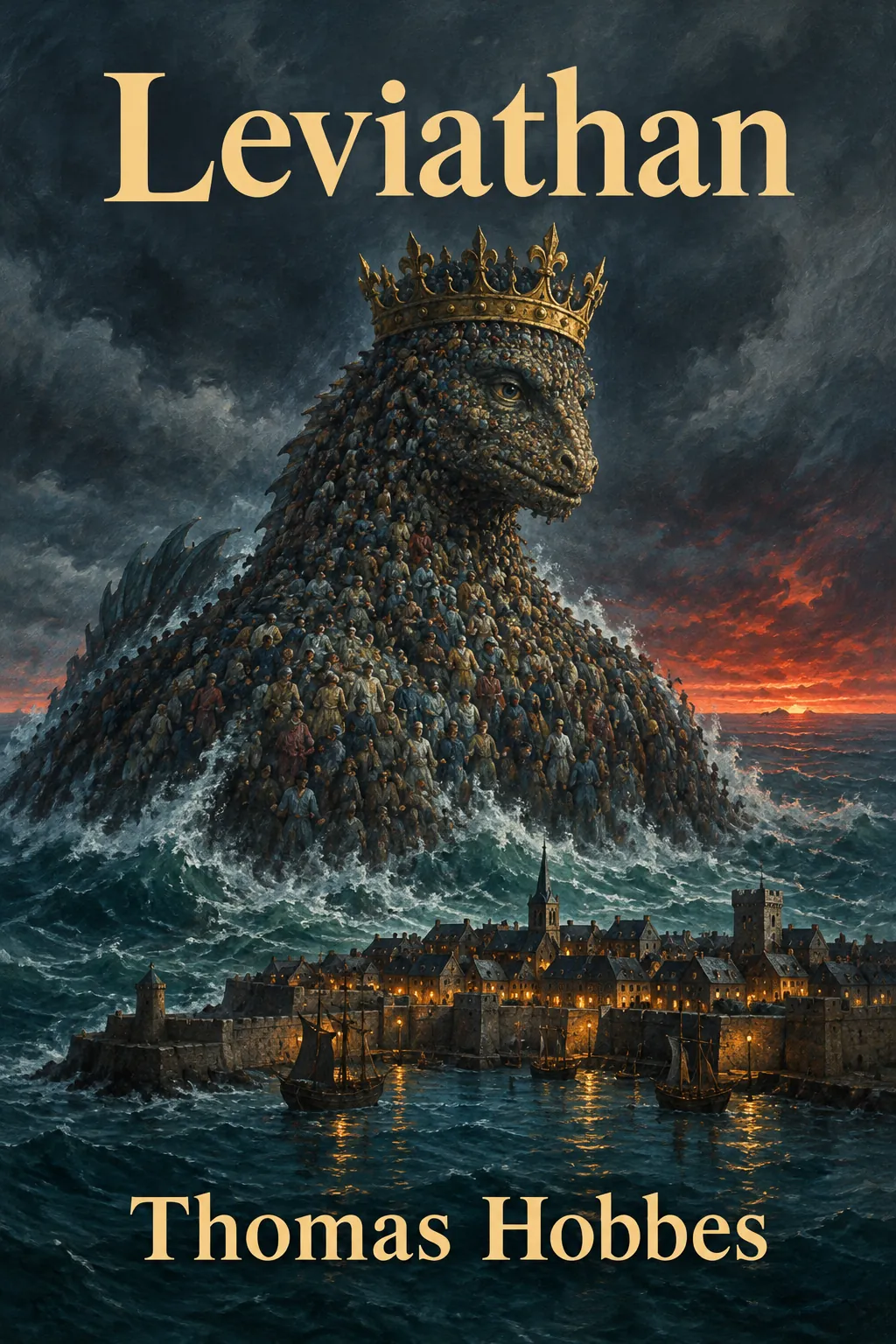
Leviathan
by Thomas Hobbes
Leviathan, published in 1651, asks why people should obey any government at all. Thomas Hobbes imagines life with no authority and finds constant fear and violence. To escape it, he argues, people agree with one another to hand power to a single sovereign who keeps the peace. In return they get safety and order. The book then defends the sovereign's wide powers and examines religion and the church.
The Big Idea
"People living without a common authority fall into constant fear and conflict, so Hobbes argues they should agree to obey one sovereign power that keeps the peace."
Key Insights
Fear is where politics begins
Hobbes does not start from human goodness. He starts from fear of violent death, which he thinks everyone shares. Without a power to restrain them, even peaceful people have reason to strike first, because they cannot trust that others will hold back. Fear is not noble, but it is reliable, and Hobbes builds his whole case on it. A political system, he suggests, should be designed for people as they are, not as we wish them to be.
Imagine a town with no police or courts. Everyone locks doors, hires guards and spends more time on defence than on work.
Authority is created by agreement
For Hobbes, no ruler has a natural right to rule. Authority exists because people agree to give up part of their freedom so that all can live safely. This was a bold shift from the idea that kings rule by divine right. The sovereign's power rests on a human decision, and it makes sense because it serves the people who made it. That idea became the starting point for modern social-contract theory.
A group of neighbours who agree to follow one referee in a shared sport has created that referee's authority, even though none of them was born to it.
Safety is the sovereign's first job
Hobbes says the sovereign exists for one purpose, the safety of the people, and safety means more than staying alive: it includes the contentment people gain through lawful work. If a ruler cannot protect his subjects, the reason for obeying him disappears. This makes the book powerful but also conditional. It gives government wide authority while also giving it a measure of success. Later thinkers would build on that opening to argue for limits on rulers.
A government that cannot stop violence in the streets is failing the one test Hobbes sets for it.
Divided power invites war
Hobbes lived through a civil war in which king, parliament and church each claimed final authority. He concluded that when sovereignty is split, people must choose sides, and choosing sides leads to conflict. That is why he argues for a single authority whose word on law and public religion is final. Many readers disagree, and later writers praised separated powers instead. Even so, his warning shows why clear lines of authority matter.
If two offices can each give an order that cancels the other, a soldier or a citizen has no safe way to obey.
Clear words prevent quarrels
Hobbes cares deeply about definitions. He thinks many disputes are really confusions about words, and that philosophers often hide emptiness behind fine-sounding terms. His early chapters define passions, power, liberty and law before he uses them in arguments. The habit is part of why the book still reads as a careful chain of reasoning. It also suggests a practical rule: before arguing, check that both sides mean the same thing.
Two people argue about ‘freedom’ for an hour before noticing that one means freedom from interference and the other freedom to act.
Chapter Breakdown
Chapter-by-chapter summary
Leviathan has 47 chapters in four parts: Of Man, Of Common-wealth, Of a Christian Common-wealth, and Of the Kingdom of Darkness. This section follows the book in eight groups so the argument stays easy to follow.
Introduction and Chapters 1–9: The Machinery of the Mind
Hobbes opens by calling the state an ‘artificial man’, a giant built by people to protect the natural people inside it. He then studies the human being as a kind of machine. Sensation comes from outside pressure on the body, imagination is a fading sense, and reason is a form of reckoning, adding and subtracting names. Speech makes this possible, but careless words can also mislead. Why it matters: Hobbes wants to show that humans are predictable enough to be governed by clear rules, not by vague ideals.
Chapters 10–13: Power, Equality and the War of All Against All
Hobbes defines power as a person's present means to get some future good. People keep wanting more of it, he says, because they can never be sure of keeping what they have. Chapter 13 argues that people are roughly equal, since even the weak can kill the strong. Quarrels come from competition, distrust and the wish for glory. With no common power, life becomes ‘a warre of every man against every man’, with no industry or arts, and it turns ‘solitary, poore, nasty, brutish, and short’. Why it matters: this is the problem the rest of the book sets out to solve.
Chapters 14–16: Natural Rights, Natural Laws and Covenants
In the state of nature, each person has a right to do whatever he judges necessary to stay alive. Reason, however, points to laws of nature: seek peace when there is hope of getting it, give up your right to everything if others will too, and keep the agreements you make. Chapter 16 introduces persons, authors and representatives. Someone can act in another's name, and the author owns those actions. Why it matters: these ideas turn fear of violence into a logic of agreement, and they prepare the sovereign as a representative of everyone.
Chapters 17–19: How a Commonwealth Is Made
Laws of nature are not enough, because ‘Covenants, without the Sword, are but Words’. People need a power strong enough to hold them to their promises. Hobbes pictures each person agreeing with every other to give up the right of self-government to one man or one assembly, on condition that the others do the same. The result is a commonwealth, which he calls a ‘mortal god’. Chapter 18 sets out the sovereign's rights, and Chapter 19 compares monarchy, aristocracy and democracy, preferring monarchy. Why it matters: this is the core social-contract argument.
Chapters 20–24: The Liberty of Subjects
Chapter 20 compares commonwealths formed by agreement with those won by conquest, and explains a parent's authority in similar terms. Chapter 21 gives Hobbes's account of liberty: freedom means having no external obstacle to what you want to do. Subjects are free wherever the law is silent, and no one can be bound to harm himself, because the right to defend one's life cannot be signed away. Chapters 22–24 cover groups within the state, public ministers, money and settlements abroad. Why it matters: the sovereign is powerful but not unlimited, and self-preservation is the last boundary.
Chapters 25–31: Counsel, Law, Punishment and Collapse
Hobbes separates counsel from command: advice serves the person advised, a command serves the one who gives it. Civil law is the sovereign's command, and it gives ‘just’ and ‘unjust’ a fixed meaning. Punishment is harm inflicted by public authority to make people obey. Chapter 29 lists the causes that weaken or destroy a commonwealth, including divided power and the belief that every private person may judge good and evil alone. Chapter 30 names the sovereign's duty as the safety of the people. Why it matters: Hobbes treats civil war as the worst outcome, so divided authority is the state's disease.
Part 3, Chapters 32–43: Of a Christian Commonwealth
Hobbes turns to scripture and quotes the Bible at length to argue that Christian faith gives nobody a rival claim to the sovereign's authority. In a Christian state, he says, the sovereign decides how the church is governed and which readings count as public law, while private belief stays private. Miracles, prophecy and the meaning of the ‘kingdom of God’ are reexamined. The final chapter says the one article needed for salvation is that Jesus is the Christ. Why it matters: Hobbes tries to remove the conflict between church and state, which he blamed for the civil war.
Part 4, Chapters 44–47: Of the Kingdom of Darkness
The last part attacks what Hobbes sees as sources of spiritual and intellectual darkness: misreadings of scripture, beliefs borrowed from pagan sources, and the Roman church's claim to rule above kings. He compares the papacy to the ghost of the dead Roman Empire. He also rejects scholastic philosophy built on Aristotle as empty talk. A short Review and Conclusion closes the book. Why it matters: it applies the book's central claim to the religion and universities of Hobbes's day, because divided loyalty cannot give lasting peace.
Key people and terms
Thomas Hobbes
English philosopher (1588–1679). He wrote Leviathan during the Civil War and argued that fear of violent death and the need for security justify strong government.
State of nature
An imagined condition with no government, law or common judge. Hobbes uses it to ask what life would be like without authority, and answers that it would be a constant war of all against all.
Laws of nature
Rules found by reason that point toward peace. The first is to seek peace when you can, the second is to give up your right to everything if others will too, and the third is to keep your agreements.
Covenant
A mutual promise. In Hobbes, covenants only work reliably when a power exists to enforce them, which is why agreement alone cannot create peace.
Sovereign
The person or assembly that receives everyone's right of self-government. The sovereign makes laws, judges disputes and keeps the peace, and answers to no human court.
Leviathan (the commonwealth)
The state as an artificial man, named after the sea monster in the Book of Job. Its body is made of its people, and the sovereign acts as its soul.
Authorisation
The idea that people are the ‘authors’ of what their representative does. It explains why subjects cannot complain that the sovereign's acts are not theirs.
Locke and Rousseau
Later social-contract thinkers. Locke said government is held in trust and may be replaced if it fails to protect rights. Rousseau placed authority in the whole people's general will.
Using this book
Leviathan works well for essays and discussion because it states a clear thesis and gives reasons for each step. Here are some angles and questions.
- Fear and order: Is Hobbes right that fear of violence is the strongest reason for government? What other reasons might people have?
- Trade-offs: Hobbes gives up a great deal of freedom for security. When is that trade worth making, and when is it not?
- The chain of thinkers: Compare Hobbes with Locke and Rousseau. Where does each place the source of legitimate power?
- Modern echoes: Where do you see his ideas today, in debates about policing, emergency powers or international relations?
- A reading tip: Start with Chapters 13–18, which hold the main argument. Read the rest once you have the shape.
When you write, pick one claim, such as the state of nature, and test it against a real example in your own words.
Take Action
Practical steps you can implement today:
-
Ask what incentives people really face before designing a rule, and not only what you hope they will do.
-
Settle who decides, and write it down, before a disagreement begins.
-
Define key words first. Many arguments end once both sides use the same meaning.
-
Treat trade-offs honestly: every gain in safety costs some freedom, so say what the price is.
Notable Quotes
"“the life of man, solitary, poore, nasty, brutish, and short” (Chapter 13)"
— Thomas Hobbes
"“a warre of every man against every man” (Chapter 13)"
— Thomas Hobbes
"“Covenants, without the Sword, are but Words” (Chapter 17)"
— Thomas Hobbes
"“The Passions that encline men to Peace, are Feare of Death” (Chapter 13)"
— Thomas Hobbes
Who Should Read This
Students of politics, history, philosophy and law will find Leviathan useful, as will anyone curious about why governments exist. It suits upper-secondary and university readers, especially in courses on the social contract. The full text is hard going, so start with this guide.
Frequently Asked Questions
What is Leviathan about?
Leviathan is a work of political philosophy published in 1651. Thomas Hobbes argues that, without a strong common authority, people would live in constant fear and conflict, so they should agree to obey a sovereign who keeps the peace. The book also covers human nature, law, liberty and the place of religion in the state.
What does ‘war of all against all’ mean?
It is Hobbes's description of the state of nature in Chapter 13. With no government to restrain them, people compete, distrust one another and seek glory, so everyone must be ready to defend themselves. He does not mean constant fighting, but a lasting threat of it that prevents trade, farming and peaceful life.
Why is the book called Leviathan?
Leviathan is a sea monster from the Book of Job. Hobbes uses it for the commonwealth, a huge artificial man formed from its people. The famous frontispiece shows a giant crowned figure built from many small persons. The name suggests the state's size and the power it needs to keep order.
How do Hobbes, Locke and Rousseau differ?
All three use a social contract to explain government. Hobbes stresses a strong sovereign who ends the fear of war. Locke says government is a trust that protects natural rights and can be replaced if it fails. Rousseau places authority in the general will of the whole people.
Did Hobbes support absolute monarchy?
He argued for a sovereign with undivided power and said monarchy was the best form, mainly because one ruler's interest is closest to the public's. But he built the case on an agreement among the people and on the aim of their safety, not on divine right, and he kept the right of self-defence.
Is Leviathan hard to read?
The prose is seventeenth-century English and some arguments rest on scripture, so it can be slow going. The central argument is in Chapters 13–18, which are short and clear. Many readers start there, then go back to the opening chapters and the later parts.
Check Your Understanding
Pick an answer for each question to see if you were right.
-
In what year was Leviathan published?
1651 — Leviathan appeared in 1651, soon after the main fighting of the English Civil War.
-
How does Hobbes describe life in the state of nature?
Solitary, poor, nasty, brutish and short — Chapter 13 says that without a common power, life is solitary, poore, nasty, brutish, and short.
-
Why do people need a sovereign, according to Hobbes?
Agreements need a power that can enforce them — He argues that covenants without the sword are only words, so an enforcing power is needed.
-
Which form of government did Hobbes prefer?
Monarchy — He considered monarchy best, because a single ruler's private interest is closest to the public interest.
-
What does the Leviathan stand for in the book?
The commonwealth, an artificial man made of its people — Hobbes calls the commonwealth an artificial man, named after the biblical sea monster.
About Thomas Hobbes
Thomas Hobbes (1588–1679) was an English philosopher. He wrote Leviathan during the English Civil War, while living in exile in France, and published it in 1651. The book is one of the earliest and most influential arguments for the social contract, and it shaped later thinkers such as Locke and Rousseau.
Summary Written By

Software Engineer & Writer
Software engineer with a passion for distilling complex ideas into actionable insights. Writes about finance, investment, entrepreneurship, and technology.
View all summaries →Reviews
No reviews yet. Be the first to share your thoughts!
Write a Review
Keep reading
Explore the topic: The EnlightenmentSummaries

Educated by Tara Westover
Tara Westover
A memoir about a young woman born to survivalists in Idaho who, despite having no formal schooling, teaches herself to…

Atomic Habits: An Easy & Proven Way to Build Good Habits & Break Bad Ones
James Clear
No matter your goals, Atomic Habits offers a proven framework for improving–every day. James Clear, one of the world’s leading…
Think and Grow Rich
Napoleon Hill
What if the secrets to wealth and success weren’t hidden in complex financial strategies, but within the power of your…

Melbourne
Alex Ng
Sophie Cunningham's Melbourne is a deeply personal exploration of Australia's cultural capital, weaving together history, architecture, weather patterns, and personal…
Articles

Rousseau's The Social Contract Explained
Jean-Jacques Rousseau published The Social Contract in 1762. The book asks how people can live under laws and remain free.…

Locke, Montesquieu and Rousseau: How Their Ideas Differ
Three Enlightenment thinkers, John Locke, Montesquieu and Jean-Jacques Rousseau, all asked what makes a government legitimate. Locke said power rests…

The Enlightenment Explained: Ideas, Thinkers and Legacy
The Enlightenment was an 18th-century European movement that trusted reason and evidence over tradition and authority. Its thinkers, from Locke…