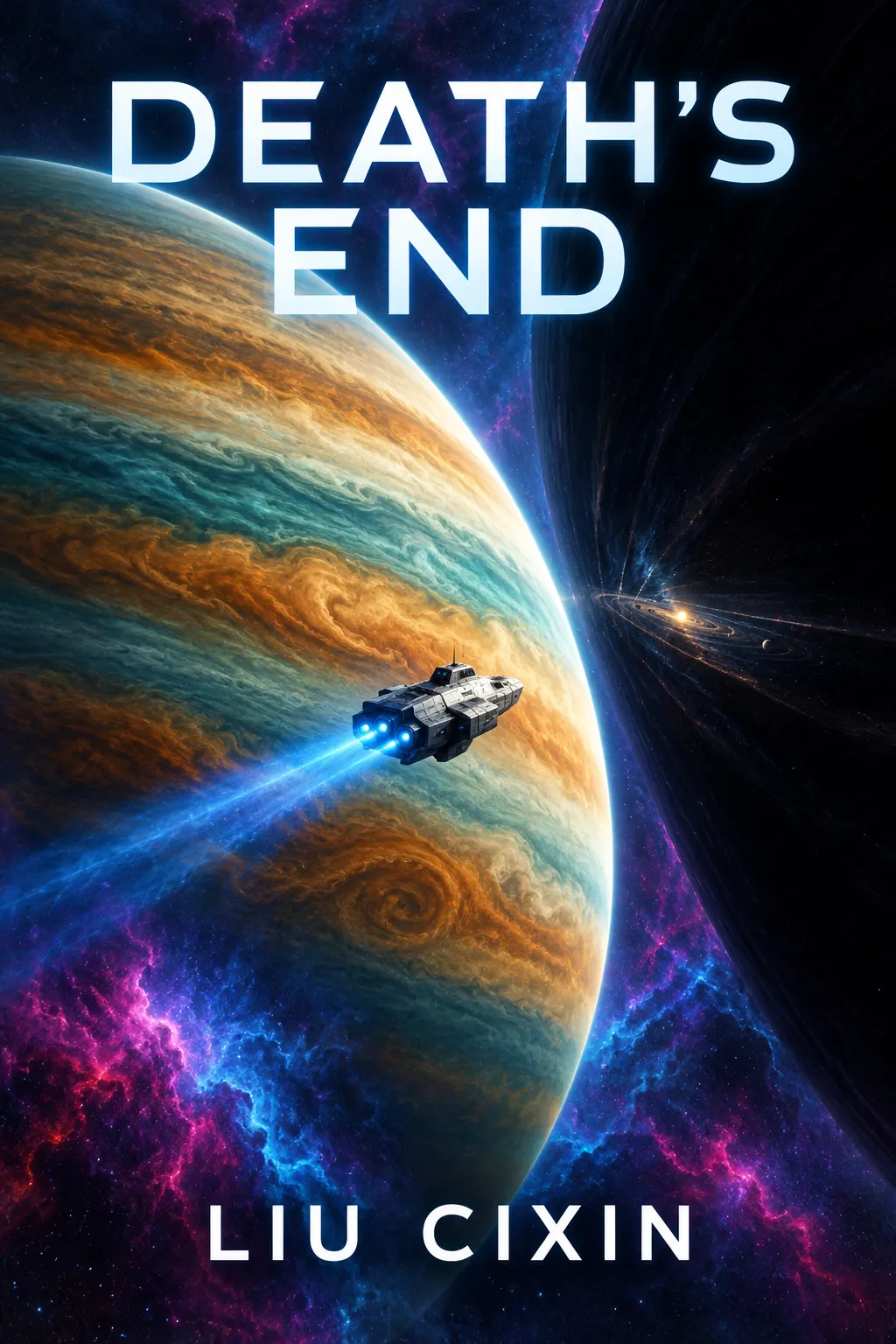
Death's End
by Liu Cixin
Death's End is the third novel in Liu Cixin's Remembrance of Earth's Past trilogy, and it follows one engineer, Cheng Xin, across thousands of years of an alien threat. Earth and the Trisolarans live in a tense balance built on the dark forest idea: any civilization that reveals itself may be destroyed. When Cheng Xin must make one terrible choice, humanity's future changes, and the story widens from Earth's crisis to the fate of the whole universe.
The Big Idea
"In a universe where hiding is the only safe policy, Death's End asks whether love and kindness can survive when one choice decides the fate of whole worlds, and what survival is worth."
Key Insights
Hiding is safer than shouting
The dark forest idea says that in a universe with no trust, the sensible move is silence, because any civilization you reveal yourself to may strike first. The book treats this as cold logic, not a villain's plan, and lets its characters feel how heavy it is. Even the most hopeful people in the story learn to whisper.
When Gravity and Blue Space broadcast the location of Trisolaris, a third party destroys the planet almost at once, and the invasion ends. The weapon was never a bomb; it was an address, and the speed of the reply shows how closely the forest was already listening.
Kindness and survival can collide
Cheng Xin is chosen for her gentleness, yet gentleness is a hard fit for a universe built on deterrence. The book does not say she was right or wrong. It shows that a decision made with good intentions can still be paid for by billions of people, and it leaves the reader to weigh intention against result.
Trisolaris bets that she will not activate the broadcast threat as Swordholder, and the bet is correct. Later she refuses to approve lightspeed research, and the dimensional strike makes that refusal very costly.
Arrogance is the real danger
The strongest civilizations in the story are not undone by weakness. They are undone by overconfidence and by the belief that the rules of the universe will not change. The most dangerous attacks do not use bigger bombs but change the conditions of space itself, which no older defence was built to meet.
The Solar System is collapsed from three dimensions into two, and no defence from the older age matters. Humanity's confidence in its own technology offers no protection against a threat that works at a different level of physics.
A small human act can echo across the universe
The long story starts with a dying man giving his brain to a former classmate's request, and ends with a gift on the scale of a whole universe. The book suggests that personal love and cosmic scale are connected, even if time and distance wear the connection thin. Small acts keep their meaning at any scale.
Yun Tianming's fairy tales carry three strategies for survival, and his Universe 647 becomes a place where Cheng Xin can see the future. His gifts are made in secret, yet they shape what happens to everyone.
Chapter Breakdown
Chapter-by-chapter summary
Spoiler warning: this section covers the whole plot, including the ending. The parts below follow the eras of the book.
The Staircase Program (Crisis Era)
Humanity knows a Trisolaran fleet is on its way and will take centuries to arrive. Cheng Xin, a young aerospace engineer, works with the Planetary Intelligence Agency under the cold, rational Thomas Wade on the Staircase Program. The idea is to launch a human brain toward the fleet so a human mind can gather intelligence from inside the enemy's world. Cheng asks Yun Tianming, a former classmate who is dying, to give his brain. He agrees. He secretly loves her and once bought her the rights to a star, DX3906. After the launch, Cheng goes into hibernation. This matters because one private act of love becomes the thread that ties Earth to Trisolaris for the rest of the book.
The Swordholder (Deterrence Era)
About two hundred years later, Cheng Xin wakes up wealthy from the sale of her star rights. Earth and Trisolaris now live in a truce based on dark forest deterrence: humanity can broadcast the position of Trisolaris to the universe, which would doom both worlds. A person called the Swordholder controls that threat. Cheng Xin takes over from the aging Luo Ji. Trisolaris then disables Earth's broadcast capability, betting that she would never have used it anyway. The bet is correct. This part matters because it tests whether mercy and deterrence can live together, and the answer shapes everything after it.
The invasion and the broadcast (Broadcast Era)
With deterrence broken, Trisolaris renews its invasion and offers humanity a reservation in Australia. One starship, Gravity, still has a working broadcast system. Its crew, together with the crew of Blue Space, defeats a Trisolaran attack on the ship and then broadcasts the location of Trisolaris. A third party destroys the planet, and the surviving Trisolaran fleets give up the invasion. This matters because it proves that the dark forest is real and that the most powerful weapon in the universe is simply telling someone where you are.
Yun Tianming's fairy tales
Trisolaris revives Yun Tianming's brain. Under the eyes of his captors, he tells fairy tales to humanity, and hidden inside them are three survival strategies. The first is the Bunker Project, building space cities in the shadow of gas giants. The second is lightspeed travel, which will later be banned. The third is the black domain, a region where the speed of light is lowered, which can shield a world but also traps it inside. This matters because a captive man can still speak, and the story turns on whether humans can decode him in time.
Wade's lightspeed project and the dimensional strike (Bunker Era)
While Cheng Xin sleeps again, humanity builds its space cities, but the black domain work stalls. Thomas Wade secretly develops basic lightspeed travel. Cheng refuses to permit it, and Wade is executed. Decades later, an alien attack collapses the Solar System from three dimensions into two. Only lightspeed could have saved people, and most of humanity dies. This matters because the book shows that a refusal made for good reasons can still have a terrible cost.
The escape to Planet Blue
Cheng Xin and her aide AA are awakened and escape on the one remaining lightspeed engine, guided by Luo Ji from Pluto. Because of time dilation, a journey of 286 years feels short to them. They reach Planet Blue in the DX3906 system, where they meet Guan Yifan, a cosmologist from Gravity. The crews of Gravity and Blue Space have founded several interstellar societies there. This matters because it gives the survivors a new beginning, and a new place to face the same old question of how to live in a hostile universe.
Planet Gray, Universe 647 and the ending
Cheng and Guan visit Planet Gray, where a black domain is spreading across the system. Time moves so differently inside it that almost 19 million years pass on Planet Blue. Yun Tianming had earlier delivered Universe 647, a self-contained micro-universe. Cheng and Guan live in it, hoping to see the universe reborn in a Big Bounce. They learn that micro-universes drain mass from the main universe, so they merge Universe 647 back into it and set off on interstellar travel. This matters because the final choice is about giving back, not holding on, and it closes the trilogy on the scale of the cosmos.
Characters
Cheng Xin
An aerospace engineer and the main character. She proposes the Staircase Program and later becomes the second Swordholder. Her gentleness and her choices make her one of the most debated figures in the trilogy.
AA
An astronomer and Cheng Xin's aide. She stays with Cheng across centuries of hibernation and takes part in the escape from the Solar System, as a close friend and travelling companion.
Yun Tianming
Cheng's former classmate. He secretly loves her, gives her the star DX3906 and donates his brain to the Staircase Program. Revived by Trisolaris, he sends humanity coded fairy tales.
Thomas Wade
The head of the Planetary Intelligence Agency. He is cold and practical, and drives the Staircase Program. Later he secretly pursues lightspeed travel, which puts him in direct conflict with Cheng Xin.
Luo Ji
The former Wallfacer from the second book and the first Swordholder. He hands the role to Cheng Xin when he grows old, and later guides her escape from Pluto.
Guan Yifan
A civilian astronomer who sailed on Gravity. Cheng Xin meets him on Planet Blue, and the two travel together to Planet Gray and later live in Universe 647.
The Trisolarans
The alien civilization whose fleet threatens Earth. Their sophons block human science and relay human speech, which gives them a long advantage in information.
The Swordholder
The person who holds the switch that could broadcast Trisolaris's location. The role makes deterrence work only if everyone believes the holder will really do it.
The dark forest
The idea that every civilization is a hidden hunter in a dark forest. Anyone who reveals their position risks being wiped out by someone else.
Writing about this book
This novel works well for a school report because it gives you big questions and does not tell you what to think. Do not look for a single right answer. Start from a question that you actually care about, then use scenes from the book to support your view.
- Cheng Xin refuses to activate deterrence, and later refuses to approve lightspeed research. Were these choices kind, or were they mistakes? Does the answer change if you judge by intention or by result?
- Yun Tianming sends his help in the form of children's stories. Why might a story be a better tool than a plain message?
- The dark forest says the safest policy is silence. What does that say about trust between nations or people today?
- The ending gives back mass to the universe. What do you think the author wants us to feel about taking and giving?
Pick one scene, say what happens in your own words, and explain why it changed your view of the story. Keep the book's science as background and let your own thinking lead.
Take Action
Practical steps you can implement today:
-
Read the first two books before this one, because the dark forest idea and the main characters are explained there.
-
Treat the three eras as three different kinds of test: trust, fear and scale.
-
Notice how often the story shows a good choice paying a heavy price.
-
Use the science as a lens for big questions rather than as a list of facts to memorize.
Notable Quotes
"“Weakness and ignorance are not barriers to survival, but arrogance is.” (Death's End)"
— Liu Cixin
Who Should Read This
Readers who finished The Three-Body Problem and The Dark Forest and want the end of the trilogy. It suits upper secondary students and adults who enjoy big-idea science fiction and are comfortable with long timelines and heavy themes.
Frequently Asked Questions
Do I need to read the first two books before Death's End?
It is strongly recommended. Death's End builds on The Three-Body Problem and The Dark Forest, including the dark forest idea, the sophons and Luo Ji's role as Swordholder. The book gives short reminders, but the full effect needs the earlier stories.
What is the dark forest theory?
It is the idea that the universe is like a dark forest where every civilization is a hunter in hiding. Because you cannot know whether another civilization is friendly, revealing your location is risky. That is why the safest choice is to stay silent.
Who is Cheng Xin, and why is she so debated?
Cheng Xin is the main character, an aerospace engineer who becomes the second Swordholder. Readers debate her because her compassion leads to decisions with huge consequences. Some see her choices as human and brave, and others as costly mistakes.
What does the title Death's End mean?
The Chinese title is 死神永生, which roughly means Death Lives Forever, while the English title is Death's End. Both point to the shadow of death over the whole story, from the threat to Earth to the fate of the universe.
When was Death's End published, and who translated it?
It was first published in China in 2010. The English edition, translated by Ken Liu, came out in 2016 and runs to about 590 pages. It was a finalist for the 2017 Hugo Award for Best Novel.
Is it hard science fiction?
Yes, it is usually described as hard science fiction. It builds its story from ideas in physics and cosmology, such as time dilation, higher dimensions and the fate of the universe, but it still centres on human choices.
Check Your Understanding
Pick an answer for each question to see if you were right.
-
Who is the main character of Death's End?
Cheng Xin — Cheng Xin is the engineer whose choices drive the story across centuries.
-
What is the Staircase Program?
A plan to send a human brain toward the Trisolaran fleet — The program sends a human brain at high speed toward the enemy fleet to gather intelligence.
-
How does Yun Tianming pass hidden strategies to humanity?
Through fairy tales — He tells fairy tales that hide three survival strategies, under the eyes of his captors.
-
What happens to the Solar System in the dimensional strike?
It collapses from three dimensions to two — An alien attack flattens the Solar System into two dimensions, which most of humanity cannot escape.
-
What does the black domain do?
It lowers the speed of light inside a region — The black domain is a region with a lowered speed of light, which can shield a world but also traps it.
About Liu Cixin
Liu Cixin, born in 1963 and raised in Yangquan, Shanxi, China, worked as a computer engineer at a power plant before becoming a full-time writer. He is best known for the trilogy Remembrance of Earth's Past. The English edition of The Three-Body Problem won the 2015 Hugo Award for Best Novel.
Summary Written By

Software Engineer & Writer
Software engineer with a passion for distilling complex ideas into actionable insights. Writes about finance, investment, entrepreneurship, and technology.
View all summaries →Reviews
No reviews yet. Be the first to share your thoughts!
Write a Review
Keep reading
Explore the topic: Sci-Fi Authors & AwardsSummaries

Out of My Mind
Sharon M. Draper
“Out of My Mind” by Sharon M. Draper is a poignant narrative that explores the life of Melody Brooks, a…

Ender’s Game
Orson Scott Card
“Ender’s Game” by Orson Scott Card is a riveting science fiction novel that transports readers into a future where humanity…

Pachinko
Min Jin Lee
“Pachinko”, a spellbinding multigenerational historical saga by Min Jin Lee, explores the lives of a Korean family trying to make…

The Perks of Being a Wallflower
Stephen Chbosky
The Perks of Being a Wallflower by Stephen Chbosky is a profound coming-of-age novel, told through the intimate letters of…
Articles

Liu Cixin
Liu Cixin (born 1963) is a Chinese science fiction writer and a former power-plant engineer. His Remembrance of Earth's Past…
Warp Drive
A warp drive is a proposed way to cross space faster than light without breaking relativity's speed limit: the ship…

A Christmas Carol themes: generosity, isolation and responsibility
Dickens's novella is usually read as a story about a man who changes his mind. Its themes are sharper than…